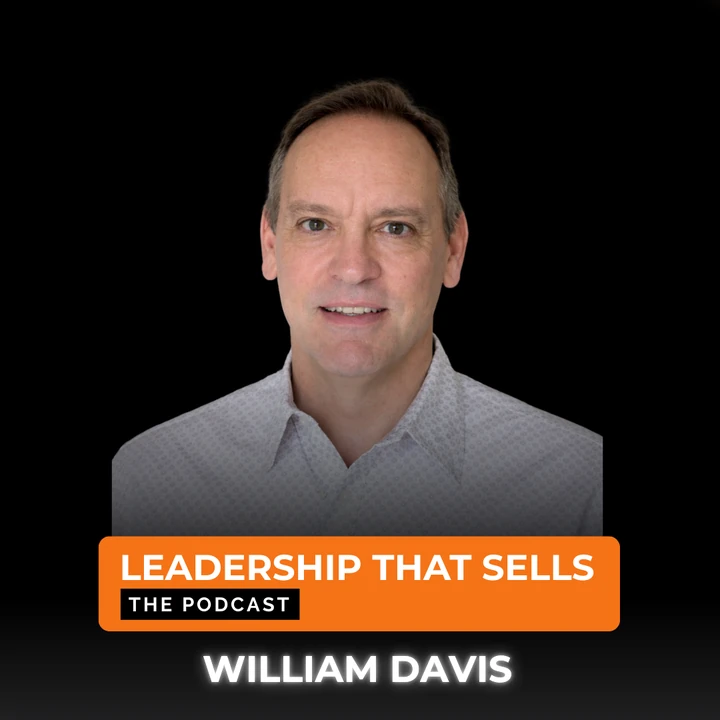
How to lead without the title trap
with William Davies
Show notes
What if the very thing you’re doing to reward success is the one thing that guarantees failure? In this episode, I speak with leadership mentor and author William Davis, who’s seen more than four decades of leadership mistakes up close. Together we get straight to the heart of a painful truth: most managers are made, not chosen—and we’re getting it badly wrong.
We talk about the classic disaster promotion—when your best individual contributor gets “rewarded” by becoming a leader, with zero prep and no support. William’s message is blunt and clear: if they don’t want to be a leader, they’ll never be a good one. So how do you spot the right ones? How do you shift that mindset from individual success to team success? And how do you build genuine, trusting relationships that hold up when things inevitably go wrong?
This one is full of practical gold for any sales leader trying to coach their team without losing their top players or their mind.
How to stop promoting your top performers into failure
- Don’t assume success in the role means readiness to lead. It’s a different job.
- Ask the question early: Do you actually want to be a leader? If the answer’s no, don’t push it.
- Great leadership starts with a mindset shift—from my success to my team’s success.
- Build trust through personal connection—get to know your people outside of the office.
- Use humour and humility to lower the pressure and make people feel safe.
- Understand what actually matters to each person—professionally and personally.
Timeline summary
[02:04] – William on why wanting to lead is non-negotiable
[03:30] – “You’ve just lost your top performer—and you’ve gained a mediocre manager”
[05:25] – The tech world’s talent trap: promoting based on skill, ignoring people skills
[06:58] – Why sales teams don’t function like traditional teams (and why that matters)
[08:43] – “Your job is to make them successful—even on their worst day”
[10:30] – Golf, woods, and breaking the boss-worker wall with humour
[12:24] – Using intentional lightness to build psychological safety
[13:31] – “You’re not leaving this job because of me”: creating real retention
[14:58] – Two-step retention: secure them now, then plan their next steps
Links & resources
- William Davis’ book: Building Genuine Relationships
- Download the Parallel Team Playbook: https://www.facebook.com/profile.php?id=61573023334183
https://www.instagram.com/williamcharlesdavis64/
https://www.linkedin.com/in/williamcharlesdavis/
If you enjoyed this episode, don’t forget to rate, follow and share the podcast. And if it hit a nerve (in a good way), leave us a review—we’d love to hear what’s working for you.
Transcript
Automated transcript. Speaker labels and spellings may contain errors.
Paul
[upbeat music] My guest today is a leadership mentor with four decades in the trenches of corporate America. He has trained executives, managers, emerging leaders across more industries than you care to mention, and he's helping them to lead more humanly and humanely with trust, with clarity, w- with emotional intelligence. He's a speaker, he's a mentor, he's an author, at least two books I know of, and he's gonna be your guide to uncovering what great leadership really can look like. Welcome to the podcast, Leadership That Sells. Uh, we are here because most sales teams are not really teams. They're what we call teams in parallel. They work in a kind of similar way, but just not working with, with each other, and most sales managers are still leading them like they've got a football team when in reality they've got the best group of golfers.
Now, that mismatch creates all kinds of pain: poor coaching, bad pipeline meetings, burned out managers, and reps who just drift along. So what we've done is we've built a lightweight reset to help your managers lead them the right way. They set clearer expectations, they build identity without the fluff, they coach people for autonomy without going hands-off. And it's not training. It's when you shift your team and your leaders to a model that fits the team they've got, your performance scales a whole lot easier. Now, if that sounds like your world, you should grab the free Parallel Team Playbook at the practicalleadership.academy website. It's short, sharp, and it's made for senior people with teams of managers just like you.
William Davis, thank you very much indeed for joining me.
William Davies
Paul, thank you. I appreciate it.
Paul
So you've said in your book one of the big things is that people who are leaders make the biggest mistake of basically thinking that now they've got the job, that makes them a leader, that makes them boss.
William Davies
Yes.
Paul
Congratulations, you're promoted. Here's your team. Good luck.
William Davies
Yeah, yeah.
Paul
What do you mean?
William Davies
Well, in many cases I've seen throughout my career, people are thrust into leadership positions that may or may not want it, right? A team is, is, uh, needing somebody to, to lead them through a project or through whatever, and we just assign somebody, and then we just leave them in that position. What I've always told my folks that have expressed leadership desires is, "You have to want to be a leader," 'cause if you don't want to be a leader, you're not gonna be a good leader. And when I talk about wanting to be a leader, it- it's a transition of mindset, and I think you hit on it a lot in the work that you do, a transition of mindset of from me being successful to my success is now my team's success, right?
What they do, what I empower them to do, how I help them. And, and so it's, it's again, to a servant leadership model that my folks are now the important aspect, not me.
Paul
There you go. That's it. Your job becomes making other people successful.
William Davies
Yes.
Paul
That's it. Be all and end all is to make someone else successful, and especially-
William Davies
Yes
Paul
... um, you have the disa- the typical disaster promotion, right? You're really, really good at what you do, so guess what? You're now managing a team of people who are really good at what you, what they do, and good luck. 'Cause if you don't burn for it, you're buggered.
William Davies
Right. And, and Paul, I've seen in the technology world particularly-
Paul
Mm-hmm
William Davies
... somebody will be exceptional in their, uh, technology skills, right? And so all of a sudden they're stuck as a leader. Well, their ability to deal with people on a day-to-day basis is awful. And, and so you're setting them up for failure, and not just them, but you're setting the team up for failure.
Paul
Yeah.
William Davies
So a- again, it's the, you know, do you wanna be a leader? 'Cause some people are gonna come back to you and say, "Absolutely not. I don't, I don't want all the hassles that go with that," right? Um, and, and so it's, it's, it's an important thing to differentiate, do you or do you not wanna be a leader? Because, again, your success is immediately put into jeopardy when people do not think you're genuine in regards to your desire to be a leader and, and help them, right?
Paul
'Cause if you don't, I think if it's not your thing, basically, if it's not your thing, and it has to be your thing, you, that you can see yourself making other people do well, then you're, uh, you're, you're no hiding to nothing for a start. And then the business who's put you in that position is just gonna spiral down the sinkhole because-
William Davies
Yeah
Paul
... they're gonna lose members of your team because you suck at what you do. They're gonna lose performance 'cause you suck at what you do. And they've already on day one lost you. You are no longer the top performer anymore.
William Davies
Right.
Paul
You know what I mean? See, I see that in sales teams all the time. Number one seller gets promoted to leading a team of people, and all of a sudden they're no longer the number one seller. They're just an average sales manager. They're not bringing in the big deals. They're just, they're now just a cost. Oops.
William Davies
And yeah, and, and unfortunately, oftentimes they'll go the step further and say, "Oh, well, you suck as a manager, so you're gone," right?
Paul
[laughs] Out the door.
William Davies
As opposed to bringing them back... Yeah, bringing them back to what they were successful at and letting them do that job-
Paul
Well-
William Davies
... and let's start over and figure out who the right leader is.
Paul
Totally, totally. And then again, and now I know, I mean, we do, we, we do similar but kind of, uh, focusedly different. I mean, I deal with a lot of sales team leadership, and for me the sales team thing is kind of important in that- The way that sellers work together isn't the way that other teams work together. So if you think about how, um, and, and examples I have are many and varied. It's a team of priests in your local diocese might work together, or a group of teachers might work together, and the way that they work together is the same as a way a sal- a group of salespeople work together in that they don't... They're doing similar things, not different things. They're not playing different positions in the football pitch, passing the ball from one to the other. They're playing golf or archery or an individual sport that's similar.
They don't need each other. In fact, they don't want to be with each other. There's no kumbaya huggy huggy here. And if you as the boss go in and think that that's how it's gonna work, you're gonna be pushing people in the wrong model for a start. That's an enlightening thing-
William Davies
Well, exactly
Paul
Yeah
William Davies
... because in the sales environment, it's, it's a competitive nature, right? Yes, we're, we work for the same company, but each of us have sales goals, each of us has, you know, metrics that we're gonna meet-
Paul
Mm-hmm
William Davies
... and, and we, you know, we wanna make sure we get ours, right?
Paul
So-
William Davies
And not necessarily how everybody else is, is doing is at the top of my list of concerns.
Paul
In your book, and this is a big thing if you're, you're selling. In, in your book, Building Genuine Relationships, okay? You talk about building rela- relationships with your team. Uh, very much like a marriage where you, you see somebody at their worst, but you know what they could be like at their best, what they are like at their best. They're imperfect, but you still love them. Uh, and in fact, you love them for their imperfections. And you're looking at a well-functioning team that you've built, and it's going great. And if you get any experience at all, you're waiting for it to fail. Okay?
William Davies
Yeah. Yeah.
Paul
Because that's what happens.
William Davies
Yeah.
Paul
They just break. Teams break. You've built, you've built, you've hired 10, 8, 10 people, whatever it is, leadership team, team of whoever's. And at some point somebody's gonna go off the rails or something's gonna happen. You're gonna have to start again.
William Davies
Yeah.
Paul
So you've got this well-functioning relationship, and it's very visible, especially in sales. It's, it's highly observable. It's very metricized. How would you advise people to navigate the imperfect?
William Davies
Well, every team, regardless sales or otherwise, is gonna, like you said, be imperfect at some point. My philosophy and what I used for, uh, 38 years was I get to know my people well enough that when they're having a bad day, when they're having a bad streak, whatever, I know them well enough to s- to understand how am I gonna help them through that, right? So that they're still successful. They come out on the other side of it good, if not better.
Paul
Mm-hmm.
William Davies
And, and they've not damaged their career, they've not damaged the project, they've not damaged the sales process. Um, and I don't do that if I don't know who my people are and, and what makes them tick. When I invest in my team as a leader, I am telling them, "I am all in with you. We're gonna win together, we're gonna lose together. My responsibility is to help you, not just in the good times, but in the bad times, and help you get through to the other side and be able to continue on and, and possibly even, you know, uh, accelerate your career to another level." What I've always done is I've never tried to get to know my people in an office setting-
Paul
Mm
William Davies
... in, in such a way that I'm gonna learn what makes them work. I've always done, uh, it outside of the office in an atmosphere that makes them comfortable, in a way in which they are able to loosen up something that's familiar to them. And, and I have some examples in my book, but one I always like because it, it just resonated so much with me. I had a young man came to work for me, and he probably mid-20s. Great kid. Funny as could be. But he was so nervous about getting fired. And so I finally just went to him and I said, "What do you like to do outside the office?" He says, "Well, I like to golf." So I said, "Okay, fine. We're gonna go golf." And that four hours that we spent on the golf course transitioned our relationship
from a boss-worker bee to people that are now on the same team. He understood it. I understood, you know, his concerns, how I needed to react to things that he did so I didn't make him paranoid, so I didn't make him concerned. Um, and, and it all came from, and funny or not, it came from I hit a tee shot out in the woods that they still haven't found the ball today.
Paul
[laughs]
William Davies
And he looked at me like, "How is he gonna react?" You know, 'cause some people take themselves so seriously they, you know, start cursing or throw the club, break the club, whatever. And I just looked at him and I said, "I want you to know that is because I am trying to make you feel better about your golf game."
Paul
[laughs]
William Davies
You know? And we just started cracking up about it. And from that point on, the relationship transcended the boss-worker, right? He saw that I saw him as more than just an asset, you know, as somebody that could fulfill a working obligation that I needed done, right? I looked at him as a person. I wanted to know him as a person, and we were gonna have a relationship that transcended just the work environment.
Paul
So- I mean, you've got another lovely example in there that I liked as well about Sherry and her birthday.
William Davies
Yeah.
Paul
That was fun. So you, I mean, do you see intentional humor, intentionally trying to make things lighthearted, less serious? Do you see that as important?
William Davies
I do. Yeah, I, I do because work is stressful enough without a boss that has no ability to bring a lighter atmosphere to the situation when it's needed, right?
Paul
Mm-hmm.
William Davies
And, and if you can't do that, to your point earlier, you're gonna have people walking out the door, not just walking, running out the door because they don't want that. And, you know, particularly as work environments have changed the last 25 years, you know, I had three jobs my entire career, three different companies, I mean. Y- you see a lot of people today that before they're out of school 10 years or before they've started the professional career 10 years, they've had five, six, seven, eight jobs-
Paul
Mm-hmm
William Davies
... right? The loyalty factor is not what it used to be. Um, good, bad, or indifferent, I, I'm not gonna judge that. But I have to go that extra step to ensure that my people understand you're not gonna leave this job because of something I did. You're gonna leave this job for some other reason, but I want you to know I'm here for you in full, right? Not just work, but o- other. And I understand that there's are, uh, a fine line that you, that you can't cross when dealing with people on a personal level and dealing with personal situations. But if I've got somebody that's got, um, marital problems, I've got somebody that's got monetary problems, I've got somebody that's got other problems, companies have resources to help them, right?
I need to be able to, one, understand what those resources are-
Paul
Mm-hmm
William Davies
... and utilize that knowledge to help my people get the help that they need and, and again, make them, or take that burden off their plate, if you will.
Paul
Yeah. Yeah. I think finding, finding what actually matters for people-
William Davies
Yes
Paul
... in or out-
William Davies
Yeah
Paul
... of work, but finding what actually matters, I think, is, it's a, it's a, I think it's a key way of hiring people, frankly.
William Davies
Yes. Yes.
Paul
Certainly a key way of retaining them.
William Davies
Yes.
Paul
You know, when I go into a company and some- and I'm, I'm trying to secure the high performers so they don't basically leave with all the institutional knowledge, y- I look for the, the two steps. So it's what are you trying to do now? What's important for you right now? Okay, what's the, what's, what do you want to do today in this job? But then it's also what's the next steps after that?
William Davies
Yeah.
Paul
So I want to secure you in what you're doing. How do we get you to the next thing and the next thing with the experiences or the education or whatever it is you need? And if you're doing that, you're kind of trying to, you're trying to show them that you actually care about them in the role that they've got, but also preparing them for the next one, the next tour of duty.
William Davies
Yeah.
Paul
You know?
William Davies
Well, and I, and I think that's where we're really missing the mark, where we have, uh, in so many situations turned somebody's career over to them and said, "You're responsible for your career," right?
Paul
Mm-hmm.
William Davies
"You need to tell me what you want to do. You need to be responsible for training," and et cetera, et cetera, et cetera. And no, I, as the leader of that group, again, have invested in my team, and part of my responsibility is to ensure that they're being challenged, that they're able to progress. Some are gonna progress quicker than others, but I need to make sure that I'm helping everyone do what they can to, to move to a different level. And one of the options that i- is not on the table is viewing your team as competition. Your team's not competition. Your team complements you.
Paul
Mm-hmm.
William Davies
And their success is my success. At the end of the day, when my career was over, I looked back on where did my people end up? And, and I have a lot of success stories of my team. They would pass me by during the course of our career, or they would move on to other places and have, you know, stellar jobs and, and, you know, great re- responsibility, and I take pride in that-
Paul
Mm-hmm
William Davies
... because it didn't have anything to do, anything w- with, to do with me except that I allowed them to flex their wings in order to be able to grow, and that's my r- my, that's my job. When I move from a manager to a leader, that's my job.
Paul
Mm-hmm.
William Davies
And, and it concerns me when, you know, people ask leaders, "Well, what do you do?" Well, take me out of the role and see what happens to this team-
Paul
Mm-hmm
William Davies
... what happens to this group. I am there encouraging them. I am there picking them up. I am there helping them through the bad days that everybody's gonna have so it doesn't adversely affect them, the company, or what we're doing.
Paul
It is those, the, it's the small things that you do-
William Davies
Yes
Paul
... when nobody's watching.
William Davies
Exactly. Exactly.
Paul
It's the, the, the quiet moments, the small things that you do that you're consistent about-
William Davies
Yes
Paul
... that you're not public about.
William Davies
And not only consistent about Paul, but you, y- you, when you say consistent, it's consistent from person to person to person. I'm gonna have some people that I'm closer to-
Paul
Mm-hmm
William Davies
... but I can't treat them in such a fashion that I'm not willing to treat somebody that I'm not closer to.
Paul
Mm-hmm.
William Davies
Right? In the same way.
Paul
Yeah.
William Davies
Can't, can't play favorites.
Paul
Yeah. It's, uh, I think it's the, the, the correct interpretation of the golden rule, right?
William Davies
Yes. Yes.
Paul
Um, so, you know, you were commanded to, uh, love your neighbor as yourself, right? Do unto others-
William Davies
Right
Paul
... as they would have others.
William Davies
Do unto others.
Paul
Right?
William Davies
That's right. Yes.
Paul
But I think if you, if you look at it in the context, it's not treat people the way you want to be treated. It's treat people the way that they want to be treated.
William Davies
Yeah.
Paul
All right? And that doesn't mean treat everybody the same.
William Davies
Right.
Paul
That means treat everybody equally, but in their context.
William Davies
True. And, and of course, I have seen some people though that feel like they needed to be treated as the queen bee or the king of the castle, right? And, and it's like, no, you, you've, one, you've not earned it.
Paul
Mm-hmm.
William Davies
And, and two, even if you had earned it, there's somebody else in that role. [laughs]
Paul
Mm-hmm.
William Davies
So, you know, but yes, to your point, I'm doing everything I can not to hold somebody back. I, I'm helping them progress. And at the end of the day, um, they're gonna feel satisfied that their career path is known-
Paul
Mm-hmm
William Davies
... and that they're on a good footing to reach the goals that they've got.
Paul
So there we go. There we go. Uh, so there's, there's a lot of, um, there's a lot there that we can, we, we can, uh, dig into, I think.
William Davies
Mm-hmm.
Paul
And if we look perhaps at... I mean, you've talked about the, the DNA of leadership, this sort of stuff. This is, this... I don't necessarily know that it's an intrinsic. DNA speaks to it being an intrinsic characteristic, and I'm, I'm a firm believer that these are learned skills.
William Davies
Right.
Paul
They're learned capabilities. But if you could do the, um, the matrix thing, you know, plug this thing in, all of a sudden I can fly a helicopter. I love that one. If you could instill this one thing in every new leader, what do you think it would be?
William Davies
Well, I, I think the first thing is when you talk about being a new leader, you have to understand that people matter, and how you treat them matters. Uh, it, it, it's gonna have adverse effects-
Paul
Mm-hmm
William Davies
... or it's gonna have great effects on them. I have an example of a young lady came to work for me, and brilliant, brilliant girl, and she just nailed the interview. But when she came to work for me, every time I turned around, it was, "Is this okay? Is this okay? Is this okay? Is this..." And I, I finally just said, "Okay, stop. I hired you because I trust you. I hired you because I have confidence in you and your ability."
Paul
Mm-hmm.
William Davies
"Why are you consistently coming back to me?" She had had such a horrific micromanager in her initial job out of college, that even to the point of approving emails that she sent-
Paul
Mm-hmm
William Davies
... he wanted that control. And I said, "No, no, no, no, no. That's not how we work here. That, that's not how I m- I deal with folks. You have my complete confidence and complete trust to do the job, or I would, or you wouldn't be here." Right? And so when I, I, I talk to people about being a leader, start off with always giving people the benefit of the doubt that they're there to do the best job, just like you are, and treat them with respect, treat them with kindness, and treat them as you are their biggest advocate.
Paul
Or, uh, a good, a good comrade. I mean, um-
William Davies
Yes
Paul
... I'll put a link to, to, uh, the various materials, and hopefully people can find your book, uh, the Genuine Relationships book. 'Cause the, I love this, I love the ancient birth certificate story. That's just quite funny.
William Davies
Yeah. That was funny.
Paul
Yeah. In fact, you wanna tell that, tell that story. That's quite fun.
William Davies
Well, there was a, a, a lady that I worked with, and I mean, she and I just went back at it and forth at each other constantly. And, and all good fun, right? It wasn't anything mean. And so she had a birthday coming up. And so she had been zinging me pretty good, and I had, had not had a chance to re- you know, retaliate, if you will. And so I put out a email to the team, uh, as, as if it was an old ancient, uh, artifact article, and it was the uncovering of her birth certificate, but it was stone-
Paul
[laughs]
William Davies
... and it was, and it was, you know, chiseled in stone, right? And, and, uh, uh, you know, just made it... And I d- obviously I wasn't dumb enough to put a year on there, [laughs] but you know, the, the thought was there. And oh, it was just, it was a hoot. I mean, it was... When I came in, everybody had read... I had done it before I went in the office. Everybody had read it by the time I got there, and just were waiting for her to come in and read it. And oh, I didn't even have to know when she read it, because everybody just kind of came to my office as she was walking down the hall, [laughs] you know, headed in there. But it was all in good fun, right?
Paul
Sure.
William Davies
And we all had a laugh about it. You know, we celebrated her birthday and, you know- It, it started the whole team scheming what were they gonna do to get me back, right? So, uh-
Paul
That's the thing
William Davies
... it was just, it was just great stuff. Great stuff.
Paul
That's the thing, where you can engineer something where people can come together.
William Davies
Yeah, yeah.
Paul
You know?
William Davies
Yeah. I mean, you're, you're the leader, but you know what? You're not any more important than anybody else. You are part-
Paul
Still put your pants on one leg at a time.
William Davies
You bet. You're part of everybody, you know? And, and that's exactly right. You put on your pants one leg at a time. Exactly right.
Paul
William, where can we find you when we need you?
William Davies
I have a website, williamcdavis.net. Uh, it has different keynotes that I give, uh, different workshops that I do, the books that you have very kindly mentioned today. Uh, there are links out there also. And then there's a list of all the various podcasts that I've been able and fortunate enough to do over the last, uh, five months.
Paul
Marvel. So we'll make sure that the links to that, uh, are in the description, in the notes of, uh, this, uh, this video, this, this podcast. Um, and just finally as we wrap up then, if I was to give you 10,000 billboards and the biggest Sharpie ever, what would be the one message you'd want the world to hear from you?
William Davies
We've talked a lot about technology, we've talked about, uh, other things, but the one constant in my mind that will never change is leadership is and will always be about humans.
Paul
Yeah.
William Davies
If you can't, if you cannot manage, quote-unquote, manage your interaction with humans, you're gonna always struggle being a leader.
Paul
Yeah. And there ain't no AI's gonna help you with that, no way.
William Davies
No. AI's not gonna help you. Um, uh, to your point, I, I don't know that it's a learned, I can l- I can teach somebody that, right?
Paul
Mm-hmm.
William Davies
Your ability to be sincere, your ability to, um, practice kindness, have a generous spirit and so forth, is either ingrained in you or it's going to feel forced.
Paul
Mm-hmm.
William Davies
And if it's f- if it feels forced, you're gonna lose your team very quickly.
Paul
And this isn't the job for you.
William Davies
Yep.
Paul
Just isn't.
William Davies
Exactly right.
Paul
William C. Davis, thank you very much indeed for joining me.
William Davies
Paul, appreciate you very much. Thank you, sir. [upbeat music]