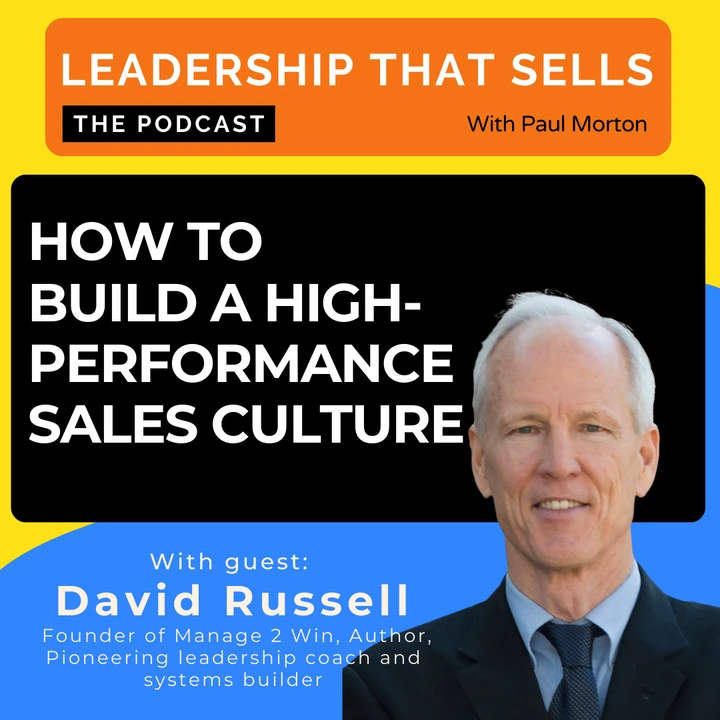
Show notes
Hiring salespeople is hard. Hiring the right ones is harder. David Russell – pioneering leadership coach, systems builder, author of five books and host of over 300 podcasts – joins me to unpack his proven, repeatable process for building high-performing sales teams without burning time, money or goodwill.
We get into why the hiring process is so often broken, the importance of treating candidates with the same respect you’d give your best client, and how to run interviews that reveal truth rather than rehearsed answers. David shares his “three core workouts” method, how to qualify candidates out before you fall in love with them, and why the real job starts after the offer letter is signed. If you want to stop gambling on hires and start building your dream sales team, this one’s a playbook.
How to hire the best salespeople without wasting everyone’s time
-
Start with you: know your strengths, weaknesses and expectations before you hire.
-
Respect candidates’ time – your #1 hiring goal is to qualify out quickly.
-
Follow the three core workouts:
-
Screen – fast, online, no fake backgrounds, ask hard questions early.
-
Skills – test hard/technical abilities and how they apply them.
-
Mindset – assess behaviour, motivation, maturity, and cultural fit.
-
-
Use a strategic plan instead of a job description – set clear goals, behaviours, and mutual expectations.
-
Onboard deliberately – train, test, and mentor until mastery.
Timeline
[03:30] – Why every sales team problem starts with the leader
[03:56] – The TTT model: teach, test, train (mentor until mastery)
[09:08] – The golfer vs football team analogy for sales teams
[10:42] – Why you should work on your strengths more than your weaknesses
[12:11] – The MAP agenda for weekly one-to-ones that keep momentum
[16:45] – What sales leaders can learn from pro sports
[18:23] – Why job descriptions sabotage your hiring process
[20:19] – The three phases: attract, assess, add
[22:21] – Screening out fast to save everyone’s time
[25:16] – Respecting candidates and thinking beyond salary
[28:34] – The three core workouts for a reliable hire
[30:47] – The strategic plan for mutual expectations
[32:14] – The “contractor for a day” test to see the real person
Links & resources
-
David Russell’s website: http://www.manage2win.com
-
Hire the Best program: https://www.linkedin.com/company/hire-thebest/
If you enjoyed this episode, please rate, follow, share and review the podcast – it helps more leaders find us and lead first, sell more.
Transcript
Automated transcript. Speaker labels and spellings may contain errors.
Paul
[upbeat music] My guest is a pioneering leadership coach and systems builder. He's helped hundreds of teams upgrade their culture, their hiring, their performance. He's authored, I think it's five books now, hosted 300 podcasts, including a great one with me. He advises high-
David Russell
It was great
Paul
It was pretty good, wasn't it?
David Russell
[laughs]
Paul
I thought so.
David Russell
It was. [laughs]
Paul
That link is in the description. He advises high growth, uh, teams on how to lead with clarity and impact. He's the founder of Manage to Win. He's on a mission to help leaders build teams that truly perform. Welcome to Leadership the Sales, the podcast for sales leaders who really want to understand what sort of team they're in. And most sales teams today are not really teams. They're what we call teams in parallel, and working in a similar way, but not just with each other. And most sales managers are still leading like, like it's 1999, like they're in a football team when they've actually got a group of golfers. Now, that mismatch then creates all kinds of pain. Poor coaching, bad pipeline meetings, burned out managers, reps adrift all over the place.
And what we've done is we've created a lightweight reset to help your managers lead them in the right way, setting clear expectations, building identity without the huggy fluff, and coaching for autonomy without going hands-off. It's not just training. When you shift to a model that fits your team, performance scales a whole lot easier. If that sounds like your world, grab the free Parallel Team Playbook at the Practical Leadership Academy website. It's a short, sharp little thing made for senior folk who have teams of managers just like you. David Russell, thank you very much indeed for joining me, sir.
David Russell
Oh, it's an honor to be here, Paul. It was kind of funny. I was listening to the podcast we did together before, and just reminded me of, you know, how much I enjoyed talking with you. So this is, this is fun to be here.
Paul
This is, this is the back at you one, isn't it?
David Russell
Yeah. And, and I didn't think about it coming on that we were gonna talk about sales teams, but it's a, it's a great topic. I mean, when you... I talk about the four management disciplines, how you hire, manage, develop, and retain people, and I say consistently, hiring salespeople is the toughest thing, and managing them, it, it is very challenging.
Paul
Yeah. I mean, you just, you've just joined, uh, in the last couple of months, uh, as salesperson par excellence in a new role for yourself. Uh, when you're in there doing the do, what is it... what, what are you seeing?
David Russell
Well, I mean, I, I'm with Blackpoint Cyber. I joined on February 28th. Uh, it's probably the top cybersecurity company, um, in the, in the... It will be in the world. I mean, it's on a rapid growth pace. Uh, it has invented several things, pat- has patents. Matter of fact, it just invented the, the unified security posture and response platform. And so it stops things 'cause now cybersecurity's changing, where instead of it's a lot of phishing, it's a lot of other things and then how people move on the network and things. Anyway, I won't go into that.
Paul
Mm.
David Russell
But the... I just enjoy selling. And as I mentioned to you, which made you laugh, might make your audience laugh, I've been selling, I realize, for over 50 years, which is kind of crazy. [laughs]
Paul
You're not actually that old, though. You're not.
David Russell
[laughs] Well, fortunately, I'm, I'm very healthy.
Paul
There.
David Russell
So it's a good thing. Yeah. But, um, sales teams are, are tough and, uh, I think really if you've got any problems on your sales team, any problems on your sales team, the first thing you've gotta do is figure out what you're doing wrong.
Paul
Oh, yes.
David Russell
Because the starting point is you as the leader.
Paul
Mm.
David Russell
It always is.
Paul
Mm.
David Russell
And, um, it can be that you didn't train people well. I, I talk about, Paul, since we talked last, I talk about a three T process of training. So you teach to transfer knowledge, you test to confirm they can do it, they can apply what they learned. And a lot of people don't do that. They just go for nodding head syndrome. "Yep, yep, I got it. Yeah, yeah, yeah, yeah."
Paul
"No, no, no you don't."
David Russell
And-
Paul
"No you don't."
David Russell
[laughs] Yeah. And then the third piece is train or mentor until the person masters it. And that's never-ending in sales. I mean, there... E- even the best salespeople are still learning.
Paul
Teach, test-
David Russell
And I wouldn't consider-
Paul
... trainer or mentor. I like it
David Russell
Yeah. So it's TTT. So, and in sales, a lot of times people are hired and then just thrown into a role.
Paul
Oh, yeah.
David Russell
They have very little training or they're given videos to watch or literature to read, and the, the train and test piece in particular-
Paul
Mm
David Russell
... are important. But even your best salespeople, you should be doing ride alongs.
Paul
Mm-hmm.
David Russell
And, you know, at least monthly.
Paul
Oh, yeah.
David Russell
And spend time with the people. It, it may be that they're gonna teach you, but, but the bottom line is, as the leader, when you got a problem on your team, you first gotta say, "Where did I mess up?" Because you are messing up.
Paul
Mm.
David Russell
And you gotta figure that out. Am I being too harsh on, on leaders?
Paul
You... I think you're actually doing us all a benefit. It's the dream... I think it's the dream of all men is to know yourselves as other people know you, to see yourselves as other people see you. And from looking in the mirror, you know everything that needs to be known about humanity. And if you are a leader or a manager of anybody at all, then your responsibility is to know yourself and have your own stuff fixed before you go off and burden other people with all your own crap. But understanding how you work helps you understand how they work.
David Russell
Yeah. And it is too bad that, I don't know how it is across the pond where you are-
Paul
Mm
David Russell
... but in America, we don't teach any of this emotional intelligence stuff to, to kids. We don't teach kids to try to understand themselves and we don't teach soft skills in schools. You know? How to be on a team, how to be a great team player, and how to, how to be a leader. You know, how to manage your time, how to set priorities, how to set and achieve goal. We don't do those things in our schools. And s- and parents are struggling. And, um, I don't wanna go off on a tangent on-
Paul
Oh, go for it
David Russell
... you know, politics or schools or whatever, but, but think of what y- what your nation would be like, our nation would be like if we actually taught people how to understand themselves, and understand we're all wounded. I don't know about you, Paul, but at this a- age, I've, I've just... I've concluded everybody's wounded.
Paul
Mm.
David Russell
Somebody... Some are really wounded, but all of us have emotional wounds. I grew up with two loving parents, I still have emotional wounds. And understanding those and how that affects how we filter information and make decisions and take actions.
Paul
Yeah.
David Russell
And then the soft skills piece, and then how do we work together? I mean... Anyway, I, I better stop on that, but I'll stay with sales teams. But sales, sales teams can be awesome, and that's what we're gonna talk about, right?
Paul
Totally. Totally. The, the awes- the awesomeitude. The awesomeness-ness.
David Russell
[laughs]
Paul
Right? Um, they teach, test, and train, um, or mentor until they get it right. I think you're, you're onto something supremely simple there. I mean, you're talking hiring, managing, developing, and retaining. Again, it's a... it's just the pathway of everything. And even then, the reason that I like and I've focused in on working with s- and I, I suppose it's because I really enjoy it. I'm not a very good salesperson. I'm really not. I'm a very good leader of salespeople. I'm a very good getter of other people to do stuff, but it still sells. And the reason I call this thing leadership that sells, yes, of course-
David Russell
Yeah
Paul
... you're trying to sell stuff. You're trying to sell a thing or a solution or whatever it is. But every leader is trying to sell an idea. Everyone is trying to lead people towards an idea, towards themselves, towards what they believe, towards their, their goal in life, towards, um, their proselytizing about their faith. They're selling their, the, the idea of the... Whatever the concept is, the, the fundamentals are, um, you are in service to another person. You are leading them towards a goal, right?
David Russell
Yeah.
Paul
And I think there's a big part of our preconceptions around both leadership and how teams work that just screws up those poor sods who are the sales managers. And it's the fact that you think that a sales team is a team, and it isn't. It's this idea that a sales team is not a football team. A sales team is this, as I s- said at the introduction there, it's this collection. It's a, it's a group of excellence of ... It's a collection of golfers, not footballers.
David Russell
Yeah.
Paul
You know?
David Russell
Yeah. So, and, and, and when you think about that, if you have, instead of you've got a, you know, a football team or soccer, like we'd call it here, um, and you have that and you have... Y- you think about, or, or even you go to Wayne Gretzky skating to where the puck's gonna be instead of where it is. When you have a team, you know, they're, they're working together down the field or down wherever, towards wherever you wanna go. Whereas, as you mentioned, where you get independent golfers, whether they're on the same course or different courses, there's ... I don't... I've never seen g- uh, golfers playing a team round where... I guess there are certain tournaments for fun where you might have, you know-
Paul
Yeah
David Russell
... two people or four people paired toget- you know, grouped together. But otherwise, everybody's doing their own thing.
Paul
So it... So the uniform bits, and again, this fits with your, your model there. It's the hiring, managing, developing, and retaining. And I wanna get into this as well. It's, it's how do you coach, develop, manage, retain, hire your golfer, right? He or she does not need to fit in the gap that's missing in your team. There isn't a gap missing in your team. He or she needs to be receptive to coaching, to training, needs to fit in with who we say that we are, the standard. Needs to be able to perform autonomously, needs to accept coach. There's all these things that they need to do, but that's just a general performance. In your model, what would you say the first step somebody should s- take if they are looking at something? Like, let's say-
David Russell
Well, I think the first step, as we just mentioned, is you've gotta take a, an inventory of yourself.
Paul
Yeah.
David Russell
You gotta understand where your strengths or weaknesses are. And it may surprise you, Paul, but I think you need to work on your strengths-
Paul
Mm
David Russell
... more than your weaknesses. 'Cause if you really get clarity on where your strengths and weaknesses are, then you'll be able to choose a strength. And when you take that to another level, you're trying to get to mastery too. When you take that strength to another level, you're gonna find some of the weaknesses goes a- goes away 'cause it'll overlap. Now, you're also gonna have to address some weakness. For instance, on the retention side, I'll jump all the way to the fourth management discipline.
Paul
Mm.
David Russell
On the retention side on a sales team, you have to be really clear, what is a realistic timeframe for someone to ramp up in sales and then maintain sales on this team? Is it six months? I mean, that's a common number that's given. You're in enterprise software sales, it might be a year or two. So, I mean, it really varies based on what you're selling and the size of, of what the sale is. So you need to be aware of that. But a lot of times on sales teams, accountability is missing.
Paul
Mm.
David Russell
That's a manager problem.
Paul
Yeah.
David Russell
Okay? Or a leader problem. And, and I'm, I'm speaking of retention right now, but the other accountability piece that's missing is you ... I, I don't know, I'm curious what your rhythm is, but I teach that you've got to meet with your direct reports once a week.
Paul
Oh, yeah
David Russell
You, you've got to
Paul
Yeah.
David Russell
Okay? And, and I get people who say, "Oh, I meet with them once every two weeks," or, "We don't really have a scheduled meeting."
Paul
Have one. Build one. Start now.
David Russell
Yeah. Exactly.
Paul
Put it in the diary. Repeat.
David Russell
Yeah.
Paul
And don't change it.
David Russell
Yeah.
Paul
Ever.
David Russell
Yeah. So I think, I think that's a huge piece. And, and, you know, I think we've talked before of my MAP agenda-
Paul
Mm
David Russell
... that, that basically, you know, you start with metrics, that's the past. Okay, what do we agree you're gonna do after, in our last meeting? Or maybe what I was gonna do for you. So, and how are you with quota? Where's your pipeline? Where's ... You know, you have different things that we're agreed on. So you start with the past, that's the M. You go to actions. That's been a change since we last talked. I used to call it adjustments. But you go to actions. Okay, what's on our plate now? What, what opportunity are we moving forward? By the way, I go with Zig Ziglar, and you and I, I heard in our last podcast, we both like say, um, we don't use the word deal. You know, a four-letter word. But what's the opportunity?
What's the contract? What are we, what are we moving forward? What client do we need to be in touch with? By the way, what's, what holiday's coming up? And we may wanna send a card, or we may wanna ... Like, we have a big client of ours at Black Point, and, um, I probably shouldn't mention this 'cause if anybody hears it and they're not one of these big clients. But, um, w- we sent out classy chocolates.
Paul
Nice.
David Russell
I mean, these are first-class chocolates. They, I don't know, they were like $40, $50, whatever. And they're beautiful to look at, they're wonderful to eat. And s- and I actually heard from a guy yesterday, he said, "Hey, I got your chocolates, man. That's, that was classy. That's great." Because, you know, if you just send 'em swag, you know, you send 'em a shirt, or you send 'em, you know, something else-
Paul
My kids have them
David Russell
... like a, like-
Paul
Yeah. My kids sleep in the shirts.
David Russell
Well, that's right.
Paul
We clean the car with some of the stuff I get for trade shows.
David Russell
[laughs] Yeah. So you figure out what's classy. My boss used to, for really big opportunities, I mean huge opportunities, they bought a $300 remote control car, and they would send it to the decision maker, but they'd keep the remote control.
Paul
[laughs]
David Russell
So they'd say, "Hey, you know, if you wanna y- you know, use the car, call us. We'll have a meeting. We'll bring the remote control."
Paul
[laughs] And for those of you working in compliance, then [laughs] that's where you go.
David Russell
[laughs]
Paul
Gifting and all that jazz. Just love it.
David Russell
Yeah, yeah. Yeah.
Paul
Yeah. Metrics, action, and planning. I said, so to me, that's-
David Russell
Yeah. So, yeah. When ... And then you come out with a plan. That's the future.
Paul
Yeah. Yeah. Where do you-
David Russell
So you gotta do that. As a leader, if you're not doing that with your people ... And, and you can run any meeting that way. Okay? I mean, I, I, my wi- my wife and I try to have a weekly business meeting where we handle all the scheduling.
Paul
Mm-hmm.
David Russell
You know, all the different finance, the rest of the stuff. We have a date night separately. We don't discuss that stuff. And we follow the same type of agenda. Don't follow it formally. You know, I'm not gonna be as minute as I'm gonna be in business. But I am gonna say, "Okay, last time we talked about blah, blah, blah, and w- we're gonna follow up on that stuff first," otherwise it gets lost.
Paul
Mm.
David Russell
But in sales, that's critical 'cause you gotta keep the momentum going.
Paul
Yeah. You gotta have the mo. Gotta have the mo. Okay.
David Russell
Yeah.
Paul
You talk a lot about when you're building businesses, you're building teams, you compare that to pro sport. I know you're a sports fan. What can your average sales leader learn from that sports mindset? Especially when you're trying to build this culture of accountability.
David Russell
I think that when you look at pro sports, and you can choose whichever one you like, but I would enc- I would encourage choosing a team sport.
Paul
Mm.
David Russell
Not tennis, not golf. Choose a team sport. I mean, there are things to learn from a golfer and how they-
Paul
Mm
David Russell
... how they work, or a tennis player, or whatever it might be. But choose a team sport. And study how your favorite team really ... And if they're successful. [laughs] We sometimes have favorite teams who are not successful for a long time.
Paul
[laughs]
David Russell
But study how they do it.
Paul
Yeah.
David Russell
I mean, they have spent millions of dollars, billions of dollars sometimes-
Paul
Sometimes
David Russell
... on talent. Okay? And they are following this process. Okay, first of all, we gotta hire the right people. We gotta get the right people on the team. If we don't have the right people, it's not gonna happen. A- and one of our favorite examples is you go back to the Golden State Warriors, like in 2015, 2016, they lost to, uh, LeBron James and his team-
Paul
Mm
David Russell
... in the finals. And, and so then they had to make a strategic hire. You know who found, uh, immediately in the locker room after that game? You know who m- who, who f- who connected with the guy who was gonna turn the team around?
Paul
Who?
David Russell
It was Andre... Uh, excuse me. No, it wasn't. It was, um, Draymond Green called Kevin Durant, who was on another team, but his contract was coming up, and he said, you know, "Hey, we need you." Short conversation, and Durant says, "Let's do this." And immediately they win two back-to-back championships. Would've won a third, but Durant went down with an Achilles injury-
Paul
Mm
David Russell
... in the finals.
Paul
Mm-hmm.
David Russell
Okay? And so the hiring piece is so important. You've gotta get the right people. And people don't, people don't hire systematically. I mean, I'm, I'm with Black Point, but my team is offering, uh, the service Hire the Best, which is a system for how to hire.
Paul
Mm.
David Russell
People don't hire systematically. And-
Paul
You hire emotionally
David Russell
... that's why you get-
Paul
Yeah.
David Russell
Yeah, exactly. So particularly if you're in sales.
Paul
Mm.
David Russell
It's like, "Yeah, I think I can work with this guy. Yeah, it'll work out. Uh, I like, you know, this gu-" Then I get back to my other stuff. And I only can say that 'cause I've been there. I've done that. [laughs]
Paul
Uh, me too, with bells on.
David Russell
[laughs]
Paul
And then you realize that it's not ... It, it's actually fairly complex to hire systematically, but it's not complicated There are just a few-
David Russell
Right
Paul
... moving parts, but once you work out what those parts are, it's what does good look like? You know, that's number one. What, what, what are we actually hiring for here? And you get this laundry list of copied and pasted job descriptions for the last five years, and you realize-
David Russell
Yeah
Paul
... I only want them to do three things. And if I'm hiring for 50 things, there, there are two things. One is you're not gonna get somebody who fits everything, so when you, the minute you talk to them, ah, they're not good enough. Okay? Second thing is that women, in particular, don't tend to apply for jobs where they don't hit all of the criteria. Men tend to be, "Ah, I'm fine. I'm good enough."
David Russell
[laughs]
Paul
But you've auto- you've automatically excluded a significant proportion of your audience. And the more broad you're getting rather than more narrow, like anything, let's just... sales is this microcosm for life, the more narrow, the, the, the harder you're making your life. You know, you want, "I want you to do this, this, this. I need to have done that," or it's this scale or it's this speed or this is a cycle or whatever it is. Ah, done. It's enough.
David Russell
Yeah.
Paul
Add some value.
David Russell
Oh, yeah.
Paul
Throw in some value.
David Russell
Oh, yeah. And so i- in, in Hire the Best, I talk about that there's three phases of hiring.
Paul
Yeah.
David Russell
So it's how you attract people.
Paul
Yeah.
David Russell
How are you gonna attract the right people to your hiring trial? And then how do you assess them? And then how do you add them, the onboarding process, which a lot of people don't do a good job on-
Paul
Yeah
David Russell
... which I talked about earlier. The attract phase, um, there's a lot of things you can do there, but, but really let's, let's make an assumption for a moment that you're attracting at least some interesting players to come to your trial. So I can walk you through really fast the process. And as you say, it's, it's, it is... It has some complexities, but it's relatively simple what you need to do in the assess phase, and people fall down on this constantly. So you have to comprehensively look at... We do, the first thing that's pre- pre-trial is you're gonna look at a resume. You're gonna glance at it. Does it look like it's a match? You're looking for some key things, you know, longevity in positions and some other things. But you, you kind of give it a glance. Does it look good? Does this line up? Okay. Then that you're gonna jump to, we use scorecards, we keep track of things.
The second thing you're gonna do is you're gonna jump online. Okay, what's this person's LinkedIn profile look like? What do they look like on Facebook or anywhere-
Paul
Mm
David Russell
... else online? If they're doing crazy stuff, okay, or they have friends that are, you have to make an a- a f- you have to figure out, is this person gonna fit-
Paul
Yep
David Russell
... w- with us or not?
Paul
Yeah.
David Russell
Okay? Um, then you're gonna go back and you're gonna finish the resume scorecard 'cause you really wanna... I- if they've got all the time in the world to do their resume, why should there be typos? Why should there be grammatical errors? Why... I- if there's big gaps in, in, in the time between jobs, why are those happening? Maybe there's a good reason. Okay?
Paul
I've never-
David Russell
But maybe there's not
Paul
... I've never understood gaps. I've never understood gaps in people's resumes. I mean, we know that resumes are typically a bunch of lies, okay? Why are you not gonna lie about that? Okay, this is terrible. Don't lie about things.
David Russell
[laughs]
Paul
Lying is bad, boys and girls. It's bad. Mm. [laughs] You know, I noticed you got four years. Oh, that was my top secret spy experience. I can't tell you about it.
David Russell
[laughs]
Paul
Okay, fair enough. Six years in pokey for doing something. Oh, okay. [laughs] I don't, I don't get it. I'm sorry. I derailed you. Assess-
David Russell
Yeah. No, no. No, it's fine. But that's the, that's the whole point. You have to figure out what can I believe, what can I not believe? See what's validated. A lot of times the LinkedIn profile is not updated.
Paul
Yeah.
David Russell
Or the resume's telling lies. So you gotta kind of get a feel for things. Sometimes the photos... I mean, I saw, uh, we were recruiting for a client and there were photos of a guy, and I don't want to discuss what was, uh, how, what the photos were, but it was like, uh, there's something off about this guy, and that proved true. So if they pass the resume and the online, then you do a screen. Now my recommendation is, that's your first what I call a core workout. Core workout is, Paul, you and I can see each other, and you're gonna do it online. You tell them there's no back- there's no fake virtual background.
Paul
Mm.
David Russell
Okay? My background's boring here, but it's not fake. And so you're gonna see, you know, what's the background look like, and you do it online. Why? Why do you think I do it online instead of in person if this is the screen?
Paul
Because it's, it's quicker, it's faster, it's easier. You can do it remotely. You can record it.
David Russell
Exactly. Exactly. And if three questions in, person's not a match, we're gone, and it's easy.
Paul
Mm.
David Russell
They didn't drive 45 minutes to my offices or something like that. Okay? And I'm gonna ask hard questions up front. Okay? What are your compensation needs? We can't ask in the States here, what, what is your compensation? What are you earning today? That's was made illegal by the, by whomever. But so we... I ask, "What are your compensation needs?" And if they say $120,000 and my budget's 60, I say, "Well, thanks a lot, but this isn't gonna work."
Paul
Yep.
David Russell
And we're done in three minutes.
Paul
That's it.
David Russell
Okay? It's done. I'm not wasting their time. They're not wasting my time. I'm gonna ask what's their commute to our offices if they gotta come in.
Paul
Mm.
David Russell
If it's over an hour, I'm doubtful-
Paul
Yeah
David Russell
... each way. So I'm gonna ask different questions to screen. Now if their resume, if this is a sales position and their resume says closed 140% of quota this year. Last year I did 210% of quota. I walk on water, but that's just in my spare time.
Paul
[laughs]
David Russell
Okay? So then I, then I might-
Paul
After I invented the internet.
David Russell
[laughs] Yeah, that's right. That's right. So, so then, uh, if they're saying things like that, then I might say, "Hey, you know, your resume looks really interesting. Do you have people I can call to confirm this?"
Paul
Yeah.
David Russell
You know, "Can I talk to your boss? You know, I'm not gonna talk to your buddy who sat in the cubicle next to you, but can I talk to your boss? Or is there somebody or do you have some paper s- ... documentation that shows you did this, so just to make certain we're on the same page.
Paul
Mm-hmm.
David Russell
So 'cause my number one priority in hiring, what do you think that is? You... And we might have covered it in the last conversation, I don't remember.
Paul
I don't remember.
David Russell
But
Paul
No.
David Russell
Yeah. Number one objective, what do you think?
Paul
Well, you're getting the right person on the bus, you wanna see are they telling you the truth. Can you trust them?
David Russell
Those are all important.
Paul
Yeah.
David Russell
But when I'm in the hiring process-
Paul
Uh-huh
David Russell
... my number one objective is to save time. So I'm not trying to confirm-
Paul
You confirm if they're f-
David Russell
... how much I love this person.
Paul
Yeah, yeah, yeah, yeah, yeah.
David Russell
I'm trying to confirm when they're not a fit.
Paul
Mm.
David Russell
Because I wanna save them time-
Paul
You wanna qualify them out
David Russell
... and me.
Paul
Yeah.
David Russell
Exactly. Exactly. For their sake as well as mine. Because 50% of my responsibility, and I don't think managers do this well at all, 50% of my responsibility is to respect their time to find the best fit for them.
Paul
Mm.
David Russell
'Cause if I'm not respecting their time, if I'm not showing them I value them, if I'm not finding the best fit for them, then it's probably not gonna work out.
Paul
Yeah.
David Russell
It's not all about me, baby, when I'm doing hiring.
Paul
Mm-hmm.
David Russell
It's really... Yeah, I'd even give it an edge, it's about them. Because if they, if they... For instance, we got a guy on the, um, on the Black Point team, and I was with him at a trade show. I hadn't been with him before. He's actually gonna join my sales team. It's not my sales team, I work for my boss, Mike Estepp, who's awesome. And that's why, that's why I joined Black Point, is 'cause of Mike. This guy's gonna join the team. He was telling me when he applied at Black Point, he had already had an offer from another company, or it came while he was interviewing with Black Point. And the other company was offering him 30%, 30% more money. He took the job with Black Point.
Paul
Mm-hmm.
David Russell
And he's never regretted it. Okay? So if you're, i- if you're thinking more of the other person-
Paul
Yeah
David Russell
... and you're connecting on purpose, what you're gonna be able to do here, how you're gonna grow here-
Paul
Mm
David Russell
... and you actually line up and you can do this well, that's what's gonna make a great hire in, in... to a lot of the degree. I mean, you have to do qualifications. I'm not done with what we do as far as the workouts, but that's where it's key. Have you found that true?
Paul
I think you are almost res- trying to respect... Sorry, back up for a second. It's, it goes back to the sales is microcosm of life. This is a selling process you're going through. You're going through discovery, you're going through a whole journey with them. And it is s- you are in service again. You're back in service. You're back in service of the applicant. You're in service of the team that the applicant's coming into. You're in the service of the business. And I think-
David Russell
Yeah
Paul
... if your, if your mentality, if your mindset, your posture is that of service again, you can't go far wrong. Because yeah, if you're... Yeah. You're, you're trying to save, you're starting to try to save time. That's, that's the, the, the, the mid- mid endpoint. The end endpoint is you're respecting them as, as the person they are by not messing them about.
David Russell
Yeah. Exactly. And you said earlier, you said you're not a sales guy, but you're a great sales manager.
Paul
Yeah.
David Russell
I would wager one of the reasons you're a great sales manager is because when you work with people, they just know you care about them. You have a connection with them as a person, Paul.
Paul
Mm.
David Russell
And that's probably one of the key reasons that you're very effective in leading people, is like, "This guy's got my back. I can go to this guy, he's gonna help me. You know, he's gonna do what he can or everything he can to try to help me be successful." And you're structured, so you're gonna provide some structure so they, they know what's coming next, they know what's expected of them.
Paul
Yeah.
David Russell
That's a huge thing. A huge thing.
Paul
I think so. I like to think so. You know?
David Russell
[laughs] So, so that's the first core workout, you're gonna do the screen.
Paul
Mm-hmm.
David Russell
Right?
Paul
Good.
David Russell
The objective of the screen is, hey, you're gonna be cut. The second core workout's typically where we do hard skills, technical skills. And-
Paul
Tell me how you did as well
David Russell
... it's gonna be dis- Yeah. It's gonna be discussion of that. It may or may not be do a l- a little bit of this or a little bit of that with some minor testing, where you're going to do what we would call a scrimmage, where you're gonna be maybe working with someone else, they're gonna watch what you do. But that typically doesn't happen then, it's more like a discussion. "Tell me how you did this. What happened?" But it's all very much role-related-
Paul
Mm
David Russell
... skill-related, hard skill-related. And then the third core workout, which is often the final one, deals with mindset.
Paul
Mm.
David Russell
Okay? So we have a lot of questions where we're gonna find out how they think.
Paul
What's important to you?
David Russell
And also, typically before the third one, we're gonna do a Manage Men Talent Assessment. So we're gonna have a report, what's their behavioral profile-
Paul
Yeah
David Russell
... what's, where are their motivations and what's their maturity in 25 soft skills. And we have a sales version of it that actually does, you know, here's how the person is in, in the different parts of the sales process. You know, qualifying, closing, et cetera. And we're gonna discuss that with them. And we also have, instead of a job description, we put together what we call a strategic plan for their success. So that has their goals, it has the key, uh, uh, responsibilities, it has behavioral expectations. "I'm your boss, here's how I expect you to behave to be successful on the job." And by the way, you write out as part of your homework, "How do you expect me to behave so you'll be successful and you'll love working
here?"
Paul
Yeah.
David Russell
And then, you know, it has our cultural piece of mission, vision, values. And then it has r- the role. But it has the role not as a job description, but it has two or three weighted areas of key responsibilities Not every little thing, and then it has qualifications, and it has the key graphics from the talent assessment. But we give the SP as a, as a homework assignment before the third workout.
Paul
Mm-hmm.
David Russell
"Okay, I want you to go in, write your expectations for me. And if you disagree with any of mine, let me know. If you think any of the goals should change, let me know. If you think parts of the role should change, let me know." So if they come into the third workout, and you say, "Okay, let's discuss your SP edits," and, and they say, "Well, I really couldn't think of much expectations. I just want you to be there when you... when I need you."
Paul
Mm-hmm.
David Russell
I mean, that's a yellow or a red flag.
Paul
Yeah.
David Russell
"Did you have any other edits?" "No, I really didn't have time."
Paul
Okay. Thank you for playing.
David Russell
"Okay. Well, we're done." You know? [laughs]
Paul
Yeah. See you.
David Russell
So... Yeah. But you should be ready in that core, that third core workout, you should have the offer letter ready. It's already written.
Paul
Yeah.
David Russell
So that if it goes well, you may take time, and that's gonna be in person ideally, unless it's a remote person, but you may have to go huddle with other people who are involved. But you're ready to make the offer, and then oftentimes the offer is subject to-
Paul
Reference
David Russell
... you hiring them for, uh, you know, you're gonna do a background check. You're gonna do a reference check, if you haven't already. And then you're going to, um, typically either have them do about two hours of real work with other people, or hire them for a day or longer with a contract-to-hire environment-
Paul
Mm-hmm
David Russell
... where you get to see how they really work.
Paul
Mm-hmm.
David Russell
So I have a client in New York City that, you know, they hire technical people. They're an IT managed service provider, and they go through the whole process through the third core workout, and then they hire him as a contractor for a day. Come in and work for a day, pay him as a contractor-
Paul
Yeah
David Russell
... at the rate that they would receive, and they throw him real work to do. They're working with somebody else, so they're not gonna mess anything up. They work on their system. They teach them things, how quickly can they apply it, and they throw them something, at least one thing that's impossible.
Paul
Yeah.
David Russell
What do they do? Do they just get stuck? Do they get angry? Do... You know? They're still gonna be on their best behavior, but then y- you're gonna get a feel for it, and other people on the team.
Paul
Yeah.
David Russell
So your hiring team, I like to talk about the hiring team, then expands to more people who are interacting with the player and can say, "Yeah, I'll support this, this person. I'll, I'll do what I can to make certain they're successful." So you have buy-in.
Paul
It's a, it's a-
David Russell
Yeah
Paul
... matched identity. Beautiful. I think we've got our title there. How to hire.
David Russell
Yeah.
Paul
How to hire the best, something like that. That's definitely what this is gonna be called.
David Russell
Yeah.
Paul
We gotta wrap this up. This is ... This could easily go on forever, David. It really could. Um, we had, I think... When, when we spoke last time, I, um, I was talking about the, you know, the one, the one thing that I would put on a billboard. It'd be something like, you know, God is good. If you had the 10,000 billboards, and the biggest marker pen ever seen, and you could share one core message with the world, what would it be?
David Russell
So, um, I don't know how I would word it.
Paul
It's all right. It doesn't have to be short.
David Russell
But I have been, I have been, um ... In, in, in, uh, I think it's First Corinthians, the end, or Second Corinthians at the end of it, um, Paul writes, "Be on your guard. Be strong in the faith. Be men of courage. Be strong." And here's what I'd put on the billboard, "Do everything in love." That's what I'd put on the billboard. It'd be a great world if we all did everything in love.
Paul
It would be. It would be a beautiful place. Um, 1 Corinthians 16. There you go.
David Russell
[laughs]
Paul
Simple.
David Russell
[laughs] I think it's 13 and four- verse 13 and 14, isn't it?
Paul
13 and 14.
David Russell
Yeah.
Paul
Yeah.
David Russell
Yeah.
Paul
"Be on your guard. Stand firm in the faith. Be courageous. Be strong. Do everything in love."
David Russell
Yeah.
Paul
On that note-
David Russell
Yeah
Paul
... David Russell, thank you very much indeed for joining me.
David Russell
Thank you, Paul. You take care. I'd love to meet you in person someday. One of us is gonna have to fly across the pond.
Paul
We will. We absolutely will. [outro music]