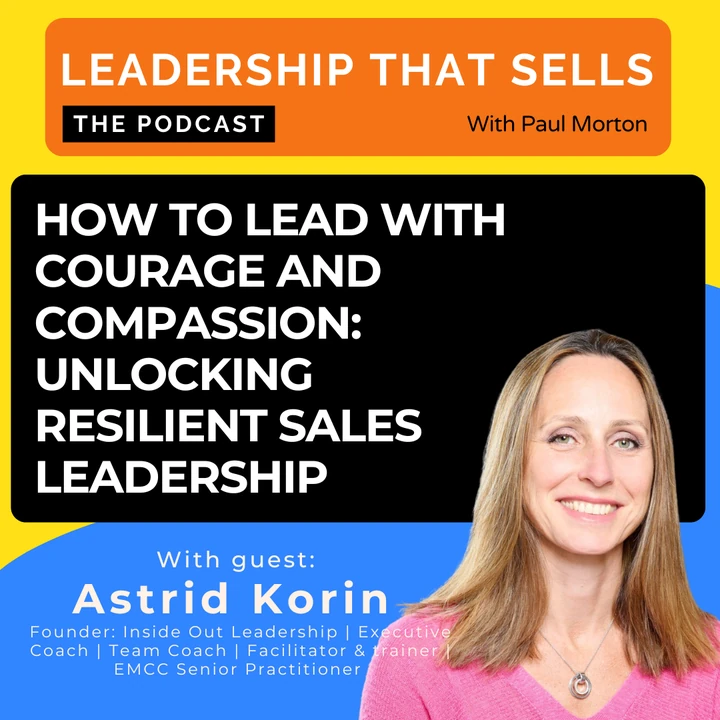
How to Lead with Courage and Compassion: Unlocking Resilient Sales Leadership
with Astrid Korin
Show notes
In this episode, I’m joined by the warm and wildly wise Astrid Korin, leadership coach, consultant, and the creator of the “Inside Out Leadership” programme. We dig deep into what it really takes for sales leaders to stay resilient, especially when the pressure’s on and the targets feel impossible.
Astrid brings both heart and rigour, combining her experience in global leadership roles and business development with a profound understanding of human behaviour. We unpack why the best salespeople already have the raw materials for deep self-awareness and how that curiosity, when turned inward, can help them lead more effectively, coach with intention, and avoid burnout. If you’ve ever felt like you’re “brute forcing” your way through tough quarters, or watching your team drift into exhaustion, this one’s a must-listen.
We also take on the myth of the “group hug” sales team and talk bluntly about why some well-meaning leadership habits can do more harm than good.
How to use self-awareness to build resilience:
- Get curious about yourself. Notice when you’re triggered, reactive or spiralling. Ask: what am I assuming? What else might be true?
- Pause, then choose. Interrupt automatic behaviours. Take a breath and ask: what are my options right now?
- Practice being the observer. Notice physical responses, emotional surges, and what they signal. Don’t just react, reflect.
- Understand what’s underneath the trigger. Many sales leaders tie their worth to outcomes. Recognise when underperformance starts to chip away at your identity.
- Remember: all relationships are co-created. How you land a message matters, but so does how others receive it. Take shared responsibility for communication.
Timeline summary
[03:02] – Astrid on how business development in International Development is sales — and why rejection builds resilience.
[05:13] – Curiosity as a superpower: why assumptions kill leadership and curiosity saves it.
[08:47] – Noticing the clutching: how busy-ness masks vulnerability and fear in sales roles.
[10:35] – Sales leaders must lead from the inside out — or risk pushing their self-protection behaviours onto the team.
[14:25] – The most practical starting point: build your observer muscle and watch how you respond.
[18:03] – “How did that land?”: why good sales leaders ask, clarify and co-create understanding.
[25:59] – Astrid unpacks the achievement trap — where performance becomes self-worth, and why that’s dangerous.
[34:45] – The honest mistake new leaders make: hitting the ground running without understanding the context.
[39:33] – Astrid’s billboard moment: “You are enough.”
Links & resources
- Astrid Korin’s website: http://www.astridkorin.com/
- Connect with Astrid on LinkedIn:https://www.linkedin.com/in/astrid-korin-a7612969/
- Learn more about the Inside Out Leadership programme (next cohort launches Feb 2026)
If you got value from this episode, please rate, review and follow the show. It really helps spread the word to other sales leaders trying to lead first and sell more. And if you know someone who needs to hear this conversation, send it their way.
Transcript
Automated transcript. Speaker labels and spellings may contain errors.
Paul
[upbeat music] Today's guest is all about resilience. She's a leadership coach and a consultant who helps leaders lean into courage, compassion, and resilience. She's got an 18-year career spanning education, international development consultancies, and now she's led global teams through huge transformations. Now, uh, she's working as a leadership coach, and she empowers individuals to embrace authenticity, overcome self-doubt, and to build high-performance cultures. A mindfulness practitioner, a runner, a lifelong learner. She brings warmth and honesty to every conversation, and I'm sure that this one will be no exception. Welcome to Leadership That Sells. This is the podcast that helps you lead first and sell more.
Now, most sales teams today are just not really teams. They're what we call teams in parallel, working in a similar way, but just not with each other. And most sales managers are still leading like they've got like a football team, when in reality, at the best case, they've got a group of golfers. Now, this mismatch then creates all kinds of pain. Poor coaching, bad pipeline meetings, burned out managers, and reps who just drift on. And what we've got is a lightweight reset that'll help your managers lead them in the right way, setting really clear expectations, building identity without the huggy fluff, and coaching for autonomy without going hands-off. It's not training. It's a mindset shift, shifting a model to fit your team, helping you perform scale, uh, scale performance and make everything a whole lot easier. Now, if that sounds like your world, grab the free Parallel Team Playbook at the Practical Leadership Academy website.
It is short, sharp, and made for senior people with teams of managers just like you. Astrid Cotton, thank you very much indeed for joining me.
Astrid Korin
Thank you, Paul. It's so good to be here.
Paul
So I gave you a far too, far too brief introduction there. What did I miss out?
Astrid Korin
What did you miss out? Well, it's always a bit, a bit uncomfortable for me hearing other people speak about, uh, about my-
Paul
Your brilliance
Astrid Korin
... CV, my, my trajectory. [laughs] Brilliance, maybe. Um, you see how I'm trying not to reject that, and I'm trying to embrace it, and receive it, and accept it. Um-
Paul
Have the courage.
Astrid Korin
Yeah. With courage, yeah.
Paul
Yeah.
Astrid Korin
Um, so I don't think you've missed much out really. Uh, it has been a, uh, you know, 20-odd-year career in education and international development. A big part of that is sales. It's, um, uh, fundraising, business development, writing proposals, getting knocked back, striving towards KPIs, profit margins, et cetera, even within the realm of the not-for-profit sector-
Paul
Oh, yeah
Astrid Korin
... to keep an organization alive by, um, you know, winning work and satisfying customers. Uh, and for a lot, for, for some, uh, of that time, I was in, actually in a business development role, and for the whole time, you're always involved in business development because, um, because everybody's got to get stuck in, as you say. It's not that there's a team of people that do the selling. The, the, the, the people that do the selling are embedded into, uh, other teams for specific projects and so on. So, um, yeah, that's been a, a part of the journey, I guess, that is relevant to what we're going to talk about today.
Paul
And it's, I think, particularly interesting when I get the chance to speak to, um, people who are involved in leadership and organizational development who have that commercial background because you get a lot of people who come from either consultancy or you come from either HR or, or even an operational side, like, you know, business ops or engineering background, and that's valid, absolutely valid. And some of the best executives I've ever worked with have been engineers, they've been finance professionals. But when you're a sales bod, when your arse is on the line, when your job is on the line if you don't hit the target, that, uh, you have this understanding, this, this, this, um, clarity of thought because you can be as busy as you like with as much quantity of stuff as you like, but it's all just a distraction because you're paid in results.
You're ultimately paid in results, and if you don't make a result, you, you lose your job, quite simply, quite, quite frankly. Three quarters in, you've not done a thing, you're gone. That's it. There's no, "Well, you know, it might..." Well, actually, in a bad team, you might just drift on for a while if your manager hasn't got their head screwed on. But it is the most visible, the most measured, the most central part of any organization is getting the, getting the meat up onto the table, you know? In my opinion, successful salespeople are inherently very, very curious.
Astrid Korin
Mm.
Paul
They dig in. They listen so much more than they talk. They really want to understand what's going on. They want to understand themselves, but also your business that they're trying to sell. Now, whether that's, uh, business development as in I'm trying to sell this company, or it's business development as in I'm trying to sell things that this company makes to somebody else, it's still this curiosity. How can you spin that curiosity and apply that same skill of curiosity to yourself?
Astrid Korin
Mm, I love that question. I love that question primarily because what I think is so important and often missing in leadership development, um, is the, the building and the development of the inner world and the awareness of ourselves as human beings when we are in positions of power with responsibilities and how, um, you know, the way that we were brought up, the culture we grew up in, the, uh, teachers we had, all of those influences actually have shaped, uh, our belief system, our values, and so on, and how all of that manifests in the day-to-day, in the way that we interact with others, in how we perceive ourselves in relation to others, um- Uh, the extent to which we're able to delegate, mentor, coach, uh, or whether or not we keep everything nice and close because we believe that if we need to get something done properly we need to hold onto it and we need to do it ourselves.
All of that, um, is, is quite deep and relevant to the, to the human, to the individual. And so curiosity is, it really is the superpower to get to some of that stuff. And where I think some leaders fall down is in that lack of curiosity, where, where, where, where they make assumptions that things are the way that they appear to them.
Paul
Mm-hmm.
Astrid Korin
So they've got their lens on the world, they see things in a particular way, and assume that that is the right way, the only way, um, and that anybody else, uh, who thinks differently either is wrong or just needs to learn and understand better and needs to be convinced that actually their way is, uh, is in fact, uh, the right way. So, uh, so really that curiosity, that ability to pause and ask themselves, "Actually, what is really going on here? What else might be true? What am I not seeing? Um, what are they saying that I'm not hearing?" Um, or, "What am I hearing that they're not saying?" Uh, in order to be able to lead from, from the inside out. So from the, from, from a, a, a greater sense and understanding of the assumptions and the judgements that they are making, and to be able to pivot towards curiosity. So that skill that great salespeople have, that ability to really deeply listen to another human or another group
of humans, or to go through that co-construction process, which you're absolutely right, is so key to, to success in sales, isn't it? Because the more you listen, the more you understand your client, the more you know what they actually want, the more you're able to play back to them the thing that's going to meet their needs, and the more likely they are to buy from you. Um, and, and, and that was absolutely my experience of it in, in international development. Um, if they are able to harness that curiosity and apply it to themselves, then perhaps they might be able to, um, uh, notice when they're being triggered by situations that are out of their control.
Paul
Mm-hmm.
Astrid Korin
Notice when perhaps they are falling into self-doubt, self-judgment because they haven't met their KPIs or because they're not on track to meeting their KPIs, and all of the anxiety and the worry that comes up with that. And some of it, as you said in the, in the introduction, is, is absolutely valid because their jobs may be on the line. Um, but there may also be other things that are more in their control in terms of the rumination and the catastrophizing that actually is deeply eroding, uh, in leadership in, uh, in any kind, but particularly when you're under that kind of pressure. That if they were able to apply their curiosity, notice that perhaps they're feeling, um, a sense of a lack of safety, a lack of certainty, a lack of, um, stability that is then, um, inviting them into some of the behaviors that maybe they don't
want to, to adopt, um, then they can have, they, they have a greater choice. So they can choose what behaviors they want to adopt and they can choose to move away from some of the ones that might not be, might not be, uh, supporting them. Like for instance, getting super busy with absolutely everything and anything because they're clutching at straws trying to make a sale. If that is coming from a sense of, "I am safe as long as I am doing, I'm safe as long as I am busy," then that's going to be perpetuated until the person is able to notice and go, "Actually, you know what? I'm clutching at straws here because I'm feeling unsafe and I'm feeling vulnerable."
Paul
Yeah.
Astrid Korin
"But actually that's not what I want to do right now. Right, right now I need to pick the two or three things that I think are likely to land, and I need to put all of my effort behind it." So that's a really long-winded answer, but I think it gi- it just gives full circle picture of curiosity as a superpower when it's applied to others, and when we can then reflect it back on ourselves how that can help to build our own resilience.
Paul
I think salespeople, sales leaders, commercial people need to have deep understanding of people, the people they're working with, people, people in general, capital P. And a large part of that has to start with a deep understanding of one's self. And if you wanna understand people, first look in the mirror. Fix your own damn problems, at least understand what they are. Understand what your limiting beliefs are, what are the things that you run up against again and again. When it's not going right, you double down and you try and brute force things rather than step back. And by brute forcing, what you end up doing is drifting. And you're not actually drifting as in the guy sitting in the couch drinking lager and watching sport all day, but you might as well be, because your head's down and charging ahead.
You feel like you're making progress, but you're really not. And I think what's worse is that sort of behavior, or not particularly that behavior, but that behavior set when you see it in sales leaders or leaders of any s- any, any color and shape. Um, because they're the ones who will double down, they're the ones who will force this behavior in other people. Says, "Oh, help. We're not doing it." And then they look at their team, and this is where, this is my point, they look at their team and they try to Bu- buoy their team up. Group hugs. They try to build competition in the team, you know, build leaderboards. They try to, you know, let people go. They'll give them their hands off, you know, just, "Oh, I empower you." And all of these things are deeply destructive to the nature
of how salespeople work, and work together, 'cause they don't work together. You know, I'm not talk- saying they're all lone wolves or anything like that, but when you try and make a group of individual performers behave like a team of different performers, they're working similarly, they're not different. They're not going for a common goal. They're not gonna have a group hug. They're not gonna improve based on a competition. And I've got data that proves this one, actually, some really good data points. You have a massive list of sales performers, and you put all sorts of leaderboards and things in place, and guess what happens? In the three years, nothing. The top three to five sales performers are still the top three to five sales performers. The next ones are moving in and out, and the bottom ones just flip around. Doesn't actually improve.
So competition isn't a thing. There's all these... The, the, the upside and the downside of curiosity, I think, is where we're getting to, right? So when you, when you, when you respond from this place of awareness, you're talking about just being conscious of it, bringing it out. How, how can you help people to know themselves better? What do you do?
Astrid Korin
Get a coach. [laughs]
Paul
[laughs]
Astrid Korin
I mean, that's an obvious one. I think that-
Paul
And Astrid's number and email address will be in the bottom of this. [laughs]
Astrid Korin
[laughs]
Paul
And she's available, but she's really, really expensive.
Astrid Korin
Uh, oh, I don't know about that. Maybe, maybe I'd surprise you. Um, well, it is really hard to get to know yourself without, um, without a m- a mirror, a reflective partner. You know, you can, you can to a sense. So one thing that perhaps people can do is, is start to notice, is start to, to practice being the observer of themselves. So, uh, Dan Siegel calls it mindsight. Um, uh, and people have different word for, words for it, but essentially it's the practice of observing yourself. So the practice of noticing when the body is reacting resp- to something. There's a sort of physical reaction. And instead of just jumping straight on the next thing that the, the body and the mind is drawing you towards, which might be get busy, get going, next task, next thing.
It might be distraction, procrastination. It could be all sorts, depending on how you self-protect, and we're all individual in how we self-protect. Um, just notice. Notice what happens. Notice what happens when you get a, a- an email that comes in that's talking about targets for next year, and you re- you see that they're absolutely unrealistic and, or, um, you get the response that your bid was unsuccessful, or that a client that's been working with you for 10 years is not renewing their contract. Or whatever it may be, just, just notice. Notice what's going on. Notice your physical res- reaction, and then get curious. "What's going on for me right now? What is happening? What is my fear? Uh, w- what am I assuming? Am I assuming anything about what the meaning of this event, this email, this client not renewing? Am I, am I taking it personally? Am I assuming that this decision that this person has made is a reflection on me, my capabilities, my achievements,
my value, my worth? How am I internalizing whatever situation is happening?" Um, and that sounds simple, but it's really, really hard. It's really hard to do because it, w- we, we live on autopilot. We're in this automatic state of stimulus, response, stimulus, response, or stimulus reactivity, reaction actually I should say, 'cause a response I think is more considered. Um, and, and the key to any kind of behavior change, even if it's, or, or mindset change, is, is noticing, is the pause that allows us to notice to then proactively choose a different way of feeling, being, et cetera. So we might in that moment choose to reframe how we've received that email. We might choose not to hold full responsibility for it. We might choose to share that responsibility with the person who sent it. Um-
Paul
Yes. Oh, yes.
Astrid Korin
Or-
Paul
Oh.
Astrid Korin
Yeah.
Paul
Oh, oh, hang on a bloody minute.
Astrid Korin
[laughs] Okay.
Paul
Right. We might choose to share the responsibility for the p- for, for, for our interlocutor, wonderful word from the French, for the person who sent it, for the person at the other side of the table. We have a joint responsibility for understanding, for clarity, for emotion, for, for everything with the person with whom we are working with, dealing with, talking with.
Astrid Korin
Mm-hmm.
Paul
And all our fault.
Astrid Korin
Mm.
Paul
Even though-
Astrid Korin
And it's not all their fault either.
Paul
No. No, but it's not-
Astrid Korin
It, it-
Paul
It's not all their f- that's the thing. Okay, number, number one place to look if you're having a communication problem is yourself.
Astrid Korin
Mm.
Paul
Right? How have I not been clear? How can I say this better? I am not explicing... I'm not explicing, expressing myself, explaining myself as clearly as I should be. But, you know, what, uh, what, what questions can I ask to ensure understanding?
Astrid Korin
Mm.
Paul
Yeah. Sorry, I just derailed you. I jumped on that. I, I love that. Absolutely.
Astrid Korin
No, I love it. Let's go with it, because I think that's really important too, isn't it? It's that acknowledging, and this is something else that people can probably try and practice, is acknowledging that everything that is relational is co-constructed. So if there's a real, there's real chemistry between a salesperson and a potential client or team of clients, and they're working really well together, they are brainstorming together, they're co-creating, they're generating something that's, uh, that's new, that's innovative, that's, that's going to make a difference, then there's something that the salesperson is bringing, manager is bringing, and there is something that the client is bringing that together is creating the conditions that are ripe for that kind of creativity, innovation, et cetera.
Equally, in a, in a, a conflict situation with a, a line manager that's pushing down targets, right? So they receive the targets from the powers that be, and they're pushing them down or distributing them across their team of salespeople. And then, so if there is a conflict in that relationship, then there is something that, that, that the, the line manager's bringing in the way that they deliver that message, in the way they set the expectations, and there is something, the energy that they're bringing to it, the compassion, the, the, the, the courage, the cl- the clarity. And there is something that the individual on the receiving end is bringing that is their lens and their habits and their beliefs that will influence how that information is received.
And, and that dynamic between the two people is co-created. So you can't really, even though it's tempting, and we like to do this because the brain likes clar- it likes, you know, facts and black and white, because that's a lot easier for us to accept than the gray, um, is that, uh, whatever dynamic is going on is shared. So what is it that, if I can't control the other person, what is it that I can control that is in my purview? And that might just be how I view it, how I receive it, how I frame it.
Paul
Mm-hmm.
Astrid Korin
It might not be that there's anything to do. It might be that there is something to do. Clarifying communication, feedback. "You know, when you sent me that email, it felt a little prickly. Can we have a conversation about that? Because for me, it landed in this way, and I really would like to share that with you and see if we can have a different type of conversation." Whatever that looks like. But it could just be, it could just be an internal shift.
Paul
Landed is a lovely word. Um, there's a, one of the pastors at my church, he has this terrible habit of saying, "Do you understand that? You understand that, don't you? You understand that," whenever he's trying to explain something theological and I'm thinking, "What? Hmm?"
Astrid Korin
[laughs]
Paul
And there's a, just such a better way of asking, which is, "How did that land?" How did, how? Not, "You do under-," you know, or even why. Why is quite accusatory. But how? How, what do you think of that? "I don't understand it." "How did that land for you?" "Not well." [laughs] You know? Gives you space to easily say, "Huh?"
Astrid Korin
Mm-hmm.
Paul
Rather than, "Oh, yeah, that was, that was, um, perfectly, uh, clear." Uh, not.
Astrid Korin
Mm-hmm.
Paul
You know? Landed. How did that land with you? "It didn't land well with me." You know, it landed like a shit ton of bricks landing in my noggin. You know? [laughs] It hurt.
Astrid Korin
[laughs]
Paul
You know?
Astrid Korin
Yeah.
Paul
Yes. Beautiful. So using this, using the intrinsic power of a good salesperson, this curiosity, and the courage that comes with that, actually, to apply the curiosity, 'cause you can be as curious as you like, but if you don't ask good questions, you ain't gonna fulfill your curiosity.
Astrid Korin
Mm-hmm.
Paul
Using that to get to know themselves better, respond from a place of awareness rather than drifting through or brute forcing through, 'cause then you end up burning out. You end up burning everything you touch on the journey.
Astrid Korin
Mm-hmm.
Paul
Helping people know themselves. What is... I, I think, I think the thing that I draw people's attention to mostly is to try not to drift through life.
Astrid Korin
Mm-hmm.
Paul
And the thing to do is exactly as you said, I think, which is just take that microsecond to say, "What's going on?"
Astrid Korin
Mm-hmm.
Paul
"Where am I? What's happening here?" Just, what is this conversation? What is this conflict? Is it a con- what is, what is the moment that I'm in? Just lift your head up and say, "Oh, hang on a minute."
Astrid Korin
Mm-hmm.
Paul
Just, and that, that microsecond of awareness elevates you from the drifting mundanity of the masses. And I, I have no data to back this one up, but I would say 99% of the world just bash through heuristically res- not responsively. What was the word you used? Reactively. You know, push button. You put coin in slot, thing happens. You know, one challenge, response. And the second you take that second to take that second and say, "Huh," turns you into some superhero.
Astrid Korin
Mm-hmm.
Paul
Superpower of curiosity. And it's already there in really good salespeople.
Astrid Korin
Mm-hmm.
Paul
It's already there. The, the, the best ones I've ever worked with are, they're, they're deeply interested in people, in stuff.
Astrid Korin
Mm-hmm. Yeah.
Paul
How do you then use that? Now, we've kinda covered this. How do you use that to build your resilience? It's ba- it is basically st- take that step back and take the moment to say, "Huh, where am I? What's going on?" And I think the, the next one is, once you've done that, is then to label it, to say, "Okay, that is a thing. That is what it is."
Astrid Korin
Mm-hmm.
Paul
'Cause you've got the ref- you've got the moment. Just the pause itself- Whether you do anything with the pause or not, just the pause itself to say, "Just take the breath." But then the action to say, "Okay, this is one of them."
Astrid Korin
Mm.
Paul
And then the next one, this, this like multiple order effects. The next one is to say, "This is one of them. And what are my choices now?" Sort of kind of self-coaching.
Astrid Korin
Mm-hmm.
Paul
What's stopping me? What are my options? Where do I wanna get to? How's... And a- a- anything you can do to build up that.
Astrid Korin
Mm. Yeah, so I think that, uh, I think that on the, on the surface you'll probably get to a level of understanding of, of sort of cause and ef- not cause and effect, of, yeah, cause and effect. What happens, and then my reaction to it. I think that to what is the sort of next level, um, which I think is where you get that kind of transformative shift, is where you understand the connection between the stimulus and the response. So for example, I could be wrong, but I'm going to make a hypothesis that in sales we have a group of people who, on the whole, um, because society defines their worth by what they achieve and the numbers that they rack up-
Paul
Yep
Astrid Korin
... they perhaps have also internalized a bit of that. They might have ha- they, uh, so it can be chicken or egg. Perhaps they were someone who started off, um, feeling like their worth and their sense of purpose, their sense of, of contribution comes from what they achieve, right? How much they do, how much they sell, how much they... And so they were drawn to the field of sales, because that's a great place to be able to prove your worth in the day-to-day. Um, or conversely, they got into sales, and then because they were being judged on all of these outcomes that were very tangible and measurable, that they started to internalize that, that they have, they then have a sense of, "My self, my sense of self-worth comes from the numbers at the end of the month."
Um, so understanding that there is a, a depth to the reaction. So if I'm reacting negatively to the fact that I haven't met a target or that I've got, uh, feedback from someone on the, on the executive team that I have underperformed this month, no matter how that is delivered, if I'm receiving that from a place of my worth is in my achievements, is in the numbers, I'm going to internalize that feedback as there's something wrong with me, I'm not good enough.
Paul
Mm. Interesting.
Astrid Korin
So my immediate reaction to that is going to be whatever reaction I have developed that has kept me safe from feeling like I'm not good enough, like I haven't performed, I haven't achieved, and therefore my worth is, is, I have, I have no value in this moment. I'm, I'm exaggerating for effect, right? But-
Paul
Not that much.
Astrid Korin
No?
Paul
You're not exaggerating that much at all.
Astrid Korin
Mm.
Paul
You're really not. Um, I've, I've felt it. I've seen it many times. But no, it's, it's, um, I think the number of deeply thoughtful, philosophically courageous, um, aware adult salespeople who, whose sense of worth can be crushed at the end of a month or a quarter when they don't hit a target that's arbitrarily pulled out of my arse, quite frankly, to meet my group number. And it crushes them. And you're thinking, "Dude, no. It's just, shit happens. You've had a bad week, bad month, bad whatever." And as long as the, it works both ways, you know. I mean, the, the worth in these things is have you hit 100 grand this month? Have you sold 100 grand? No. Have you made 300 grand's worth of pipe? Yes. 'Cause if you haven't done this, you've done that. 'Cause if you haven't done one of them, you're gone.
Okay? And you would know that anyway 'cause you're either in the wrong market, you're not doing, whatever's gone not, not working right. And if you're half-decent at what you do, you've done one of them. Or more likely than not, you've done a bit of this and a bit of that. You've sold 50 grand and done 200 grand of pipe. And they both add up to next month being better. But if you don't, haven't done the magic target number thing, and worse, you're being mismanaged, and I've done a lot of that too. I've mismanaged so many people. I'm so sorry if you're a part of my trail of destruction in learning how to do this. If you're listening now, I apologize. You, you see just damage been done, and you, folk end up doing it to themselves.
It's like self-inflicted.
Astrid Korin
Well, it's, it's, it's complicated, isn't it? It's, um, it's society, it's individual experience, it's the role that we're in, it's, um, it's repetition. So if this is a big part of your daily life, then you're more likely to be more sensitive to it than if it's a thing that you do, you do sometimes and that's not, doesn't sort of define your, your role. Um, and I think just coming back to the, the question you were asking before about so how, what can people do? How can people notice? It's that trying to get underneath that first level of self-awareness to going, "Actually, why am I so upset by this?"
Paul
What's triggering me?
Astrid Korin
Yeah. What is it that I-
Paul
What's setting me off? Yeah
Astrid Korin
... what meaning am I making of this that is causing this, um, considerable emotional, physical response? Because if, if we, if it wasn't, it, if it doesn't have depth and it is not meaningful to us, then we won't react to it.
Paul
No. No. Yeah. I mean, and, and in part you can... I don't know, this is, this is a, this is a convers- an, an entirely different conversation probably. But the, in, in part you've got people who turn up for the paycheck, and you need a lot of people who turn up for the paycheck. We need that in the world. And there are people who are materially invested in the results that they want to achieve. Um, and both, I think, are damaging. There is no... I don't know, what is the future of work? How do we actually all, uh, just rub along and get things done without damaging ourselves and damaging the people who work for us? I mean, if you have to put pressure on somebody to, to, to, to achieve something, is that thing achievable?
Astrid Korin
Mm.
Paul
Well, maybe, maybe not. Uh, how do you find out? Well, you put pressure on your team to see if they can do it, and if it's not and they burn out, well, it wasn't achievable then. But I've just managed to... Uh, so it's just, you know, it's, it's-
Astrid Korin
It's really hard
Paul
... it is just, it's not, it's not... I think the, the one, if there's one thing I've, I've, uh, picked up over the years is that you can absolutely abuse your team. Totally do this, and you can do it intentionally and on purpose. But you can do it with, um, clarity and with honesty and say, "We're gonna do this-
Astrid Korin
Mm
Paul
... and it's gonna be mean, and it's gonna be unpleasant, and we're gonna push like the devil to make this work." But you can only do that when you've built up the trust capital-
Astrid Korin
Yeah
Paul
... that, "We're doing this. I've got your back."
Astrid Korin
Mm.
Paul
You know? "It might work. If it doesn't work, we're still gonna have plan B, which it means we're all gonna have the joy of continued employment."
Astrid Korin
Mm.
Paul
Um, or even not, you know? If that's the clarity, "We're gonna take a risk here. We're gonna do this. You wanna, you wanna play along?" "Ah, I'll go for that." You know, some, some people will say yes, some will say no. As long as you have that done with honesty, um, and you've set the foundation as such that you can, you can shake the building really, really hard, but the foundations are there.
Astrid Korin
Mm-hmm.
Paul
You know, you've got that in place. What I see is you see new people coming into teams, and they say, "Oh, I'm gonna shake things up," and they do. They start pushing things around, they p- p- pushing people around. And, or, you know, dick-waving contests especially, even for the girls, right? It's, it's doesn't really matter. It's just a big, "Ah, I'm the great I am. You go." And you have people look at them and say, "Life's too short, mate. Sorry. Not interested, and you're an asshole, by the way." [laughs] "I'm gone." And they're the best performers, and you get less, well, you get left with the dregs. The C players are the ones that are still there. So it is a, it's this monstrous dichotomy. It's not even a dichotomy, it's a trichotomy, isn't it?
Astrid Korin
Mm. Yeah. Yeah, it's really complicated. I definitely don't have the answers for that, and I d- and-
Paul
Well, if you did, we'd all be millionaires, Rodney. [laughs]
Astrid Korin
[laughs] Forget this coaching malarkey, yeah.
Paul
Oh.
Astrid Korin
Um-
Paul
Let's go shift some dishwashers. It'll be easier.
Astrid Korin
[laughs] But I do, I, I love what you're talking about in terms of, of, of honesty and transparency.
Paul
Mm.
Astrid Korin
Right? To know where you stand, and to be very clear about, um, expectations, this is how it's going to work. Not try to, um, bullshit people, for want of another word.
Paul
Yeah.
Astrid Korin
To, that, you know-
Paul
Yeah, yeah, yeah
Astrid Korin
... it's a supportive environment, come and join us, and, you know, you'll have all of this support. And then, "Oh, yeah, but by the way, if you don't make this target, then you're out."
Paul
Well, exactly.
Astrid Korin
Mm.
Paul
I mean, what-
Astrid Korin
Mm
Paul
... is making the gain-
Astrid Korin
But you've touched on something really interesting there about the people who come in, uh, and I've seen this so many times. So a new role is advertised or an old role, somebody's moving out, and someone comes in, and, and it's, and it's, and again, it's co-created. But the org- the, the organization has set this person up to be the person that comes in that revolutionizes things, that turns things around, that, um, you know, uh, gets the oil tanker to, to, to swing in the opposite direction. And so they come in, and they have to hit the ground running. Please, listeners, if you are listening to this and you are coming to a new role or you are hiring for a senior position, do not hit the ground running.
[laughs] It causes so many problems. So if you want to set up a new team, a new function, a new way of being, a slight pivot, whatever it is, you, you have got to take the time to understand the people and the history and how you got to where you got to, and, and all the efforts that these people have put their working lives into so far to get to where you are before you come in and rubbish the whole thing and decide that it's going to be completely different because that's the only way to save this organization. Um, yeah. So don't do that, please. [laughs]
Paul
Yes. Um, and, uh, frankly, see, if you do it again, uh, I'm gonna find you, and we're gonna have words.
Astrid Korin
Okay.
Paul
'Cause it's not... It's... Oh. And you s- you, you still see it. It just happens all the time. Just happens all the time.
Astrid Korin
Mm-hmm.
Paul
It's disastrous. Astrid, where can we find you when we need you?
Astrid Korin
Uh, so I have a website. Uh, and that's astridkorin.com. So if you Google-
Paul
Link will be in the description. Link will be downstairs, yeah. Mm-hmm.
Astrid Korin
Yeah. You can find me on LinkedIn. Uh, again, just search for my name. I'm quite unusual, so I don't think there are m- multiple Astrid Korins out there. Uh, my last name starts with a K, so K-O-R-I-N. And, uh, that's it. I don't do other social media. It's a very intentional choice for me. It's LinkedIn and my website, and you can find, there's a contact me button on the website if you'd like to have a chat.
Paul
Beautiful. And what are you working on that's exciting you at the moment?
Astrid Korin
Oh, I'm so glad you asked that. So at the moment, so I have a program for leaders called Inside Out Leadership, which won't surprise you. Um, and it is all, it is a curation of, um, tools, approaches, paradigms from, uh, the field of coaching, psychology, um, leadership, and mindfulness, and it's all geared towards helping leaders do exactly the sort of thing that we've been talking about, being able to notice what's going on, go within, be curious, understand themselves better, and then to be able to choose responsiveness over reactivity, and therein to build their resilience so that they can not burn out, they can hold better boundaries, they can, uh, let go of things that are outside of their control, um, and, and be more focused on the things that, that they can influence.
Um, so that's Inside Out Leadership, and we have done now, uh, 13 cohorts, uh, and it's going really well. So at the moment we are updating it. We have a new associate, not so new anymore, um, but a clinical psychologist, Ro- Roger Bretherton, he's joined us, and he has brought so much wisdom and nuance to what we've been doing already for the last three years. So we are updating the program. Uh, we are going... It's going to be just a little bit more streamlined, a bit more, um, um, sort of sequenced in the way that it's delivered. Uh, but essentially the core of it will stay the same, and that will be ready to launch in January 2026. It will come with an app with prompts for exercises, mindfulness practices, uh, and so on, which we are hoping will help the transition from knowledge to implementation to behavior change.
Um, and that will be a, there'll be an open cohort running from February 2026. So if anybody's interested in that, let me know. And we also do in-house cohorts for organizations that want to shift the dial on culture that we tend to work with the, kind of most senior leaders, uh, to, to try and affect some culture change. But that's the big thing at the moment. So it's the revamp of that program and the launch of, uh, Sustaining and Going Deeper, which is going to be a follow-on program for alumni to keep the practice going, to keep it live, and to, um, uh, and to continue the good work that they start on the program.
Paul
Magnificent. Astrid, if there was one message you could take to the world, what would it be? I'll give you 10,000 billboards and a huge marker pen. What are you gonna write?
Astrid Korin
Oh my God. [laughs] It's impossible. I really struggle with these. Um-
Paul
That's why you ask them, right?
Astrid Korin
Yeah.
Paul
So what I'm gonna do is I'm gonna just talk randomly for a few seconds to give you some time to think, because I've just sprung this on you.
Astrid Korin
Um-
Paul
But it's a magnificent question to really help you to focus in on what is core to either you, your practice, your soul, your life, your existence on this earth. What, what, what's the one message you wanna share with the planet?
Astrid Korin
I think I have it. It's cheesy. Is that okay? Can I bring some cheese?
Paul
Cheesy's good.
Astrid Korin
Okay.
Paul
Cheesy's good.
Astrid Korin
Uh, it's you are enough.
Paul
Hmm.
Astrid Korin
You are enough. Just the way you are, you are enough. You are not perfect. You are flawed in many ways, uh, and I'm speaking to myself as much as to you, as much as to your listeners. Um, and that's okay, and we can continue and evolve and grow and learn as long as we accept ourselves just as we are. But the moment that we decide that we are not enough, we will be operating in a way to try and prove ourselves that we are enough, and that doesn't lead to learning, growth, et cetera. So you are enough. That's my billboard.
Paul
You are enough. Astrid Karin, you are enough. Thank you very much indeed for joining me.
Astrid Korin
Thank you. [outro music]