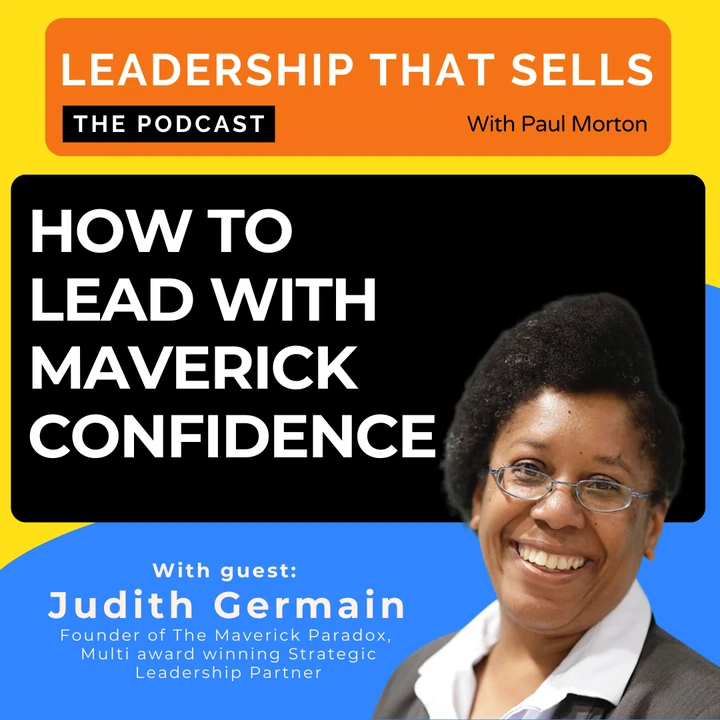
How to Lead with Maverick Confidence
with Judith Germain
Show notes
If you’ve ever tried to “manage” a maverick, you’ll know it’s a losing game. Judith Germain – leadership strategist, author of The Maverick Paradox, and founder of the Maverick Paradox consultancy – joins me to unpack what it really takes to lead willfully independent, pathologically curious people. The kind of people who can transform a sales culture… or wreck it.
We dig into why most sales teams aren’t actually teams at all, the dangers of rigid systems, and why curiosity only works when it leads to execution. Judith shares her DRIVEN framework for decisive leadership, the difference between execution and mere implementation, and how to give high-performers the autonomy they crave without losing sight of the target. If you want to stop fighting Mavericks and start leading them, this one’s for you.
How to lead Mavericks without killing their independence
-
Replace rigid rules with guideline-based structures that fit the purpose.
-
Be someone worth following – respect, trust, and genuine care matter.
-
Discover each person’s compelling reason and align your leadership to it.
-
Focus on execution (achieving the outcome) over implementation (ticking the boxes).
-
Use the DRIVEN framework: Determination, Reputation, Influence, Versatility, Execution, Narration.
Timeline
[02:12] – What a Maverick really is (and why the cattle story matters)
[04:30] – How pathological curiosity changes the sales game
[07:12] – The difference between curiosity and rabbit-hole procrastination
[10:21] – Jazz, adaptability, and leading in context
[13:48] – Why you can’t “manage” a Maverick – and what to do instead
[14:09] – Judith’s DRIVEN framework for decisive leadership
[17:33] – Execution vs implementation: why ticking boxes isn’t enough
[20:15] – How to create autonomy without losing accountability
[23:01] – The four elements of influence and why they matter in sales
[25:04] – How amplifying your influence helps you sell more
Links & resources
-
Judith Germain’s website: https://maverickparadox.co.uk
-
Influence Scorecard: https://amplifyyourinfluence.scoreapp.com
-
The Maverick Paradox by Judith Germain – https://www.amazon.co.uk/gp/product/B0727WP2SC/ref=as_li_tl?ie=UTF8&camp=1634&creative=6738&creativeASIN=B0727WP2SC&linkCode=as2&tag=maverickparad-21&linkId=cfd757574de06f194bafdb253e33e052
If you enjoyed this episode, please rate, follow, share and review the podcast – it helps more leaders find us and lead first, sell more.
Transcript
Automated transcript. Speaker labels and spellings may contain errors.
Paul
[upbeat music] She's a renowned leadership strategist and founder of the Maverick Paradox, a trusted mentor to C-suite leaders, and the voice of challenge in the world of leadership development. She's made it her mission to create clear-thinking, decisive leaders who transform culture. Author, podcaster, and consultant, she champions the power of maverick thinking in leadership. And we need it, because you know what? Most sales teams today aren't really teams. They're parallel performers, and they're working towards a shared number, but they're not doing it with each other. And most sales managers are leading like they've got a rugby squad, when in reality what they've got is a track relay. Now, the mismatch there creates all kinds of friction, ineffective coaching, bad pipeline meetings, burned-out managers and reps who just drift. So we built the Leadership Reset. It's a short, sharp program to recalibrate how sales managers lead.
You set clear expectations, you build identity without the fluff, and then you coach for autonomy without going hands-off. It's not training, it's a model shift. And when the model fits the team, performance scales a whole lot more easy. Check it out at the Practical Leadership Academy, and this is the Practical Leadership, Leadership That Sells podcast. Judith Germain, thank you very much indeed for joining me.
Judith Germain
Thank you. What a lovely way to introduce someone, and it's good to hear that the stuff that you do seems to be quite aligned to what I'm thinking as well.
Paul
I'm so glad. But it was a far too short introduction.
Judith Germain
[laughs]
Paul
What did I miss out?
Judith Germain
Oh, gosh. Um, I'm a multiple, multiple award-winning, uh, consultant. I speak a lot. I do a lot of public speaking. Um, you t- you said I wrote a book, which is true. I do a lot about influence, and I'm asked ... My opinion's been sought around the globe, so I've written in lots of magazines and, and things like that. And I've been on, um, BBC Radio a couple of times too.
Paul
Oh, we won't hold that against you.
Judith Germain
[laughs]
Paul
[laughs] It's fabulous. Well, the book, we mentioned the other book, um, The Maverick Paradox. This is the whole idea. What is a maverick and why is it paradoxical?
Judith Germain
Right. Okay, so being a socialized maverick myself, I didn't like any of the definitions for maverick, so I defined it myself. So I define mavericks to be willfully independent people, and when I say willful, I don't mean like a toddler stamping their feet going, "Gimme, gimme, gimme." I mean, it's like you understand, uh, what you want to do, it's the right thing to do, so you will do it despite people saying no. So you're standing on your integrity. This is what I'm gonna do 'cause it's the right thing to do.
Paul
'Cause I mean ... And, and I looked, I looked this up, right? So it's a bullock or heifer that has not been branded and is unclaimed or wild. And it's supposed to be from Maverick, the name of a cattle owner in Texas who'd, who refused to brand his cattle.
Judith Germain
Yeah. And him refusing to brand his cattle meant that he could, he could take any cattle that hadn't yet been branded, so he, he-
Paul
That one's mine. [laughs]
Judith Germain
Yeah, so he, he ended up having a lot of cattle, [laughs] a lot of cattle.
Paul
Which, which if you think about it, you follow the maverick, the maverick protocol and you lean into the paradox. It, it's, it's a, a recipe for success, is it not?
Judith Germain
Yeah. I, I define mavericks in two ways. So you have a socialized maverick.
Paul
Mm-hmm.
Judith Germain
That's the kind of maverick you can bring home to your family, okay?
Paul
Right.
Judith Germain
So they're the ones w- who know how to, to, to get what they want by enabling you to get what you want. And then you've got extreme maverick. So I'll give you an example. We can look at Barack Obama and we can look at Donald Trump and say they're both maverick leaders.
Paul
Mm-hmm.
Judith Germain
One is socialized and one is extreme.
Paul
Mm-hmm. Yeah. And I'll leave you to work out which one it is depending on where you're listening to this from because, you know, uh, uh, my wife's American and all the Americans we know love Mr. Trump.
Judith Germain
[laughs]
Paul
Absolutely adore him. Now, your book explores the idea that maverick leaders are willfully independent, okay? So it's that willful independence, but also pathologically curious. Now, curiosity and the courage of independence I think are the two of the biggest things I hire for in, in any role, but in particular sales, sales leadership roles.
Judith Germain
Mm.
Paul
How could that mindset of independence and curiosity there help sales leaders build stronger but more autonomous teams?
Judith Germain
Because if we encourage curiosity, then we can get rid of outdated ideas like always going for the close.
Paul
Mm.
Judith Germain
Because we're a bit more sophisticated th- than that now, aren't we? So if we, we ... So pathologically is like we're gonna continuously do it, so we're constantly being curious about, especially in sales, like the, the individual, uh, the context that they're in, uh, why they need the thing that they, that you want them to buy. Um, that's the difference. So if you can ... If you're a sales leader and you have a team that's pathologically curious, you're going to generally move to a more collaborative point of view. Because if they see someone who is a better, uh, salesperson, for example, that curiosity is gonna ask, is gonna lead them to asking and finding out why without the competition. And that person who is like maybe the, the better booker will want to help the other person because they're curious as to what they can learn from the exchange as well. So you can get rid of needless competition within a team-
Paul
Yeah
Judith Germain
... that is cannibalizing the potential of the whole team.
Paul
Yeah.
Judith Germain
You want to move out.
Paul
And the, I think the challenge when you're thinking of the, the, the pathological natured of anything is it becomes very quickly you're, you're, you're borderline redline. So you're just, you're not quite ... You, you don't want lounge music, and neither do you want, uh, atonal cacophony. You want jazz right in the middle.
Judith Germain
Exactly.
Paul
So you're balancing this, this- High functioning, high value, but not messy pabulum and not chaotic nonsense. You want the valuable bit in the middle. So that's the, the challenge is where you have people who are, as you said, pathologically curious rather than just being, as I would just say, curious, 'cause I've never used the word pathologically in a positive environment.
Judith Germain
[laughs]
Paul
But pathologically curious is really interesting. It's, um ... And I, and I suffer a bit from, um, being a very active learner. I will learn and learn and learn and learn, and that's my version of procrastination, and that took me a long time to realize I wasn't procrastinating, sometimes. I wasn't procrastinating, but was actually just trying to gather the right amount of information so that I could make the informed decision. My red line, my challenge, is that I can easily say, "Oh, rabbit hole," and I'll just follow that, and I'll keep on being curious.
Judith Germain
Ah, but there is a way around that. So maverick leaders are execution and output minded.
Paul
Yeah.
Judith Germain
So they will ... They're curious as long as that curiosity leads to something.
Paul
Yeah.
Judith Germain
So they're not just pathologically curious with, with no reason.
Paul
Yeah.
Judith Germain
So, so if they've ... They want ... They're leading to execution, so the knowledge that they're gaining will lead to execution of something.
Paul
Absolutely.
Judith Germain
So that that's why they're pathological, because there's an end point.
Paul
Yeah, and it's the interesting idea that, um, laziness or procrastination, maybe that is a misframed focus on the moment rather than on the outcome.
Judith Germain
Mm-hmm.
Paul
So I'm focusing on the thing that I'm doing rather than the thing that the one doing gives. And it's just, I think, a reframe in your head to think that I'm not doing this for the thing, I'm doing this for what happens.
Judith Germain
Yeah.
Paul
So I don't go to the gym to go to the gym, I go to the gym to stay fit. You know, it's that ... It's, it's, it's a sales paradox as well.
Judith Germain
Mm-hmm.
Paul
You know, you're not selling socks because socks are good. You're selling warm feet.
Judith Germain
Yeah. Another reframe as well for me, I've noticed that if I'm procrastinating, subconsciously there's something not right with the thing that I'm going to do.
Paul
Mm.
Judith Germain
So, so I found, found that ... 'Cause being executionally minded, I just tend to get on with it.
Paul
Yeah.
Judith Germain
But when I'm finding myself procrastinating, when I start to dig, I either don't believe the individual or it's a pathway I shouldn't be following anyway. There's always a reason. So rather than getting angry like I haven't done it before, I stop and go, "Why aren't, why am I not doing it?" And that's that pathological curiosity coming back. Why am I not doing this? Because I've already stated it's important to me.
Paul
Yeah.
Judith Germain
And if I'm digging, it might be I'm going down the wrong end. It's like my book. So, like, I'm writing my second book now, and I've-
Paul
Mm
Judith Germain
... procrastinated for two years, right? And I was just going-
Paul
That's not procrastination
Judith Germain
... and then when I thought about it-
Paul
That's a heart attack. [laughs]
Judith Germain
Yeah. And I finally realized it's because what, what I wanted to do with the book is wrong, but I didn't want to-
Paul
Mm
Judith Germain
... admit it to myself. And once I really went, go, "Why am I not writing this book?" I suddenly realized because what I want to put in there, it's all wrong. It's like, it's just not the right thing to be doing. And now I know what I'm doing, so I'm no longer procrastinating. So it's understanding yourself.
Paul
Listening to the small, still voice of calm.
Judith Germain
[laughs] I like that.
Paul
Or is it ... It's the, it's the psalm, isn't it? Through the earthquake, wind, and fire, your small, still voice of calm, you know?
Judith Germain
Oh, wow.
Paul
So he's on the hills, um, and I think it's Samuel, and he's, he's, he's trying to listen to the voice of God. Maybe Abraham. I can't remember. It's one of the ear- the early Old Testaments, and he's listening. He's trying to listen to the voice of God, and the earthquake comes. No. The waves come. The storm comes. No. And then in the peace is that small, still voice that speaks, and that's the one you should be listening to. It's that-
Judith Germain
Wow
Paul
... the, the ... When you get the ... It's how the world works. It's how we're made. It's the, when you get that core, that, that message that comes through and you actually learn to listen to it, you learn to listen and you learn to trust yourself, I think, is a, is a big part of this dealing with the, the pathological nature of curiosity.
Judith Germain
Mm.
Paul
That it, it is, it can be very easy to fall into the, to the atonal chaos, but when you get jazz and you get that, that, um, Mihaly Csikszentmihalyi focus, that's of, uh, the, the, the f- the flow piece-
Judith Germain
Yeah. I love-
Paul
... that's high performance. Yeah.
Judith Germain
I love the idea of jazz because maverick leadership is, is contextualized.
Paul
Mm.
Judith Germain
It's all about the context, and it's all about adapting. So the idea of playing jazz and when you play jazz well is you're con- constantly adapting to what else is happening around you. It's a perfect analogy.
Paul
Yeah. There's a lovely piece as well. It's the, um ... A very good friend of mine who's a dancer as well as being a business chap, and he says it takes a great deal of effort to be a f- free spirit.
Judith Germain
[laughs]
Paul
Um, and there's ... The, the wonderful thing is when you had, you have recordings of Dizzy Gillespie and he's playing, um, th- there's a couple of film recordings and you see him raising his hand like this, you know, just numbers, and you think, "Oh, my, he must be controlling things." No, he's finding them. Yeah. When he hears somebody make a mistake, two bucks.
Judith Germain
Wow.
Paul
Five bucks. He's finding them, right? It's because the intensity and the collaboration and the degree to which this team has to work to perfection to create this free form, wonderful sound, but the, the, the, the compressed focus that has to be there in order to perform that jazz is just beautiful. Anyway.
Judith Germain
Mm.
Paul
That's kind of, kind of distraction there. Now, one, one of the big things you ... This, this is a piece about, um, I think clarity of thought, is you, you, you s- say that you try to help create clear thinking yet decisive leaders, execution focused leaders. What, where do you start? What are the first steps, um, a sales manager, for example, should take when they're trying to lead more decisively but not be controlling? Because in a sales team, that can be devastating. 'Cause it's not a team of different performers. It's a team of individuals who happen to report to the same person. Mm-hmm
Judith Germain
An o- an orchestra. Just to give
Paul
No, not, not even. I think it's, it's, it's ... And because an orchestra isn't a collection of soloists.
Judith Germain
That's true. That's-
Paul
An orchestra plays differently. I- if you think of the sports analogy, which is ... Sometimes it works, is you're thinking of football or rugby, and it's a team of ... You get somebody who's good at this, somebody who's good at that, and they-
Judith Germain
Yeah. Makes sense
Paul
... come together to, to a goal.
Judith Germain
Mm-hmm.
Paul
This is a group of a group or a, um, a collective or, um, what do you call it? A, a, a, a, a competency w-
Judith Germain
It's a group, not a team. Gotcha.
Paul
Yes. Of golfers. Yeah. You've got 10 golfers working for you, but they're all playing on different courses. So what do you do for them? Why would they want to work with you? 'Cause they don't wanna work with each other. What can they get out of each other? They can learn from each other, but I don't really care what you did. I wanna, I wanna learn from you, but if you get 10 out of 10 and I get three out of 10, it's nothing to do with each other. The only person that concerns is the boss.
Judith Germain
Mm-hmm.
Paul
It's a diff- It's the two sorts of teams. You have the interdependent sort of team that work together because of their differences, and you have the extra dependent team that work ... that, that happen to work together. They learn together because of their similarities. That's the difference here. So when you're thinking about this, this move of enhancing the maverick, typically it'll be the sales leader trying to work with a bunch of, eh, can, they can be prima donnas, but the, the mavericks in their team. How can you lead decisively without becoming controlling?
Judith Germain
Okay. Well, I'm glad you used the word lead because you can't manage a maverick. You can't ... Y- you're just not gonna work.
Paul
You manage things.
Judith Germain
Yeah. You can lead. So when I talk about decisiveness, I'm talking about someone who is driven, and I ... And driven for me is an acronym. So the first one is about determination. All right? So how determined are you to get this done, and how determined are the individuals? There's a measure of determination. Really important one, the R is about reputation. So reputation are, are four things. Do they have a track record of success? Are they competent in what they do? What are they like in terms of character? What's the character trait there? Um, you know, do they have integrity all the way through? And what's the intention? So how clear is the intention? Then the I for me is about influence, so that's understanding how you influence people.
So influence not manipulation. So although sometimes you have a sales leader that wants to manipulate, so they use co- coercive persuasion. "You will get this commission if you do this" sort of thing, which is fine to a point, but it- it's not sustainable. If you want someone to be ... If you want to influence someone, you need to align them. So you win, I win, society wins. That's what, that's what you're looking for through influence. The V is about versatility. So how versatile are you? How can you flex? So this is about bringing the context. This is about flexing. This person needs this, that person needs that. So how I've got framework and I'm fair, but I'm gonna flex here and I'm gonna flex there because that's what they individually need.
Paul
Wow.
Judith Germain
So the, um, E is about execution and the N is about narration. Now, that's something that salespeople should know about. Um, how well do you narrate the thing that you need to do? So you've got this group, this collective group, which is not a team. What's the narration? So there's an overall narration for what the whole group needs to achieve, but there's an individual narration, and that narration will be different because the circumstances are different from each person. One person selling might want to buy their first house, so your narration's about how you can make that happen. Another one might be they're going for a turkey divorce [laughs] or-
Paul
Mm.
Judith Germain
Or whatever. Whatever it is that is motivating and is important for that person is where the narration's gonna fit. And this is not about ... Uh, so if you're a good maverick leader, you are respected and trusted and seen as trustworthy. So this is not about making stuff up. This isn't about manipulating people to do things. This is about honest, uh, honest caring and honestly trying to work together to achieve something. Does that help?
Paul
It does a lot. It does a lot. I love that. Driven. Okay. So I'm just ... Let me, let me recap on that. You've got determination, just the will, the, the desire, the, the drive.
Judith Germain
The willful independence in play.
Paul
There we are. Willful independence in play. I like that. Reputation. Success, competence, character, intention. Influence, how you get people to where they need to be. I mean, I, I ... My, my shorthand definition of leadership is getting people on a, getting people on a journey towards something where they would not get on their own.
Judith Germain
Mm.
Paul
You know? There's somewhere they won't get on their own. As individuals you might get quite far. It's, it's the proverb, you know. You wanna go, you wanna go, uh, uh, fast, go on your own. You wanna go far, you go together.
Judith Germain
With others. Yeah.
Paul
Influence. And then versatility, how you flex. You bring that context to life. Execution, how well you do what you do. And narration, storytelling. I like that.
Judith Germain
Can I-
Paul
How you tell the story of what's important
Judith Germain
... can I just make a distinction of execution and implementation? So a lot of people-
Paul
Sure
Judith Germain
... implement, right?
Paul
Yeah.
Judith Germain
And that means they have a strategic plan. They follow the plan and it gets done. Right? Execution doesn't start with the plan. It starts with the s- the strategic thought beforehand, and it means that you look to see that whatever you've executed delivers what you planned it to happen. So for example, I'll give you COVID.
Paul
Mm.
Judith Germain
Um, people had to get paid during COVID. Um, all the payroll systems required people to be physically in a building to do, right? But what happened, we ... There was a plan, it got implemented. Everybody got paid on time. Amazing. The execution was terrible. Payroll staff burnt out ... saying I'll never do payroll again. The, so the, uh, there was an ex- unexpected, well, I won't say they're unforeseen circumstances because you could forss- if you had thought about it, you would have-
Paul
Mm
Judith Germain
... foreseen this was gonna happen. And that's the difference between implementation tends to be I have a strategic plan that I'm following and I've done it. Whether it actually solves the problem is a different thing. So if you put it in the sales, you could say, "I've got a sales member who has implemented the script." Did they sell anything, though?
Paul
Yeah.
Judith Germain
No. [laughs]
Paul
Yeah. That's, that's, that is huge.
Judith Germain
But they've argued that they've implemented exactly the protocol. They followed all the frameworks.
Paul
Mm.
Judith Germain
Execution was terrible, though. Why? Maybe they ran through the script really fast and didn't stop to listen. So maverick leaders are looking to, for execution, not implementation.
Paul
I, that's my takeaway.
Judith Germain
[laughs]
Paul
I, I love your differentiation here. Execution, not implementation. Okay. Maverick leaders execute, they don't implement. Yeah. Okay. All right. Hmm.
Judith Germain
Sorry if I keep jumping in.
Paul
No, no, that was, that was immensely valuable. Um, i- on that, in that context then, and thinking of the poor sods who are the only ones who are actually responsible for a collective target in a sales team, and that's the manager or the leader of that team, 'cause the individuals, you know, I'm sure they care, but they don't care, you know. Um, how do you then in, how can you get, how would you encourage a sales leader in that situation to cultivate that independence in their team members' makeup with still the, still having to drive towards clear targets? So how do you encourage a sales leader to cultivate, to grow that independence in their team while still driving towards clear targets, their autonomy?
Judith Germain
Okay. Well, the thing is, first thing, is that you need to have a structure that is guideline based, not rigid.
Paul
Mm-hmm.
Judith Germain
All right? So quite often, uh, especially with sales teams, there's certain ways to record the sales and doing all this stuff that you don't necessarily need to follow because the end execution is we need a record. How you put that record could actually stop you getting the sales, for example. So make sure that you have a good guideline type structure that fits the purpose of what you want to do. You have to remember that you, the leader, is instrumental to whether somebody gets executed or not. So if you think about leadership, leadership in itself has often been taught as manipulation. If I follow this, whatever system it is, I can get you to do whatever I need you to do.
Paul
Mm.
Judith Germain
Which is ridiculous, right? Or maybe it worked Industrial Revolution a little bit. But if you think about it, me, the leader, who I am, what I care about, who, what I bring, is just as important to whether that person in front of me is actually going to do the work. So you need to be somebody that people care enough to want to follow. So if you're a sales leader that's trying to get people to work together, a group into a team, but you don't yet show genuine care, you don't treat them in a way that's respectful or engender trust in yourself, it's just not going to happen. So I think, I think that's probably the key starting point, point. Be somebody that people want to follow and want to support and help.
Um, make it clear as to... 'Cause I always talk about, um, it should be a compelling reason. Not your compelling reason, "I, I want a bonus myself." [laughs] Their compelling reason, which is why you got to know them. What is their compelling reason? 'Cause my compelling reason, so we both run podcasts, right? But my compelling reason to do it is different from yours.
Paul
Mm.
Judith Germain
But if I just had a generic idea of, "This is why you need to do it," then it's never gonna touch anybody. So you have to discover their compelling reason and then be able to align to that compelling reason, and it's different for everybody.
Paul
Yeah.
Judith Germain
So you can't sheep. So that's why I think leadership is personal. You can't sheep dip people through a structure. It needs to be contextualized. Is that all?
Paul
I like, that helps a lot. That helps a lot. Tell me, Judith, what you're working on at the moment. You've mentioned a second book.
Judith Germain
Yes, which is on influence. So I'm very excited about that. I do a lot of work around influence. Um, and whether it's you're a salesperson and a sales leader and you want to influence your group moving forward, or whether you're a salesperson and you want to influence your avatar, your prospect.
Paul
Mm.
Judith Germain
There are certain things that needs to be done. And the way I look at influence is I look at it as a combination of capability, decisiveness, impact, and power. So I help people utilize that, those four aspects, so that they can influence others.
Paul
Okay. Say that again. So influence for you is a combination of?
Judith Germain
Capability, which has eight elements to it. Decisiveness, which is driven, and then, um, impact and power. So there's, um, there's power dynamics which you should be aware of.
Paul
Capability, decisiveness, impact, and power. Okay. That, that's an, an, that's interesting. Um, we don't unfortunately have time to dig into that one. Maybe we have to come back to this another time.
Judith Germain
Okay.
Paul
I've been studying influence and, and persuasion and even hypnosis for, I don't know, 15, 20-odd years. Um, impact, yes. Capability is interesting Decisiveness, yes. Power, absolutely. Hmm. Uh, that definitely needs some, some investigation. You said there are eight aspects to capability as well.
Judith Germain
Yeah, there is.
Paul
Okay. Well, we'll just have to buy the book when it comes out. Where can we find you when we need you?
Judith Germain
Okay. So, um, my website is maverickparadox.co.uk. And if people are interested in doing the influence scorecard, um, they can do that at amplifyyourinfluence.scoreapp.com.
Paul
And we'll have all these links in the description down here. And what, what happens if I amplify my influence, Judith?
Judith Germain
So you see, my maverick self [laughs] immediately thought you can get what you want, but I need to ex- I need to explain that so it doesn't sound manipulative. If you amplify your influence, you are able, so from a sales perspective, you are able to sell ethically and responsibly in a way that people want to buy. You'll be able to stand up in a room and have real presence. You will be, um, even if you're not a salesperson, it's, it's anybody, you'll be able to have the, the capability gives you a strong foundation of who you are and what you do, and it's tangible. So when you speak to people, you're actually to be very clear who you are, what you do, why they should buy from you. It's, it's just that provides that clarity. So some of the work that I do is helping to define people's core identity, so that looks at what's the proposition.
So like for salespeople, quite often the proposition that they try, unless you're like Coke or something massive, the proposition that they have tends to be the organization's proposition, but that's not what people are buying. They're buying your proposition. So what is it about you that's different? And especially if you're in a marketplace where there's lots of salespeople trying to sell the same thing, how, what makes you different? So takes a couple of hours, and it just looks at your proposition, your processes, what makes you different, what makes you stand out. And that sort of core proposition piece helps people sell more, for example.
Paul
Highly recommended. Um, that's on my to-do list.
Judith Germain
[laughs]
Paul
Judith German, thank you very much indeed for joining me.
Judith Germain
Thank you. It's been a lot of fun. [upbeat music]