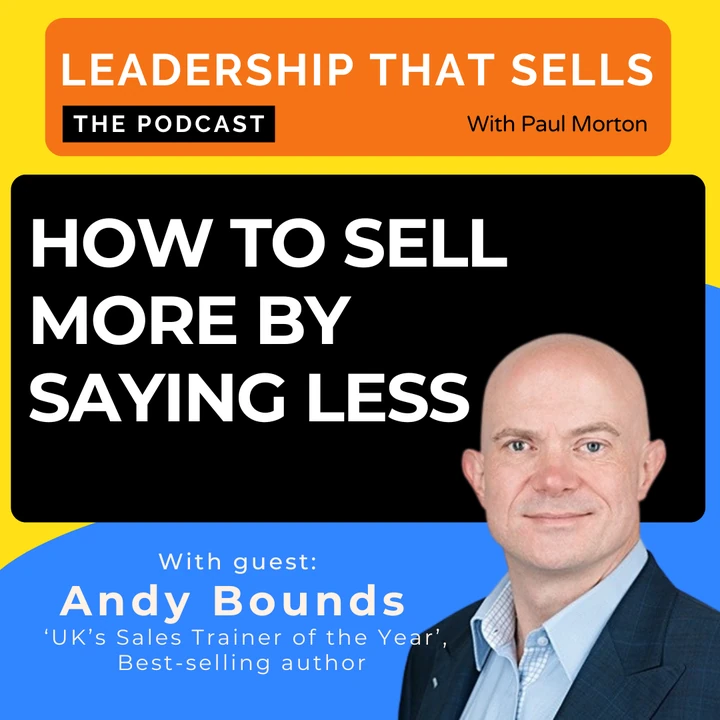
How to Sell More by Saying Less
with Andy Bounds
Show notes
Most sales leaders dread pipeline meetings – and their teams dread them even more. That’s because too often, they turn into boring history lessons nobody cares about. In this episode, I talk with Andy Bounds – award-winning sales trainer, bestselling author, and global keynote speaker – about how to make them short, sharp, and productive.
Andy shares his “Who Do” method to instantly focus sales conversations on what matters, the power of “Afters” in selling and leadership, and why great leaders under-communicate to empower their people. We dig into hiring, coaching, closing, and the art of making communication stick. If you want more sales, faster – without killing the will to live in your next meeting – this is the episode to steal ideas from.
How to run pipeline meetings your team will actually value
-
Replace “update” meetings with “Who Do” meetings: Who is the client, and what do you want them to do next?
-
Focus conversations on next actions and blockers, not history.
-
Sell “Afters” – why the client is better off after working with you – not just your product or service.
-
Under-communicate with capable teams to encourage ownership and problem-solving.
-
Use coaching prompts like “What three things have you thought of?” to build initiative.
Timeline
[01:33] – The “Who Do” method for instantly sharpening sales conversations
[03:40] – Why pipeline meetings fail and how to fix them
[07:18] – Selling “Afters” instead of product features
[10:53] – Start engaging, end with action: Andy’s 4-word rule for communication
[14:45] – Systems over goals for consistent sales behaviours
[19:03] – Under-communicating to empower capable people
[24:47] – The mindset and traits to hire for in sales leaders
[28:18] – The one interview question that reveals everything
[31:12] – Andy’s billboard message to every leader and salesperson
Links & resources
-
Andy Bounds’ website and Tuesday Tips: https://andybounds.com
-
The Jelly Effect by Andy Bounds – https://andybounds.com/resources/
If you enjoyed this episode, please rate, follow, share and review the podcast – it helps more leaders find us and lead first, sell more.
Transcript
Automated transcript. Speaker labels and spellings may contain errors.
Paul
[upbeat music] An award-winning sales trainer, bestselling author, and global keynote speaker, he's helped companies unlock billions in extra revenue by transforming how they communicate and how they sell. With clients in 50 countries and three hit books, his tips are trusted by everyone from Fortune 500s to solo salespeople. I have learned an awful lot of, from this man over the years, so you're gonna love meeting him in just a second. Welcome to Leadership That Sells. This is a show where we decode what great sales leadership actually looks like. If you are leading a sales team of managers and wondering why things still feel a bit misaligned, it might not be them. It might be the model that they're following. And that's because most sales teams today are not actually teams at all. They're what we can call teams in parallel. That's reps who do similar work, but independently. And what we've built is a lightweight reset to help your managers lead them the right way, and that's using clarity, identity, and autonomy.
And if that sounds like your world, grab the free Parallel Team Playbook at the Practical Leadership Academy website. It's short, sharp, made for senior sales leaders and CROs like you. Andy Bounds, thank you very much indeed for joining me today.
Andy Bounds
No, it's great to be here, Paul.
Paul
Now, you've got one core message, which I absolutely adore, which is more sales faster. That's it.
Andy Bounds
Mm-hmm.
Paul
Right? Straight to the point. What is, in your opinion, the one thing that sales managers can do today, or sales leaders can do today to unlock that?
Andy Bounds
Uh, well, there's lots of things, but one thing really important is to focus on the who do. And what I mean by that, very simply, is when a sales manager is talking to one of their colleagues about a deal they're working on, they often say, "Tell me how we're doing with the deal." And what happens is a long, probably boring history book where you say, "Well, this happened. And there was a challenge because, and this and this and this and this." And the simplest thing to do always is just say, "Who do?" Say, "Before you tell me any background at all, all I want to know is who at the client do you want to do what next?" So that's just who do. So for example, if I was briefing you on how I was going with a particular deal at the minute, um, if you say to me, "Andy, what's the who do?" And I would say, "Okay, the who is there's a lady called Jemima, and what I want her to do is to reply to my emails because she isn't doing."
Paul
[laughs]
Andy Bounds
Right? There you go. And that's it. And then after that you might say, "Do you want to give me some background on the deal, or should we just talk about the who do?" And that's the thing that I find that people just do not do. What they do is too many of the meetings they have are history focused.
Paul
Yeah.
Andy Bounds
They're boring. They have information that nobody cares about. As you say-
Paul
Yeah
Andy Bounds
... it's not really a team, it's a load of individuals. Then I might be in a meeting listening to five other people doing this to us about their deals, while I don't care. But if someone says, "What's the who do?" And we say, "How do we get Jemima to reply to the email?" We can have a nice little conversation about that.
Paul
Collective intelligence.
Andy Bounds
So there you go. Simple, isn't it? Better. That.
Paul
Collective intelligence. That's the bunny, right?
Andy Bounds
Yeah.
Paul
I think that's the, that's my, my biggest ever learning about, um, these pipeline calls, these, these sales meeting things that everybody bloody hates. And you get your, you know, your four minutes in the sun, or rather you get your four minutes with a blowtorch to your nadgers.
Andy Bounds
Mm-hmm.
Paul
And some of your, some of you are being asked, "Where's that deal? Is it coming in now?" And then you're saying, "Well, actually, you know, Jemima's a lovely woman, but she really doesn't get to the point. And what she really..." Ah.
Andy Bounds
Reduce what you want to say and simple it.
Paul
And then you get your pals to chime in, and your pals all chime in and say, "Well, have you thought about, what about, how could you, well I've done this before and that." And all of a sudden, everybody, you lift all the boats-
Andy Bounds
Mm-hmm
Paul
... just by answering those, those, those questions in the moment. Um, it's ... I think though, as a sales leader, it's really hard to recognize your sales people as individuals because you as the leader are the only one who actually thinks they're a team. Because you need them to be a team.
Andy Bounds
Mm-hmm.
Paul
Because they're your team.
Andy Bounds
Yeah.
Paul
'Cause if they don't perform, you don't get your target. And you're the only one with a collective target. So you're saying, "Well, you need to hit my collective target." And they're individually going, "I could give two rats about your collective target."
Andy Bounds
Yeah.
Paul
"No, I'm hitting my boat, thank you very much. Not yours."
Andy Bounds
Yeah.
Paul
Um.
Andy Bounds
Yeah. It's a nice way to look at it. I mean, my childishly simple way of doing it is if you're a sales manager and you had a team of golfers, um, you've say got 10 golfers and they're playing 10 different golf courses on their own. So they're not on the same golf course, they're not in competition with each other. It's really how each golfer can do. So your job is to realize that it's not a team. Golf is an individual sport, so the individuals need the extra help. They need a bit of camaraderie. They need to know they're in it together. But ultimately, they each have to play on their own course and be brilliant. So your job is to manage 10, 10 golfers on different courses. It's not like the Ryder Cup where we're all in it together.
Paul
And, and you've got to give them the right clubs.
Andy Bounds
Yeah.
Paul
You've got to make sure their balls are clean. You've got to make sure that all those good things are in the right place. It's not too windy for them. If it is too windy, well, you've got to hit into the wind, you know, kind of curve. All that sort of good coaching in the moment.
Andy Bounds
Mm-hmm.
Paul
That's the stuff. That's the gig. I love it. And most people, I think, think of it as football or any other team sport of your choice-
Andy Bounds
Mm
Paul
... where everybody's different and trying to work together, and that just, it just hammers people. I mean, I don't know how many hours are wasted in these pipeline meetings where the sales leader or somebody is just asking the most god-awful questions.
Andy Bounds
Yeah. It's like actually when we're in like, I mean, uh, so we do lots of training and conference speaking, as you said in the introduction. But I do lots of coaching of leaders, and one of the things that we talk about is next time you have a pipeline meeting, maybe don't call it a pipeline meeting, call it a who do meeting. Eh? And then you say to someone, "Right, I want to know about this deal, and all I want to know is what's your who do and what's your blocker?" So who do you wanna, wanna, who do you wanna do what? And what's the blocker? Why aren't they buying? They're the only two things. Don't tell me even what the name of the company is. I don't care. I just wanna know who do in the blocker, and we'll chat about it. And it's interesting, pipeline meetings instantly trigger boredom. There's lots of things in work trigger boredom. It's like if you get invited to a meeting called updates, like already you know it's boring.
Paul
Oh, they're my favorite, Andy.
Andy Bounds
Yeah.
Paul
They're my favorites.
Andy Bounds
But then when you see them they're not. They're awful and you hate them and so does everyone. I mean, do you wake up in the morning going, "It's today"? I mean, nobody likes updates and pipeline review catch up. It's like when, as a salesperson, you open your slide says, "We're founded in 1922," and wonder why everyone just drifts into tears or stuff. And you go, "No, it's just the capital all down."
Paul
Yeah. I love it. I've only got 47 slides on the history of our founder and when he first teemed. That's, uh, that's magnificent. Magnificent.
Andy Bounds
It gives you a career, so it's fine.
Paul
Yeah. That's the thing. It go- keeps you going, but it keeps us off the streets and that. Now, when these poor sods then get out and they end up, ending up sitting in front of, um, the... No, hang on. I'm gonna ask you this in a minute. The, I loved... I was in one of your sessions quite a while ago, and one of the, the core, it's one of the core things that I tell salespeople, even fairly senior people, is you try and you, you start off with what they're actually selling and what their job is. Go, you pair back. It's like psycho- it's like, um, psychoanalysis. What is it you actually do? Well, yeah, sell things. Okay. What is it you sell? I sell, I sell socks. And how do you sell them? Well, they're the, the best socks. You know, they're knitted from the finest alpaca wool. They're by, by, uh, virginal, um, sock knitters in the high Alps, and they do all this, and they're the brightest colors.
Aye, okay. Then what happens? Well, well, they're, they're really good s- Oh, for goodness sake. And your word is the afters.
Andy Bounds
Mm.
Paul
And that's so simple.
Andy Bounds
Yes.
Paul
They're such a simple thing to get out of there. But there's so many people, you have a team of maybe 10 salespeople or even sale- sales leaders.
Andy Bounds
Mm-hmm.
Paul
I always swear at least half of them are going, "Right. So I should be selling what it does, not what it is." And I said, "Hmm."
Andy Bounds
Yeah. It, I mean, is it, you know, they're right. This, this word afters, I mean, I mean, is, if anyone listening hasn't heard me before, if you have heard me before, you've heard me say the word afters 'cause I bang on about it all the time. But what I mean by afters is why the client is better off after you. So you say, um, you might go to see a lawyer and the lawyer tells you how good she is at law and how qualified she is at law and how many years she's been doing law and what her track record is. You don't want any of that. But after seeing her, you're hoping not to go into jail. Yeah. So you go home, the lawyer is no jail time is what you want. You go and see the tax accountant, but after the tax accountant, hopefully you're not paying as much tax. And nobody suddenly or wants you or me, but after us, hopefully their sales go up. So that's this idea that nobody wants you, they want the afters of you.
Now, when people hear it, as you say, they often go, "Eh, yeah, fair enough." And they go, "Yeah, I get the logic." And then I say, "Do you, though?" And they go, "Well, the logic's obvious, so clearly I do." And you go, "Right. Have a look at your most recent proposal. Was it called Our Proposal, or was it called Our Proposal Confirming How We'll Help You Export Into Belgium?" So do you have afters in the title? If you do a presentation, is it called Credentials Presentation or is it called How We'll Help You Export Into Belgium? When you have a meeting, is it called Updates or Catch Up, or is it called Meeting to Agree the Best Ways Into Belgium? And everyone goes, "Oh, wow, we don't do it like that." I say, "But that's the only..." They start.
What's... Start.
Paul
Yeah.
Andy Bounds
Start now. Start now.
Paul
Oh, it's not, no, no. I, I mean, you, you built that into the whole, um, the best way of writing your, your proposals thing.
Andy Bounds
Mm.
Paul
And again, that's why I'm, I'm just coming out with this, this, this, it's foundational stuff. It really is. But it's beautifully foundational, and there's a reason that the, the, the basics are magic. It's because if you get them right, I think most people spend... Most people think that they're, they're like the, the GB cycling squad, and they have to dust off their, their spokes before they get onto their bicycle. I said, "No, mate, you have to actually learn how to pedal first." Right? If you cannae pedal, you're really not going to get very far. [laughs] And it, and it's the, this, the idea that your proposal should be confirming something in a structure where you've got, it's saving you £1 billion and it's only gonna cost you a million. You know, that sort of, that foundational practices.
So I can highly, highly recommend you go to Andy's website. It's andybounds.com, I believe. And you'll find a whole ton of resources on his w- into website, and all of this stuff is there. It's brilliant, brilliant, brilliant material.
Andy Bounds
Thank you.
Paul
You got a book called The Jelly Effect, and it's all about communication.
Andy Bounds
Right.
Paul
And you write there that people remember what you say after you've left the room.
Andy Bounds
Right.
Paul
What you say after you've left the room. How do you get people to do that? And it's, you know, about m- the emotional connection, this, uh, making them feel in a certain way. How can a sales leader, for example, use that idea to lead more effectively?
Andy Bounds
Right. That's a great question. So any communication you do whatsoever, but let's use the example of a sales leader talking to their team of golfers. Um, any communication you do, the, there's four words that matter. Two of them are start and end. So you need to start well. Another word for start is first impressions. Your opening sentence has gotta be good. I mean, I have seen sale leaders start their weekly pipeline meeting with, "Okay, everyone, I hate these too, but we need to get through it." Well, that probably is not gonna get people saying, "Please say sentence two, esteemed leader." So we need a good start, and we need to end with action. So the four words are start engaging. So you need to start in an engaging way. So one thing I always say to sales leaders is make sure you got your opening sentence that's good. Yeah? And then you need to end with action. So the four words are start, engage, end, actions.
Any communication, start, engage, end, actions. If I want one of my kids to go to bed, I start engaging. I don't say, "It's time for bed," they don't wanna go to bed. So I start engaging, say, "It's nearly time for your favorite story," so it's all exciting. And then I can do the action, so put your pajamas on, get in bed, and I'll read you two chapters. So you start engaging and you end with a call to action. It's the same thing with a proposal. Page one says, "Here's how I'll help you get into Belgium." And the final page is the action, sign page three that we can get going So as a sales leader, when you're talking to your team, start in an engaging way. So for example, if you have weekly regular meetings, maybe use the word difference and say, "Morning, team. I thought we'd try something different this week." They go, "Really? Now, gosh, what's different now?" Yeah, that's right. Like, what is it? Yeah.
And you might even go, "And I think we might be facing 50 minutes today instead of the usual 60." People are really listening now. "Holy moly, pencil, please." Best meeting ever. Um, but you have to end with actions. Uh, and the rule I have with any meeting at all, and certainly sales leaders with your one-to-one meetings and your team meetings and your one-to-one meetings, the number of actions you want you and your colleague to do are this. Three words, more than none. [laughs] That's it, just more than none. I say this to all of my sales teams. How many referrals do you each and ask for every week? And they say, "Oh, well, we're busy," and we try and... Just ask for more than none.
Paul
More than none.
Andy Bounds
More than none. There's 10 of you. If you ask for more than 12, more than none each, that's the least you've asked for 10, which means over the year you've asked for 500, and you'll probably be fine. Just do more than none.
Paul
It's, I think it's the idea you, everybody wants to be... It's the problem with goals. Philosophical thing-ish, right? There's the idea if you've got goals, you've got systems.
Andy Bounds
Mm-hmm.
Paul
And I think we're both on the systems, uh, angle. 'Cause, you know, let's say you wanna go off and you wanna lose 10 pounds. The minute you say, "Right, I'm gonna lose 10 pounds this year"-
Andy Bounds
Uh-huh
Paul
... now, the best way of doing that is opening your wallet and letting somebody take it. 'Cause quite frankly, the minute, the minute you say, "I wanna lose 10 pounds," you're a failure.
Andy Bounds
Mm-hmm.
Paul
'Cause you haven't lost 10 pounds. But-
Andy Bounds
Well-
Paul
... more often you say, "I'm gonna hit, every time I talk to somebody, I'm gonna say, 'I want to ask for more than none.'"
Andy Bounds
Yeah.
Paul
Right?
Andy Bounds
Just more than none.
Paul
Do something.
Andy Bounds
Yeah. Yeah. I always... I mean, I like the idea of systems. So, and, and my wife says a good thing. So my wife is somebody who naturally always makes the right decision about food. Sometimes I need to just think about it for about 10 minutes before I decide what food. So some people naturally do it without thinking, those irritating people.
Paul
Mm-hmm.
Andy Bounds
And salespeople are. Some salespeople irritatingly always ask good questions, and they always close it really well. They just irritatingly do. So there are these immortals who do things this way. But most of us aren't like that. Most of us are mortals, so we have to think what the system's gonna be. So if I ask for referrals, um, I need to do things like this. Number one, I have to know what sentence I'm going to say to ask for referrals, so I need to work on that. Number two, I'm gonna need to put time in my Outlook calendar to dictate time that I'm gonna spend, 'cause if I don't do that, I'll get to the end of the week and say, "Well, I don't have time. I won't put it in my calendar." So it's things like create your script, put some time in your calendar. Maybe you just need to your PA or a colleague to, hey, say, "Check with me on Friday to make sure I've done it." You sort of need... And you get these building blocks in. So I agree that individual systems are important.
As far as the goals go, I'm, I don't think it's a binary have systems or goals. You can do both.
Paul
No.
Andy Bounds
The thing I think with goals is I don't, I'm not somebody who likes specific goals personally, but I want to know a general sense of direction. I mean, there's a book by a guy-
Paul
That, that's it. That's it
Andy Bounds
... yeah, absolutely. Guy, there's a book by a guy called David Campbell, and the book, it's a great title. It says something like, "If you don't know where you're going, you'll probably end up somewhere else."
Paul
Yeah. [laughs] That is very true.
Andy Bounds
I mean, the title's as good as the book, actually.
Paul
It is.
Andy Bounds
So true, right? If you don't know where you're going, you'll end up somewhere else, which goes back to my who, do thing.
Paul
Yeah.
Andy Bounds
So if you don't know what you're doing, if you don't know what you want Jemima to do, she's probably not gonna do it.
Paul
Sh- well, odds are y- if you don't know what she wants you want her to do, neither does she. She doesn't know what you want her to do, right?
Andy Bounds
Mm.
Paul
And I would say 90% of the people I've ever sold anything to have no clue how to buy things. Not the first scooby, because their job isn't to do that. Our job is to, is, is it's not actually to sell things, I think. Our job is to help people buy stuff.
Andy Bounds
Yeah.
Paul
Because you kind of have to walk in their shoes and get them to do what they need to do in their mad context of their business.
Andy Bounds
Yeah. I, I, I love that idea about helping them buy. Um, it's, it's, I mean, when, when I've been working with our customers and you always say, "What's your favorite closing line, and how do you close things off, and how do you make it easy for them to buy?" Um, and over the years, there's two things I find work really well. So, I mean, I don't know if this helps people listening, but, um, so the penultimate closing question is, "This all seems fine to me. Does it to you, or do you have any final concerns?" So I love that. So what happens, if you've got any final concerns, they'll say yes or no. If they don't have any concerns, happy days. If they do have concerns, that's called objection handling. You go, "Oh, I'm glad you told me. What are they?" And then you can just deal with it. So you get rid of objections that way with that penultimate question. And then your final thing is, if they're interested, just as you say, they're not used to buying from you, they're not used to making some buying decisions, so you simplify it.
And I just use words like easy and only, and I say, "Well, that's great. In that case, the next steps are easy, and there's only three things we need to do." Bang, bang, bang. And you almost see the customer go, "Oh, that sounds quite nice." So again, as a sales leader, a really good question to ask your team is, word for word, what's your favorite closing sentence?
Paul
Mm-hmm. Mm-hmm.
Andy Bounds
And you'd be amazed how often they go, "No."
Paul
The, my, I had a phenomenal sales manager when I was, when I took on my first team. And, uh, he said that my workload, my workload would double when I first took on managing a sales team from being an individual bod. And he was wrong, actually. It tripled.
Andy Bounds
Yeah.
Paul
Um, but he, he drilled us all collectively. Drilled us. Drilled. He'd just pull people. It's like he'd walk into the room and say, he was French, and you know, you have to go do the French accent. "You, Paul, come with me. I will punish you today."
Andy Bounds
Right.
Paul
And then he'd go, "What is your pitch? Pitch to me. Pitch to me you." Just, and you'd make something up on the spot, and you'd have to pitch to him. "Close me. Close me down." You know, he'd just make you do it again and again and again. And his concept, uh, I, well, learned later, I think he got it either from Seneca or Tacticus, which was that, um, drill should be bloodless battle, and battle should be bloodied drill. Right. So you do the, the drill is, is hard, if not harder than the real gig.
Andy Bounds
Mm.
Paul
And then, but there's no blood, you know? [laughs]
Andy Bounds
[laughs]
Paul
And thankfully, you know, in, in enterprise sales, there typically isn't that much blood. Although I've had a few moments.
Andy Bounds
[laughs]
Paul
Fantastic. Right. When you then think of this, this jelly effect, you've got jelly mistakes. Is there a jelly mistake that leaders typically make when they're talking to their teams?
Andy Bounds
Um, yeah, I mean, there's a few. But the, the reason I call it the jelly effect is because how most people communicate, whether it's leaders to their teams or teams to their customers, is they basically have a bucket. They fill it with jelly and they fling it at the customer and hope some of it sticks. I mean, obviously that's where you have a sales pitch that's first founded in 1922, and it is a map of our offices. You know, nobody cares. It's a black and white photo of our two dead founders. Like, nobody cares. But we're situated just above a gooey way smoking drunk, and nobody cares. And so what happens is people just throw loads of jelly at the person and hope it sticks. And the, the, the, the ethos behind the book is the best way you can satisfy the other person is find out what jelly they like and then just spoon-feed them the bit of jelly. Don't throw a book at them.
And you find this with sales leaders as well. Um, when they're talking, they often give too much information. They just do the worst and I'll sit down, shut up while I brief you. I'm not saying all leaders do this. I don't mean some of them are absolutely brilliant, but a thing all of us can do is we can over-communicate.
Paul
Mm.
Andy Bounds
And one of the things I feel is if you have a team who are very able and capable, if anything, you want to under-communicate. And so-
Paul
Mm
Andy Bounds
... it's almost like you've got a bit of a challenge with this. So what outcome do you want? I'll say what, let's do three and three. I'm gonna give you three minutes. I want you to think of three solutions to your challenge. I'll think of three solutions to your challenge, and then we'll come back in three minutes and we'll see what we think. And I love things like that. So, so often a, a team member will come to the leader and say, "How do I deal with this challenge?" And the leader thinks they're helping by saying, "Here is my wise answer."
Paul
Mm.
Andy Bounds
And yes, it does help. It also stifles their initiative. It's much better to say, "You need a challenge. Tell me three things you've thought of." And you go, "I haven't thought of three things." Right. Three minutes. Still waiting for three things. I'll see you in three minutes and we'll have a chat. 'Cause one of your jobs as a leader is to enable and to empower and make people better without you. If they carry on having to come back to you, that doesn't ... It just stifles them, I think. So another great things leaders can do is just anytime anyone comes up with a problem, you go, "Hmm, that sounds hard. What three things have you thought of?"
Paul
There are so many resonances, I think, between general, any sort of leadership frankly, but particularly sa- I love sales because it's such a microcosm of life.
Andy Bounds
Mm.
Paul
It reflects so much of how people interact, how you get around in the world, and particularly parenting. It's, I mean, you've got ki- I've got kids, and I'm watching them grow up, and I'm watching them learn how to navigate the social situations and get things done and get other people to do things with, for, and around them.
Andy Bounds
Mm.
Paul
And the negotiation skills, the presentation, the communication, the influencing, the, the persuasion, all this sort of stuff. The one thing that my son in particular lacked is listening.
Andy Bounds
[laughs]
Paul
He has no listening skills.
Andy Bounds
Yes.
Paul
No listening. My daughter's very good. She's, she's better at it. She's 13.
Andy Bounds
Yeah.
Paul
My 11-year-old is, is, is, he's quite a thoughtful kid. You know, it's wonderful to see him be so thoughtful. But then he'll ask something, and he'll be looking out the window dancing while you're trying to answer it.
Andy Bounds
Fair.
Paul
But yes, so my, my, my take on the, the, um, the problem-solving thing is what are our options here? Our options, as in we'll, we will solve it together.
Andy Bounds
Yeah, yeah. Yeah.
Paul
But what, what, what can we do? It's, it's coaching.
Andy Bounds
Yeah.
Paul
It's a coaching conversation.
Andy Bounds
It is. And there's so many great coaching sentences. I love this, what three things have you thought of? I mean, 'cause I'm ... 'Cause the great, if you wanna change people's behaviors as a leader, you just relentlessly ask them the same thing all the time. So if you want-
Paul
Hook them in.
Andy Bounds
Yeah, that's right. If you want your team to ask for referrals, every time you see them, you say-
Paul
Ask for referrals
Andy Bounds
... "Have you asked for referrals since I last seen you?" And the 10th time you ask them, they'll probably go, "Ugh, no." And say, "Okay, well, I'll give you that one, but next time I see you, you might wanna be ready for it." And then, "Have you asked for a referral? Have you asked for a referral?" And after a bit people go, "Oh, no, Paul's coming down the corridor. He's gonna ask me about referrals in a minute." And so that's a very simple way to do it. And so one thing that I found works, what I do is for my coaching clients, anytime they say they've got a problem, I do the sentence I've just said to you. "Oof, that sounds hard. What three things have you thought of?" And they know I'm gonna say the question. So now what happens is they say, "I've got a challenge." And before you ask, these are the three things. That that's so great 'cause at least I have stimulated that they need to start thinking of things.
Eight other coaching things, we've all got our favorite coaching sentences. If you knew what to do, what would you do? That seems to work quite well. And do you think he's good at this sort of thing? Oh, that's interesting. So how do you think she would handle this then? All right, so why don't you just do that? And so you get so many limiting beliefs that your colleagues have, and just helping them come out of it is one of the most rewarding things we can do, aren't they?
Paul
Uh, that, I mean, I think, I mean, you just touched on something that I think is almost foundational here is the rewarding piece.
Andy Bounds
Mm.
Paul
Because for so many years, I had to lie and cheat and be enthusiastic when somebody closed something 'cause I could give two ... I really, what are-
Andy Bounds
Mm.
Paul
You know, I'm as good, fine, you know, one step closer to my bonus. Yay.
Andy Bounds
Mm.
Paul
But frankly, I don't care.
Andy Bounds
Yeah.
Paul
The thing that was, that really boiled my kettle and buttered my parsnips at the same time-
Andy Bounds
Fair
Paul
... was watching somebody get from A to A+ to B-
Andy Bounds
Mm
Paul
... to B+. Just moving along that line. And I think my conclusion at least is, 'cause I've seen a lot of different folk promoted into different aspects of leadership, even fairly senior levels, they don't really, they don't, they don't burn for that.
Andy Bounds
Mm.
Paul
And if you don't burn for the success of other people, you, I think are gonna struggle at some point because it's not your thing. But it's, the only thing out there. It's the only game in town for a lot of people. Well, I have to, I'm, I'm a grownup now. I have to move, I have to be a, a manager and a leader and a, an executive now, and I have to do ... But I hate people, a lot.
Andy Bounds
Mm.
Paul
I hate all of them, indiscriminately.
Andy Bounds
[laughs]
Paul
I'm gonna fire you and everybody who looks and smells like you. You know, it's, it's a, it's, it's a gig.
Andy Bounds
Mm.
Paul
So trying to, trying to, when you're picking people to promote, that's a thing as well. How would you choose someone from a group? What would, what would be your go-tos for picking somebody to be a good sales manager, sales leader?
Andy Bounds
So there are certain characteristics that I look for. So, um, one of the, um, you, um, you're hired based on attitude 'cause you can always train the skills later.
Paul
Training and skill.
Andy Bounds
So there's certain attitudinal stroke, traits I look for. Uh, one of them is, as you said, the, a desire for other people to succeed, even if it's selfish because it's reflecting glory for you, there has to be some desire for other people to succeed. That's really important. And I also want to see, um, optimism-
Paul
Mm
Andy Bounds
... um, proactivity-
Paul
Mm-hmm
Andy Bounds
... um, uh, willingness to learn, all those sorts of things. But it's interesting, things like optimism and proactivity, the sort of thing that you might not think of those words, but when you think about it, all the best leaders have that. Um, and one of the most rewarding things and useful things and valuable things that I've ever done for me ever is when I set up on my own, because when you're an employee, when I was an employee, the ultimate flag stops with you, ever. And when I was the employer, all of a sudden it does. And so I'm not saying everyone should go on their own. I'm not saying that at all. But I just found that that was really good for my own initiative, 'cause I had to show initiative and proactivity and positivity, and have to be the face of, "We'll get this sorted, don't worry." And so anyone who has that sort of vibe about them, self-starting, let's fix
this. And when we've interviewed people in the past, we've often, um, said things like, um, "If you were given this challenge, what would you do? Come up with three ideas as quickly as you can, and another." And so we'd just, like, test things like that. Another thing we would always do is one of our colleagues, um, so one of our PAs or whatever, would knock on the door with about five minutes to go of the interview, and say, "Really sorry to interrupt, but just, yeah, I've got another meeting in five minutes." Just let you know. And then this would be set up in advance, and then the PA would disappear. And then I'd say to the person I was interviewing, um, "Okay, you've got five minutes. Um, tell me anything you wanna tell me. Ask me anything you wanna ask me. Do anything you wanna do.
I'm not setting the agenda for the next five minutes. Go nuts." And we found that really interesting to see how people would respond to that. So some people are like, "Right, okay. Sit down. Shut up while I rant at you for five minutes." But the people we really liked will be, "Well, I've only got five minutes. What would be most useful to you, Andy? What do you wanna know? What do you wanna talk about?" And we just found that was a really good little question to ask.
Paul
That's really nice. That's nice. It's, I think when you've got an interview with someone, um, how you want to hear from them, but you also want to hear that they are a good questioner. Whether they're a salesperson or a sales leader or not, that they can ask good questions. They can, and listen to the answer.
Andy Bounds
Yeah. It, it is interesting, 'cause when you're doing things like interviewing, um, interviewing and selling are really similar things in my view. Um-
Paul
Discover it. It's discovering
Andy Bounds
... it is, absolutely. And, uh, something to say, um, child one who, uh, sorry, my oldest is like 28, and she was, uh, going into an interview, I remember a couple years ago, and she was saying, we were just talking about what questions she was gonna ask in the interview. And I said, "Well, if you think of the interview as a sales job, one of the most important questions always is to say have you got any concerns? You ask that before finding what the other person's objections are." Um, and so when she went into their interview, it was all going pretty well, and at the end they said, "Have you got any final questions for us?" And she said, "Yeah, I just wondered what you were currently thinking, and if you had any major reservations about hiring me." So they said to her, "Have you got any reservations about hiring me?" I thought, bloody hell, that's brave.
Um, but she said that have you got any reservations, then it stopped them in their tracks and they went, "Oh, that's a good question." And she said, "Well, do you mind me asking?" And they go, "No, no. It's a good question." And they said, "Well, I suppose the only reservation is your experience maybe." And so she was able to objection handle and say, "Well, thanks for your honesty. I actually don't think that's a problem. Do you mind if I explain why?" And she said when she started answering, they were just laughing, which, and she thought, "Oh, I've got this job." And it was just bec- and it's just the same thing. It's listening. It's selling. But I love that question of, what are your final concerns, or do you have any reservations, or are there any reasons that we can't do this?
'Cause the only answers are, "Yeah, I've got an objection. Let's deal with it."
Paul
Mm-hmm.
Andy Bounds
Or, "No, I'm fine. Crack on."
Paul
Magnificent. You have been a very busy man for many, many years, and for a long time you've been sending out this nice little Tuesday Tip.
Andy Bounds
Yep.
Paul
Um, and of course, you can see it on his website. Go down, go, go sign up, which is really good.
Andy Bounds
It's all free.
Paul
It's all free. There we go. Um, what is, is there one that has consistently got the biggest reaction?
Andy Bounds
Um, y- well, there's two that have got the biggest reaction, and then there's, um, yeah, okay, so here we go. So I'll tell you, I'll tell you the one that I'm most pleased with, then I'll tell you the other two.
Paul
Of course.
Andy Bounds
The one I'm most pleased with, I frequently get lots of feedback on the afters by people saying, "I've not thought of it like that. I always thought I was selling myself, but I'm selling what happens after me. Like, I'm not a lawyer. I'm someone who teaches people how to job." Like, I don't think I'm a consultant. I think my job is to help people make more sales faster. So I get lots of feedback around that one. But the two that we get the most open rates and the most email case is every year we do a Christmas quiz. [laughs]
Paul
[laughs]
Andy Bounds
It's got a pretty full on. Sorry, I'm sweating.
Paul
It is good.
Andy Bounds
Yeah. Well, thanks, but here I am sweating, covered in my searing insights, and nobody cares. Bang out a Christmas quiz and they're all over it. But our biggest open rate ever was one of my 2D tips was called something like, What We Can Learn About Communication From the Durex Sex Survey. And for some reason everyone seemed to open that. Don't know why.
Paul
[laughs] Fuck. And tell me, what are we learning from? [laughs]
Andy Bounds
Where do you start?
Paul
Oh, well, it, it's a family podcast. That's all.
Andy Bounds
I think that's right. We'll just leave it there. Yeah. Sorry everyone if that's not been expunged.
Paul
Uh, last one for you then. If you could take one message and you could smear it over a, a world's worth of billboards.
Andy Bounds
Mm-hmm.
Paul
10,000 billboards, north to south, worldwide. Your name was on it, what would it be?
Andy Bounds
Uh, sorry to redeem myself. It'd have to be afters in there somewhere. Um, it would be something like, "Nobody cares what you do. They care why they're better off after you've done it." Yeah. So if you sell, don't talk about your products and services, tell me why I'm better off after. I mean, you have to have products and services to prove I'll get the afters, but ultimately I want the afters. If you're a leader, your job isn't just to lead. Your job is to cause afters. In other words, you want to enable your team to hit their targets, get a recognition, look good, enjoy their job. I mean, I often think as an employer, one of my jobs is to give talented people the job of their dreams. You know, my job is not to be an employer. The afters are these wonderful people get the jobs of their dreams and they are enabled to do whatever they wanna do. So yeah, it's all about the afters. Nobody cares about you. They only care why they're better off after you. Beautiful message then.
Paul
Beautiful. 10,000 billboards. Nobody cares about afters. They only care about what happens after you've been.
Andy Bounds
There you go.
Paul
Love it. Andy Bounds, thank you very much indeed for joining me today.
Andy Bounds
You're welcome, Paul. Thank you. [upbeat music]