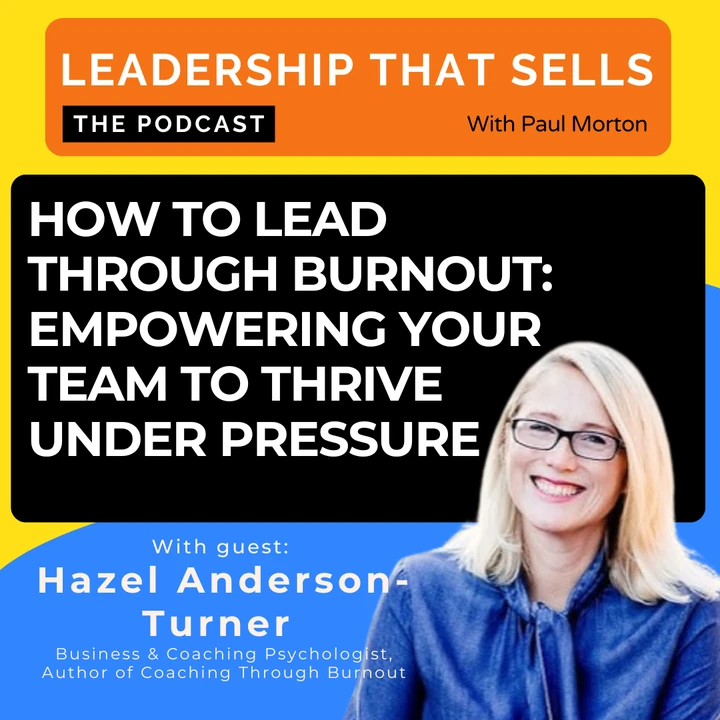
How to Lead Through Burnout: Empowering Your Team to Thrive Under Pressure
with Hazel Anderson-Turner
Faith at WorkShow notes
Most leaders think burnout is just “feeling tired” – but that’s like thinking frostbite is just “cold fingers”. In this conversation with Hazel Anderson Turner – business psychologist, mindset coach, and author of Coaching Through Burnout – we break down what burnout actually is, why leaders often miss it in themselves, and how to spot it early before it wipes out your team’s energy, performance, and trust.
Hazel draws on over 15 years of coaching leaders, including front-line NHS managers during the pandemic, to explain how chronic stress changes the way we think, act, and relate to others. We cover the subtle early-warning signs, why our coping mechanisms often accelerate burnout, and the conversations that build trust and resilience long before a crisis hits. If you want practical, human-centred ways to keep yourself and your team in the game – without sacrificing your sanity – this is the episode.
How to spot burnout early and protect your team’s resilience
-
Learn the three key burnout symptoms: exhaustion, cynicism, and reduced effectiveness.
-
Pay attention to disrupted sleep patterns, withdrawal from hobbies, and tech overuse.
-
Notice when you start pushing away activities and people that relieve stress.
-
Shift from directive management to coaching-style conversations.
-
Build trust early by asking “what’s most important to you?” and listening to the answer.
Timeline
[01:45] – The three signs of burnout every leader should know
[04:00] – How trying to “just work harder” makes burnout worse
[07:15] – Why leaders often don’t recognise burnout in themselves
[12:12] – The early-warning signals that mean it’s time to act
[20:55] – The team-level conversations that prevent burnout
[27:25] – Building trust before you need it: Hazel’s go-to question
[33:18] – Why the best managers listen more than they talk
[36:13] – Hazel’s billboard message to the world
Links & resources
-
Coaching Through Burnout by Hazel Anderson Turner – https://hazelandersonturner.co.uk/coaching-through-burnout/
-
Hazel’s podcast Coaching Unpacked – https://hazelandersonturner.co.uk/coaching-unpact/
If you enjoyed this episode, please rate, follow, share and review the podcast – it helps other leaders find us and lead first, sell more.
Transcript
Automated transcript. Speaker labels and spellings may contain errors.
Paul
[upbeat music] Today's guest is a business psychologist, mindset coach, and author dedicated to helping leaders navigate workplace stress and burnout. Co-host of the Coaching Unpacked podcast, she's spent over 15 years coaching individuals across the public sector, including key workers in the NHS during the COVID-19 pandemic. Her book, Coaching Through Burnout, gives a practical framework for leaders to support their teams while maintaining personal resilience. Welcome to Leadership That Sells. This is the show where we decode what great sales leadership really looks like. If you're leading a team of managers and wondering why things still feel misaligned, not quite working, it might not be them, it might be the model that you're following.
And that's because most sales teams today aren't teams at all. They're what we call teams in parallel. You've got some people doing similar work independently. We w- what we've done is we've built a lightweight reset to help your managers leading them in the right way using clarity, identity, and autonomy. And if that sounds like your world, grab the free Parallel Team Playbook at the Practical Leadership Academy website. It's short, sharp, and made for senior sales leaders, CROs, and folks with teams of managers just like you. Hazel Anderson Turner, thank you very much indeed for joining me.
Hazel Anderson-Turner
Oh, thank you for having me.
Paul
So you've got this wonderful book, Coaching Through Burnout. It is a powerful toolkit for leaders. What are some of the key strategies some of our sales managers can implement to avoid burnout in themselves and in their teams?
Hazel Anderson-Turner
Well, I think the first one is knowing what burnout is. So I think-
Paul
What is burnout?
Hazel Anderson-Turner
[laughs] Well, I think it's one of those, like, buzzwords, isn't it?
Paul
Mm-hmm.
Hazel Anderson-Turner
It's one of these things that is kind of... I don't know, people go, "Oh, I'm feeling a bit burnt out," and actually understanding what it is in reality, I think, is that first step. So burnout is the combination of exhaustion, a bit of cynicism and detachment, so we started to kind of distance ourself from our work, and, um, h- a sense of, like, ineffectiveness or feeling like you're failing. You're just not getting to stuff. So it's a combination of, of these three things, and it is about chronic stress.
Paul
Mm.
Hazel Anderson-Turner
So we all experience a bit of stress, don't we? And we know a little bit of stress is good for us.
Paul
Yeah.
Hazel Anderson-Turner
But this is about unhelpful stress that we just can't recover from, you know, day after day after day, week after week, month after month. It's, it's just stress that goes on for a very long, a long period, and leads to, leads to those three symptoms.
Paul
So you've got... I mean, just for the, the non-medical ones here, the two words that I think people don't really understand very well is the difference to, between acute and chronic.
Hazel Anderson-Turner
Mm.
Paul
So acute is not cute.
Hazel Anderson-Turner
Mm.
Paul
It is something that's short and sharp and happens occasionally. So it's that stress. It's the, you see your kid about to run into the road, and you go, "Ah!" And you leg it over there, and you grab them back. It happens in the second, in the moment, and doesn't last for very long. But chronic is the stuff that continues quite a while.
Hazel Anderson-Turner
Mm.
Paul
And I'm gonna... The, the example from, in my world is gonna be quarter end, month end, something like that. You get a day or two, three, 10, and then it's over.
Hazel Anderson-Turner
Yeah.
Paul
If, however, you're in a failing business, or something's going wrong, or there's a group of people that are causing you pain or whatever it is, and that just goes on and on, the challenge I think you have is, how do you see yourself clear enough to, to know that you need to dig yourself out?
Hazel Anderson-Turner
Yeah, and that is a massive problem, and I think that's why, for me, the first step is noticing and awareness.
Paul
Mm.
Hazel Anderson-Turner
So, so when I'm delivering sessions or, you know, talking about burnout, it, it is about raising awareness in people because often people come to talk to me because they wanna help their teams.
Paul
Mm-hmm.
Hazel Anderson-Turner
And I, I do a bit of a disclaimer at the start, and I say, [laughs] "I've had so many leaders who have come to me saying, 'I really wanna help my team prevent burnout.' I mean, I can see people starting to fall over." And then I start to go through the symptoms. I start to talk about, you know, what burnout is, and they have this sudden moment of, "Oh my God, like, I thought I was okay."
Paul
Mm-hmm.
Hazel Anderson-Turner
"But now I think about it, yes, my sleep is terrible. Yes, I have stopped doing the hobbies that I used to enjoy. Um, yeah, I really do feel like every day I'm just trying to get to the end of the day, and I'm just holding on [laughs] until my next holiday." And, and I think often it's through our interest in helping others that then we realize in ourselves, um... I think, you know, so, so I came to this work because I experienced burnout myself, and I... Yeah, I think-
Paul
It's so often the case, that. It's so often-
Hazel Anderson-Turner
Yeah, it is. [laughs]
Paul
If... I mean, it doesn't really matter what, what, what things, people who genuinely seek to serve and to, and who have success in doing so are trying to solve a problem for themselves.
Hazel Anderson-Turner
Yeah, and also I think there is this bit of the awareness that it gives you when you go through it yourself.
Paul
Mm.
Hazel Anderson-Turner
I think partic- particularly as a psychologist, I mean, I talk about how embarrassing it was for me. So I was a, a psychologist. I'd been a leader for many years, and you know, I didn't see it coming. And I, I think being able to take both my personal experience and then my academic background and the work that I was doing w- it enabled me that unique perspective, I think, to, to look at it and go, "Well, if that happened to me," [laughs]
Paul
Mm-hmm.
Hazel Anderson-Turner
"What can I, what can I take to help others-"
Paul
Yeah
Hazel Anderson-Turner
"... uh, in the future?" And you're right. There's definitely this motivation to go, "I don't want anyone else to go through what I went through."
Paul
Mm.
Hazel Anderson-Turner
"Is there a way that I can be of service?"
Paul
And the service thing, I mean, my, my ethos is, um, that it's fundamental, a Christian one, but it's, it's this idea of servant leadership.
Hazel Anderson-Turner
Mm-hmm.
Paul
And it's this thing that you're designed to do. You're meant to be of service, and if you are of s- if you're feeling down, go serve If you're feeling miserable, go help someone else. There's always some other poor bugger out there who's worse off than you are, right? Go help someone. Go do something to help serve someone else, and if you serve someone else, it's almost selfish.
Hazel Anderson-Turner
Mm-hmm.
Paul
It's beneficially selfless 'cause you're helping somebody, great.
Hazel Anderson-Turner
Mm-hmm.
Paul
But you're also, you get to go home at night, and as long as you're not bragging about it, you're sitting there going, "I did good today." Even if you don't think that, it's in your, it's in your, it's in your soul. You know?
Hazel Anderson-Turner
Yeah.
Paul
It's, it's, it's a good thing to do. The challenge, I think exactly as you named it, is you're going through this journey of thinking, "I'm gonna try and serve my team," but I haven't slept more than three hours a night for the last six months, and I've put on 50 kilos-
Hazel Anderson-Turner
Yeah
Paul
... and I'm eating cake by the gallon, and ... [laughs]
Hazel Anderson-Turner
Yeah, and I think as well, you can get into a place as a leader, I think when you're in that place, and, you know, with total compassion, um, you know, you're, you, you get to quite a selfish place because your mind becomes totally focused on your survival.
Paul
Mm-hmm.
Hazel Anderson-Turner
And so what often can happen is that you stop asking for help, or you get very much, like, in that fixer mindset of I can't afford to give it to anyone else on the team. I just need to get ... It's gonna get ... If, if I do it, it's gonna get done right, and I, I'm just gonna keep it all myself. It's really, really interesting that what the mind does when we're in a place of moving towards burnout is it actually uses some coping mechanisms that get us there quicker.
Paul
Hmm.
Hazel Anderson-Turner
So we, we kind of narrow our focus, and we're like, "If I just worked harder, if I just push myself a bit more, if I just rely on myself and I push other people away, um, then I'm gonna get through this." And the reality is that actually that gets you closer to, to a place of crisis with burnout.
Paul
I blame computers.
Hazel Anderson-Turner
[laughs]
Paul
Entirely. I genuinely do. I blame, I blame the fact that we spend so much time in front of screens and, um, immersed in the pain, and we surround ourself with the pain, and all we see is the pain. I have a great friend, James. He's a, he's an amazing mountain biker among many other things, and he says that when you're cycling down a hill, the last thing you do is look at where you're going. I said, "What?" And I've seen some of his GoPro videos, you know, going up and down and all over the place. I said, "How can you not look where you're going?" "No, you look past where you're going 'cause if you look at where you're gonna go, you're gonna hit it." And if all you're doing is focusing on the pain and focusing on the things that cause you the pain, that's what you're gonna get is more and more pain. I think when we used to go to the pub and we used to have time outside or we used to have to write letters or even send faxes, goodness me, or interoffice memos back in the 1950s,
it was slightly slower. And you had, there was, there were more things going on than just this immediacy, the focus on the pain. And you ... I think it's almost addict- it's almost addictive.
Hazel Anderson-Turner
Hmm.
Paul
There's probably an aspect of addiction in there as well. I'm not, I am no psychologist. I'm an amateur, but I've been dealing with salespeople and humans for a very long time, and I've got a rough idea. Addiction, I think, isn't the opposite of sobriety and health. I think addiction is the opposite of connection. And because we don't connect to other people who can point to us and say, "Go for a walk," or whatever your solution is gonna be-
Hazel Anderson-Turner
Hmm
Paul
... "Get out in the sun," you end up just focusing and focusing and focusing and narrowing in and, as exactly as you said, everything you're doing to try and solve the problem is making it worse.
Hazel Anderson-Turner
Hmm.
Paul
So anyway, that's my yellow crayon psychological textbook for the day.
Hazel Anderson-Turner
Yeah. And there's, I mean, there's definitely a link, isn't there, when you think about the, the dopamine and the adrenaline-
Paul
Mm-hmm
Hazel Anderson-Turner
... that you get from busyness.
Paul
Yeah.
Hazel Anderson-Turner
Um, and, and then we use-
Paul
Busy. Busyness. Yeah.
Hazel Anderson-Turner
Yeah. We, we use artificial stimulants as well, so we're using-
Paul
Mm
Hazel Anderson-Turner
... coffee and sugar as well to kind of keep us going and motivate us.
Paul
Mm-hmm.
Hazel Anderson-Turner
And so yeah, there's, there's definitely that, that we're definitely ... You get a bit of a buzz, don't you, from, you know, when you've worked really hard and you've been, been doing ... And I, I don't know. There's the, kind of the, um, the addiction as well to feeling like, um-
Paul
Important
Hazel Anderson-Turner
... I don't know, I'm, I'm worthy.
Paul
Important.
Hazel Anderson-Turner
Like I'm-
Paul
Special
Hazel Anderson-Turner
... yeah, I'm important.
Paul
Mm-hmm.
Hazel Anderson-Turner
I'm special. Yeah.
Paul
Yeah. I mean, I, I was made redundant, um, about five years ago, and, uh, I felt grief. I mean, I knew it was coming 'cause I was part of the process of making it happen, right? But, um, there's, there's an element of grief in there, and there's, there's this stopping of being important 'cause I was like a mini celebrity, senior exec flying all around the world. People go, "Oh, here's Paul. He's coming. Fabulous." It was like, "Okay then, let's go for dinner." And all of a sudden, bang, stops.
Hazel Anderson-Turner
Yeah.
Paul
You're not important anymore. But the realization of what was happening there doesn't come until a year or two later, and you go, "Ah, you were whacked off. You were mad. You were going insane. You were addicted to the busyness, the importance, the ti-
Hazel Anderson-Turner
Mm-hmm
Paul
... the, the status and all that sort of stuff, and not really getting much done."
Hazel Anderson-Turner
Hmm.
Paul
And you go back to the burnout, and I was at the very, very, the very edges of disillusionment and burnout and thinking I'd be, I, I can go through the motions and I'm doing the thing, but I really don't give two shits about this at all. [laughs] It was no longer fun, all that stuff. Um, and it was a very healthy thing for me to get, to get, to get canned, Paul, eventually. Very freeing, very liberating. If you're listening to this right now, Hazel's gonna take us through, I'm, I'm preempting for you, what are the three, four, five, whatever it is-
Hazel Anderson-Turner
Mm-hmm
Paul
... these are the things that if you tick the box, you should then do whatever it is she tells you to do next, okay? So listen. Hazel's about to speak 'cause I've been talking too long.
Hazel Anderson-Turner
So, uh, so I think the things to look out for for me, sleep is a massive one. So for some people it is struggling, uh, to get to sleep at night. For other people, like me, it's the 3:00 AM cortisol wake up. Um, so if you're noticing that that is becoming chronic, so that's happening a lot, then that's definitely a signal. Uh, if you're noticing that you are finding it very hard to put technology down, so if you're needing to distract yourself a lot, particularly outside of the workplace, then again, you've got a mind that is kind of looking for a distraction from some discomfort that it's feeling.
Paul
Mm-hmm.
Hazel Anderson-Turner
So that's something to look out for. Like I said, starting to push away the things that actually help you process stress, which again, is counterintuitive, but stopping doing exercise, um, stopping seeing friends. You know, feeling like, you know, I ... How can I go out, um, um, you know, go to my son's football match, um, and then, you know, do some socializing afterwards when I've got this project which is due in on Monday, and it is not worth the rubbish that I'm gonna feel or, or have to deal with on Monday if I don't just sit down and do it on Sunday? But it's noticing that again, that becomes a pattern. Um, it becomes the norm that you start to, um, limit the, uh, that kind of outside world stuff. Um, and-
Paul
The connection.
Hazel Anderson-Turner
Yeah.
Paul
You're limiting the connection.
Hazel Anderson-Turner
Yeah, and you're doing more just get it done-
Paul
On your own
Hazel Anderson-Turner
... um, stuff. Yeah.
Paul
Mm-hmm.
Hazel Anderson-Turner
Yeah, and I think that, that, that cynicism bit is really important. So again, that feeling of, "Ugh, I actually ... The organization doesn't care about me." Um, you know, in the NHS it's kind of like, "Oh, wouldn't it be great if there weren't any patients?"
Paul
[laughs] Yeah.
Hazel Anderson-Turner
So we ... Yeah, when we start to-
Paul
COVID-19, no patients.
Hazel Anderson-Turner
Yeah.
Paul
Brilliant.
Hazel Anderson-Turner
Yeah, and we just feel like we're going through the motions. So if you're sta- if you're starting to get really cynical and you've, you've lost the love-
Paul
Mm-hmm
Hazel Anderson-Turner
... um, again, that's something to look out for. Um, because this isn't just about exhaustion. This is about our relationship with our work and, and how, how it connects to what's important to us.
Paul
So there is, I think, the, the healthy side of cynicism is, is to temper it and call it pragmatism.
Hazel Anderson-Turner
Mm.
Paul
And I would, I would call myself a skeptical, pragmatic optimist.
Hazel Anderson-Turner
[laughs]
Paul
So, right? A skeptical, pragmatic optimist. So I think everything's gonna be great. I know that there's a plan. It's not mine. I know it's gonna be good. I wanna make sure that everything's, everything that can go well will go well. However, you know, trust but verify. Uh, and is this actually gonna work? How are we gonna make this work? Yes, that's very nice, but how is it actually gonna work?
Hazel Anderson-Turner
Mm.
Paul
So you've got the cynicism for pragmatism there. Um, I've got ... Cynicism is almost, is almost giving up.
Hazel Anderson-Turner
Mm.
Paul
It's, "This is a waste of time."
Hazel Anderson-Turner
Yeah.
Paul
"This is a waste of time." But the pragmatism is, "I can make it work if we just dial it down to the fundamentals and I understand my relationship with my work."
Hazel Anderson-Turner
Mm.
Paul
Not, not the people, but my relationship with my work, which is a, the, the organization.
Hazel Anderson-Turner
Yeah.
Paul
And the challenge, especially in something as big as the NHS, it's not a company, right? I work for companies, and NHS is an organization. In fact, the NHS in the UK is, is a quasi-religious institution. Okay? There are priests, there are high priests, and there are, there ... There are.
Hazel Anderson-Turner
Mm.
Paul
Really, there are. You know, you have the consultants are the high priests. Okay? You have the directors of whatever it is, and they are all the, the priestly class. Okay? And then you have the acolytes, and then you have us plebs wandering through in our, in our white gowns with our bums hanging out. So there, there's, there's that. Companies, and the word company comes from with bread, compan. People that I would break bread with. You don't break bread with 100,000 person institution organization like Cisco or Microsoft or the NHS. You don't know that. You know the people there. You might have a small subsection or a group that you can bond and gel with, but your relationship isn't with those people. Your relationship is with the organization, the institution, if it's that scale.
And the pragmatic relationship that I think is healthy is I will be as dedicated and as loyal to this organization as they would be to me. How long will I last when I don't need to last here anymore? Two minutes. Here's your ticket, out the door. Slightly less in the public, slightly ... It's a little different in the public sector-
Hazel Anderson-Turner
Mm
Paul
... but not that far removed. Okay? You don't sing from the right hymn sheet, gone. Okay? You're promoted to, you know, Ulster or something pleasant. Uh, I love Ulster, by the way.
Hazel Anderson-Turner
[laughs]
Paul
It's a great place. So there, there is that, that pragmatism, the, the pragmatic approach of, well, my relationship to m- the organization that I'm within. Um, just keeping it real.
Hazel Anderson-Turner
Yeah, and I think healthy, healthy perspective-
Paul
Healthy perspective.
Hazel Anderson-Turner
I think-
Paul
Healthy cynic- not, it's not cynicism-
Hazel Anderson-Turner
Yeah
Paul
... a healthy skepticism.
Hazel Anderson-Turner
Yeah, I think, you know, that, that is really important. So like we said earlier, you know, when your identity is too attached-
Paul
Mm
Hazel Anderson-Turner
... to the organization, when you've got too ... I don't know, when it's got into an unhealthy place of, you know, "I can't leave here. I absolutely need this."
Paul
"I'm essential."
Hazel Anderson-Turner
"I'm essential. I'm important." Um, that's, that's not healthy. And at the other end, it's not healthy to, to just be like, "I'm just coming in for the paycheck, and I'm ... You know, I've, I've lost my connection. I've lost my connection."
Paul
Phoning it in, the Americans would call it.
Hazel Anderson-Turner
Yeah.
Paul
They were phoning it in.
Hazel Anderson-Turner
Yeah. It's not... I- it's just, you know, we, again, you know, pragmatically we might be able to say, "Well, that is the transaction, isn't it? That, that is the transaction that I'm doing. I show up for work and they pay me money." The reality is that we are humans that have values. Um-
Paul
And purpose. We need-
Hazel Anderson-Turner
And purpose
Paul
... we need purpose
Hazel Anderson-Turner
And we need those things-
Paul
We need purpose
Hazel Anderson-Turner
... don't we?
Paul
Desperately.
Hazel Anderson-Turner
And I think, yeah, you can-
Paul
And identity
Hazel Anderson-Turner
... kid yourself, you can kid yourself that you can just be in it for the money. The reality is that you, there has to be something else that you're getting from it.
Paul
Mm-hmm.
Hazel Anderson-Turner
There has to be, you know, some other benefit. Um, because the more that you switch off, I think the more that you then move away, the more you become disengaged. Um, and it becomes harder and harder to motivate yourself.
Paul
The, there was a, what was his name? Daniel Pink, he wrote a book called Drive-
Hazel Anderson-Turner
Yeah
Paul
... The Surprising Truth About Things That Motivate Us. And he wrote the three things that motivate people i- in his opinion. It was autonomy, mastery, and purpose. Autonomy, y- you get left alone to do what it is you need to do yourself. Mastery, you get a chance to develop and grow and learn things. And purpose, you have to have a reason to get out of bed in the morning. And he said later, uh, about 10 or 15 years after he wrote the book, that he was slightly wrong. He thought that there was a capital P and a lowercase P. Capital P purpose, changing the world, doing good for humanity. Hard to get out of bed to change the world and do good for humanity. The lowercase P, the small P purpose, the whispered purpose, is what actually gets you out of bed, and that's not letting your colleagues down.
Hazel Anderson-Turner
Mm-hmm.
Paul
That's being there, being one of the team, identifying as flying the same flag as everyone else. Whether you're an independent in a parallel team of salespeople or teachers, or you're actually in a, in a collegiate dependent team who need each other to do the, to, to meet the goal. There's still the concept of a shared identity. What is it like to be part of this team? Who, who else, what are, what people, sorts of people are part of this team? You know?
Hazel Anderson-Turner
Mm-hmm.
Paul
Pe- don- not just people who dial in, not just people who c- who get away with it. Or-
Hazel Anderson-Turner
Yeah.
Paul
You've identified the, the characteristics of-
Hazel Anderson-Turner
Yes
Paul
... sleep, needing distraction, stopping these connections, these friends, exercises. There's the sense of cynicism here. Okay, so we've ticked all the boxes.
Hazel Anderson-Turner
Mm-hmm.
Paul
Uh-oh, I'm ticking all the boxes. Hazel, what do I do?
Hazel Anderson-Turner
[laughs] So obviously it depends where you're at. So I have to, I have to say that if you are really close to that point of burnout, then, you know, a, a professional, so a GP, whatever your, your source of going and getting support is. So, so my, the work that I do is about prevention. So generally I am talking to people that are getting those early warning signs. So if you were getting all of those and you're like, "Oh my gosh, this is really bad. I am," you know, a bit like you described, "I, I'm at this precipice," then going and getting professional help is really important. But there are absolutely things that you can do if you're starting to see those symptoms or, or, you know, you're, you're just getting a bit concerned about yourself.
Um, and in the book, so I divided it into three sections. So the first section is about, you know, what burnout is and, and sharing different stories around burnout. The middle section is about how you can k- help others through conversation. So there's types of conversations that are helpful, and mostly that is about getting away from a, a place of just being incredibly directive in your leadership style, to being much more, uh, coaching, conversational, asking really good questions and listening to the answers, and supporting individuals. You talked about autonomy, but supporting your team to identify what's in, within their control and to build their own self-efficacy, so their sense that they're able to improve their situation, and to work out collective solutions.
'Cause often burnout, it's not an individual thing, it is a team thing, it's an organizational thing, and so we need team and organizational solutions. So h- we need to get together. You know, all of us just head down trying to get through it, um, isn't gonna help us to get out of it. We have to talk about, okay, what is it about the demands we're facing that means that we're all really struggling at the moment? What additional resources might, might we need, or how could we work together differently in order to help each other from, um, you know, not falling over? So there, there are... It, it really is about the quality of our conversations, and I think what's really challenging is when time is really tight and we just feel like we're busy, busy, busy and working every hour,
convincing our mind that actually what a g- [laughs] a good thing to do is to stop, and let's start getting a bit curious and let's start asking ourselves some really good questions. A bit like you were saying about your cyclist friend. Let's take our eyesight away from just the immediate, gotta get that report out, gotta get that email out, to how are we gonna sustain this? How are we, you know, w- what can we do about the demands we're facing, about the resources that are available, in order to collectively find a way out of this, this situation that we found ourselves in? So that's the middle part of the book. And then the last part of the book is more for the, the leader themselves. So it looks at how understanding what's really important to you can be really helpful around preventing burnout and, and it goes, you know, into practical ways to do that.
It looks at the inner critic, because a lot of the time we keep ourselves in a place of, um, [sighs] I don't know, high stress because our mind is saying, "Come on, just put your big boy or girl pants on and, you know, just keep going," and we, we can be incredibly hard on ourselves. Um, and then- It also looks at something you talked about at the very start around pace, um, about pausing, around a how do we, how do we slow things down a little bit? Because again, when we're going really, really fast, generally we are not thinking well. We are not making good decisions, and it's finding ways that we can get some pause in, find some ways to notice what's going on, uh, to enable us to take control
of the stuff that actually w- is within our control. So that was a massive download. [laughs]
Paul
Beautiful. No, that, that's ... There you go. Problem solved.
Hazel Anderson-Turner
All in one book. [laughs]
Paul
All in one book. And the link to the book is in the description down here, Coaching, uh, Coaching for Burnout, right? So it's coaching to avoid getting burnt out through burnout, sorry. Coaching through burnout.
Hazel Anderson-Turner
Mm-hmm.
Paul
Okay. Now, the high-pressure environment, obviously you're working in, uh, healthcare-
Hazel Anderson-Turner
Mm-hmm
Paul
... helping, helping various different practitioners here. What would you think ... What's the best thing I can ask here? So there's, I think there's an aspect of communication and leadership here as well. So, and that's ... You need to, I think, build this up before you need it.
Hazel Anderson-Turner
Mm-hmm.
Paul
Ideally, you've spent the time building an environment where people have a bit of trust with each other. And it's very hard if you're coming into a ... I mean, one of the things I do is I help companies who are challenged, and, uh, you come in and everybody's at each other's throats, or they're, there's a lot of stress. There's people close to burnout there. I don't have the intel- I have the intellectual capacity, but not the emotional credibility with people to say, "It's okay to t- to tell us what's going on." Well, no, it's not. I'll get yelled at because the guy whose position you just took used to yell at me. He said, "I'm not that guy." So you've then got to spend the effort, the intellectual and the emotional energy, getting to a point where you can be trusted. And almost, a lot of the time, it happens because they no longer care.
Hazel Anderson-Turner
Mm-hmm.
Paul
And now you can catch them. You've got a cusp, a moment in time just before they s- they, they mention, they say what they're actually talking about, and then they shut up. 'Cause if they've shut up, they've gone past caring, right? So they no longer care what you think or what happens 'cause they know it's all going to crap and they're probably gonna get fired or th- th- everything's dying. Beyond that, they've given up and they're gonna, they've, they've already left mentally or they're on their way out the door. So you've got that moment in time that ideally you've started six months before, so you've got an environment, a comm- like a community that trusts each other there. So what would you suggest-
Hazel Anderson-Turner
Mm-hmm
Paul
... to manager, sales manager, somebody like that, who could support somebody who's struggling?
Hazel Anderson-Turner
Mm-hmm.
Paul
But then dial it back a wee bit. How would you ideally have done this before?
Hazel Anderson-Turner
So I think one of the best questions that you can ask in order to build trust really quickly is, "Tell me what's important to you." So-
Paul
Yeah
Hazel Anderson-Turner
... often leaders, understandably, we're asking questions about, you know, "Tell me about anything you're struggling with." We, y- we're very quick to get into the work, and that makes sense, and we want to be helpful. So we're kind of like, "Tell me what you're struggling with, and then we'll work out a plan." And they might even go into a coaching place where they're supporting that individual to develop their own skills. Brilliant. But if you want to build an emotional level of trust with someone, saying to them, you know, "What, what is most important to you? What, what are the bits that you're fearful about? What are you worried that, that might be the outcome of this?" What, getting into that language. So like I say, in, in the book we talk about values and, and this bit is really important because when we understand our values, we, we have a better idea of who we are separate from
the role we're playing at work, separate from whatever we're delivering. And when a leader says, you know, shows, "I'm interested in you beyond, beyond your role, be- beyond the output that you do for me," not just in a, oh, I know the name of your children or your dog or, or, you know, what activities you do.
Paul
That helps.
Hazel Anderson-Turner
Yeah. It does help. It also really helps when, when, when you're able to say to someone, you know, when something happens, you know, maybe someone's got a value of fairness. So they've said to you, you know, "Actually, do you know what? The thing that's really bugging me about this thing is that it's not fair." And so later something happens and you know, oh, this is gonna trigger this person's fairness thing. I know. So you walk into a meeting with them and you say, "Look, I know how important fairness is to you. This thing's happened over here. It's done for this reason. I know it's gonna be challenging for you because of that fairness aspect. So let's work through, you know, how, how you might navigate this, and how I can support you to do that." Honestly, that says to that person, you know, "I get you.
I get. I don't just, you know, if you, if you're upset about something or you're worrying about something, I understand why, and it's okay. It's because you're a person that cares about stuff, and I, I care about what you care about." So we're not always gonna agree. So my values, you know, I might not have a core value of fairness, but I've got a value of integrity. So let's, let's bring those two together and talk about how we can navigate this with those values. And we don't have to talk openly, and I guess that's why I s- I say the question is, "Look, tell me what feels important about this." Because we're not, I don't ... Sometimes it can sound a bit, I don't know, woo-woo or, you know, when you're t- going like, "Tell me what your values are." Um, but I think it just comes down to that, you know, tell me what you care about.
Tell me what, what bugs you about this. And, and getting into that, um, that humanness. And, and I think that's the safety bit.
Paul
Mm.
Hazel Anderson-Turner
You know? I think we've kind of, um, touched on that whole psychological safety. That's what we're trying to create, isn't it? When you said, "Oh, if you could only have come in six months earlier"-
Paul
Yeah
Hazel Anderson-Turner
... what the environment that you've wanted to create is one where someone feels safe to go, you know, "Hey, I'm not okay," or, "I'm really struggling with this," or, you know, "I need some help." A- and, and I think that conversation about the things that matter, that really matter-
Paul
Mm
Hazel Anderson-Turner
... is just so important to lay that foundation.
Paul
Beautiful. Beautiful. Um, the values thing, um, I think are vastly underrated. There's so many organizations that laminate them on a keychain or something like that.
Hazel Anderson-Turner
Mm.
Paul
And values are things that you value, that are valuable to you, that you would be hurt if they were taken away from you. Somebody steals your wallet, you're gonna be pissed off, you know?
Hazel Anderson-Turner
Mm.
Paul
And unless you're able to use them as a decision-making tool, you know, I have the decision ahead of me, I need to then look at my values and say, "Yes, no, yes, no, yes, no. Okay, let's do it." It doesn't line up. Unless you can use them as a decision-making tool, the decorative-
Hazel Anderson-Turner
Mm-hmm
Paul
... performance are. So the value things. "Tell me what's important to you" is wonderful. Tell me what's important to you. Tell me where you wanna be next. What's, what's, what's your next job look like? This is my thing for keeping high potentials, by the way.
Hazel Anderson-Turner
Uh-huh.
Paul
Even when you find somebody who you think might be a, a person to hang onto, where do you want to be next? What's your role after that? Okay, let's create a plan to get you there. What? Yeah, totally. It might be here, it might be somewhere else, but let's make sure that you get the experiences and the-
Hazel Anderson-Turner
Mm
Paul
... knowledge so that when you, it's time for you to go to your next job, you get it. You know?
Hazel Anderson-Turner
Yeah.
Paul
It shows them, show me you know me. Show me you, show me you know me. It's a sales thing, right? The, I, I-
Hazel Anderson-Turner
Mm
Paul
... the reason I love sales, 'cause it's a microcosm of life, is show me you know me. You actually understand somebody. You, you diagnose them. You've ... It's, it's, um, no prescription without diagnosis.
Hazel Anderson-Turner
Mm.
Paul
You should do this. Why? You don't know who I am.
Hazel Anderson-Turner
Yeah. And again, you know, that I think that's why the listening piece, and I imagine it must happen to sales managers. So like you say, there, there are skills that they have in a sales space-
Paul
Mm
Hazel Anderson-Turner
... around, you know, ask questions that are gonna get people talking about themselves and opening up to you, and then listen really well, and listen for the things that are important to them. And then, you know, use that to build rapport, and it's really fascinating, isn't it? 'Cause that's the same in, in lots of different industries. And then we go into management, and something weird happens because we believe that suddenly our role is to transmit.
Paul
Mm.
Hazel Anderson-Turner
That we have to be the expert, that it's about this amazing wisdom [laughs] that we're gonna be sharing with everyone else.
Paul
Mm.
Hazel Anderson-Turner
Whereas actual fact, the biggest skill that you can have is asking good questions and listening-
Paul
Yes
Hazel Anderson-Turner
... to the answers.
Paul
Yes, yes.
Hazel Anderson-Turner
Which is the skill that you had [laughs] in your previous role, and it's just fascinating, isn't it? There's the identity of a manager or leader, like, the i- the idea that we have in our head can be such a, a limiting factor on us really, you know, being good at that role.
Paul
It's the archetype of kings.
Hazel Anderson-Turner
Mm.
Paul
It's the archetype of kings. So this is an- conversation for an entirely separate episode, but it's the idea that I think ... It's, it's fathers and kings.
Hazel Anderson-Turner
Mm-hmm.
Paul
Okay? And we're all children and, and serfs. Uh, and the ... That's fine for the, the hierarchy of the relationship because actually that's just how humans tend to work. Um, there's o- there's, there's any s- any community over a certain size has a king or a chief or a judge or something. Um, but then you become the king, or a king or a prince or a, a lesser queen or whatever it is, and you think, "Oh, I have to act in a certain way that is now completely separate from everything that I've learned and done," and, and, and what in the hell are you doing? [laughs] You're spending all your time alienating and, and damaging all these wonderful relationships you'd spent all these years building up.
Hazel Anderson-Turner
But do you know what I did? My worst point-
Paul
Go on
Hazel Anderson-Turner
... as a leader, as a new leader, I, I actually said the old Cartman, um, like, "Respect my authority."
Paul
Oh, yes.
Hazel Anderson-Turner
I, I, I did that.
Paul
Yes.
Hazel Anderson-Turner
And, and, you know, after-
Paul
You win
Hazel Anderson-Turner
... I could hear him like ... Oh, I don't know if I can do his accent, you know-
Paul
Go on, go on
Hazel Anderson-Turner
... "Respect my authority."
Paul
[laughs]
Hazel Anderson-Turner
Um, but I could hear it in the back of my head. I knew in that moment-
Paul
"Hey, guys, I'm going home." [laughs]
Hazel Anderson-Turner
[laughs] Yeah, that's it. Better than mine.
Paul
Oh. [laughs]
Hazel Anderson-Turner
Um, but y- that, that suddenly realization like, oh, my gosh, who the hell have I become?
Paul
Uh-huh. That's magnificent.
Hazel Anderson-Turner
You know?
Paul
That's magnificent. Um, last word then. If you had, if I gave you 10,000 billboards and you had one message that you were going to share with the entire world, and they would see your name against it, what would the message be?
Hazel Anderson-Turner
[laughs] Um.
Paul
Doesn't have to be related to anything we've talked about.
Hazel Anderson-Turner
Oh, it doesn't?
Paul
No, no, no. What's important to ... What's important to you, Hazel?
Hazel Anderson-Turner
[laughs] Oh, God. Yeah, 'cause again, you know, if it was related to the topic, it would definitely be the, you know, ask a question and listen to the answer.
Paul
Mm-hmm.
Hazel Anderson-Turner
And I, I ... 'Cause often it is the simplest things, isn't it? Um-
Paul
Totally.
Hazel Anderson-Turner
Yeah. My, my general thing is, you know, don't be a dick, but, um, I don't know if that's appropriate. [laughs]
Paul
That's good as well. That is totally good.
Hazel Anderson-Turner
[laughs]
Paul
Yeah.
Hazel Anderson-Turner
I think we all just ... I mean, it would keep me out of a job, to be honest, but I think, yeah, there is that whole thing of y- yeah, just, just try and be a, a decent human, isn't it? I think it's so funny how, and again, said with compassion, how we get into these roles, like we said, and we, we try and squeeze ourselves into this thing of who we think we should be, and actually, um, yeah. I think maybe there's something about trusting, like trusting ourselves, um, because I think often we're, when we're acting in a role of what a manager or leader should be, that's because we don't have trust that we can find our own way, that we can do it in our own, in our own, you know, path of what that looks like.
That's a very, very long billboard, isn't it? Sorry. [laughs]
Paul
I think it's outstanding. I think you should stick with, "Don't be a dick."
Hazel Anderson-Turner
Yeah. [laughs]
Paul
It boils down. Hazel Anderson Turner, thank you so very much indeed for joining me.
Hazel Anderson-Turner
Thank you for having me. [upbeat music]