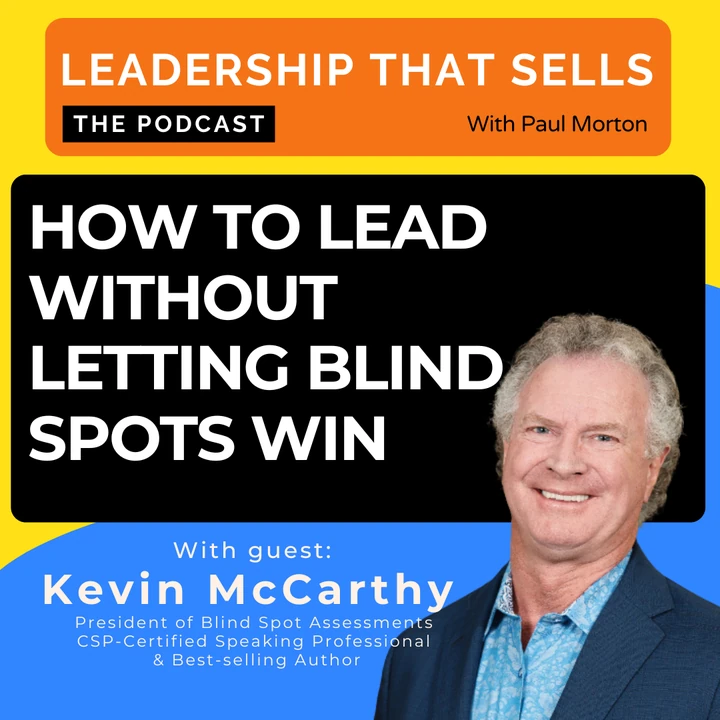
How to Lead Without Letting Blind Spots Win
with Kevin McCarthy
Show notes
Most leaders think their biggest threat is what they don’t know. The truth is, it’s what they don’t know they don’t know. In this conversation with Kevin McCarthy – bestselling author of Blind Spots, creator of the Blind Spot Assessment, and someone who went from leading a 54-person sales team to spending 33 months in federal prison – we unpack the unseen forces that drive our decisions and how to spot them before they wreck our careers.
Kevin shares how his own blind spots landed him in prison for a crime he didn’t knowingly commit, what prison taught him about perception versus reality, and how leaders can build stronger teams by owning their mistakes. We talk confirmation bias, triggers, the “expert fallacy”, and why curiosity is a leader’s best defence. If you want to make smarter decisions, build deeper trust, and lead with real connection, this one’s for you.
How to uncover blind spots and make better leadership decisions
-
Give trusted confidants permission to challenge your thinking.
-
Slow down and question your automatic “system 1” reactions.
-
Recognise and manage your own triggers before reacting.
-
Use curiosity to understand others’ perspectives, not just your own.
-
Model vulnerability so your team feels safe doing the same.
Timeline
[01:33] – How “kernels of truth” hid the largest stock fraud in Washington state
[06:56] – The moment Kevin learned the difference between moral and legal reality
[10:42] – Why confirmation bias is every leader’s Achilles heel
[13:05] – The “expert fallacy” and how seniority can make blind spots worse
[17:15] – The prison lesson that transformed Kevin’s leadership approach
[23:45] – Practical tips for spotting your own blind spots
[27:47] – How to help your team surface and share theirs
[33:36] – The one message Kevin would put on 10,000 billboards
Links & resources
-
Blind Spot Assessment: https://www.blindspotassessments.com/
-
Blind Spots by Kevin McCarthy: https://www.amazon.co.uk/BlindSpots-Good-People-Make-Choices/dp/0999103407
If you enjoyed this episode, please rate, follow, share and review the podcast – it helps more leaders find us and lead first, sell more.
Transcript
Automated transcript. Speaker labels and spellings may contain errors.
Paul
[upbeat music] A best-selling author, that's "Blind Spots: Why Good People Make Bad Choices," and certified speaking professional. He once led a 54-person sales team to record-breaking success before uncovering his greatest leadership lesson, spending 33 months in federal prison for a crime he didn't knowingly commit. Today, he's the creator of the Blind Spot Assessment, which is helping leaders around the world uncover hidden biases and make smarter decisions that drive real results. Welcome to Leadership That Sells. This is the podcast that helps you lead first, sell more. Great sales team need great leaders, but often sellers become managers without any training or support. That's why we built the Leadership That Sells playbook, and that shares just what leaders need and no more.
Two 30-minute live expert-led sessions a week over nine weeks with coaching clinics on top. Check it out, Practical Leadership Academy. Kevin McCarthy, thank you very much indeed for joining me.
Kevin McCarthy
Thank you, Paul. Thanks for having me on your broadcast today.
Paul
Absolute pleasure. Now, that was a very, very short thumbnail sketch of the magnificence that is you and your background and your history. So what did I miss?
Kevin McCarthy
[laughs] Well, let's see. How long do we have? [laughs]
Paul
29 and a half minutes, but you've got... We can get to the point. We'll be fine. [laughs]
Kevin McCarthy
[laughs] Sounds good.
Paul
Mm-hmm.
Kevin McCarthy
Yeah, so you, you definitely, uh, didn't bury the lead. Spent 33 months in a federal prison for a crime I didn't knowingly commit.
Paul
Mm-hmm.
Kevin McCarthy
Now, it's really important to clarify, I did commit the crime. I beca- I found out I was guilty. I just didn't know in the context of the moment that my boss was running the largest stock fraud in the history of the state of Washington in the US. And as the FBI put it, he was masterful at what they called kernels of truth stuffed with a lie. So during the context of this, uh, of this run that I had, and I'll give you a little bit more backdrop, but during the context, I saw red flags, and I started, I questioned, e- even some of the other guys I worked with, we questioned some of these red flags, but he had just enough surface material that when we did our, our investigating to make sure that what we were hearing seemed accurate, we were satisfied. But then in hindsight, looking back, I recognize that really we rationalized and we justified because we wanted this to be a real deal.
We, we wanted the company to go public. We, we, uh, we're tied to a lot of stock options and, and shares, so we wanted the, the success for our own greed and, and, and our own personal success. A lot of things were skewing the ideas. Uh, but just to give you a little backdrop, I had just sold a technology company during the craziness of that dot-com era, as you all remember, and I was li- literally at the top of my game. And then of course the bubble burst. Now, most of my stock that, uh, was given to me during the purchase, uh, was restricted stock. I was dumb enough to margin my, uh, my portfolio. [laughs] Uh, just young and dumb and, and financially illiterate, but I didn't realize the ramifications of margins, right?
And so when the bubble burst, of course Merrill Lynch wanted all their money back, and at that point I didn't have all their money, and so they sold off the portfolio. So long story short is I went from the top of my game back to starting over. And in that process of starting over, a friend of mine from church, uh, we were having coffee, and he basically shared with me an investment opportunity, uh, which somebody says, "Hey, I got an opportunity for you," you know, your, your skepticism should kick in. You might wanna have a little thought process going there. And mine did, and I asked, uh, to meet with the treasurer of this company who was local, and so I did. And again, long story short, asked just enough questions to satisfy my curiosity, and I wrote a check and became an investor in this company.
And the company was supposed to go public. Well, I had just come out of that arena of being at the top of my game on a public company. So all these thoughts were going through my head, and this was the context that allowed me to jump in headfirst. So I thought this is gonna be the, the, uh, uh, opportunity that was going to land me back on my feet, right? The next thing I know is I'm being asked by my buddy to contact the CEO because he had reached out and said, "Hey, I heard about Kevin's biz dev background, uh, business development, and so I'd like to talk to him about a short-term consulting opportunity to help me take the p- company public." I thought, "Well, that's in my wheelhouse." Now, honestly,
it was my own ego saying that 'cause it was way over my head. Um, I had never been that intricately involved in a public company. But nonetheless, we, uh, came to a meeting of the minds. I ca- became a consultant for this guy. You know, he had a company that was six b- six years in business. I was coming in at the last year of it, and it was supposed to be 30 days of consulting with him. It turns out I was working as a consultant for 15 months, uh, even running one of his divisions with the idea of handing it off to the publicly held company once they did their IPO. Never once did I see prison coming. And then flash forward now, as... And I'm skipping a lot of steps, Paul. You, as you know, uh, you mentioned the book, "Blind Spots," right? The entire story's in there, and, and my audiences always wanna know, it's like, "Well, what's the smoking gun? You said you're in it. You, you weren't innocent." It's like, it's all in there, smoking gun and everything.
So it's a real cliffhanger if you wanna turn all the chapters.
Paul
Available in books and on the link in the description.
Kevin McCarthy
[laughs] That's right. So I'd say I share that only to say that's why I'm skipping a lot of parts. But the, the essence was I ended up working for him for 15 months. FBI came, raided my house, raided the office, raided the off- uh, homes of, uh, 10 other men in the company. There was 35 employees at the time. And flash forward again, I ended up with a federal public defender All my assets were frozen, and, uh, and I had really nothing to hire a, a private attorney with. And so I, uh, of course, public defender scared me more than anything at that point. But in all fairness, uh, my attorney, Carol, at the Federal Public Defender's office, was a phenomenal attorney. She really did a great job. But it took about 30 days, Paul, for, for me and, for meeting with her, for me to understand that I had blind spots, because for those first 30 days, I was convinced, I want a trial by a jury of my peers.
I'm innocent. I did not know my boss was committing a crime. I even told her, I think I- I've seen enough Law & Order to know that you have to have intent to commit fraud. I had no intent. And she finally looked at me and she said, "Kevin, I, I think I finally understand why you and I don't see eye to eye. You're seeing this through a moral lens."
Paul
Mm.
Kevin McCarthy
"I'm seeing it through a legal lens." And see, that's the first time I really understood, Paul, that two people can witness the same exact event and yet have two very different understandings, understandings of what reality is, right? It's why we have problems with eyewitness accounts of crimes and accidents. So that was the moment that really opened my eyes, and I recognized that it didn't matter whether I knew I was committing a crime and h- and helping him out. My attorney called me an unwitting accomplice, but she said, "You still did what you did." Uh, the minute he put or asked me to put the letters in the mail to the investors telling them about the next PR event or whatever, he said, "You became an unwitting accomplice in his mail fraud." Right?
And so, uh, I, at that point, I owned it. I accepted a plea bargain. Uh, I ended up, uh, with a sentence of 48 months. I spent 33 months due to good time behavior calculations in the federal system here. And, uh, and then I had a little extra time off. I took a 500-hour cognitive behavioral therapy course that was meant for drug addicts and, uh, alcoholics.
Paul
Interesting.
Kevin McCarthy
I wasn't either, but I was able to get into that program on a loophole, and that was what really revolutionized my thinking process and un- understanding how these blind spots impact our decisions and how these blind spots impact our relationships. And so I began to dive into cognitive, uh, psychology, and that was just the beginning of my journey into a whole new arena. With came, coming out of prison thir- 33 months later with a passion to say, y- yeah. I mean, I'm, I feel like I'm smarter than the average bear, but I still have these blind spots that cause all kinds of ruckus in my life. So how can I help others understand their blind spots so that they can make better decisions and build better relationships?
Paul
Magnificent. And so you have a background. You've worked with, you, you, you, you spent some time in the, I, I think it was the, the Air Force you were in.
Kevin McCarthy
Mm-hmm.
Paul
You've been a salesperson. You've been a felon, which is an interesting career option.
Kevin McCarthy
[laughs]
Paul
Not one you would recommend, I'm sure.
Kevin McCarthy
No.
Paul
And then you come out of this as, uh, full of curiosity around the, the, the human operating system.
Kevin McCarthy
Mm-hmm.
Paul
How can you program the human operating system to do what it should be doing, uh, what it could be doing? Perhaps, uh, the blind spots are there for a reason sometimes, I think.
Kevin McCarthy
Mm.
Paul
But the, what it could be doing, how do you open people's eyes to these, especially-
Kevin McCarthy
Yeah
Paul
... in situations where they can cause you trouble?
Kevin McCarthy
Right.
Paul
Yeah. And-
Kevin McCarthy
Yeah, absolutely right. And, uh, and I, a- and I think a good catch on the terminology there, should be versus could be doing, right?
Paul
Yeah.
Kevin McCarthy
Um, w- we do have a lot of expectations of what, how our minds should work and how we should be making decisions, but the reality is, is that there's a lot more that goes into it than what meets the eye. Now, there's a lot of training that, uh, around this idea of unconscious bias, just for an example, right? Uh, confirmation bias, a big one that many of us suffer from on a-
Paul
Mm
Kevin McCarthy
... occasion in our lives, right? It's like, I want the... This is like I suffered from. I, I wanted the IPO to be real and to be true, and therefore it, that desire and that d- want so desperately to have this company go public kind of skewed me and allowed me, in my own unconscious way, to filter out information I didn't wanna know and to only hone in on the information I did wanna know, right? So that confirmation bias can, uh, can cause a lot of i- issues all by itself, uh, and that's just one of the types of blind spots. Uh, I, when I think in terms of blind spots, Paul, I think in terms of an overarching term that includes unconscious biases, includes thinking errors, limiting beliefs, basically everything that impacts how we process our reality.
I th- I, I think of it through this term, uh, uh, called worldview. Now, my definition of a worldview is this framework through which we perceive reality, interpret those perceptions, and then act on the, those interpretations.
Paul
Mm.
Kevin McCarthy
And our worldview, for each, each one of us, we have a very unique worldview. Nobody else can have our worldview 'cause it's made up, of course, of e- everything that's existed and happened in our life, uh, whether, you know, it's our childhood or our upbringing, our familial status, economic, economic status, whatever the, you know, our education or lack of or whatever. All these factors, our traumas, our successes, everything goes into how we see the world right now, right? You've heard, uh, perception is reality.
Paul
Yeah.
Kevin McCarthy
It's really not true. It's not true. Your perception, Paul, is your reality in the moment.
Paul
Yeah.
Kevin McCarthy
Right? And that's where we run into conflict. So as a sales leader or any leader of an organization, we all have our perceptions of how the organizat- organization should run, how we want it to run, how people should be performing, how we want them to be performing, but the reality is- ... is that people perform at different levels for different reasons at different times, and we have to take a step back from our should thinking, our internal beliefs, and step back and really understand what's going on. We have to really juxtapose our, our viewpoint into their viewpoint. You know, perspective-taking is what that is, right? Uh, and there's a lot of, lot of areas we can, we can touch on today in the, uh, the conversation if you wanna go there.
Um, but the, the essence is we all have blind spots. Now, side note, don't tell somebody they have blind spots. It won't go well for you. [laughs] But we all have them, right? And he, the biggest problem that I see, Paul, is, uh, especially the higher up we get in leadership, is we tend to think we have less blind spots because we're more seasoned.
Paul
Mm.
Kevin McCarthy
In reality, it's the other way around. If you think-
Paul
You're, you're crustier. You're more, you're more-
Kevin McCarthy
Yeah. [laughs]
Paul
... layered and layers and layers of experience, which makes it harder.
Kevin McCarthy
Yeah. Yeah, yeah, we build those, and, and I call it the expert fallacy 'cause we-
Paul
Yeah
Kevin McCarthy
... we think we're doing better, we think we're more mature, we think we make better decisions, but in reality, we create more blind spots because of the framework that we see the world. Now, give you a great case in point. I was working with the head of the internal audit department for a major university here in the South, in the US, and she made a comment. She goes, "Kevin, I've been doing this long enough to know that everybody's guilty of something." Well, first of all, that's cynical, but second, [laughs] it's that expert fallacy. She's been doing it long enough to know, right? I- if, if you wanna counteract that, I think the best way to start doing that is to recognize that, hey, I've heard it said jokingly, but take it serious, I mean, the older I get seems like the, the less I really know.
Paul
Mm-hmm.
Kevin McCarthy
That'd be the opposite of that.
Paul
Yeah. No, the... Yeah, the, the... I think the... There's a couple of things here. There's, um, you mentioned you heard, you heard a guy at church and there's a line from Matthew. It's, um, "Unless you change and become like little children, you'll never get to heaven." Right?
Kevin McCarthy
Right.
Paul
So you've got to have this curiosity, this innocence, this humility of the child which, uh, which, who is beautifully enough surprised by the rain.
Kevin McCarthy
Yeah.
Paul
You look outside and say, "Rain? There's water coming from the sky? That's so cool."
Kevin McCarthy
[laughs]
Paul
I ... We got a kitten recently, and the kitten went outside for the first time, and it was, it was like, "Wow, this is, this is grass stuff going on here. It's, like, weird." And you just saw even in the, the, the shape and the face and the actions of the animal, it was like, "Huh?" This curiosity, this eternal openness to experience-
Kevin McCarthy
Mm-hmm
Paul
... I think, um, this... But at the same time, um, with the, what's the line from Reagan? Tr- ch- trust but verify.
Kevin McCarthy
But verify, yeah.
Paul
Trust but verify. 'Cause you've then, you've got the idea that do you take the world as it is or do you take the world as you think it should be?
Kevin McCarthy
Mm-hmm.
Paul
Do you, "I see you act in a certain way. This is because this is how you act, but it's wrong. You should be doing something different, so I'm going to bend you, bend your will to my will." Or w- is this the, an i- an idea that when we're not actually rational, we are irrational and we are rationalizing?
Kevin McCarthy
Mm-hmm.
Paul
You know, you, you make up the rationality afterwards. Why did you buy the red car? "Well, it's got very high safety standards and excellent mile per gallon." No, it's not.
Kevin McCarthy
No.
Paul
You like the color, and the stripe makes you wanna go vroom. That's why you bought it.
Kevin McCarthy
Right.
Paul
You know, there's, there's, there's all these aspects to that, and I think the idea of your, your blind spot, I think a large part, and please correct me, I'm sure you will, is that if you are able in any aspect of life or any as- any aspect of leadership or business or whatever, is simply to take the breath, pause, take the step back, and ask you, "Where am I? What am I doing? Who am I doing it with? What, what, what's going on?" Rather than just drifting through, and you drift through and you let things come to you and you react, and you're doing your things. You, you see the, the, the figures and you think, "Yeah, that makes perfect sense." No, it doesn't. "Oh, yeah, yeah. It's fine. We'll be, we'll be totally on... Yeah, we'll just kind of keep going, keep going." And that childlike sensibility of looking at it and going, "Wow, look, a spreadsheet.
What, what, what's this telling me?" You know, that-
Kevin McCarthy
Mm-hmm
Paul
... the innocence. Maybe the, the innocence rather than the skepticism. There's, there's an, there's something going on there anyway.
Kevin McCarthy
Yeah. And l- let me give you a, a couple examples of, uh, something you just said there about stepping back, right? Um, I had the fortunate experience, and I say that tongue in cheek considering it was 33 months in prison, but, uh, most, as an executive myself, and I, and I venture to say most executives and, and even managers and, and most of us in life because of the craziness and frenzy of the fast pace of life, don't have the opportunity to really just step back, shut everything down, and reflect who am... And I had to start. When I... Here I am, you know, showing up at a federal prison. Never in my wildest imaginations did I think I'd be there, right? I'm, I fa- I always consider myself a good guy with good morals, you know, uh, uh, good intentions.
Of course, always, you know, making mistakes like anybody, but I never thought I'd be there. So I had to ask some really hard questions when I got there, Paul. It's, you know, who am I? H- how did I get here? How did I not know my boss was a criminal with an intent to defraud people as opposed to a good guy that I thought he was, right? You, you start going down that, uh, that trail and it becomes- ... scary in many ways, and maybe that's why I didn't do it before. I don't know. Um, but you start looking in the, uh, the proverbial mirror, which by the way doesn't reflect at all. It actually refracts what you see, uh, because it's not giving you a true picture. But we, we look in that mirror and we st- ask those hard questions, and that's when we begin to understand more deeply how we are functioning, how we're making decisions, how we're building relationships, how we're building
our companies. What is, as you mentioned, what is the reality? Not my reality. Well, not what I think the world should operate as, but as what is the world operating as, right? And then to kinda bring that into the business world, it's, we operate the same way. It's like we are in, we're in this fast frenzy of getting the job done, reaching our, our goals, quarterly, annually, doesn't matter. And we don't step back long enough as managers, leaders of people, to ask very curious questions. Who is Paul?
Paul
Mm.
Kevin McCarthy
Paul works for me. Paul needs to perform. Paul needs to do his job and do it right, but really, who is Paul? How do I connect with Paul? How do I lead Paul, because Paul's very different than Bob or Sue? How do I lead Paul in a way that's going to impact Paul, help him grow, and we get the benefit of the results of that growth, right? But most managers don't take the time to do that. So, and not only that, but if we're not self-reflective, we all carry baggage, some more than others, but we all have baggage that turns into triggers, right? So, uh, in fact, uh, my wife and I were playing a game last night around the dinner table, and, uh, she asked if, you know, if, um, we wanna go sit on the couch. This is after dinner, and I made a comment.
I was like, "Well, you kinda been sitting on the couch for the last couple hours," 'cause sh- currently she's unemployed. She is looking for work, if you know anybody. But she, uh, she took offense to that, and m- my intent in that comment was simply, like, uh, and I didn't get the, all the words out, was simply, "Well, you've been sitting on the couch, so maybe that's not what y- we wanna do 'cause that might be boring to you right now." Like, that's kinda where I was heading with it, but she recognized immediately, and she even told me, she goes, "I just recognized a trigger from my past relationship because he, he always thought I was just a lazy bum," as a housewife.
Paul
Ooh.
Kevin McCarthy
Now she's a hardworking senior director level professional, and, uh, you know, so but that's... We don't stop long enough. So here I am, a leader of a team, and my team member says something, puts something in an email in some way that triggers me, or behaves in a way or doesn't behave in a way that I think they should, and rather than taking a step back and go, "Oh, wait a minute. That's my, that's me. That's my trigger that's an issue. It's not, they didn't do anything. They didn't say anything wrong. They didn't mean to say anything wrong. That's me."
Paul
Mm.
Kevin McCarthy
But instead, we take offense. We, we create these divisions with our people, and we treat them like a means to an end as opposed to building a real human connection with them because I, I don't like how they, how they talk to me. I don't like how they respond. I don't like how they don't report when I need or don't respond to me. You know, whatever excuse we wanna put around it, when in fact, uh, I love how Zig Ziglar, you know, used to say at the, the famous seminar speaker, he said, "I can point one finger at you, but three of my fingers are pointing right back at me," right? So taking time is critical to slow down and start asking some really good questions, and that takes what you talked about, Paul. That takes that curiosity.
Paul
Yeah.
Kevin McCarthy
It's like I need to develop, as a leader, I need to develop more curiosity. I need to, to, uh, to want to know what's reality versus what I think reality should be.
Paul
Hmm. So you've got then blind spots. We say blind spots are the unseen forces that drive our decisions, right? And so I think-
Kevin McCarthy
Sure
Paul
... that's your language. How do you, quite simply, uncover them, deal with them yourself? And you said you don't wanna say, "Oh, you've got a blind spot."
Kevin McCarthy
[laughs]
Paul
How do you help somebody else recognize them? Let's start with yourself. How, what, what's, what's the magic formula?
Kevin McCarthy
Great question, and I wish I could tell you there is a magic formula. Um-
Paul
Darn
Kevin McCarthy
... if there was, everybody would no longer have blind spots, but we all do. So let's just own that right off the bat. Um, first thing we can do is there's, uh, two, two factors. One is how do I maintain, uh, uh, protect myself against my blind spots causing me to go back to prison? Like, right, how do I make better decisions so I don't get involved with, uh, you know, the wrong parties? Um, one of the things I do practically is I have confidants, people around me that I trust, that I've given permission to, this is the key here, that I've given permission to say, "Listen, I don't care what it is. If you see anything that I'm doing or thinking, or if I s- if I have an idea and you have any kind of visceral reaction that says, 'Whoa, red flag,'" I said, "you need to confront me on it. You need to tell me on it.
Uh, just tell me. And I trust you. That's why I'm asking you to do this, 'cause when you say something, I'm gonna stop and, and pay attention," right? So I've gotta put myself in that vulnerable position to trust others to help me understand my blind spots. The other, uh, part of that is we, we all deal with the, what Daniel Kahneman, uh, calls, uh, System 1 thinking.
Paul
Mm.
Kevin McCarthy
This is our automated thinking, right? So we, it's like getting into a vehicle, and y- you're gonna make a right turn. Well, you don't ever think at this point, if you've been driving for any length of time, you're not thinking, "Well, right hand over left hand, right hand over left hand." You just do. And you get where you're going, right? In fact, how many of us have driven from point A to point B and didn't even recognize a burning building or s- or something that was like, "Oh, that business is new." No, it's been there 10 years. You've been driving right by it, right? I- I- so system A is that, or system one is that just automatic thinking. Well, we do the same thing in the way we lead people, the way we make decisions at work. Sometimes it's just, it, it's old hat. It's just automatic.
Paul
We drift. We drift.
Kevin McCarthy
Right?
Paul
Mm-hmm.
Kevin McCarthy
Especially when it comes to the triggers, which these triggers are what really impact team culture and team performance. And so stop and take a moment. So I have to do this, you know, occasionally. It's like I'll feel something. Now, rather than just react or just act like I think I should or normally, I go, wait, something, something's amiss in- internally. Like, I feel this, what they call cognitive dissonance, right? I feel this disturbance. Could be small, could be large. Now I need to get curious. What is going on here? Why... Like for my wife, for example. You know, w- why am I feeling disturbed by his comment? Oh. Oh, it's a trigger. Yeah, I know his character. He didn't, he didn't intend to insult me. It's just from my past. So now I can deal with it and be rational and make better decisions as a result of it.
So that's, those are some of the tips. There's many.
Paul
Mm-hmm.
Kevin McCarthy
But those are some of the tips to get started with how can I be a better version of me and, and start to mitigate the blind spots. Then your second part of the question-
Paul
Yeah
Kevin McCarthy
... uh, which I'll get to, but if you wanna interject or anything at this point
Paul
No, I, I-
Kevin McCarthy
Yeah
Paul
... I think that's beautiful. It's, uh, it's, uh, s- know thyself, right? I mean, as the-
Kevin McCarthy
Mm-hmm
Paul
... I would say you would look in the mirror. If you wanna know, if you wanna understand other people, the first thing to do is look at yourself.
Kevin McCarthy
Mm-hmm.
Paul
Maybe not quite look in the mirror as you said. It reflect, refracts, doesn't reflect.
Kevin McCarthy
[laughs]
Paul
But yes, know thyself before you do anything else.
Kevin McCarthy
Oh, yeah. Yeah, that's true.
Paul
That's where the bulk of all the information is. Okay, so let's go on to other people then. How... You might not know that somebody's got a bri- blind spot, or perhaps you do, but how can you help people, other people? 'Cause it's the best thing you can do. Service is such a wonderful thing to do. It's very selfish 'cause you get a lot out of serving, but if you can serve somebody to uncover something as powerful as a blind spot, it's a good job.
Kevin McCarthy
Yeah, absolutely. Uh, and to that point, the, the generations of today, Paul, as you, as you know, they don't want a boss.
Paul
Sure.
Kevin McCarthy
They're tired of bosses. They want a coach. They want somebody who cares enough about their future-
Paul
Mm-hmm
Kevin McCarthy
... not just the boss' future. They want somebody who cares enough about their future to invest in them and help them become a better version of themselves, uh, whether it's for their career or life in general, right? Um, so how do we then help them understand their blind spots? One of the, one of the beauties, uh, that we've developed and, and have used, uh, multiple times is what we call the leader's glide. The blind spots leader's glide. Glide? Did I say glide? Guide. [laughs] There was a blind spot right there. The leader's guide is a conversation that starts with the leader-
Paul
Mm
Kevin McCarthy
... and the leader has to be vulnerable. Now that's, you know, scary position there-
Paul
Mm
Kevin McCarthy
... right, right now. But here's how we make that a little less scary. We use the blind spot assessment. So we tell the leader, say, "Okay, you've taken the blind spot assessment. Now have everybody on your team take the blind spot assessment. Now call a meeting." Here's a practical example. Let me just walk it through this way. Uh, I was coaching an executive, well, actually, she, uh, she was senior level at this, uh, healthcare company. She did the blind spot assessment. She had her team do the blind spot assessment. She had just acquired a new team as she got promoted into this role, and she had 21 direct reports.
Paul
Oh, impossible.
Kevin McCarthy
Yeah.
Paul
Oh.
Kevin McCarthy
Yeah, it's impossible. And she, and she knew it, and they knew it. Uh, her job, she was the fixer, the cleaner in the company, so her job was to figure out where everybody should be and who they should be reporting to and then create a better culture, and she did. But in the beginning of that process, I said, "Take, do the leader's guide exercise with your team." So she did. She called them all together. She said, "Hey, everybody's taken the blind spot assessment. Now we're gonna talk about our blind spots, and I'm gonna start." Now you've got your whole team on the edge of their seat going, "Oh, you're gonna tell us what we already know? This is cool." [laughs] Right? So she, she didn't just recite, you know, what the blind spot assessment reported back to her. She literally opened up and said, you know, y- everybody, this is, you know, aside from my strengths, these are the areas that I know I need to work on, I'm still trying to work on.
Uh, or, hey, I didn't even realize that this was an area that I need to work on. She had that kind of a conversation, and it-
Paul
Awesome
Kevin McCarthy
... opened up, it opened up the conversation in such a rich manner that her t- everybody in her team wanted to share their blind spots. And they ran out of time, and the team, by and large, said, "Can we schedule a second session so we can all finish?" Right? So that was revolutionary for, for that team, which was so, you know, uh, disjointed that they started building cohesion because they now, now they saw each other as human with, with their own blind spots, and it's okay to own the fact that we have blind spots. Now we're real. And that humanness, that realness, if you will, that's what builds connection.
Paul
Yeah. I think your friends and good colleagues are there to remind you that you're normal, that the, the human experience is what it is. And, uh, if we take ourselves as we find ourselves, then the only way is forward.
Kevin McCarthy
Yeah, that's right.
Paul
So Kevin, can we get, uh, we'll put, what we'll do is we'll put a link to the blind spot assessment in the description and the, to the chat down here as well so you can see what's going on. Uh, what are, what big things are you working on right now?
Kevin McCarthy
A couple, uh, exciting things. Uh, first of all, we're- Uh, we're improving the blind spot assessment software. So we, uh, we took it from, uh, a blind spot assessment developed almost 10 years ago now, uh, which has been at ASI validated, uh, to developing a, uh, a software of our own to manage the distribution. So now our clients, our HR departments, our, our, you know, hiring managers, our team leaders, now they can actually go in, log in, and distribute, uh, the assessments at, as, at will, basically as they need to. Um, so we're, uh, the-- one of the big things is just continuing to develop out the feature sets to make it even more robust. One of those is AI.
Paul
Of course.
Kevin McCarthy
Jumping on the AI bandwagon.
Paul
Of course.
Kevin McCarthy
Uh, but this is what we're excited about, is that when you log in as a manager or a team leader, for example, the, uh, your whole team is already in this software because they've all taken the assessment. And now if you've gotta have a performance review with Billy, so, you know, just go into the AI and say, "Hey, tell me all about, you know, best way to communicate what I have to share with Billy based on Billy's temperament, based on Billy's style-
Paul
Mm-hmm
Kevin McCarthy
... and communication style," right? Um, so that's how AI will start to, uh, uh, bolster the, uh, the software. The other project is taking, uh, similar to what you're doing with, uh, your, your, uh, program, your nine-week program, uh, we are developing, taking a lot of the materials I've done in workshops and keynotes over the last, you know, number of years, uh, and we're developing that into also an online course specifically for aspiring and s- younger leaders, not younger by age, but younger by seniority. Uh, so that, to your point very early in this conversation, one of the biggest problems in an organization, whether it's the sales dep- department or whether it's any other department in the organization, one of the biggest problems is that we say, "Oh, that subject matter expert or that independent contributor's doing a bang-up job. We should promote them to leadership," and we give them a supervisor title or a manager title or you name it, right?
Paul
Mm-hmm.
Kevin McCarthy
And we just assume that they're going to lead people effectively. They have the technical skills. They're doing a great job. They're loyal to the company, but now we need to actually teach them the people skills so they can lead effectively, and that's what this program is designed specifically to do.
Paul
Bravo. Well, um, I can't let you go without asking one last question, which is, if you had the 10,000 billboards, you know, big billboards, side of the road, Eat at Bucky's, all that sort of stuff, but you could put one message on them all, all the billboards would be seen all around the world, what's the one message you would put on there?
Kevin McCarthy
Wow, that's a great question, Paul. What is the one message I'd put on every billboard I had an opportunity to put on there? I would say it was, "Own your blind spots. Own your blind spots." Uh, do you have time for a, a quick-
Paul
Go on. One more
Kevin McCarthy
... metaphor on that?
Paul
Go on.
Kevin McCarthy
I learned that from Officer Howard in the federal prison. Now, as an inmate, 500 roommates in this community-style living, 'cause it was minimal security, so it wasn't harsh. It wasn't like TV. But as a general rule of thumb, most of the guards treated the inmates like second-class citizens, like outcasts. Not Officer Howard. He was a supervisor level, uh, and he treated every single inmate with complete respect. So everybody respected Officer Howard. Well, I made a mistake and was caught in the billiards room. Yes, we had two pool tables in our prison. Now you don't feel sorry for me anymore. Um, but we had, uh, I was in the pool room, uh, after the bell rang for a count, s- what they call a stand-up count, and Officer Howard basically said, "Okay, you and the other guy," uh, he said, "I need to see you in admin after dinner." So we go to admin after dinner.
The other guy who I hung out with a lot and played pool with, he was giving Officer Howard a lot of excuses for why we were still in the pool room. "I didn't, I didn't have my watch. I didn't hear the bell," blah, blah, blah, blah, blah. And then Officer Howard turned to me and said, "Kevin, what's, what's your story?" I said, "Officer Howard, I have no story. I was in the wrong place, wrong time. I, I really apologize. Didn't mean to offend you or your, your staff." And I just had the presence of mind at that point, 'cause I wanted to own my blind spot, my mistake. And so he said, "Okay, here's, here's the deal. You guys are gonna empty every trash can in the entire compound tonight before lights out." That was a daunting task, and so we started heading out the door.
Officer Howard says, "McCarthy, come back here." And he said, "Not you. You go ahead and shut the door," to the other guy. And so he goes off, the other guy goes off, and he, uh, Officer Howard looks at me and he goes, "I, I appreciate the fact that you owned it." He goes, "You're off the hook. He's gonna do all the, the work tonight." [laughs] Now, in all fairness, Paul, I, I just, my character wouldn't let me just sit back. I ended up going over and helping him. I never even told him, uh, that, about that part of the story. Um, but the point was, and I realized right then and there, it's like we all have blind spots. We all make mistakes. We're all human. Just own it. It's okay.
Paul
Absolutely. Kevin McCarthy, thank you very much indeed for joining me.
Kevin McCarthy
It's been my pleasure, Paul. Thanks for having me. [upbeat music]