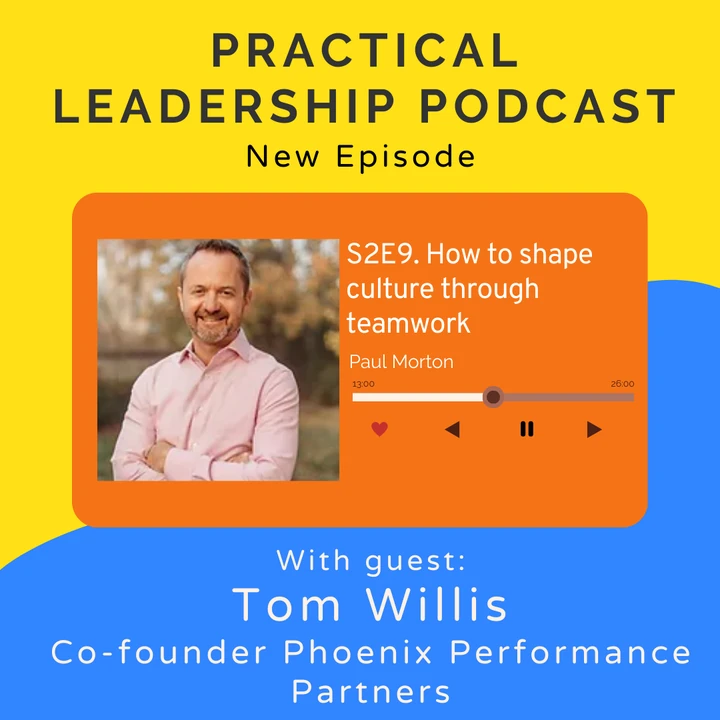
How to shape culture through teamwork
with Tom Willis
Show notes
Today I’m talking to Tom Willis, partner at Phoenix Performance Partners. Tom is an expert in helping executives and their entire leadership teams create cultures that foster growth.
Tom shares the challenge with culture. Culture is the set of unconcious rules that drive everything in any organisation. And how then, can you change something that you are simply not aware of?
Tom talks about the importance of making unconscious culture more conscious. He believes that by focusing on tools rather than titles, we can provide effective leadership and management coaching. Tom shares his own journey and background and experiences that led him to his current work.
One of the key points that Tom discusses is the need for leaders to be conscious of their impact on their teams. He speaks to the importance of creating a coaching culture within organisations, where leaders are actively involved in the growth and development of their team members.
To shape culture, Tom introduces three essential tools: leadership, management, and coaching. He explains how these tools can improve team engagement and build a positive culture within organizations. It’s fascinating to hear how these tools can be applied in different contexts and how they can make a significant difference.
During our conversation, Tom and I also touch upon the significance of having a shared future vision. Leaders need to have a clear purpose that inspires and motivates both themselves and their team members. This shared purpose creates a sense of unity and drives everyone towards a common goal.
If you want to connect with Tom and learn more about his work, you can find him on LinkedIn. I highly recommend reaching out to him for further insights and discussions.
And – he has a book coming out: https://www.phoenixperform.com/book
https://www.linkedin.com/in/thomasawillis/
https://www.phoenixperform.com/phoenix-performance-partners-about-us
Transcript
Automated transcript. Speaker labels and spellings may contain errors.
Paul
Culture is the way that we do things 'round here. It's also mostly unconscious, which is why it's so difficult to change. We spend billions trying to change cultures, but it doesn't work. And to improve it, you need to make that unconscious culture more conscious. Go for tools, not titles, leadership, management, coaching. Engage your teams. Let's talk to Tom Willis from Phoenix Performance and find out what he's all about. [upbeat music] Hello, and welcome to the Practical Leadership Podcast. I am your host, Paul Morton, and we are talking about leadership, management, and the various lives that surround it. It's my joy, delight, and privilege to bring into my studio some of the smartest, wisest people I've been able to find for your delectation and enjoyment, and I hope that you do get a lot out of the conversations that we have
here. When you realize that your management team has grown too fast or you've inherited a new team and the fastest, best lever you have for growth and improvement is attached firmly to those managers, get in touch. I help you run management, coaching, and training programs that'll make a big difference really quickly. You can find me at the Practical Leadership Academy website and on all the usual social channels. [upbeat music] Tom Willis, thank you very much indeed for joining me.
Tom Willis
Thanks for having me, Paul. It's great to talk to you.
Paul
You're a former teacher, school superintendent, and now, not recently, seven years founder at and partner at Phoenix Performance Partners, where you help schools and nonprofits build cultures that foster growth. Now, that was very shorthand. What have I missed?
Tom Willis
[laughs] That about covers it professionally. Um, but the... You missed the good stuff, which is I have an amazing wife and three awesome kids, and life is good.
Paul
That's the stuff that is... That's the foundational stuff. I heard a lovely, um, ex- ex- exposition of life in general, and it was a guy juggling five balls, and one of them was gl- one of them was rubber and four of them were glass. The rubber one was work. The glass ones were your faith, your family, your friends, and your health. And if you drop any of the four glass ones, bad news. But if you drop the work one, it bounces.
Tom Willis
I love it.
Paul
So you gotta keep juggling.
Tom Willis
I love it.
Paul
So those things are the important ones.
Tom Willis
I love it.
Paul
The rest of it is just stuff that we do. It's not who you are. Okay, how great.
Tom Willis
Yeah. I love it. I d- and I do know how to juggle, but only three balls, so I, I gotta figure that one out, I guess.
Paul
Apparently five... Well, I can do three, but a- five is the way to go 'cause four is, like, two in each hand, and that's just, like, too hard.
Tom Willis
Yeah. [laughs]
Paul
Five, you're, you're still spinning them. Uh, anyway, we digress. [laughs]
Tom Willis
[laughs]
Paul
No, we do. This is part of the thing. So building cultures that foster growth. How, how, how did you get from Tanzania to building culture?
Tom Willis
Yeah. [laughs] Great question, Paul. And the short answer is I think my, my faith, um... I've been blessed in my life to have lots of different experiences, to, to get exposed to lots of things, to be fired from a couple jobs along the way, um, which was-
Paul
It's great for you
Tom Willis
... at, at the time very painful, but in the hindsight, a huge gift. Um, one in particular from a large, large company, PricewaterhouseCoopers, uh, during the whole dot-com explosion of the 2001 timeframe. And I remember being quite depressed, frankly, and not really knowing what to do with my life. Um, and I went over to, to Tanzania, Dar es Salaam, Tanzania, Africa, to spend some time with my best friend who was over there, and I ended up helping him with, run a school and teaching, and it just was a, a real life-changer because I'll never forget how engaged these kids were. And it was one of about three high schools in the entire city with a few million kids, by the way. So it shows you how, at the time, how few kids got to go to high school. And, you know, not, uh, obviously very well-to-do.
Um, many of the kids barely had shoes to get to school, and yet their joy and their sense of eagerness to learn was palpable. And I just remember thinking, like, kids are kids. It doesn't matter where you are in the world, how much money you have or don't have, that kids are kids, and it really changed my life to wanting to come back and be of service to others and, you know, specifically to, to children. And so I came back to Detroit, Michigan, and started teaching, and one thing led to another, and, um, I e- eventually became the, the school CEO or school superintendent, as we call it, of a school system in Detroit, and just, just loved my time there. I was there for about 15 years. Absolutely loved every minute of it. And we were quite good at the culture work, at creating a strong culture, and really pouring into the, the children that life was much more than just test results and test scores.
And so I wanted to help more schools with that and more organizations, and so I ventured off on my own and have been doing this work now for about seven or eight years with my business partner and a few others to, to do just that, to help shape cultures, to help teams take their, their team lev- teams and their cultures to the next level. And, um, it's been a real, real joy 'cause we get to work from coast to coast. We've worked in Alaska. We've actually done some work a while back over in across the pond there with you guys in England. Um, and a- again, it's, you know, humans are humans, and wherever humans are trying to work together more productively is where we, we can be helpful.
Paul
And culture eats strategy for breakfast, lunch, and dinner.
Tom Willis
Yes. Yeah. Actually, we think it's culture eats everything. You know, it's, um-
Paul
Yeah
Tom Willis
... it really is the ultimate differentiator. If that's the one thing you take away from this as a leader, that would be my suggestion, is spend most of your energy thinking about, "How do I make the culture better today?" Because if you do that as a leader, everything else tends to fall into place because culture really is the ultimate competitive advantage.
Paul
Can you define it? I mean, I used to lead teams. I've led organizations and businesses, and I advise people, and the focus is on revenue, the focus is on sales, it's marketing, it's on internal operations, it's on your presentation to market, it's on, it's on, it's on shareholder value, stakeholder value, board meetings. There's, there's stuff that goes on all the time. And then you sit back and you get an NPS result or an internal thing And says the culture sucks, or the culture's great, or whatever. I'm not entirely sure anybody really knows what they're talking about.
Tom Willis
Yeah. That's a great, great point and a great question. All those things are important, by the way. Um, it's not that they aren't. I've, you know, I've got my, my master's degree from the University of Notre Dame, and it was an MBA, so I'm, I'm f- fully steeped in all the, the business terms and whatnot. And so those things are absolutely important. It's just that when you're working in an organization, there... First of all, there is no such thing as an organization. It's just a, a legal document that says these people work together. Um, and if you can get those people aligned and working together more effectively, then your organization's gonna be more effective. It's that simple. So much of our energy... In fact, there's a, there's a drama researcher called Cy Wakeman, and she's, I don't know how she's done this, but she's determined that roughly 20% of our day, so about two hours a day, is wasted on drama.
So think about that. Think about if you could, if you could change your culture to not maybe, not even get rid of the drama, but cut it in half. That's a tremendous improvement in the ability to be of service to the people that you serve and to be more productive and to generate more revenue and to generate more profit to the bottom line. But, uh, fundamentally, it's a human issue. And so culture is, is, is... I like the Seth Godin definition, that it's the way we do things around here. Um, but it's invisible. It's, it's... What makes it so difficult to change, by the way, is this one thing that people most often miss, which is that it's mostly unconscious.
Paul
Mm.
Tom Willis
That we, we don't realize how much of what we do as human beings is unconscious. And that's not a bad thing, by the way. That's a huge strength. If you think about just the act of driving a car is amazingly complex. Amazingly. That we've got our body doing lots of different things. You know, we're, we're tensing the muscles in our legs, in our calf, in our toes while we're thinking, while we're talking maybe, while we're listening to the radio, while we're turning the wheel, while we're judging the oncoming speed of cars coming. I mean, all that stuff is amazingly difficult, and yet our, our brains can handle it mostly unconsciously. We don't have to think about it too much. So that's a huge skill. Problem is, when we show up at work and we start to work with other human beings, we don't realize that what we're doing, especially as leaders, it's, it sets a, sets a tone.
You know, who we're being is much more important than what we do, um, as leaders. And we've gotta become much more conscious of how am I showing up at work, how am I being, because people are following my lead.
Paul
You said the organization doesn't exist. I prefer... I mean, you see, you work with profits, non-profits, companies, organization, groups, schools, whatever. I like the word company because you work in the company of other people.
Tom Willis
Mm.
Paul
You're working together with other people. And whether it's a pizza team or it's, uh, whatever the size of the group is, it's in the company of other people. And even if you look at company as a word, it comes from compan, with bread. I break bread with these people.
Tom Willis
Mm.
Paul
That's what it comes from. These are people with whom I break bread, with whom I, you know, whom I live. That's where the, the company in the company of others comes from. So yes, I think culture is the foundation, the, the, the, the keystone, call it what you like, of, of organizations. It's, it's, it's a thing. All right, I've just spent $300 million in my multi-billion dollar company trying to improve my culture because my, somebody in my MPS and HR and my board said, "Culture's a thing and go and do culture." So cul- we're culturing and nothing's happening. Why is nothing happening despite all the millions of dollars I'm spending on this? Tom, help me out here.
Tom Willis
[laughs] Yes. Well, for lots of reasons, and that's the case that, you know, most strategic plans and most culture work doesn't, doesn't work. Um, billions of dollars are spent around the world, and most of it is wasted. And again, a lot of it's because of that one key f- piece, which is we don't realize how unconscious it is, and that if we're going to go about improving it, we've gotta become more conscious as a CEO and as an executive team, and then we've gotta help the rest of our people become more conscious, um, so that we can all literally, um, be more aware of what we're doing and, and the impact that our words have on others. So I'll give you, give you an example of an amazing leader that we know and, you know, she is about the most generous person you'll ever meet. You know, walks around the different locations that they have.
Doesn't matter, um, if it's 500 miles from the other location. And, uh, you know, the s- the people that work, uh, and clean the buildings, the, the frontline office staff, whatever, they know who this person is. He knows who they are. Just very affable, very likable, very lovable, and was struggling to get results, was struggling, uh, was getting frustrated because his p- his team wasn't delivering to, on things they said they would deliver on. And he had this epiphany one night in working with us that, that, um, wasn't doing the same thing for his team, wasn't, wasn't delivering on promises that, that, uh, were made, and this became a huge problem. And so went to work on it, realized that, oh, boy, well, if I'm not doing it, then nobody else is. And wasn't doing it on purpose obviously, but just wasn't conscious to it. So that's a, that's an example of what we're talking about here.
Paul
I've noticed that, that if there is an endemic cultural problem, it is invariably from the top. There's a company I was working with who had an appalling, appalling approach to time management. Never on time for meetings, ever. And you know, y- y... in a Zoom call, if you are three minutes late for a Zoom call, it's like being 30 minutes late for a real face-to-face thing. You know, that's the sort of approach. But they were always late, and then you realize why. It's because the CEO had no respect for time, or rather, his appro- he was time fluid, or call it what you want. It was just a different attitude to time. And we had a chat, and I said, "You know, there are many people who are like you, but there are many people who are not.
And the people who are not like you consider it disrespectful if you are late to their one-to-ones." If that... And that, making that conscious for him, I'm realizing now is, is what you're saying. You're making something conscious. It's a coaching thing. I coach a lot of people, and 95% of coaching is awareness. You make it conscious and you say, "Look, this is what it is. This is the impact it's having." Oh, really? Gosh. Well, that... It wasn't overnight, it wasn't a miraculous cure, but it is just making these things conscious. Making things conscious, though, is culture values? Is, is it writing the values of the company on the wall? Or my wife used to work for a company where you had them laminated in a little card. You know, is it... So are you living your, your culture or is it laminated? How do you make it conscious? What's the, what was your toolkit?
How to?
Tom Willis
Yeah. Yeah, great question. Um, there's a, there's a professor, Dr. Wilson, um, he was at the University of Virginia, and he, he talked about how the human mind can take in, uh, roughly 11 million pieces of information at any given moment, and that at any given moment we're conscious of about 40 of those. So 11 million, 40, 4-0. So in a way, we have no shot at becoming conscious of all that. It's, it's, it's, like, an impossibility. Which is why we need the people in our company, you know, the people we break bread with, to help us. We need that. That's why the work we do is always in teams. We don't do one-on-one coaching. Not that that's bad, it just doesn't tend to have the impact. You need a team of people to come together to help each other to become more conscious, because I may not realize that, you know, I'm avoiding the issues.
And luckily, Paul's able to step in and say, "Hey, Tom, did you realize that in that last meeting you, you kinda sidestepped the real issue there?" And I'm like, "Oh, yeah, I guess you're right. Thank you, that's helpful." And when we can s- when we can really create a coaching culture where we're all just there to help each other, it's not because I'm right and you're wrong, or you're right and I'm wrong, it's just because we all see things differently. We don't see the world as it really is. We need multiple perspectives. And so, um, the one of the most valuable things you can do is, is engage the team in the work of creating a culture. Don't outsource it to one person. You know, um, many cases, not always, but in many cases, if you've... If a company has a, a director of culture, then they probably don't... They're probably struggling with their culture.
Paul
Mm-hmm.
Tom Willis
Because everybody looks at it like, "Well, that's that person's job." Well, no, it's every single employee's job. As we're either, we're either an cultural ambassador, as Matthew Kelly likes to talk about, where we are adding to the culture every single day in multiple ways, or we're a cultural detractor. We're taking away from it. We're gossiping, we're doing whatever. Well, there is no neutral. We don't get to be neutral. We don't get to blame others. Uh, we're either a part of making it better, or we're a part of making it worse. And so that's the first thing, is engaging the entire team to make sure that we're all in this work to improve our culture. And it doesn't... It's not about perfection, it's just about progress. It's are we better this week than we were last week? And there's three specific tools that we, we help clients with to really wrap their heads around that you can use to, to shape that culture, and we can get into those if that's, if that's interesting.
Paul
Oh, I think a, a, a, a toolkit would be a phenomenal thing to take away from this. Just as I think of the director of culture equaling a problem with culture, I think... What's, what's the line? I think the gentleman... I don't know, I think the lady doth protest too much. It's when you, you're starting to flag something like that, it's a s- it's a sign, it's a cry for help. [laughs] It's like having a direct- director of innovation tells you, "Yeah, you shouldn't be investing in this company." You know? If they're not innovative, and you're saying, "Well, I'm the director of innovation." No, you're not.
Tom Willis
[laughs]
Paul
You're really not. Sorry.
Tom Willis
Yes.
Paul
Yeah.
Tom Willis
Yes. And that's not always the case, obviously. There are some amazing folks doing those, doing that work. Um, but many cases it's, it, they're shooting themselves in the foot. You know, just like many large companies d- um, stopped hiring a director of safety. You know, if you're a, if you're a manufacturing facility, you don't wanna have one person. It's, it's every s- person's job to take safety seriously.
Paul
Yeah. You actually see it in, in aspects as well. You, it's a siloing thing. When you have a very strong finance team, you have a head of finance or head of compliance, you have that team doing that. But typically nobody else understands the money. Typically nobody else understands the compliance pieces. So you're trying to move these things into the business, and make the business units, the teams themselves, as you're saying, responsible for whatever that aspect or aspect is. In this case, culture. So what are your three tools?
Tom Willis
Yeah. So let's, um, let's just put 'em on the table right out of the gate here. So, and these are tools, not titles, and this is an important distinction, because too often we talk about the titles and we get confused. Um, so the tools are leadership, management, and coaching. These are not three new tools. These are, these are not three new words. We're not trying to, uh, create buzzwords. These are time-tested tools that unfortunately nowadays we've, we've made some of them bad and some of them good. So for instance, on LinkedIn you'll see people say, you know, "Leadership is good and, and ba- management is bad," or, "Coaching is good and management is bad." And we think that's all phooey. Y- you need all three.
They're equally-
Paul
Mm-hmm
Tom Willis
... valuable tools in your toolkit. Because let's say I'm, I'm a soccer coach, which I am. I need at times to lead, and then at times I need to manage, and at times I need to coach. Even though my title is a coach, I need to use all three tools. As a leader, as a superintendent, as a CEO, uh, you are considered the leader. That doesn't mean that's all you do. You, there are times when you need to manage, and there's times when you need to coach. So when you can do all three of those effectively, you're, uh, you're able to shape the culture that you want. And so let's walk through each of those, um, quickly. You know, we could spend two hours on each one of these, by the way, so we're gonna, we're gonna give it a very cursory, cursory, uh, run-by here. It reminds me of the story of these two, two vultures that are out West United States over the desert circling a prey and talking to each other, as vultures tend to do, right?
And all of a sudden this, this airplane goes flying by, and the one vulture turns to the other and says, "Whoa, that bird was sure in a hurry." And the other one said, "Yeah, you would be too if your ass was on fire."
Paul
[laughs] Love it. [laughs] All right.
Tom Willis
So the point of that is that we're gonna, we're gonna fly through these, we're gonna fly through these tools and give it sort of a cursory-
Paul
F16 version
Tom Willis
... glance. That's right, that's right. Um-
Paul
F1.
Tom Willis
So leadership is the first and the most important of the three. It's gotta come first because if you don't have what we like to say is, you know, a shared future, then you got nothing. So leadership is all about generating a view of the future that others take on as their future. So there's a lot of key elements in there, right? At first, you gotta generate the future. You gotta talk about where the heck are we going? What's the why? You know, what's the vision? What's the purpose? Most of those words, you know, um, by the way, we, we think are pretty synonymous. Um, there's lots of people that will disagree with me and spend hours debating the difference between a purpose and a mission and, and a vision, and that's mostly wasted time, in our opinion. Um, the fundamental point of any of that stuff is that we have a shared future that we align on, and that it's not my future and you're compliant to it.
It's that you are excited about it, too. You aspire in your heart to that same thing. Because when you and I aspire to the same thing, then we're unstoppable, and that's the real key to leadership, is, is making sure that people genuinely want to go where you wanna go. And when we have that shared future together, now we've got something that we can go to work on as a team and as a company.
Paul
So leadership. Okay. Shared future. Vision of the future. Right.
Tom Willis
That's right. That's right. And if you don't have that future, then you can't... You got nothing to manage, you got nothing to coach. So I can't emphasize that enough. It has to come first, and way, way too often, we jump straight into tactics. We straight, we j- jump straight into feedback and giving people, you know, performance improvement ideas. Well, you can't do that if I don't, if we don't share a, a s- a similar future. So leadership, leadership, leadership. It's gotta come first. Then you can, uh, you can manage. And what we like to say is you can't actually manage people, um, which is, I know, uh, many people just said, "What?" Um, you can manage promises that people make, and that's it.
You can manage agreements that people make, and that's it. So we like to use the word promise just because it amps up the stakes a little bit. When somebody says, "Hey, Paul, I promise that I'll meet you at 9:00 AM on Wednesday for this podcast," it's like, oh boy, I better do it 'cause I just made a promise. So it literally gets people sort of perked up and attentive. And so making sure that you're getting promises from people to accomplish X by a s- by a Y date is really critical. Because that's what allows you to move from where you are today towards that shared future. And it sometimes takes dozens, if not hundreds of promises to, to move towards that future. Most often, though, we as leaders forget to do that. We skip over it, or we're too indirect. You know, we're like, "Well, it'd be nice if somebody would do this by next week," right?
Um, or we say, "Hey, can you, can you take care of that?" "Yeah, sure. I'll take care of that." And then a week later, it's not done and you're frustrated. Well, because you didn't, you didn't get a timeframe. You didn't get them to promise to a date. So it's really critical that you're direct, you're specific, and it has a timeframe s- you know, of the promises that we're making to each other. Because then when you've got a promise, now you've got something that you can use to hold the person accountable, not in a punitive way, but in a supportive way. Like, "Hey, you promised to do that. How can I be helpful?" Which sort of takes us into coaching. Coaching is everything else. It's literally helping the person pick ideas around. It's giving a book to read. It's sending 'em to a conference. It's brainstorming. It's reading a book. It's listening to an audiobook.
It's whatever. It's whatever it takes to support that person to meet their promises so we can move towards that future. So you can see these three things tie together nicely because they're all inter- interrelated. If, if I was able to draw for you, one of the things I like to draw is a, a Venn diagram, you know, the leadership, management, and coaching all overlapping. Because most of us are really good at one or two of these, but very few people are really good at all three. Are very, uh, not even good, but conscious of the need to do all three. But when you can, when you can really get that fine-tuned and do all three of those, that center overlapping part of the Venn diagram is results. That's where you get the results you're looking for.
One more thing about coaching that's important, which is that coaching is only coaching if it's asked for, and we forget this very often. We think just because we're the boss that we can tell people what to do or we can give them feedback. But if they don't want it, uh, we just created a bigger problem than we, we need and, uh, we, we are consciously thinking about. And so it's really important to slow down and say, "Hey, I've got some ideas for you if you're open to it." And if the person doesn't say yes, you've gotta, you've gotta walk away. You gotta give them some time and say, "Okay, like, that's fine. Let me know when you're open to it." Or, um, there's other things you can do to generate that interest, but fundamentally, our job as, as leaders, managers, and coaches is to get the person to be open to coaching, uh, which again is a whole nother subject.
But fundamentally, coaching's only coaching if it's asked for.
Paul
That's a, that's a very good definition. Yeah. Otherwise, you're throwing your valuable seeds and they're landing in the path, you know? Not in the, not in the fertile ground.
Tom Willis
Yeah. Not even the path. They're, they're outrightly rejected. You know, they're, they've done studies on this. It's fascinating. But if you... They literally, I don't know how they did this, but they hooked up the brain, right? And they found out that saying Are you open to feedback to somebody is the same thing as hearing footsteps in the dark behind you. Like, it triggered that sort of same brain chemical reaction.
Paul
Nice.
Tom Willis
And so it's, it's really important that we- we're thoughtful about how we do that.
Paul
Mm.
Tom Willis
That the only way that, that somebody's gonna be open to coaching is if you have a big enough relationship with them where they trust your intent in the first place. If I don't trust that you're on my side, then I'm not gonna be interested in your perspective, I'm not gonna be interested in your coaching. So it's a really, really valuable, um, distinction, we think.
Paul
Mm. I like the word observation. So rather than giving somebody some feedback, "Can I give you some feedback?" "No." [laughs] "Oh, um, I mean, can I make an observation?" "You can make any observation you like. Doesn't mean I have to listen to it."
Tom Willis
[laughs]
Paul
"So you can now make an observation." "Well, I think..." So you, you, you... gives you a, kinda cracks the door open just a little bit. Sounds, seems to be a little bit help- quite helpful. So we've got leadership, shared future. Management, not being able to manage people, but you can manage activity. Promises, managing a promise. And coaching, which is only coaching if it was asked for. Okay? So these three, these tools together are helping you to engage a team and to improve a culture. Then how? How are you improving the culture? How, how... What is it you're building? Where are you going?
Tom Willis
Yeah, great question. And, you know, from here, the, the work of, like, Simon Sinek and many others is fa- is, is foundational. Because now it's, "Okay, well, let's get specific about what that future is. You know, what, what is our why?" And really diving into that. Because most often we unfortunately have reduced that to an exercise. Like, let's get together, let's pre- let's sort of craft the perfect mission statement and fine-tune it and, and, um, play words, you know, play with the game, play with the game of words and, and word crafting and all that until we get the perfect statement. And then we're like, "Okay, check, we're done." Well, I don't know about you, but I've yet to read a mission statement that inspired me by reading it. Because they're, they're, they lack inspiration, which is the whole point. So a mission statement at best, at best is a reminder of the mission that you're on.
And too often we, we stop there, and it's... And I did the same thing, by the way. I, I made the same chall- I made the same mistake when I was a new leader. I'd go off, we'd do a summer retreat. We'd, we'd revisit the mission statement or maybe recraft it. We'd revisit our values, all that. It was, and it was good stuff, but then it was like, "Okay, check, we're done with that. We'll come back to it next summer." When really the job of leadership is to keep it alive 365 days a year. For ourselves, first of all, because if we're not inspired, if we're not, if we're not striving for some future, then we can't possibly have people follow us. And then for our people. And so to be on a mission is very different than have a mission statement.
Paul
Your North Star, your reason to get up in the morning. What is it, um... It's not Sinek, it's, uh, D- Drive. Daniel Pink. Daniel Pink. It's the three is the people are motivated by purpose, they're motivated by autonomy, and they're motivated by the opportunity to master something. But the P, the purpose, he says, he's kind of got that one wrong in the original book. Um, yes, Drive: The Surprising Truth About Things That Motivate Us. I think that's the t- the name of the book. He said the purpose people tend to craft, the majestic mission statement. "We shall place a man on the surface of the Moon and return him to Earth safely within the end of the decade." That's a pretty good mission statement, right? But y- it's kinda hard to get out of bed every morning to, to craft, to, to, to deal with whatever that is. The real purpose tends to be more in the small P rather than a capital P.
It's a small p of the people around you, the company that you keep, and it's doing your best for them every day. And if you can get the balance between the two, one is the, "We're gonna change the world with a new, you know, uh, financial device that will transmit currencies at the speed of si- " Okay, great. Ooh, super duper. Not gonna get me out of bed every morning. Good, enjoyable, meaningful, but not the thing that drives me. The thing that drives me is the small p purpose wrapped into that, which is we're gonna build a team that's gonna build a thing. You know? It's the people that you're surrounding yourself with, I think. So the who-
Tom Willis
Yeah. Yeah, absolutely. It's, um, you, you brought up financial, so I can't help but think of my wife, and she, you know, she had this idea for y- for, for years of, "How do I help more people?" 'Cause she was helping millionaires really as a financial wealth advisor. And she said, "Why can't, why can't we provide these same sets of tools to people that aren't millionaires, you know, to the rest of the world?" And so finally she ventured off and started her own app. It's called Pocketnest. And now they're working with banks and credit unions and, and employers to help them with their financial wellness tool for employees. And they're on a mission to quite literally help the everyday man get their financial house in order. And they think if they can do that, when they do that, it will change the world fundamentally.
Um, so that's sort of the big purpose of, of Pocketnest is to literally make a difference in the world by helping people get their financial house in order using an app. Um, now every day they've gotta figure out how to make their sort of what we call sub-purposes. Like, what's my part of that purpose?
Paul
Yeah.
Tom Willis
If I'm leading the technology team, what's our sub-purpose? Or if I'm leading the financial team, what's my s- what's our sub-purpose as a department? And then below that, you know, what's mine individually? What's my component of that? What, what a- what am I doing to contribute to the, to the big purpose? And so you've gotta help cascade down and throughout the organization the, the purpose, because if you don't, then you're, you know, then you're lost. There's a great story of, um, John F. Kennedy, you know, speaking of the Moon, walking around NASA, and he's talking to people, and they're giving the dog and pony show tour, and he kinda goes off script and starts talking to this gentleman who's got a mop in his hand. And he said, you know, "What's your young, what's your name, man, um, sir?" And so they started talking, and he said, "So what's, what's your job here?" And, uh, the janitor says,
"My job is to help put a man on the Moon." And that's, that's when you know you've got it as a culture, when every single person sees that they're a part of, not the only part, but they're a part of the overall mission, you know, of putting the man on the Moon.
Paul
Yeah. It's an organizational diagnostic that I do when I go into companies and try and help them do whatever they wanna do better, and you ask the leadership team, "What do you do? How do you make money? Who are your customers? How do you find them?" All that sort of stuff. "Where are you going?" And it's rare you get a consistent set of answers. When you do get a consistent set of answers, I'm thinking, I'm sitting there thinking, "Well, well, never mind. [laughs] No work for me here." But it's, [laughs] it's where you're finding, "What do you do?" "We do, we, we, we sell widgets. Uh, we, we service widgets. Uh, we develop widgets." "Okay. Right." Mm. Good work to be done. That's good. Let me ask you, what is the book, podcast, movie, video, whatever, that you recommend most for people?
Tom Willis
Oh, there's a few out there that, that are good. I expect this whole top row is stuff that I, I particularly love, um, uh, including the book that we're, we're writing. We just got the, we just got the cover of it. It's, this is the, this is the little co-
Paul
Oh, look at that
Tom Willis
... of the book
Paul
Great
Tom Willis
The Great Engagement
Paul
... picture.
Tom Willis
So it'll be out in a few months, so stay tuned for that if you're interested. But, uh, the other one I really like is, um, Brave New Work by Aaron Dignan, uh, a really innovative book. You know, most of the business books that are out there are kind of regurgitating a lot of the same stuff, which is not bad, it's just, it's just, you know, some of the timeless wisdom. In fact, our book does some of that, too. Um, Aaron, Aaron really does a nice job of mixing things up and really coming at, um, how do you truly innovate, you know, in the, in the world of businesses and companies and organizations? So that's, that's top of mind for me.
Paul
I like that. Innovation, Brave New Work, Aaron Dignan. We'll put a link and we'll put some details in the descriptions of this, uh, this episode here as well. Is there one thing, apart from making that to Tanzania, that you would like to thank young Tom for having done?
Tom Willis
Well, even a lot of it's, uh, I was just fortunate, frankly, to have an amazing family, you know, parents that were married for 50-plus years and two older brothers that really motivated me. Um, and, uh, I think they, that, that, that work ethic, you know, my dad had in particular was really probably the thing that I'm most proud of and still proud of, is just, you know, there is no, there is no overnight success. Um, even though the world wants to tell you that and social media wants to tell you that, that if you want anything in life, you gotta work for it. And, um, you just gotta grind it out sometimes. Um, so that's probably the one thing is, is nothing replaces, uh, hard work.
Paul
One sp- 1% inspiration, 99% perspiration, I think it was.
Tom Willis
Yes. Amen to that.
Paul
And lastly, then, how can people find you, Tom?
Tom Willis
Yeah. Uh, phoenixperform.com is our company. Phoenix like the, the city, uh, perform.com. I'm on LinkedIn mostly. I don't do much of the other social media. So, uh, Thomas Willis. We're in, uh, Michigan here. And, um, email is just tom@phoenixperform.com.
Paul
Marvelous. Team engagement, leadership management, coaching tools, not titles. 20% of your day wasted in drama. Culture is just the way that we do things around here, but it's mostly unconscious and therefore hard to change. Tom Willis, thank you very much indeed for joining me.
Tom Willis
Thank you, Paul. It's been great.
Paul
That's a wrap. Thank you for joining me today. Your homework is to leave your five-star review and please, any comments you have. You really help me to improve every day, and it also helps people to discover me online. You should check out practical-leadership.academy because you want to help your new managers succeed with hybrid or remote working. [upbeat music]