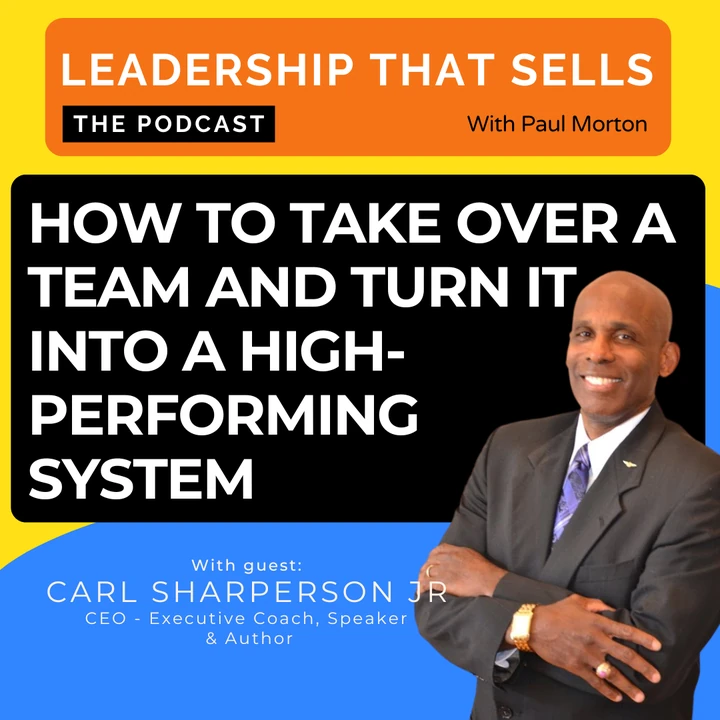
How to take over a team and turn it into a high-performing system
with Carl Sharperson Jr.
Faith at WorkShow notes
What’s the smartest way to take over a team without falling into the usual traps? In this episode, I’m joined by Carl Sharperson Jr. — a former Marine Corps pilot, corporate VP and leadership coach who’s worked with brands like Chick-fil-A, BMW and Lockheed Martin. Carl shares the exact process he uses to walk into a new team and turn it into a high-performing system (not just a team).
We get into how authenticity and resilience aren’t just personal values — they’re strategic leadership tools. Carl breaks down his “join-up” approach for building trust, getting buy-in and turning adversity into fuel. No theory here. Just straight-up, battle-tested tactics from someone who’s lived it in the military, the boardroom and life-or-death moments. If you’re a leader stepping into a new role — or rebuilding a struggling team — this one’s essential.
How to take over a team and turn it into a high-performing system
Build trust with a “join-up” conversation — start with your own story
Ask what the org can do better, from their perspective
Set expectations and invite the truth, even if it’s uncomfortable
Ask: “How can I help you?” Solve one problem, earn long-term loyalty
Co-create the vision, strategy and plan — don’t dictate
Focus on the system: people, processes, relationships and metrics
Teach resilience: if you quit once, it gets easier to quit again
Timeline summary
[04:52] – The P&G plant that outperformed by building trust and diversity
[11:07] – Carl’s join-up method: the conversation every new leader should have
[13:20] – “Help them with one problem, and you’ve got a friend for life”
[16:13] – Turning trust into results with clear, co-created goals
[20:01] – Why high performance means building systems, not just teams
[24:46] – Resilience in action: what football, cancer and leadership have in common
[31:33] – Why you should go with their solution, even if yours is better
[36:08] – The real leadership challenge execs confess too late: balance
[40:08] – Carl’s message to the world: “Love covers a multitude of sins”
Links & resources
👉 http://www.carlsharpersonjr.com
📘 Sharp Leadership: Overcome Adversity to Lead with Authenticity — available on Amazon
If this episode helped shift your perspective, do me a favour: rate, follow, share or leave a review. Let’s help more leaders lead first and sell more.
Transcript
Automated transcript. Speaker labels and spellings may contain errors.
Paul
A trailblazer in leadership development, Marine Corps veteran, and corporate powerhouse turned entrepreneur. He's coached executives from global brands like BMW, Chick-fil-A, Lockheed Martin, using his unique blend of military precision, corporate expertise, and entrepreneurial insight. A graduate of the US Naval Academy, nearly pilot, but not quite, of the United States President's personal helicopter, but that was a near miss. Vice president of manufacturing, he now empowers leaders to overcome adversity, lead with authenticity through his sharp leadership framework. Accomplished speaker, author, and coach, Carl Sharperson Jr. Welcome to the Leadership That Sells podcast, where we help you lead first and sell more with great insights and tactics from the best minds we can find.
Every leader is in sales, whether you're selling products, ideas, a mission, or a vision, and great sales team in particular need great sales leaders. When managers bring out the best in their teams, targets get hit on time every time without stress. But most sales leaders never learn how to lead. They wing it, or they repeat bad habits, and the cycle continues. Sales leaders need practical, real-world ideas that fit their busy schedules, and that's why we created the Leadership That Sells playbook course. Nine short weeks changes your world. Check it out at the Practical Leadership Academy. And now, on with the show. Thank you very much indeed for joining me. Now, just to celebrate the fact that you have to be junior because we now have His Royal Highness Carl IV.
Is that grandson?
Carl Sharperson Jr.
Right. Carl C-IV. Grand- grand, my first grandson.
Paul
Oh, well done. Gorgeous. And how old is he? How old is he, Carl?
Carl Sharperson Jr.
Oh, he's, um, almost two months.
Paul
Two months. There we are. Is, uh, are you dangling him on your knee yet? Have you had a [laughs]
Carl Sharperson Jr.
[laughs] Well, he lives about 1,000 miles away, so we're gonna see him, uh, in, in a month-
Paul
Oh
Carl Sharperson Jr.
... for the first time.
Paul
That's tough. That is. That's wonderful you get to do that. Granny, my, I have two kids, and, uh, Granny lives up in Scotland, and I'm down in the south of England, so it is, it's a seven-hour trip for her to come and see. But she does it every six weeks or so. And she says-
Carl Sharperson Jr.
Okay
Paul
... that that's her ration. She ha- she can't do any more than about six weeks away from the kids be- before she has to come and see.
Carl Sharperson Jr.
That's it.
Paul
But that's great. First grandchild. It's, it's, that's, seems to be a very special relationship you end up with.
Carl Sharperson Jr.
Yes, sir. Definitely.
Paul
Wonderful. So I, that was a far too short introduction for somebody of your stature and experience. What did I miss?
Carl Sharperson Jr.
Well, I'll tell you a little bit about myself. So I was born in Washington, DC. Capital city, very busy, a lot of things going on, in an environment where everybody knew me, looked like me. At the age of 14, my dad decided to move us to Spotsylvania, Virginia, which is about 60 miles south of Washington, DC. So I go from an environment where everybody knows me and likes me to an environment where nobody knows me, doesn't look like me, and doesn't like me, you know? So I helped integrate a school in Virginia. Um, you know, I was called names and all kinds of negative things occurred, but what I learned over time was once people got to know me, then they became my friend. So that was a mantra that I took with me as I continued to do different things. You know, if somebody does or says something that's not good, to me, it's not my issue, it's their issue.
And it's not what you call me, it's what I answer to that's most important. So I go, uh, to the school. I play football for the first time. Go out for football for the first time. My high school coach, who was the third most influential person in my life, he's the one that sent the recruiter to my high school to recruit me to play football at the Naval Academy, and I didn't know what the Naval Academy was. It was only 90 miles up the road, primarily because there weren't a whole lot of people that looked like me going to the Naval Academy. So I applied, but I did not get in initially because I was not academically competitive. My GPA and my SAT scores were not competitive. So the Naval Academy sent me to a preparatory school in Harlingen, Texas, the southern tip of Texas, and I learned to study for the first time. Reapplied to the Naval Academy, got accepted.
Uh, played football for four years. Graduated. Decided to go into the Marine Corps and become a pilot in the Marine Corps. After five and a half years in the Marine Corps, I did two deployments to, two six-month deployments to the Mediterranean Sea, one three-month deployment to the Caribbean Sea flying off ships. Uh, and then I made a transition to corporate America. I went from Procter & Gamble in Albany, Georgia, southwest Georgia, that was the first place I landed. Uh, and it was a very unique experience in that, uh, when the plant was founded 10 years before I got there, the leadership of Procter & Gamble wanted to hire the same multicultural mix as the community during that time period, which was very, that was unheard of. So when I got there, 20% of the managers were African American, 20% of the managers were women, and 40% of the technicians were African American.
That was unheard of during that time period. So Procter & Gamble was leading edge in organizational development, so we had visioning sessions, team-building sessions, strategic planning sessions, and we would bring people from every level into these meetings to talk about where we wanted to go and what we wanted to do. It took us longer to get to a point, but when you have all, when you have those diverse ideas as well as diverse levels, you end up with a process and strong buy-in. So we were the, we were the best-performing facility, best-performing paper plant in all of Procter & Gamble. The leadership would send people to our plant to train on how to do leadership training So that was a great, uh, intro to corporate America.
I had the military experience, then I learned how to take those skills and apply them in corporate America in a very, uh, futuristic way. Worked for Procter & Gamble for five years in their facility, took a corporate job in Cincinnati for three years, then I went to work for Frito-Lay. Procter & Gamble is a paternalistic organization in that they hire people, train them, develop them. Frito-Lay steals people from places like Procter & Gamble, Coca-Cola, say, "Here's the money. Go make it happen. I don't care how many dead bodies there are, get the results." Right? So I was in that environment for three years. Learned some different things, but I said, "You know what? This is not the culture that I wanna work in." So after about three years, I started looking again and went to work for Colgate-Palmolive in Topeka, Kansas.
Uh, the subsidiary was called Hill's Pet Nutrition. We made Science Diet and Prescription Diet cat and dog food. Uh, and it was a union facility, the first time I'd ever worked in a union facility. We took a very traditional union facility where the people could only work one job, turned it into a high-performing work system where people could do multiple jobs. We were the best-performing facility out of four facilities in the company, and we were the only union facility. We had the oldest people, the oldest equipment, 20% of the workforce was illiterate, right? And we were the best-performing plant. We turned a traditional union facility into a high-performing work system. Again, taking the experience that I had from the military, Procter & Gamble, Frito-Lay. So that was, uh, that was a very, very monumental experience that I had.
So I'm constantly moving west. My parents are living in Virginia, my wife's from Florida. I wanted to live somewhere between those two states. Took a job as the vice president of manufacturing for Dunlap Slazenger. We made Dunlap Slazenger and Maxfly golf balls, actually headquartered in England. After about a year with that company, it was clear my boss and I agreed to disagree. So then I said, "Okay, I'm in the right area, but what do I wanna do? What can I offer?" So I said, "Oh, I can do speaking, I can do business consulting, I can do executive, uh, coaching." So I hung out the shingle and used my network to get business. So that's kinda how I got the business that I got. Um, I've been married for 38 years. I have a son and a daughter. Uh, and uh, 12 years ago, I was diagnosed with stage four non-Hodgkin's lymphoma, which is a type of cancer.
You know, I learned a lot about life there. Uh, 83, I had a brain tumor removed. But when you get to a point in your life where you're not strong enough, you're not smart enough, you don't have enough money in the bank, that's a whole different level of humbleness, and it teaches you some things that you normally don't get. 'Cause when you, when you're faced with mortality, you know, things that used to be important no longer become important. So that's a little bit about me, my friend.
Paul
I love that. The h- the humility, the acceptance of your own mortality. Um, I think it's also, there's also dealing with fear in there as well. Uh, reconciliation. All these, all these different elements that have made up your story that, that have, that have added depth to your expertise and possibly w- they, they def- they define your drive as well, I think. I mean, these, these... It's easy to look at the different aspects of experience, uh, and h- it's how you can use them. But when you look at the different aspects of the experiences and the things that have happened to you, and you reflect on how they drive you forward as well, it's... These, these are the tools I have. So you, you have the options of saying, "Well, this, this is...
I have now got a set of tools available to me because of my experiences." But I think from what you've been talking about here, you've thin- you have things that have driven you forward as well. Is there-
Carl Sharperson Jr.
Yeah, so yeah, some of my best lessons and achievements have occurred in the darkest times.
Paul
Yeah.
Carl Sharperson Jr.
That's why my book is Sharp Leadership: Overcome Adversity to Lead With Authenticity. Um...
Paul
Okay. Then, now, your, your leadership framework talks about auth- authenticity and resilience. How, w- how do we apply just that? Let's talk about authenticity and resilience, 'cause I think they're, they're quite tightly connected. How do you apply them if you wanna... You, you said you went into a union business and you were looking to build a high-performing system. And I like that you said system, not team. Okay, you called the organization as an, an organism, as a system, uh, system thinking, that sort of thing. How do you then take authenticity and resilience and you turn that into a high-performing system?
Carl Sharperson Jr.
Well, I'm a firm believer that, um, it's all about relationships.
Paul
Mm.
Carl Sharperson Jr.
So in order for me to get people to perform at a high level, they've got to trust me, they've got to believe in me, right? So one of the things that I do, and I put this in my book, is I talk about a join-up process. So the join-up process is anytime I join up with an organization, somebody comes into my organization, I have a join-up conversation. In that conversation, I talk about myself. I says, "I'm gonna tell you a little bit about myself, uh, and then I'll ask you to tell me a little bit about yourself." The more authentic I am about what I share, the more authentic they will be. So if I'm sharing a story and I talk about my cancer struggle, right, then they're gonna talk about some struggles that they had, right? Um, and then so I tell them my story.
I say, "Tell me your story." So the more authentic I am, the more authentic they are, they tell me my story. Okay, the next thing I say is, um- You've been in the organization for a while, uh, tell me what you can, what you think this organization can do better based on your perspective and your experience. So they tell me that. Okay? Uh, the other, another question I ask them is, um, I said, "I, I have some expectations of you, and I want... I, I know you have some expectations of me, so one of the expectations," I say, "is I want you to tell me the truth. If you see me doing something that's gonna hurt the organization or hurt somebody in the organization, I need you to tell me as soon as possible."
So I'm opening up the dialogue for authenticity. Now, when they come to me with that bad news, I need to say, no matter whether I, whether I believe it, don't believe it, I've got to say thank you, otherwise you won't get any more. Okay? And the other question I ask them is, "Well, how can I help you?"
Paul
Mm-hmm.
Carl Sharperson Jr.
And when I say, "How can I help you?" How can I help you in the organization, and how can I help you in your personal life? They might say something like, "Well, I've got a special needs child. I have difficulty getting them babysitting services." Doesn't make any difference what it is. So in this conversation, all I have to do is help them with one problem. I've got a friend for life. I've got a person in the organization that will cover my back. So I do that with individuals in the organization, and over time... Because what I've found is it takes me six months to develop credibility in a new organization. Because when I say, "Trust me," they say, "Yeah, you're just like the last person, the last two or three people before you that told me that, lied, cheated, stole, treated me like whatever," right? And that's what I'm always overcoming, because only 20% of the leaders, in my opinion, in this world subscribe to the same
values that I do in leadership and that you do, Paul. The rest of them don't.
Paul
There are a ridiculous number of people, and I... You hear about it every day. I hear about it from my, my family, I hear about it from my friends. There are a ridiculous number of managers, leaders, people out there who are, to not put too fine a point on it, absolute... I don't want to use expletives in my podcast, but unpleasant piles of donkey waste, you know? I mean, where did you get those ideas? And typically they've got it from experience. Everybody learns from experience in these things, so they've been dumped on from on high. They've had a rotten experience. And you, you just can't treat people like that. Well, nobody's ever told them not to. Nobody's ever done anything different. My driver for doing what I do in terms of the leadership and management, um, coaching and training, is my kids are getting older, and they're gonna enter the world of work fairly soon, and I don't want them to enter the world of work as
the most junior employee with the poorest quality manager, 'cause that's taught what we do. The new guy comes in and she, he or she gets the, the lowest, junior-est manager with no experience and no support, and that then forms their opinion on what leadership and management looks like, and that's, that's it. It's done. It's set in their mind. Six months to develop credibility. Yeah. How'd you do it so quick? [laughs]
Carl Sharperson Jr.
[laughs] Yeah, right. By doing this joiner process.
Paul
[laughs] I love that process, 'cause that is a thing that so many people do when they have to take over a team. And I think we just got our title. The, the... I like to have a how-to for these things, so how, how, how'd you take over a team? How'd you join a company as a leader? There you go, sample of that. Um, talk about them- talk about yourself truthfully, share what can you do better, set your expectations, and how can I help? And if you can help, there you go. That's it. So you've got then trust. You've built trust. You've got an idea of what the organiza- what, what some people in the organization think needs to be done. What's next? How do you go from trust to high performance?
Carl Sharperson Jr.
Yeah. So, um, that's built over time, but one of the ways to accelerate that is, um, when you take over the team, you have a team building session. Okay, so you have a team building session. Be clear about what the goals are. What does the organization want to accomplish? Have everybody understand what that is. Um, and you know, you might do a SWOT analysis. Uh, you go str- do a visioning session to get a vision, then to get a mission. Uh, get you some strategic plans that are going to help you get that mission. Uh, now st- strategies are things that, the 80/20 rule, the Pareto principle, a few things that you can do that'll get you the maximum result. Can't do everything, you know? So, you know, you look at the things that you could do to, uh, get your results.
And key thing in my opinion is to get some on paper, have people agree to them, and be able to track them so you know whether or not they're getting better or not getting better. And then you just monitor that and you have a feedback loop. Uh, one of the things that I had going on was when I was working for this, uh, company, uh, uh, Colgate-Palmolive in Topeka, Kansas, with this union facility, that my boss had very high expectations of what we were supposed to do, right? So I'm, I'm br- racking my brains saying, "How in the world can we do this? I don't know how to do this by myself," right? So I said, "Okay, I'm gonna, I'm gonna use this process." So what I did was I called shift meetings, first, second, third shift meetings with all the employees, and I said, "This is the goal.
This is where we wanna go. I need y'all's help on how to get there." So we broke it down and had input. We put together a plan that achieved all those goals, right? So it was basically a, uh, an acceleration of, uh... I mean, I couldn't do it on my own, but with the help of everybody- We knocked it out. Got buy-in, and when you give people a challenge like that, sometimes they'll step up to the plate. Got all kinds of skills, people in the organization that you didn't know that they had. Um, and so that's kinda how I do it.
Paul
It's, uh, it's one of my favorite lessons when you're working with an exec, is for them to lean into, to, to understand that their job is to lean into the capabilities of the people around them. It's not to do everything themselves. It's to understand that they are... Their job is to say, "I need us to do X, and I don't have to do it. I just have to get other people to do it." And it's a different... I mean, even, even senior people still default back to the mindset of, "Oh, I need to do the work," rather than, "I need to get the work done." And as you lean into smart people around you and say, "This is where I think we need to go. Are we on board with that?" "Yes." "How do we get there?" "Well, we'll need a whole organization for this, this, this. This is what we need to do. It's three steps. We're..." "Great.
Okay. What, what, what's this gonna look like when we get there?" "Well, we'll have five of them rather than three." "Okay, five. How many do I have to do?" "Two." "Okay, so we need to get to five. How are we gonna do it?" You know, you break it down exactly as you say, and you let other people at the pointy end of the problem come with both the solution, come with both the measures, the steps to get there, and all you have to do is keep them on track.
Carl Sharperson Jr.
Yep.
Paul
That's it.
Carl Sharperson Jr.
Keep them between the, keep them between the ditches.
Paul
That's it. That's it. There's, there's, um, uh, there's a sport you may have heard of called curling. It's one of the few winter sports that Scotland is good for. Uh, frozen lakes and all that. And you have the big stone, and you slide the big stone along the ice. So you have a target at one end and rails almost painted on the ice. And the boss, the boss's job is to take a brush and to sweep the dust and all the bits and particles in between where the players are and the target. So your management job is to make sure you've painted the right target, you've painted the lines where you should go no further than this, make sure the guys are doing a workout, you know, they're strong enough to swing this thing, but most importantly, is to sweep all the debris out of the way as they get there
and track the scores-
Carl Sharperson Jr.
That's it
Paul
... and count them. That sort of thing.
Carl Sharperson Jr.
Sweeping the element.
Paul
Yeah, something like that. So high-performing system. Why did you say high-performing system and not a high-performing team?
Carl Sharperson Jr.
Because a team is just part of a system.
Paul
Oh, go on then.
Carl Sharperson Jr.
[laughs] You know, in the organization-
Paul
We're gonna call you Carl the Clever.
Carl Sharperson Jr.
[laughs] Right, you got the people, you got the systems, you got the information systems, you know, you got the strategic plan. Uh, and, uh, it's just... And every person, ev- everything is a system that works together. And so I believe in systems thinking.
Paul
Mm-hmm.
Carl Sharperson Jr.
So if I go into an organization, my first thing is to, I gotta do a lot of listening. 'Cause if I don't do a lot of listening and I start changing things, then I'm not gonna know what the truth is and what the issues are. I've gotta ask a bunch of stupid questions. "Why do you do that? Hmm, why is that? Tell me." You know? And then once you understand all that, then you can start getting, enrolling some people and say, "Well, how can we change this?" So, and you like to say enroll them on, on how to do that.
Paul
Mm-hmm.
Carl Sharperson Jr.
Yep.
Paul
Okay. So a system overall. Okay. So we've gone from your, uh, leadership framework, authenticin- authenticity, which is the this is genuinely who I am, this is genuinely who you are. We understand really what the authentic problems are here. Uh, resilience, though. So you're dealing with adversity, you're dealing with resilience. I mean, the, the, the outcome of adversity is I've coped with it and I have resi- I have resiled... That's not a word, is it? I have been resilient. Back, um, there's a phrase that was used during all the COVID stuff, which, um, was build back better. And you come out of these things stronger in some cases. Uh, your own, uh, dance with death, your dance with, uh, the stage four obviously put some things in mind there.
When you talk to people about resilience in terms of their work, what, what's, what's your, what's your advice?
Carl Sharperson Jr.
Um, well, um, as far as work goes, um, you have to, uh... I tell them the lessons that I've learned over time. The, the, um, one of the most powerful lessons that I learned was from my high school coach, and I went out for football for the first time, never played football. He gave us our pads. He said, "Okay, if you don't wanna play, turn them in, no harm, no foul. But if you come back tomorrow, I need you to stay until the end of the season 'cause quitters never win, and winners never quit." He said, "If you quit my football team, you might quit school. Quit school and get married, and you might quit your spouse. Have kids, you might quit your kids. Because once you quit the first time, it's easier to quit the next time." So I developed a mindset at a very young age that I would never quit.
Um, so, uh, being able to... And, and, and there's so much around, and I learned this at the Naval Academy, there's a breakdown process in the military, right? So they always give you more than you can handle when you, when you're there your first year, right? So you have to, in order to get through it, you have to say, "Okay, can't work on everything." What am I gonna work on? Put your head down, and you work on it until something happens. You know, you, you don't do analysis paralysis and, and do nothing. So that's kind of the same way, that was my mindset when I, uh, was diagnosed with cancer. Okay, tell me the data. What can I control? What can only God control? And what's the plan? And then I work the plan, you know, and have the faith that it's gonna get better. Um, so, you know, you can use that same process in the workplace.
Um, and, and, and, and so again, some of my toughest lessons I've learned, I, I've learned in the toughest times. So unless you have a mindset that breaks through that, then you won't get the blessing that, uh, that's at the other end.
Paul
I think what you just said is if you quit anything, you'll quit anything. You know?
Carl Sharperson Jr.
Yeah.
Paul
I like that.
Carl Sharperson Jr.
It's-
Paul
I'm gonna steal that one
Carl Sharperson Jr.
... yeah. [laughs]
Paul
Yeah.
Carl Sharperson Jr.
It's easy to quit.
Paul
Oh, yeah. Totally. You just
Carl Sharperson Jr.
And if you, if you grow, if you develop a mindset growing up that, okay, something gets a little bit tough, or I don't get my way, then I'm gonna quit, then y- you know, it's ... Life's not like that. Life is like this, the different seasons. Okay, it's cold now, it's gonna get warmer. That's the way life is. If you're up and you keep moving, at some point in time, you're going to go down. And if you keep it moving, you're gonna go up. So, you know, that's the mindset that you have to have. It's gonna get better. You know, uh, you do what you can control. I have... The Serenity Prayer is one of my favorite prayers. Grant me the serenity to accept the things I cannot change, courage to change the things I can, the wisdom-
Paul
The wisdom to know the difference
Carl Sharperson Jr.
... to know the difference.
Paul
The wisdom to know the difference. That's a, that is it. And, uh, yes. Yes, indeed. I mean, I- and in part, I think if you, if you quit anything too early, 'cause sometimes you need to see, you need to draw a line in the sand. You need to say that this is... Now, now I've done my best. I've done this, and I'm going to move on to something else. I mean, you decided at one point that the Naval Acad- the Naval Academy was, that was it, and you were going to move on to something else. So you're not necessarily quitting, you are moving on, and there's a, there's difference, I think, from that. And the most important part of the difference is for you, it's, is mentally for you, as to how you frame your decision, as long as you're not being lazy about it.
Carl Sharperson Jr.
Right.
Paul
So you, you frame it-
Carl Sharperson Jr.
Yeah. And that's, that's, like I said, that's, that's a good point you make about... 'Cause people have asked me the question, "Well, when do you know when, when it's, when it's time to go," right? And like, just like you says, I use this example. I say, "Okay, if, uh, we got two, two women that are in a marriage. Well, two, two different women that are in a marriage with two different people, right? That both are being abused the same way. One decides to work through it and have a successful marriage, work through all the same trauma. The other one decides to go someplace else." So within that, what have you got? You've got the, the makeup and the, and the mindset and, uh, all, all that of the person.
That's different. So it's not a cookie cutter.
Paul
No.
Carl Sharperson Jr.
Everything's not the same. But, but again, if you've, if you've had some opportunities to work through some struggles, then you're, you're more likely to not quit, uh, as soon as possible.
Paul
And when you said that, the, my, my mind went to the second part of the story, which was the second marriage for the second woman was also abusive. Uh, because she never learned to identify it, never learned to work through it, never learned to deal with it. And the first one, well, hopefully she gave him a bit of a kicking, 'cause he probably deserved it.
Carl Sharperson Jr.
Mm-hmm. Mm-hmm.
Paul
But worked through.
Carl Sharperson Jr.
Yeah. And, and so you, there's so many elements in there. So you, you might have one person, it looks the same, but they've gone through some trauma.
Paul
Yeah.
Carl Sharperson Jr.
Other trauma, childhood trauma, whatever, you know. And they just don't, they're not, they don't have the built to, to withstand whatever's coming, you know. So you, you don't make judgment on that, you just understand that, you know, those are differences. And, and I'm a firm believer, you talk about the children, is, um, what I try to do with mine was make every experience a teachable moment. So when the child comes home and says, "Somebody talked about me," or you get a bad grade or whatever, I'm building resilience-
Paul
Mm-hmm
Carl Sharperson Jr.
... so that when they leave my house, they have the resiliency to not quit, make good choices, make good decisions, have good relationships. So that's kinda, in a perfect world, that's what you wanna do from ground zero.
Paul
There is so much of leadership that is parenting, and there's so much of parenting that is leadership, hence, uh, why I was really keen to speak to you, because you have the two books. You have a parenting leadership book, and you have a leadership leadership book, you know? And it's so much, I think so many of my lessons have been learned reflecting about not only how I've led well and badly, and the, the disasters and the victims of my appalling leadership and my history that I've scattered behind me. And, uh, if you are listening out there, I'm really sorry about that. Um, but also through m- the experience you have raising your children. 'Cause as, as you say, your, your job as the parent, your job as the leader, is to build this resilience in there so that they're self-contained, so that they are capable themselves to do the job ahead of them, whether, whether it's life or work.
You don't want to have to be there. You wanna try and make yourself. Your, your goal is to raise a good adult, not a child. Your goal is to have somebody meet their, meet their objectives-
Carl Sharperson Jr.
Mm-hmm
Paul
... and to develop their skills so they can move forward, not to always be looking back at you for a decision or for guidance. There's a lovely little qui- phrase that I picked up from somebody, which was, uh, three before me. So if you wanna come to me with a problem, and you should always come to me with a problem 'cause I'm always gonna be here, but I want you to have tried three things first. Three. Three before me. Talk to somebody, tried out an idea, at least written it up. Three, three things first before you come to me, because when you come to me, we'll fix it together or we'll try to fix it together, but the process of having spoken to people or having, uh, dug into this will clarify the problem for you and
will make it richer and more soluble, I think. So you-
Carl Sharperson Jr.
And, uh, another, uh, kind of, uh, thing that I've learned over time too is, let's say there's a problem that you want to solve, okay? So one of your people, you're talking to e- one of your people or you're talking to the organization, right? And, um, there's a problem to be solved, and the organization and/or the people have a solution. You have a solution. Let's say you've done this before and you know your solution will work. You haven't heard, you haven't seen their solution work, but you know it, it might work. If you allow them to use their solution, they've bought into it a whole lot more than if it's your solution.
Paul
Mm.
Carl Sharperson Jr.
So given the choice, go with the people's solution.
Paul
That's, that's a... Yeah, that's hard.
Carl Sharperson Jr.
Mm-hmm.
Paul
That's supremely hard. Again, it's the parenting thing. It's like, "Don't do that. Don't do that. I... Oh. Oh, no. Oh, no. He's gonna fall over. It's gonna fa- a failure," or whatever it is. It's just, it's, it's, ah, ah. You're desperate 'cause I know this isn't gonna work, or I'm not confident it's gonna work. But yeah, even, I suppose there's a compromise. The compromise, I think, is probably the co-creation. You get somebody on board the creation of anything that's bought into way more than something that's applied top-down. So the, it's your, your vision meeting, your m- mission meeting, all that sort of stuff, right way at the end, way at the beginning of the journey there. They, they're part of the creation of that is, that is, um, bought into a lot more. Mm. Okay.
What, I think, what, what is next for you? What's going on?
Carl Sharperson Jr.
What's going on? Um, I, I... My books-
Paul
Mm-hmm
Carl Sharperson Jr.
... um, I think are great tools for helping leaders as well as parents navigate this world in a productive way. So, um, my goal is to get it into the hands of as many people as possible and/or teach the principles in it as much as possible. Um, and that's kind of what I do. I think, uh, I do a very good job of helping veterans, professionals transition with confidence. Transition with confidence. So in the, um, military as well as changing jobs, one of the most important things is to make sure that when you transition, that the organization you're going to has the same values that you have. What happens is a lot of times, I use the military as example, they come from an environment where you do what you say you're gonna do, you take care of your people, uh, you don't make excuses, you have integrity, okay? Let's say you go work for a corporation that doesn't value that.
Then after about a year, that veteran goes someplace else and experiences the same thing because the values aren't aligned. So one of the most important things you can do when you transition from one organization to a different organization is make sure that your values are aligned with your boss and the organization. That's one of the most important things that you can do, critical things you can do.
Paul
Mm.
Carl Sharperson Jr.
So, uh, so I teach and help people do that, uh, help people get clear, put together game plans. So that's kind of what I do now. Um, uh, the other thing that I've learned over time, I, I, I worked at the Center for Creative Leadership, uh, and actually got trained there at the Center for Creative Leadership for a program called the Looking Glass Experience, which is a behavioral-based business simulation. Week-long process. You go in, you run a simulation for a day. You have 21 executives from all over the world, different countries and things like that. You have one facilitator looking at a division. That's one person looking at seven, and they observe the simulation for a day, taking notes. At the end of the day, they start debriefing throughout the week how you impacted the organization, how the organization impacted you.
At the end of that week, um, you put together a plan on what you're gonna do when you go back. And one of the questions they ask is, what is the most important thing that you can work on to become a better leader, right? So I went through that, uh, and at the end of that, I actually talked to the lady that was running it, and I said, "I think I'd like to become a facilitator." She says, "Really?" She says, "If you come back three different times, train with the lead facilitator for a week at a time, I will certify you." So part of my developmental plan was to get certified. So I got certified, and I did probably 15 of those sessions over a five-year period. 15. So that's 15 sessions times 21 high-powered executives from all over the world. When the question was asked at the end of the session, "What's the most important thing you can work on to become a better leader?" Guess what they would say 90% of the time?
Paul
I, I... Go on.
Carl Sharperson Jr.
Work-life balance.
Paul
Mm-hmm.
Carl Sharperson Jr.
They would say things like, "I'm making a lot of money. Uh, I'm on my third wife, and she just filed for divorce." They say things like, "I have two kids. One doesn't know me, and the other one is on drugs." They will say things like, "I'm 60 pounds overweight, and I just had my third stent put in." That's what high-powered executives would say. Work-life balance, you know? So I don't care how much money you have- You know, everybody's got issues just like I have issues, you know? So the other thing that I, that I find out is as I'm talking to people and I holistically be authentic, most of the time the X's and the O's, the strategies, the plans, and... That's not the issue. It's kind of the other stuff that gets in the way.
Paul
Life.
Carl Sharperson Jr.
Life. There you go. [laughs]
Paul
It's... Yeah. And I think if you think of... The, the, the problem is, though, people think that life gets in the way, and it's not. Work gets in the way of life, and this is, this is, this is the, the thing. When I talk, when I do a little bit of exec coaching and we start off with stuff, we start... I always start off with time management. We start off with managing people's time, um, and identifying and tracking it genuinely, 'cause people are really bad at tracking time. They can't tell time. Nobody can tell the time. You can put them in a dark box, you've no idea if it's five minutes or five hours have gone by.
Carl Sharperson Jr.
Yep. Yeah.
Paul
Track your time and you work out, "Oh, that's a... I'm spending a whole lot of time on thing X and not enough on thing Y." And to your point exactly, it's are you going down the gym? Are you looking after your own health first, before anything else? 'Cause if you don't do that, you can't do any of the other stuff. Then, do you have the time for your family? Do you have the time for your... Do you have the... Then, and only then, can you stick in the how you organize your, your day around your business and tho- those challenges.
Carl Sharperson Jr.
Yep.
Paul
It's getting your priorities right. And it's when you introduce yourself, typically people come in and they say, "I am Paul Martin, senior big job at large company important-ness." And I get hit over the head by somebody recently, metaphorically speaking, and I changed my approach. And I prefer... It doesn't, it's not always appropriate, but sometimes I prefer to come on, say, "I'm Andrea's son. I'm Katherine's husband. I'm the father of two children. Uh, I'm active in my local church. I like driving my 1972 car, and occasionally I work as this, this, and this." And these are genuinely my priorities, but also shapes, it's your authentic framing of something. And because I say it out loud, it becomes... It be- you internalize it.
You know? Because it starts to become a part of who you are.
Carl Sharperson Jr.
Yep.
Paul
And makes it, sets your priority correctly.
Carl Sharperson Jr.
Mm-hmm. Yep.
Paul
Where can we find you when we need you, Carl?
Carl Sharperson Jr.
I'm on, I'm on LinkedIn. You can find me on LinkedIn. Uh, I have a, uh... I'm on Facebook. I also have a website, uh, www.carlsharpersojr.com. And, uh, you can go to the website and get my books, uh, you know, through Amazon. Um, and that's kind of how, how you... the best way to find me. And you just Google my name and I'll pop up at a lot of different places. [laughs]
Paul
Marvelous. And lastly, if we had one message that you could share with the entire world, 10,000 billboards, biggest pot of paint you can imagine, what would you paint on those billboards that everyone could see?
Carl Sharperson Jr.
What I would paint is, "Love covers a multitude of sins." If something's not working, if somebody is treating you harshly and you show them love, it's like heaping coals on their head. There are very few people that are gonna continue that behavior if you're loving on them. How do you deescalate? You deescalate by lowering your voice.
Paul
Mm.
Carl Sharperson Jr.
If somebody's yelling, screaming, or whatever at you, and calling you all kinds of names, and you say, "You know what? I love you," what are they gonna do? They gonna keep saying it? [laughs] I mean, unless something, unless they're really, really, really deranged, they'll stop it. You know? And that's what I learned when I was integrating at school as a child, you know? And it, it, it stayed with me, you know? If somebody's doing something, it's their problem, it's not my problem. You know? Uh, and being able to... 'Cause if I react to what they say or do, they win.
Paul
I love that. The, uh, there is the third way. There's always a third way. Yeah. It's magnificent. Magnificent. Carl H. Sharperson Jr. with Carl IV. [laughs] We'll soon have him as a guest. Thank you so very much indeed for joining.
Carl Sharperson Jr.
Thank you for having me, Carl. It's been a pleasure