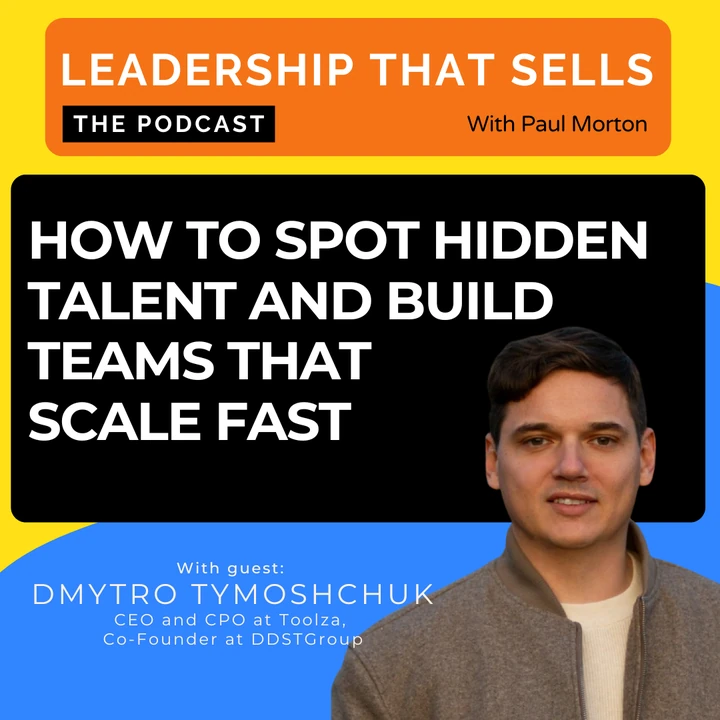
How to spot hidden talent and build teams that scale fast
with Dmytro Tymoshchuk
Show notes
In this episode of Leadership That Sells, I sit down with Dmytro Tymoshchuk, serial entrepreneur, co-founder of DST Group and CEO of ToolsOn, a platform that’s set to transform how digital businesses manage operations. But what starts as a chat about building software quickly reveals a deeper superpower: Dmytro is a master at finding hidden talent and unlocking people’s potential.
We talk about his journey from engineer to entrepreneur, the challenges of managing complex businesses with duct-tape tools like Excel, and the real reason so many startups fail. Dmytro explains how he built not one but two successful companies by spotting greatness in people others overlook—whether it’s a prompt engineer hiding in a basement or a future CTO working their way up from the ground floor.
We get into practical ways to identify raw talent, the questions that matter in an interview, and how to turn people’s passion into performance. If you’re tired of hiring the obvious candidates and want to start finding the difference-makers, this one’s for you.
How to spot hidden talent and build teams that scale fast
– Look for people already creating things, even if it’s not in your field.
– Prioritise hands-on experience over academic abstraction.
– Pay attention to how they speak—clear, precise language often signals deep thinking.
– Give them a real challenge with purpose and autonomy, then see how they run with it.
– Offer remote flexibility as a serious advantage to attract motivated self-starters.
– Nurture internal talent—developing leaders from within often beats hiring externally.
Timeline summary
[02:01] – “I’m a geek who doesn’t code” – how Dmytro helps engineers make better decisions
[04:22] – The pain of patchwork tools: why ToolsOn is built for digital-first operations
[10:10] – “We’re not building a Swiss army knife” – how a framework beats a feature list
[14:45] – 100 customer interviews in 2 months: solving problems people actually care about
[22:34] – Behind the build: the 13-year journey of trust and team chemistry
[29:03] – Finding a prompt engineer in a music producer’s basement
[36:34] – The roadmap mindset: how to turn talent into scalable execution
[43:40] – Why you should train people to be great at what they’re already good at
[46:57] – “Be responsible and live by your conscience” – wisdom from Dmytro’s grandmother
- Connect with Dmytro on LinkedIn
If this episode made you think differently about talent, teams or your own leadership potential, do me a favour: follow the show, share it with someone who needs to hear it, and leave us a quick rating or review. Let’s build better leaders, one episode at a time.
Transcript
Automated transcript. Speaker labels and spellings may contain errors.
Paul
A serial entrepreneur transforming business management. As CEO and co-founder of Toolza, he's building an all-in-one platform to streamline finance, CRM operations, including fiat and crypto transactions. He also co-founded DDST Group, a leader in affiliate marketing, ad monetization, and media buying. Passionate about innovation and efficiency, he's here to share his journey. Dmytro Timoshuk, thank you very much indeed for joining me. Welcome to the Leadership That Sells podcast, where we help you lead first and sell more with great insights and tactics from the best minds we can find. Every leader is in sales, whether you're selling products, ideas, a mission or a vision, and great sales team in particular need great sales leaders.
When managers bring out the best in their teams, targets get hit on time every time without stress. But most sales leaders never learned how to lead. They wing it or they repeat bad habits, and the cycle continues. Sales leaders need practical, real-world ideas that fit their busy schedules, and that's why we created the Leadership That Sells Playbook course. Nine short weeks changes your world. Check it out at the Practical Leadership Academy. And now, on with the show.
Dmytro Tymoshchuk
Thanks, Paul.
Paul
I got the name right?
Dmytro Tymoshchuk
Yep. Yeah.
Paul
I-
Dmytro Tymoshchuk
It's totally correct. Yeah
Paul
... do you know what? This, this is the thing, is it, it's, there's a thing from Dale Carnegie, and he says that the w- the most important words to anyone in this world are their own name. You know? Whether you get it right is good, but also remembering it. My wife is amazing at remembering names. She's really, really good at that. She remembers the names and then says, "Oh, and did your dog get the bone that it was looking for from your aunt's second cousin three years ago?" And she remembered all these crazy details. It's, such a superpower.
Dmytro Tymoshchuk
It's insane for networking, yeah.
Paul
Okay, so that was a very short and far too uncomprehensive intro- introduction to yourself. Can you add something to that, please?
Dmytro Tymoshchuk
Yeah. Uh, thanks, Paul. Yeah. So I would, uh, I would say that, uh, I'm a husband, I'm a father. I'm a father of two boys, four and five years old. I'm, uh, a bit addicted to technology. Uh, I'm fa- I'm an engineer with my, uh, primary education, and I'm, have a bit of, uh, gig skills, let's say. But a part of this, uh, the most funny fact, I think, that, uh, I'm not in coding. You know? I don't write a code. I'm not a coder, but, uh, I'm helping my technical team to implement some sort of things and to, to, um, purify, uh, technical, uh, decisions that they're making. Yeah.
Paul
Are you allowed to be a, a geek type if you don't code, though? Is that a thing? I mean, I call myself a bit of a nerd because I'm a nerd in specific areas. I'm a language nerd, I'm a leadership nerd, I'm a sales nerd. But you geek, you use geek, and that's a very strict term. Don't you have to be a bit of a coder if you're a geek?
Dmytro Tymoshchuk
No.
Paul
Okay.
Dmytro Tymoshchuk
No. Especially now in era of AI. Thank you, but-
Paul
Yeah
Dmytro Tymoshchuk
... I can make it, like, in few clicks. Yeah.
Paul
Yeah. I was playing with, um, what is it? Uh, Replit the other day, which is like an AR coding tool. You basically tell it what it was you want it to build, and it goes off and builds things for you. It's incredible. It's really g- I mean, the, so the agent AI stuff is very, very powerful. That's, that's where the AI thing is gonna be really, really interesting.
Dmytro Tymoshchuk
Hopefully we'll play a role over there as well.
Paul
Oh, okay. All right. So-
Dmytro Tymoshchuk
[laughs]
Paul
... Toolza then, you are trying to streamline business operations. You're trying to sort of integrate multiple management functions into one platform, and I think that's really, really interesting. When you look at where companies are investing today, if you can replace some task, people are interested. If you can replace a role, if you can replace, like, a, a $100,000 role using your platform, that's really, really interesting for investors, really interesting for the market. What is it that drove you? What was the challenge you identified that led you to create the solution?
Dmytro Tymoshchuk
Yeah. It's a great question. So, um, the main thing, like, uh, being a entrepreneur for 13 years, we have, uh, by we I mean me and my partner. We're running business, uh, together. Uh, we have a huge experience, uh, with the business operations, like, overall. Uh, that include finances, HR, lead generation, the customer acquisition, everything pretty much. So the, uh, initial, uh, problem that we faced was with, um, no common site for young businesses to get the tools necessary to initiate the business operations. For example, you need to go to one place to get the CRM. You need to go, to go to another place to get the, uh, accounting tool. You need to go to another place to get the HRM. Of course, it's up to the, uh, size of the business you have, the size of the team you have.
But what if there would be, uh, software on the market where you have all the basic stuff ready, uh, ready to use? It's like the framework that any business can use, pretty much any digital service business can use. And, uh, based on finance perspective, we started to, mm, de- Implement the functions that are necessary for a company to switch from the spreadsheets to the business operations software, or to a particular business operations software. So we made, uh, around 100 customer developments with the players from the affiliate marketing, from PR agencies. We have e- even few customer developments from the, uh, legal service agencies, and, uh, pretty much all of them manage their finances in Excel.
Like, um, they're using, uh, HubSpot to keep track of their customers and partners, like the database, uh, actually. And, uh, m- usually they don't have, uh, anything to make in the HR operations, for example. But a part of that, they have a pretty, uh, decent amount of legal entities, you know, pretty decent amount of, uh, bank accounts, crypto wallets, because a digital business, uh, uh, it's necessary to have, uh, uh, s- um, how does it call? The, the substance, yeah, on the diff- in, in the different locations. So basically, uh, when you get into any accountant and try to explain the complexity of digital service businesses, uh, you're getting stuck because, uh, based on our experience, based on everything that we, uh, passed through for this 12 years, it's something that not really common for the, uh, teams of integrators, for example, and for the, mm, uh, software that's on the market.
Uh, it is possible to build, uh, kinda, uh, framework in a notion, for example, but it's, uh, really tough to be aware of what actually do you need in order to bring the quality of decision-making, for example, or to f- for day-to-day management. So yeah, that's, uh, what we're bringing on the market with tools on. This is the framework that b- that businesses can, uh, switch from, uh, Excel, uh, from very basic tools they're using, and to get partial CFO, partial accountant with the partial, uh, HRD and actually the HR manager, yeah. The place they can manage the team, partners, employees, uh, pretty much all the, uh, necessary thing, yeah, for the business operations.
Paul
Okay. So you're talking this is a technology platform that allows basic financial functions, basic CRM functions, basic HR management functions. Okay?
Dmytro Tymoshchuk
Yeah.
Paul
So my challenge to that, and having lived through, uh, several decades of business and cycles, things start to be centralized and then decentralized, and then centralized. Products are one-stop shops or they're best of breed, or they are point-bought, which means basically you go off and you buy something that does just CRM. You go off and buy something that just does finance. And then the market tends to go, and now you can consolidate, and now it breaks apart again. So this is a cycle that repeats itself over time. I've seen it repeat maybe three or four times in my, in my professional career.
Dmytro Tymoshchuk
Mm-hmm.
Paul
Um, uh, how do you then cope with the challenge that if I'm looking for, uh, HR, finance, uh, CRM, sales, whatever it is, and you're trying to build something that is everything to everyone, doesn't that end up being nothing to no one?
Dmytro Tymoshchuk
Yeah. That's a very good question. Like, uh, we explored this, um, um, idea a few times. We're not building a Swiss knife.
Paul
Mm-hmm.
Dmytro Tymoshchuk
We're not bringing the, um, end solution. For example, with the HR, this is the framework, so you can use it, um, as a very, uh, first, uh, point of, um, interaction with your team, with your employees. But for example, on, uh, at the end, you can bypass all the data, for example, to Gusto, yeah, and have all your, uh, payrolls alongside with your, uh, financial agreements with the employees, um, over there. So we're not bringing like the, uh, final po- uh, f- final point, yeah. We're bas... Uh, we're giving the, mm, basic framework for those who doesn't know or those companies who doesn't have. Uh, we are the building site, let's say, like this. Yeah.
Paul
Okay. Okay. So you're doing this together with your partner, your, your business partner. You're talking about trying to pull many different types of business operations together. You've got experience in business operations. You're looking, I think, how do you... What's your, what's your approach then to try and pull all these different things together? What I'm interested in, I think, here, is how do you get the right knowledge, the right information out of the right people? How do you pull it all together? 'Cause I think it's very easy to ask, either ask the wrong questions, not ask good enough questions. I think it's very easy to, to, to go down the wrong path. And I'm wondering what I'm trying to ask here. I'm looking at the human side of this, okay? 'Cause the technology's fine, absolutely, but people listen to this, when they do, for the, the, the human, your experience in how you brought people together to deliver something.
Okay?
Dmytro Tymoshchuk
Yeah.
Paul
So it's your leadership that then goes off and makes something you can sell. How do you pull that together? What's the... What's your, what's your-
Dmytro Tymoshchuk
Yeah
Paul
... approach?
Dmytro Tymoshchuk
Yeah. So, uh-
Paul
Why as well.
Dmytro Tymoshchuk
[laughs] Yeah. So, uh, the main thing, uh, during our, uh, digital service, uh, business, uh, it's like 12, 13 years now, uh, we spoke with our partners, with our clients. Um, we try to find a... Because we don't have basic education in management, in finances. Like I'm the engineer. You might have, uh, as well, uh, non-operation, uh, how does it calls? Degree, yeah. The-
Paul
Yeah. Some qualification or other, yeah.
Dmytro Tymoshchuk
Qualification. Yeah. All right. So, uh, basically we made a very long time customer development, let's say, like this. On the market we been present. The market is around 4,000 companies-
Paul
Mm
Dmytro Tymoshchuk
... uh, with the average, uh, size of 10 to 15 people, I think it's like, uh, if we would say, uh, the average size. And the problem, uh, exists for a decade so far, uh, because the service business, it's not something that could be aligned, uh, with the rules for accounting, for example. And you need some sort of, uh, tool to bring it to pre-accounting, let's say, like this. Yeah. For the primary invoicing or primary reporting to see the balance, to see the P&L before it goes to the accounting software to anywhere, right? And there was no solution like this. So, uh, we come up with the slow cost def, let's say, during 10 years, and recently w- we finish up, like when we initiate to build the tools up, we made two months really, uh, tight schedule of customer development
with the companies who's doing digital service business, like consultancy agencies, PR agencies like I mentioned before. And, uh, with this, uh, expertise, uh, we brought the, uh, solution. Uh, the one thing, like I'm gonna, uh, mention now, like usually, uh, usually people asking this, uh [laughs] , in the end, uh, regarding the books. So, uh, we read The Mom Test, yeah?
Paul
Mm-hmm.
Dmytro Tymoshchuk
Uh, the book about the customer development. And we, uh, really got a lot of, uh, energy by, uh, pulling these ideas to work through, and we got the, uh, result from the first interviews we made, and we couldn't stop. Like, we made it for two months. We made 100 customer developments, and we just, uh, at one point we decided that we need to stop and to make the first version of the product to start to deliver. Because, uh, by the time we understood the pains, uh, the pain points of our customers, uh, we start to dig in too much.
Paul
Mm.
Dmytro Tymoshchuk
We need to... We define the first problems, and we start to implement the, mm, better decision, better decisions than we, that we, uh, uh, plan to make initially, right? So, uh, the expertise coming from the people who demand the product.
Paul
So you, you were clear about trying to solve a problem that existed rather than trying to make something up. I think that's-
Dmytro Tymoshchuk
True.
Paul
Yeah. That's, that's... If you look at most of the s- most of the businesses that fail is they end up trying to solve a problem that doesn't exist.
Dmytro Tymoshchuk
Uh, that's true. Yeah. We're coming from the market.
Paul
Mm. Or you're trying to solve a problem that does exist but that people aren't willing to fix. 'Cause if you-
Dmytro Tymoshchuk
Uh-
Paul
Yeah. You look at, you-
Dmytro Tymoshchuk
Yeah
Paul
... you ask people, "Is this a problem for you?" Yes, it is. Now, been there. I was with a business actually who spent several million pounds, it was a big corporate. They spent several million pounds trying to solve a problem, built a platform, then took it out and they showed it to people, and people went, "Ah, it's fantastic. It's a wonderful solution. Great." And nobody would buy it. Why is nobody buying it? Does it solve a problem? Yes. Does it solve a problem you'd be willing to pay to have fixed? No. Shit. [laughs]
Dmytro Tymoshchuk
True. True.
Paul
Oops. That is a problem, because if, if it's not something that they are currently fixing with bits of Post-it notes, and sticky tape, and spreadsheets, then they're not fixing it. They don't care about it enough to fix it. It's a problem. It's a thing they've identified, now you've exposed it. Would they like it? Yes. Would they like it for free? Maybe. What- Even if it's free? Maybe. Would you like to pay for it? Eh, not so much. So it's too difficult a problem to fix or not as important enough, or it's too expensive to fix in terms of time if I was anything else. So you've identified a nice niche here, a nice, a nice problem set where-
Dmytro Tymoshchuk
Sure
Paul
... people have come and said, "Here are the priority. This is the priority." Okay. "Here are the other things I need to have done. Here are the, the, the challenges that I've got, and I'm already trying to deal with it in spreadsheets and PowerPoints and stuff. If you can make it just a little bit easier for me, I'll pay you some money."
Dmytro Tymoshchuk
Yep.
Paul
So they're not ready for Salesforce. They're not ready for, I don't know, QuickBooks or whatever the accounting, whatever the different systems are. They want tools up, which will then allow them to get to a stage where they can get something else. You're, you're, you're targeting this intermediate layer, right?
Dmytro Tymoshchuk
True. Yeah.
Paul
Okay.
Dmytro Tymoshchuk
This is the idea. Yeah. This is the idea, and this is the part of, uh, mom's test when you ask the potential customer if he wills to pay. But we're lucky enough to have, uh, mostly, uh, positive answers.
Paul
Mm-hmm.
Dmytro Tymoshchuk
But the, uh, best part of this, when they're asking, "I hope it's not gonna cost thousand per month," we're like, "It's fine. It's not gonna be. You're good."
Paul
Yeah.
Dmytro Tymoshchuk
So yeah, we've been lucky enough. Uh, but we're gonna start to deliver this month, February 2025, uh, we're gonna see, like being entrepreneur is a kind of gamble, so-
Paul
Mm-hmm
Dmytro Tymoshchuk
... we're gonna see if it works out, hopefully. [laughs] 'Cause we spend a year, uh, 100% fully concentrated, uh, on Toolza.
Paul
So this is your MVP.
Dmytro Tymoshchuk
Um, I, I would say we bypass MVP during demo calls-
Paul
Okay
Dmytro Tymoshchuk
... because after the customer development, we made the demo calls, uh, to understand if the platform clear enough for the potential customers, and, uh, we made, uh, uh, I would say self-onboarding on the, uh, Westland. [laughs]
Paul
[laughs]
Dmytro Tymoshchuk
So it's something that the, the person should suffer to get. So what we made, uh, we give the, uh, bolt platform, uh, and we said that, "You're, you want the system?" He said, yes. We said, "Then we need your help. You need to fulfill the platform, and, uh, your final goal is to create the invoice." So this is basically, uh, the quintessence of the system. You know, when you got the invoice, that means that you're gonna have reports. You, by, by the time you, you get invoice, you, uh, fulfill the team with the employees, with the structure of the business and everything. So there is a certain path that a, a potential customer should pass through. Yeah? So, uh, they made it in 40 minutes. There was guys who made it in 50 minutes, but I think it's not the, not the worst scenario, you know.
Of course, they were motivated. We spoke with them before. But, you know, being the person for whom the software solved the problem and to make it run in 40 minutes, it's something that we're pretty... It, it brought up some confident, yeah, confidence, uh, to, to, uh, mm, to initial idea what the, what we're, what we're building. Yeah. So yeah.
Paul
Okay. So you've got, you've got the platform. You've got, um, your customers. Everything's going well. Talk to me then more about the people who built it, because that's the most interesting part. Yes, delivering something to market is, that's the, that's the end of the journey. But I think like life itself, the journey is the destination.
Dmytro Tymoshchuk
Yeah.
Paul
So it's, it's the process of building it. Uh-
Dmytro Tymoshchuk
It's true. We have a, we have a great team that, uh, been, uh, working with us in DDST Group. Uh, we took a slice of the team n- with the technical stack that we demanded for Toolza, and, uh, we asked for former CTO of DDST Group if he wants to move forward in his life journey [laughs] and to join this, [laughs] kinda, you know, uh, tricky path of, uh, being a startupper as well. So basically he agreed from the, uh, very question. Yeah. And, um, it's three of us, three co-founders. Uh, I'm doing m- mainly, uh, uh, CEO responsibilities. Uh, another Dmitry, uh, Dmitry Shevchenko, he's doing the operations. Uh, and, uh, Matvey, uh, he live, uh, a bit far from us in Andorra. Uh, he doing, uh, CTO. So he's the CTO, and he's dealing with all technical task- tasks that we have.
Uh, basically right now, uh, everything on his shoulders.
Paul
Mm-hmm.
Dmytro Tymoshchuk
As for the background of our team, uh, with the DDST Group, we build a lot of micro products for, uh, m- mobile premium portals. It was something popular, like, uh, in 2010, 2015. Uh- Afterwards, uh, being the service company, we had the customers for whom we successfully closed the projects, and the team was, uh, uh, I think like during four or five years altogether, so we're pretty solid in this term. Uh, by saying for, uh, as for C-level, uh, me and Dimitri, we worked together for 12 years. It's... Sorry, thir- [chuckles] 13. It's 25, yeah, right. And, uh, with Matvi, we're working for nine years. So he was the third person who came to DDST Group, and by the time he, uh, improved that much and become the CTO.
Um, yeah, and in 2023, we spoke with him deeply, uh, and he said that he wants to move, he want to move further. That's why, uh, it's three of us, uh, doing this. Yeah.
Paul
What's your biggest leadership challenge?
Dmytro Tymoshchuk
Um, to find a talent. To find a talent, because I have a really nice experience of finding talents where they shouldn't exist. For example-
Paul
Tell me.
Dmytro Tymoshchuk
Yeah, yeah, yeah. I'm, I'm going to tell this story. It's really, really cool. Just before we started Toolza, we had the, as a part of, uh, service business, uh, we had, uh, uh, AI, uh, content generation on demand. Yeah. We had the clients who ask for the content, and being myself, uh, a bit in technical part, yeah, understanding how it works, understanding the framework, it was the question of the person who wants to become a prompt engineer and have a, uh, it... and have a taste, you know, with the visuals, have, uh, understanding how the, mm, visual should be appealing, how it should attract the, mm, final, uh, customer for our partners. So I started to dig, uh, being Ukrainian, yeah, I started from the Ukrainian market u- with Ukrainian jobs market, and of course, like two years ago, it's, it wasn't too much, uh, people who actually understand what's AI in general.
So I start to dig in, and I found a guy who was actually making music. He was, uh, sound producer, like really minor sound producer, somewhere in his basement, you know, doing some sort of stuff, looking for a job, uh, to have some money. And it's like just some, you know. Uh, but I don't know why, it's like, uh, I just assume for myself, like, if this guy, uh, make results with the music, then probably he have this feeling, you know, of the, uh, of what's the customer wants. Like, he, he'd been doing really well because it was, uh, before the war in Ukraine, okay? So he lost a main slice of his customers because of the war. And basically, I came up to him, spoke with him like, "Are you in AI?" He's like, "Yeah, I'm kind of fond of it." It's like, okay, sounds good. I gave him a few examples to generate the, uh, images for me.
Uh, he made it fine. I made few creepy images on the purpose, like to define if he have this, this tech.
Paul
Mm-hmm.
Dmytro Tymoshchuk
And he made it. He made it really well, and since then, two years, he works in DDST, works fine. The customer's happy, he's happy, and you know, he become a prompt engineer right now 'cause he know all the techniques. He know how to run LoRA, how to run local models, what the technical stack should be to, uh, initiate the, uh, image gen- image generation models to run. It's plenty of stuff he learned during these two years. Yeah. So, a- a- and it's not the only story we have regarding people that, uh, mm, that been doing, uh, another business, had another stack, uh, and we basically brought the opportunity to express, uh, himself. Yeah. So finding bright talent in, uh, unex- in unexpected places, yeah, it's something that we like.
Paul
That's the... Okay. Uh, uh, uh, this is getting really interesting. This is the bit. It's where you uncover that there is actually a reason that you're, you're running two businesses, you're scaling two businesses, okay? And the reason seems to be you can find the right people, because-
Dmytro Tymoshchuk
Probably
Paul
... you can have a good idea. I mean, the, the best ideas are killed by the worst teams, but an average idea can be turned into the proverbial rocket ship by the best team, right? So an average, just an average idea, but really good people can take that and turn it into something amazing.
Dmytro Tymoshchuk
True.
Paul
So you've found talent repeatedly. Uh, the English expression would be down the back of the sofa, you know?
Dmytro Tymoshchuk
[chuckles] Yeah.
Paul
Right?
Dmytro Tymoshchuk
True.
Paul
And in my house, you put your hand down the back of the sofa, and you find sticky bits of ... chocolate and stuff like that because my kids just, they use it as a bin, right?
Dmytro Tymoshchuk
Yeah.
Paul
Um, but you put your hand down the back of the sofa, and all of a sudden you've brought out a CTO. All of a sudden you've brought out somebody who's a prompt engineer. You've brought... You've found these people, and you've then shaped them into something of real value. Go into this a bit more. This person you found, this musician, this music producer you found, w- who, who were they to you before you found them?
Dmytro Tymoshchuk
Mm, nobody. I never knew them. I found them on the, uh, Ukrainian job website.
Paul
So you were, you were going out, doing a bit of, well, it's almost like a sales process. Well, everything's like a sales process. That's what I love.
Dmytro Tymoshchuk
Pretty much.
Paul
Right?
Dmytro Tymoshchuk
Yeah.
Paul
You, you were hunting.
Dmytro Tymoshchuk
Yeah. He was mentioning that he, uh, using, uh, some sort of AI in his, uh, music production, but I think for him it was just keyword, and for me it was a trigger. [laughs]
Paul
Uh, okay. So you, you have... Do you think it's a sense, or is that something that other people can do? Where I'm going with this, where I'm going with this-
Dmytro Tymoshchuk
Yeah
Paul
... if you've got an innate sense of something, that's great. Good for you. Congratulations. Damn all your stay anyone else. If you have the ability to take that innate sense and then quantify, qualify, and explain it to somebody else who can do the same, all right? So let's imagine you're trying to teach me how you do that. Where do we start?
Dmytro Tymoshchuk
Hmm. That's a nice question. Let me think about it. Uh, I would definitely look for the people who try to make, uh, something themselves but never found a real world usage, uh, in a sense. For example, uh, being a student when you study in theory, it's something different from being, uh, actual employee and doing appliable job, yeah, uh, with the same knowledge that you can apply. So, um, basically I can give you example of the, another idea I had three years ago, and I was, um, actually, I never initiated, but, uh, I wanted to... Hmm, I always wanted to, like, I'm keeping it away for more, uh, calm times for me, yeah? It's, right now it's, uh, a bit, uh, more intensive where the tools are. It's, uh, impossible to run something, uh, apart tools are.
But the idea, yeah, so, uh, the, uh, pillow for the flights, you know this pillow?
Paul
Mm-hmm.
Dmytro Tymoshchuk
Yeah. So everybody has a problem with it. Like, there is no, uh, one choice pillow for this. And I decided to move, uh, with another path, to find an engineer w- with, um, for example, the student or some engineer who's doing, uh, like, uh, appliance jobs, you know? There is plenty of people who's doing this, and offer them the idea to bring on the market. Uh, because of the service digital, uh, uh, uh, of the, uh, s- service business experience, I can bring the product on the market and to spread it around the masses doing the marketing, for example. Yeah? So the initial idea was to, uh, find an engineer who can only draw and cut, and, uh, being a fan of, uh, 3D printing, yeah, try to, uh, make the first, uh, samples 3D printed. So this is my, uh, workflow, let's say, like this, with the ideas.
Paul
Mm-hmm.
Dmytro Tymoshchuk
I'm not trying to push them by myself, but I'm trying to, uh, make a roadmap, for exam- let's say, like this roadmap, yeah? And looking for the solutions that simplify the path by finding right stack of skills for the people who haven't found themself, let's say, like this, or are looking to, uh, improve, uh, where they are or are looking to apply their skills on something different, valuable, and, uh, more interesting, let's say, like this, for themselves. Yeah.
Paul
Okay, so you have a, a, you have a seed.
Dmytro Tymoshchuk
Could be.
Paul
A seed of an idea.
Dmytro Tymoshchuk
Oh, yeah. In this sense, yeah. Right.
Paul
A seed of an idea, and then you're looking for, you're looking for people who like planting flowers in their garden. But they've never really tried to... I'm looking for an analogy here, and I'm failing to find one. Maybe you're looking for a seed of an idea, and you're looking for somebody who likes planting carrots, but they've never thought about trying to serve the supermarket-
Dmytro Tymoshchuk
Yep
Paul
... because they wouldn't. Why would you do that? But they're really good at planting carrots, and you can think, "Actually, if I give you my special seed, okay, maybe you can take your skill And apply it slightly larger.
Dmytro Tymoshchuk
Yes.
Paul
How do you get that person to, to have the confidence that this is the ... that they can do it themselves? 'Cause I think a big part, one of the big parts of leadership for me is unlocking the greatness inside of them.
Dmytro Tymoshchuk
Yes. Yes.
Paul
Okay? Most people have great skill that they just don't know about, and that speaks to me of servant leadership. Uh, if I can be of service to you as an individual in helping you unlock the potential that's inside of you, we can together do great things.
Dmytro Tymoshchuk
Yes. So, uh, the first thing is, uh, it's, uh, it's not 100% success, for sure. There are people, as you said, as you mentioned, the great skills, but they're either lack of ... They have either lack of motivation, either lack of time, or they're just not ready for this, you know? So particularly I'm looking for the people who has this passion to move, who has this passion, uh, to align with the same values that we have. And, uh, basically I can pretty much define it, like in 80% with the first interview. We're making ... It's for 40 minutes, 30 minutes, you know, to get know each other, and, uh, I'm starting, uh, to bring the value and, uh, explain the possible opportunities that, uh, certain person can get by
pivoting, let's say like this. Yeah?
Paul
Mm-hmm.
Dmytro Tymoshchuk
Or getting the job at our place, uh, for example. Yeah. So this is the initial idea, to have the interview to hear the people. But yeah.
Paul
What do you ask?
Dmytro Tymoshchuk
I'm getting, I'm getting-
Paul
Stick on that for a second. What do you ask them? You talk about, d- are they aligned with our values. Okay. What do you ask?
Dmytro Tymoshchuk
Uh, first of all, I'm, uh, I'm checking the background, uh, with their words. If they speak, uh, let's say, um, purified language, yeah, without, uh ... It's like the literature language, for example. Yeah?
Paul
Mm-hmm.
Dmytro Tymoshchuk
Uh, those people sound a bit nerdy. Yeah? And, uh, those people have, uh, uh ... I don't know. This probably a sense of the person, yeah. I never, uh, mis- uh, made mistakes a lot with def- defining the general, uh, portrait of the person. Yeah? Uh, there was some ... Of course, there was some mistakes, uh, when, uh, using this, uh, workflow. We found people who was not aligning with the values, uh, in, in the terms of, uh, working hours, for example. Yeah. Because something that we consider as well. Yeah, so, uh, I went, I went to s- somewhere. Yeah, so I'm, I'm stuck. [laughs]
Paul
No, no, no. It's okay.
Dmytro Tymoshchuk
Let's get back to the question. Yeah.
Paul
This, this, this is, this is good because you've ... I think we've just ... I'm, I'm sure you've known it yourself, but we've just identified your superpower. So you have the seed of an idea. You had Tulsa.
Dmytro Tymoshchuk
Yep.
Paul
You had the, um, DDST. You have this magical idea of your neck pillow thing, uh, which I'll, I will buy the first one, by the way, so I'm your-
Dmytro Tymoshchuk
Great
Paul
... first customer.
Dmytro Tymoshchuk
Deal. [laughs]
Paul
Um, and you're looking for somebody who has a core part of how you would translate that idea into something useful. Okay?
Dmytro Tymoshchuk
Yep.
Paul
So an engineer, typically an engineer or an artist or a pra- a practitioner, somebody who does something, somebody who has a connection to, uh, to, to reality, not the abstract.
Dmytro Tymoshchuk
Yep. Definitely.
Paul
And then you identify are they, are they a pragmatic person or are they abstract? You use ... You, you identify language. If they talk in the abstract, uh, I think that might be what you're trying to get to.
Dmytro Tymoshchuk
Yep.
Paul
Are they academic and abstract, or are they realistic and hands-on?
Dmytro Tymoshchuk
Yep.
Paul
Can you do this, or have you only ever read about it?
Dmytro Tymoshchuk
Or are you ready to, uh, approach to make it? Yeah.
Paul
Mm-hmm. Mm-hmm. And then you get them on board and you give them the opportunity. You give them the tools. You give them the mot- It's like a murder scene, you know? You have to have the motivation. You have to have the opportunity, you know?
Dmytro Tymoshchuk
Yeah.
Paul
So you have to have the motivation, you have to have the opportunity and the tools and the, and the, the, the capability to do this. And you-
Dmytro Tymoshchuk
Another ... Yep.
Paul
Go on.
Dmytro Tymoshchuk
Another leverage that, uh, we bring in, actually, it just ... You helped me a lot to identify this right now. Another leverage that we help, that we're bringing is the online job. It's something that people, uh, dream of, and basically, uh, our team of 110 employees working remote, uh, everybody, everybody's online, everybody's on site. Uh, there is n- no penalties that we have in the company for 12 years, never, for not being present. So we bring this opportunity to get in, uh, online, and we not hesitate to bring people without experience Initially, we hired people without any experience in digital marketing, for example, yeah, and we taught them everything that we know, and we build a, a tool set for them
to get onboarded really in easy way. For example, uh, just, just a brief example, to have the password manager. It was not so common in 2010, 2012. Nobody used pretty much the password managers. Now it's getting mainstream, but we use it since 2014. Yeah, yeah, this is the case, but this one is for crypto, all right?
Paul
[laughs]
Dmytro Tymoshchuk
[laughs] Yeah.
Paul
Cool. Very cool. All right. Uh, that, that's a, that's a fascinating angle. Okay. Uh, I'm conscious of time, and as much as we could keep talking about this for, for a very long time, 'cause I'm fascinated by how you ... I mean, f- finding the right people is a superpower. Finding the right talent is a superpower. It is absolutely, it is without question the ... It's the first thing that every major thinker writes about. You know, you have, uh, getting people on the bus, getting the right people on the bus, getting the right people into the right roles, managing from strength, finding people, what people are good at, and getting them to do that and not what they're bad at, which is a lot of what we spend our time on.
We spend our time trying to train people to get better at stuff they're bad at. Why? Right? Why don't you train people to get incredible at stuff they're already good at? Because the difference between somebody who's a bit crap at this and a bit all right at that, that's meaningful, but the difference between somebody who's really good and somebody who's amazing, that's where your, that's where your rocket ship takes off. That's where you get to Mars, you know? So strength-
Dmytro Tymoshchuk
That's why you should ... Yeah, that's why you should always give the people opportunity.
Paul
Yeah.
Dmytro Tymoshchuk
When I was working on my first job, uh, I was really proactive over there. I implemented a different structure of, uh, URLs we used to, uh, we, we used. Uh, I implemented the, uh, Google Analytics that were not used by the company of 2,000 people. And but I was just simply just a regular one with experience, like, of 11, 12 months, and basically I felt myself that if you want to bring something and you bring the value, this is nothing that you can't do. So right now, uh, in the company, in DDSD Group, like, we're not dealing with a day-to-day m- job over there, but being on the board, something we discuss with our HR department, uh, we try to, uh, define internal talents. We try to define, uh, who, who is capable to pivot, either who's capable to get on the higher position, for example, to manage certain business.
Because still, uh, 110 people, not that much, like, understanding right now, and, uh, there is, uh, tons of ideas that could be, uh, tested, but there is no people who are able to manage them. And the path to educate the person to be a leader in the sense of a project, yeah, some particular small project, uh, it's way shorter than to find a leader from the scratch, like from the, uh, interview. Uh, because they know the, the system, they know the people inside of the business, they know whom to ask, they know everything pretty much. So cultivating people inside of the company, it's something that we're doing really well since, uh, this, uh, 13, for 13 years, yeah.
Paul
Bravo. Very good. If there was one message you wanted to leave the world with, if I gave you 10,000 billboards and a huge pot of paint, what would that one message be that everyone would see that would be coming from you, Dmytro?
Dmytro Tymoshchuk
Yeah. Uh, be responsible and live by your conscience.
Paul
Ooh, I like that. Be responsible.
Dmytro Tymoshchuk
Uh, it's something that my grandma taught me. [laughs]
Paul
Okay. What does it mean?
Dmytro Tymoshchuk
Uh, it mean if you want to do something, for example, living here in Spain, when, uh, people throwing out the, uh, burning cigarettes on the highway, you know, they're not responsible. And be responsible in any sense. If you need, there's somebody need help, offer it. Yeah.
Paul
Mm-hmm. Mm-hmm. Marvelous. We will take that. Where can we find you when we need you, Dmytro?
Dmytro Tymoshchuk
Yeah. I'm fully available on LinkedIn. You can find me with my first and last name easily. Either Toolza.io, I'm over there as well, yeah.
Paul
And when is Toolza gonna be available to the general public who need it?
Dmytro Tymoshchuk
General public who need it gonna be after the March, so probably April, May is gonna be available for general public, because we finishing our, uh, conventions that we're visiting. It's gonna be, uh, nearby here in Barcelona, and in, uh, Emirates. It w- it will be two conferences we're visiting. Yeah, so by the chance if you're gonna be over there, so hit us. [laughs]
Paul
Dmytro Timoshuk, thank you very much indeed for joining me.
Dmytro Tymoshchuk
Thanks, Paul. Glad to be there.