Show notes
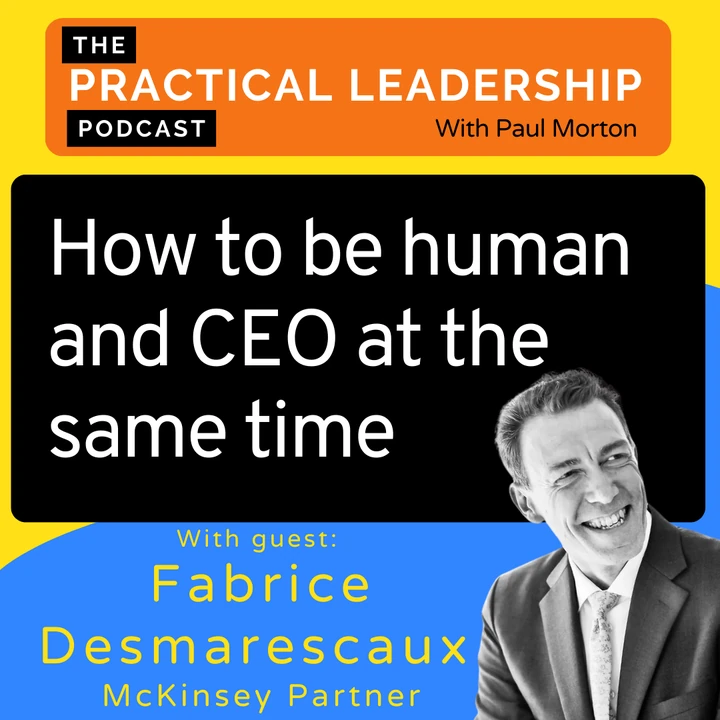
In this episode I had the pleasure of speaking with Fabrice Desmarescaux, who brought profound insights from his experience in leadership development with McKinsey in Asia.
Fabrice shared his holistic approach to leadership which encompasses not just business performance but the human elements that drive sustainable success.
He introduced several key concepts for leaders striving to balance their roles with their humanity:
- Leadership Retreats: A method to gain clarity and rejuvenate one’s purpose and strategy.
- Four Dimensions of a Balanced Leader: Physical, emotional, mental, and spiritual well-being are essential for a leader to function optimally and compassionately.
- Sustainable Leadership Practices: Advocates for a balanced approach that fosters an environment where employees and leaders alike can thrive.
Fabrice’s approach challenges the traditional corporate focus, redirecting leaders towards a path that values both achievement and well-being.
Impactful quotes from Fabrice include:
- “With great power comes great responsibility.” Reminding leaders of their influence and duty. (00:06:41)
- “You need to find fulfillment every step of the way because this is a journey, not a destination.” A call for persistent self-awareness and presence. (00:08:44)
- “I only need five hours of sleep because I’m so strong and superior… that’s complete BS.” Debunking the myth of the ever-enduring leader. (00:07:29)
- “Happiness is very fleeting… fulfillment I think is much more important.” Shifting focus from momentary happiness to long-term fulfillment. (00:15:13)
Find Fabrice here:
https://www.linkedin.com/in/fabrice-desmarescaux/
Buy his book:
https://www.amazon.com/Art-Retreats-Leaders-Journey-Clarity-ebook/dp/B09RQ31S88/ref=sr_1_4
Transcript
Automated transcript. Speaker labels and spellings may contain errors.
Paul
Balancing organizational growth and creating organizations that allow humans to flourish, not just delivering the number. Trying to build something that is sustainable. [upbeat music] Hello, and welcome to the Practical Leadership Podcast. I am your host, Paul Morton, and we are talking about leadership, management, and the various lives that surround it. It's my joy, delight, and privilege to bring into my studio some of the smartest, wisest people I've been able to find for your delectation and enjoyment, and I hope that you do get a lot out of the conversations that we have here. When you realize that your management team has grown too fast or you've inherited a new team, and the fastest, best lever you have for growth and improvement is attached firmly to those managers, get in touch.
I help you run management, coaching, and training programs that'll make a big difference really quickly. You can find me at the Practical Leadership Academy website and on all the usual social channels. [upbeat music] Fabrice de Mareschal joining us via Singapore in Bangkok today. Thank you so much indeed for joining.
Fabrice Desmarescaux
It's a pleasure to be with you, Paul.
Paul
Would you be so kind as to introduce yourself?
Fabrice Desmarescaux
I am a Frenchman who has, uh, spent most of his life in Singapore, so, but I still hold a French passport. Um, I am a partner with McKinsey & Company, the consulting firm, uh, where I look after our, uh, leadership development practice in Asia. I am married, and I have a twenty-five-year-old, uh, daughter.
Paul
You must be-
Fabrice Desmarescaux
My topic that I love is, uh, developing leaders. That's, uh, my passion in life.
Paul
Magnificent. So, the, the, you wrote a book called "The Art of Retreat: A Leader's Journey Towards Clarity, Balance, and Purpose." And as I alluded to in the introduction there, the challenge of building organizations that milk the environment, that milk the individuals who work for them, leaves us all empty, shallow, and barren. Yes, we do a number, but so what, and so what? And one of the challenges that leaders in these organizations have is that we're all taught that that's what we do, and we forget about the holistic. So where do we go? Where do we start? What's the actual problem set we're trying to solve?
Fabrice Desmarescaux
That's right. I, I, I would start by saying I, I don't believe in conspiracy theories, so I don't think someone sat down one day and said, "You know, I'm going to design a system that is going to extract the resources of the Earth so that we can destroy the environment and change the climate and alienate the masses who work in the corporate world." I, I, I don't think it happened like that. I think it's where we are today is the evolution of a system that is, uh, that has been evolving for about years, maybe years, which is essentially the modern capitalist system that emerged after the second Industrial Revolution. And that system has produced immense wealth and, and growth, has lifted literally billions of people out of poverty, has given us, you know, modern healthcare, uh, mobile phones, uh, trains that run on time, or at least hopefully in your country they run on time.
Paul
Absolutely.
Fabrice Desmarescaux
Uh, not, not, not so much anymore, but, uh, it, you know, and, and planes that fly and, and, and, you know, all the marvels of, of the modern world. So my, my point here is not to say, you know, we need, we need to, to throw away, uh, the capitalist system, uh, because it's bad and it destroys the world. Uh, what I'm, my, my quest is to say, h-how do we complement the system that we all know very well so that we can be, and particularly for leaders, because we have, as leaders, the responsibility for the companies that, uh, operate in the world. What can we do as leaders to create a better future, a better world? Uh, what can we do as leaders to create organizations where people flourish instead of being alienated? I mean, you know, I was reading the latest, uh, employee engagement surveys in the US, and I think it's, it's less than thirty percent of employees are, are actually
engaged in their jobs. How, how did we get there? You know, in a, in a world where, in a knowledge economy where most people are educated and, and, and choose to go to work, how, how did we get to a point where people actually don't like their jobs and don't like their companies, right? So what can we do to change that? And, and I think as leaders, it is our responsibility to, to invent the future. And, and one of the solutions I have, it, it's probably not a magic, uh, wand, but it's, uh, it's definitely, uh, proven to, to work quite well, is to, uh, complement the, the hardcore side of leadership with a, a softer approach that is focused on human development, self-awareness, self-reflection, taking time out to see the big picture, an appreciation of systems dynamics so that we are not just looking at our own little silo, but we understand the impact that we have on the world.
And also a, a very solid understanding of what makes teams work, and particularly teams at the top. Because if I'm not alone as a CEO, but I have a very strong team that really operates cohesively with almost a single consciousness around me, I can, I can re-really leverage my action. So, so that's, that's, uh, what we bring to, to our clients. It, it may sometimes sound surprising that a consulting firm that is really associated with, you know, hardcore performance and strategy would also be interested in, in human development, human flourishing, and, and the creation of the leadership of the future. But that, that is really my, my passion and the topic I've been, you know, working on for the last two or three decades, and, and, and which I captured in, in this book, "The Art of Retreat," which is really the inner journey of a leader.
How, how can you as a leader develop this inner journey so that you become much more aware of yourself, of your teams, and of your environment? So I know it's a, it's a long answer, Paul. I apologize, but-
Paul
Well, that's what it's-
Fabrice Desmarescaux
That's as short as I can, I can do.
Paul
That's, that's what we're here for. That's what we're here for. So, I mean, looking then at the people that you work with every day, which is the chief execs of big companies, you've got- An individual who has at their fingertips and on their shoulders the responsibility for the lives of 10 or 20,000 other human beings. And there's a lovely phrase of putting your own oxygen mask on first. You know, when you're on the plane coming from Singapore to Bangkok there, they said, "And please, if you're travel- traveling with somebody else, put your own mask on." So the leader themself, the CEO thems- him, him or herself has to look after him or herself, and then their team, and then that cascades down. So in the same way as, you know, as you said McKinsey is focused on delivering the hard number, deliver that number. Starting at the top, the responsibility is, I think what you're trying to explain, is it, it evolves into being responsible for caring for performance, caring for the individual to deliver the how.
Fabrice Desmarescaux
Well, I think you're, you're very right when you say we need to take care of ourselves before we can take care of others. Uh, it's true on an airplane. It's, it's definitely true in the, in the corporate world. Um, now, taking care of oneself doesn't mean acting out of self-preservation to grab whatever I can for myself and leaving the crumbs for, for the others, right? Uh, as a, as a leader, and, and the larger the organization, and therefore the more powerful the leader, I believe the greater the responsibility that you have-
Paul
It's like Spider-Man
Fabrice Desmarescaux
... to care for the entire system, right?
Paul
It's like Spider-Man.
Fabrice Desmarescaux
And... It's like Spider-Man.
Paul
Responsibility. With great power.
Fabrice Desmarescaux
With, with great power comes great responsibility. And it is difficult for a whole number of reasons that we can, that we can get into to really care for the organization and care for the people if you yourself as the leader, you are not in a, in, in a right place. And by right place, I mean balanced mentally for sure, but you need to be balanced emotionally. Increasingly, I think we're starting to recognize, and there's research that shows that we need to be balanced physically. So we need to-
Paul
Oh
Fabrice Desmarescaux
... reach a, a stage where we can actually manage our physical energy. Sleep in particular, because lack of sleep leads to very poor decision-making. That's been very firmly established. And as a leader, you make decisions, and so going the, the macho way and say, "Ah, you know, I only need five hours of sleep because I'm so strong, I'm so superior," you know, that, that's complete BS. So you need to take care of yourself physically, and I would add you need to take care of yourself spiritually. You need to have a very strong sense of what is your role in the universe, what, what, what is yours to do, what is it that you should be doing that no one else can do, and deriving daily fulfillment from what you're doing.
You know, it's not about, oh, in three years, uh, you know, I'll, I'll be happy when we get there. I'll be happy when we get a market capitalization of $10 billion, or I will be happy when my net worth is, uh, $50 million, or what. You know, I will be happy when.
Paul
Mm.
Fabrice Desmarescaux
That, that's complete... I'm not sure we can swear on your podcast, so I'll say it's complete BS.
Paul
Sure.
Fabrice Desmarescaux
Yeah. Okay. All right. Okay.
Paul
We're not a podcast. It's fine.
Fabrice Desmarescaux
[laughs]
Paul
But as you said-
Fabrice Desmarescaux
Okay
Paul
... that frankly is-
Fabrice Desmarescaux
Yeah
Paul
... is, is-
Fabrice Desmarescaux
It, it, yeah, it, it-
Paul
... journey
Fabrice Desmarescaux
... it's completely ridiculous.
Paul
Journey.
Fabrice Desmarescaux
Right? So I, I will be... It... There's no destination, and in the world of leadership where we've been brainwashed to believe that everything is a destination, my annual budget is a destination. I will be happy when I meet my targets. I will be happy when I meet my numbers. I will be happy when I get promoted to vice president. I will be... That is complete bollocks. You need to find fulfillment every steps of the way because this is a journey, and this is not a destination. So you need to have this spiritual fortitude in a way that you are on the right journey 'cause there's no point climbing the ladder if at some point you realize it's leaning on the wrong wall. And, and so it's these four, it's these four components of, of finding balance in a world that is increasingly insane.
And I can, you know, tell you that CEOs are under so much pressure from their boards if, if they're a publicly listed company. But from all constituencies and stakeholders, they are 24/7. There's really no place to hide. They are facing a, a degree of complexity in the environment that, you know, we didn't have even 20 years ago because the pace of change has accelerated, and there are so many unknown unknowns today-
Paul
Mm
Fabrice Desmarescaux
... that decision-making has become incredibly complex. You know, you, just to give you a simple example. You, you, you do an acquisition. The investment bankers will give you a nice PowerPoint and, and Excel spreadsheet showing the synergies and the value that you can create through that acquisition. But who's gonna manage the post-merger integration? And do you really know how this is gonna work when you merge two cultures, when you merge two sets of individuals with different habits, different behaviors, different mindsets, right? They don't tell that in the PowerPoint. And, and this is the kind of complexity that as a CEO, and particularly a CEO of a large corporation, you're facing every day. So all this, you know, is, is very, very demanding, very taxing, and that's why you need to, to find this balance on, on the f- these four dimensions, physical dimension, emotional dimension.
You cannot lose your temper. You cannot get depressed. You have to, to find joy in everything you do.
Paul
Yeah.
Fabrice Desmarescaux
You need me-mental focus, right? You cannot be, like, fogged out, et cetera, because you've been working too long. So you need practices to keep your mental focus, and you need a very strong spiritual grounding. So that's, that's, you know, a whole part of the discipline of being a CEO that we, they don't teach you in school. They don't teach you, you know, they don't teach that to you at Harvard Business School or INSEAD where I studied or any of the business schools around the world. They don't teach that to you in most leadership development program. They just tell you, you know, "This is how you do your budget. This is how you do a plan. This is how you operate a factory. This is how you run a supply chain." So the art of being human and CEO at the same time, wanting to deliver the numbers and wanting to find balance and purpose and clarity so that you can build a better world, that is something that no one has taught you.
Paul
I think you just hit on the, the title of this episode, "How to Be Human and CEO." There we go. That's, I think, what we're gonna-
Fabrice Desmarescaux
I love it. I love it
Paul
So that's, that's your next book, okay. How to be human and CEO at the same time. So you came up with four things. Can, can, I mean, just scribble those down again. The four aspects there. We have the spiritual, because of course the journey is the, is what it's all about. The meaning of life is the journey of life. The, because the destination, the goal, is not your promotion, it's not your new car, it's death. So let's avoid that and enjoy the journey. So it's the journey. It's the spiritual aspect, which I, I strongly believe is the, the physical. And what were the other two you had?
Fabrice Desmarescaux
Emotional-
Paul
Emotional
Fabrice Desmarescaux
... and mental.
Paul
Mo- m- mental.
Fabrice Desmarescaux
So e- emotional balance is, starts first and foremost by being aware of your own emotions. Again, this is not something they teach you in school. How am I feeling today? What am I experiencing? Where do I feel it in my body? I, I find that with a lot of leaders, the emotional vocabulary is, is fairly limited. You know, I'm, I'm glad, I'm sad, I'm mad, you know, but it, it rarely goes much beyond that. Um, being aware of your emotions is very important because it allows you to understand where they come from, how emotions are made, and it allows you to act in a way that doesn't make you a victim of your emotions.
Paul
And of-
Fabrice Desmarescaux
In, in... Sorry, go ahead, Paul.
Paul
Sorry, I, I don't mean to, but I guess I do mean to interrupt you. It's my podcast, I can do what I like. Um, it's the [laughs] it's the, the you don't be... You're not a victim of your own emotions, and you don't make other people a victim of your emotions. Right? It's-
Fabrice Desmarescaux
Yeah, exactly
Paul
... leaders get mad, but you get mad on purpose. You get mad-
Fabrice Desmarescaux
Exactly
Paul
... intently, with deliberate intent. I'm, I'm showing you, uh, my displeasure. Right? I'm not actually angry with you.
Fabrice Desmarescaux
Well, and, and that's the second part, right? The first part is being aware of your emotions. The second part is being able to, uh, channel them in a way that doesn't affect others in a negative way. So let's take an example. You, you are, um, entrusted with a certain responsibility. Say you're, you're, you have a project to run. Project is not running well. The board is on your back. They're asking what's going on, et cetera. If you start feeling fear for yourself, a lot of managers tend to push that fear down, and they go after their people and say, "Guys, if you don't deliver this, you will suffer. There will be bad consequences for you." Right? So our, our natural tendency when we're put under pressure and when we experience fear and insecurity and danger, is to push it down to the people who work for us.
That's a terrible thing to do. If you think of it, what you would like to do, actually, if you, if you're completely rational, is to say, "Look, I need to make my people really feel confident and trusted, and I'm going... and, and inspired, so they can really give their best to the project, so we have a chance of turning things around." If you make people feel terrible and afraid, et cetera, there's absolutely no chance that they will deliver what you want to deliver. But by pushing the fear down, you actually make yourself feel better, because you think, "Okay, now I'm not the only one who's experiencing the fear." So or, or, you know, this is a, a simple example, but you, you really want to understand your emotion, and then you want to be attuned to the emotions of others, which is empathy, right?
You want, you need to want, actually, people to experience positive emotions, which is compassion, right? And, and that's basically how you create emotional balance throughout the organization. Doesn't mean that, uh, you know, everything is always rosy and we're always happy. Actually, happiness is probably not a measure of, of, you know... It's, it's not a KPI for me. Happiness is very fleeting. Uh-
Paul
Mm-hmm
Fabrice Desmarescaux
... I can be, I can be happy one moment because, uh, I'm having a great meal with, uh, with friends, and, uh, an hour later I'm feeling very unhappy because, uh, I have food poisoning, right? So happiness goes up and down, but much more fulfillment. I think fulfillment is much more important. Having a sense of satisfaction, a sense of mastery in everything we do that leaders can create for their teams. A sense that every voice can be heard, a sense that we're safe, that the leader is protecting us, so I can actually disagree with the leader without consequences, without fear of consequences. I can disagree with my colleagues, because if we disagree, we're gonna make better decisions ultimately, right? So that's the whole emotional balance that, that a leader should first experience for themselves, and then radiate throughout the company.
Paul
And you've got... I think when you are fearful or whether you're not balanced emotionally, you can't be creative. And creativity-
Fabrice Desmarescaux
Sure
Paul
... is what's gonna get you out the hole, you know? Okay, so we have-
Fabrice Desmarescaux
Yeah. Fe- fear, fear is not a good, uh, fear is not a good motivator, and we see that, you know, it's a very commonly used motivator by, by bad leaders to instill fear and manage by fear. Essentially, you do this for me or else. You achieve your results or else. But imagine, right, you want to get a surgery, and it's a, it's a delicate surgery. Imagine, right? You, you can go to the surgeon and say, "I trust you. I know you're gonna do your best for me. Thank you very much for operating on me." Or you can go to the same surgeon and say, "I know where your family lives, and if you screw that up, I'm gonna go, and I will kill your spouse, and I will kill your children." Which condition and which scenario do you believe will lead the surgeon to do his or her absolutely best job?
Paul
Well, naturally, the first, because they're engaged and willful. Desire is there.
Fabrice Desmarescaux
And, and yet we, we, we, we manage by fear as a, as a first port of reflex, right? A first port of call. We say, "Look, if I need to get these people to move, I need to instill fear into them," right? So, so you know, back, back to, to the four disciplines, if you want, of a, of a CEO, uh, uh, emotional balance for yourself and then for your organization. We talked about the spiritual, uh, aspect, right? It's a journey. There's no destination. Uh, mental focus is something that I think a, a lot of CEOs and senior leaders, senior executives are, are very good at, right? This ability to be focused to, to, to, to, um, be mentally clear, et cetera. In, in general, you don't raise, you don't rise through the ranks if, if you're- Mentally scattered and, and all over the place.
But what, what we have found, and again, there's tons of research on that, is that modern, uh, devices, you know, like our cell phones, the th- the stuff that we have in our pockets all the time or on the table, are actually creating... Uh, it's a major source of distraction. And, and it's, f- first of all, it's an extremely powerful magnet. It's a, it's a massive source of distraction because we get notifications. You- we also get notifications on our screen when we receive emails, and that destroys, uh, focus. It's very hard to, to be really mentally sharp when you're constantly distracted and interrupted. And for example, one technique for achieving mental, uh, mastery is to block time in your calendar, blocks of time, one hour, two hours, sometimes longer, where you can do deep work without being interrupted.
And that's true, you know, when you're entry level, uh, programmer, you know that, right? You cannot, you cannot write code if you're constantly interrupted. You need to be in the zone, you know, with a... But, but it's true for a CEO. There's plenty of time where you meet people, you're interrupted, and the rest, but you need to have time for deep thinking. You need to have time for self-reflection. You need to have time to, to take the measure of, of all the complexity of your environment, hence the, you know, the topic of retreats, which is so important for me. But that's how you achieve mental clarity and mental focus. And, and the, the last one is obviously physical mastery. You, you need to be on top of your physical game, which means you need to sleep well, you need to eat well, you need to exercise, you need to move so that you, you know, the, the, the connection between the body and the mind is, is very, very well established, and I don't think you can have a very fit
mind if, if you don't have a fit body.
Paul
Been around for 2,000 years at least. Mens sana in corpore sano, isn't it? Happy, healthy mind in a healthy body.
Fabrice Desmarescaux
Exactly.
Paul
That's it.
Fabrice Desmarescaux
Exactly.
Paul
Right. Right. Is there... I mean, you've, you've, you've been working on this. This has been a journey for you for quite some time. What was it that actually got you to start working towards helping these senior leaders? What, what was the thing that actually started you on this?
Fabrice Desmarescaux
So a couple of things. Uh, first of all, I, um, I'm much better working as an advisor than working as, uh, a CEO myself. I've, I've had a chance to, to operate [chuckles] a very large business in a bank, uh, when I was, uh, in my early 40s. Uh, and I was not very good at it. I, I, I don't think I had the patience to operationalize, uh, uh, PNL and, and, and, and, uh, take care of all the level of detail that is required when you run a large, uh, a large operation, which was, which was my case. So I've always thought, you know, I, I, I can be the guy in the shadow that actually supports those that are good for it. Uh, but I understand what it is because I have operated at, at, at a fairly senior level in, in, in a large operation.
I've had, you know, thousands of employees, um, under my care. So I, so I know what it's like to, to be a senior executive. Uh, I've also spent, you know, in one incarnation or another, uh, probably the best part of, uh, 30 years, uh, advising CEOs and senior leaders, um, in, in part with, with McKinsey. Um, so, so that's, that's basically the upbringing in the world of business where, uh, for, for, for lack of a better word, I, I, I, I have a certain, uh, degree of credibility and, and degree of experience. I c- I can have a conversation with, with any senior leader about the businesses they're running, and, and we can have, um, uh, a good conversation. But really what... where, where my passion lies is in, uh, in human development, and that started very, very early.
I remember, you know, when I was in my 20s, I was reading book on psychology, you know, Freud and, and, and all the, the, the great masters. Uh, I, I was very interested in, in human psychology. I was also very, very interested in, in spirituality, uh, and ended up spending quite some time studying, uh, in Eastern traditions, so in Buddhism in particular, uh, Tibetan Buddhism and Theravada, uh, spending time in monasteries and in retreats. Uh, more recently incorporating the, the teachings of the Christian mystics, so, you know, from Thomas Merton to Meister Eckhart to, uh-
Paul
Mm
Fabrice Desmarescaux
... uh, Teresa de Ávila or Julian of Norwich, et cetera. So I, uh, you know, uh, bringing the, the, all the learnings of the human experience, the human spiritual experience, uh, Hinduism, yoga, Buddhism, Tib- uh, Zen, Christianity, et cetera, because this is such an important part. I'm not saying you need to adhere to any particular religion. That's not my message. But, but there are so many teachings here, and, and so I've been interested in that since my, since my 20s. Quite frankly, I put it aside because, you know, when, when you're a banker or, or you're a McKinsey consultant, you don't necessarily have a lot of time to, to worry about the meaning of life, right? You, you get short-term deliverables, uh, in, in the world, in the secular world of business. Uh, but I had the opportunity to start bringing these pieces together, um, and today that's, that's really what I do, is, uh, operating at the intersection of the world of business, uh, the world of human development, psychology, coaching, et cetera, and, and the world of
spirituality. And if you put the, the Venn diagram and the intersection of these three circles, I'm like right in the middle.
Paul
And the, the whole concept is clarity, balance, purpose brings you right in the middle.
Fabrice Desmarescaux
Yeah, I think that's, that's what matters these days. I mean, we could, we could put a lot more attributes to that. You know, we could add, uh, love and compassion and, and, uh, uh, there, there's many, many, many qualities that I believe it is important for CEOs to, to start embodying, uh, for, for, for their own good, for the good of their organizations, and, and for the good of the, the whole system really. Uh, but I thought that when you're 24/7, you know, the nose on the wheel, under pressure, having enormous responsibility, uh, of, you know, sometimes thousands of peoples or tens of, tens of thousands of people. If, if there's one thing that I truly believe makes a difference, is the ability to step back and to say, "You know what?" My diary is completely full. I can't really afford it, but you know what? I'm gonna take an hour away, or I'm gonna take half a day, or I'm gonna take a weekend, and I'm gonna do on...
I'm gonna go on a retreat. Now, it doesn't mean I go to, to a monastery in the Himalayas and, and I shave my heads and I start wearing robes, right? That's not what I mean. I, I mean, I'm going to go in solitude, 'cause solitude is the absolute best gateway to start seeing reality. Silence. I disconnect my phones, I disconnect my devices. I leave them outside of the room. I do that in a space that starts resonating with me, a space that is... You know, very often, I, I, I advise people to do that in, in, in nature, where we can start resonating with our environment. And the last component is really to, to start opening up to, to our soul or to our spirit. You know, what, what is it that really moves us? And so it's the, these four S's, if you want, of, of solitude, silence, a, a space that inspires you, and the openness to spirit that, that I call a retreat.
And you can do it alone. You do it in a room, in a quiet room in your house. You go sit on a bench in the park. You go sit on the beach. You go for a walk in the forest. It is a retreat. We, we don't need, you know, a whole paraphernalia of, of retreat centers, et cetera. If you can go to a retreat center and have a retreat leader, it's even better, but you can do it on your own. Take this moment out of the system. Extract yourself from the system and start seeing the reality from the outside. Start seeing yourself from the outside. Bring your journals. You know, start writing what you observe, what you experience, what you feel. Start writing about what is the journey you're on. Why, why you? Why is it you that has been called to do this?
What do you want to leave behind? What difference do you want to make? Uh, there's so many questions that you can bring in these retreats. That's why I love going on retreats, and I, I love, uh, bringing clients on retreat. It's so rich.
Paul
If you had the opportunity to have 10,000 billboards, big advertising billboards, and you could write on them anything you want, hundreds, thousands, millions of people would see, what's the message?
Fabrice Desmarescaux
I have a few, actually. You know, I, I, I don't have a tattoo, but I, I think, [laughs] you know, if I, if I had one, what would I write that I want to, to carry with me? One, one that, um, is really important to me is, is this too shall pass. We make a mountain out of complete futility. You know, we... And in the corporate world, we get worried because, well, our numbers are not good this month, or, or Jocelyn in accounting has resigned, or the supplier d- cannot deliver today, they will only deliver tomorrow, and it's the end of the world, except it's not. And if we can start disconnecting ourself from all that shit and seeing the big picture and seeing that, you know, this too shall pass, and-
Paul
Mm
Fabrice Desmarescaux
... in five years nobody will care, I think that's a very good, uh, leadership, uh, slogan to put on a billboard.
Paul
You know, I teach that to my kids.
Fabrice Desmarescaux
What, what, what's yours, Paul? I, I'm curious.
Paul
Mine? Oh, um, [laughs] it would, it would probably have to be a line from the, I think the end of the Sermon on the Mount, which is, "Come to me, all you who are weary, and I will give you rest." Uh, that, that makes... That's something that, uh, uh, supports me. It's one of my anchors. "Come to me, you who are, you who are weary, and I will give you rest. You can lay your burdens down. Lay your burdens down. B- lay your burdens down, and you, you have, you have s-" Um, there is a power here.
Fabrice Desmarescaux
And this is, you know, this is so important, right? We, we, we so lose sight of the fact that we are supported. We think we're alone doing this, particularly, you know, the more senior you get in the organization, the more lonely you feel, and you're not. Your colleagues, your friends, the universe is here to support you. Your mentors. You know, you reach out, share. You're not alone.
Paul
Is there a book, other than yours, of course, that you gift or you give to people more than any other?
Fabrice Desmarescaux
You know, there's many. Uh, I'll give you two or three. Eckhart Tolle, The Power of Now, or the New Earth, is important to me. Uh, lately I've been a big fan of two books on, on physical health and physical energy. One is the, the Peter Attia, Outlive. Uh, the other one is called Younger Next Year. And you, uh, I have to apologize. I'm an older guy, so, you know, making sure that we stay in, in, in, in great physical health is important to me. Uh, but I think every leader should, should work on their health. Um, these are, these are, um, some of the books I, I gift. Roger Walsh, Essential Spirituality.
Paul
Mm-hmm.
Fabrice Desmarescaux
And, uh, maybe the last one, that is absolutely a masterpiece, is, uh, The, uh, Essence of the Bhagavad Gita by, uh, Eknath Easwaran. Not the Bhagavad... He, he's written two books on the Bhagavad Gita. This one is really distilling the essence of the text. It's a, it's a absolutely fantastic book.
Paul
Wonderful. And then lastly, how can people find you?
Fabrice Desmarescaux
LinkedIn is probably, uh... It's the only social media I use, really. So connect with me on LinkedIn, uh, and my website, um, demaresq.com, and I trust you'll put the spelling of my name in, uh, in the notes.
Paul
We will put that, we'll put that in the, the description of this as well. How to Be Human and CEO at the Same Time. Fabrice Demaresq, thank you very much indeed for joining.
Fabrice Desmarescaux
Paul, it's been a real pleasure. Thank you. [outro music]
Paul
And that's a wrap. I hope you enjoyed the show. Thank you for joining me. If there's ever anything I can do to help you on your journey, then do please reach out. You can find me on LinkedIn and all the usual sources. Do please subscribe, leave me your five-star review, and most importantly, get in touch with your comments and feedback. It's really how I grow, and that's what I'm doing this for. Thanks again. [outro music]