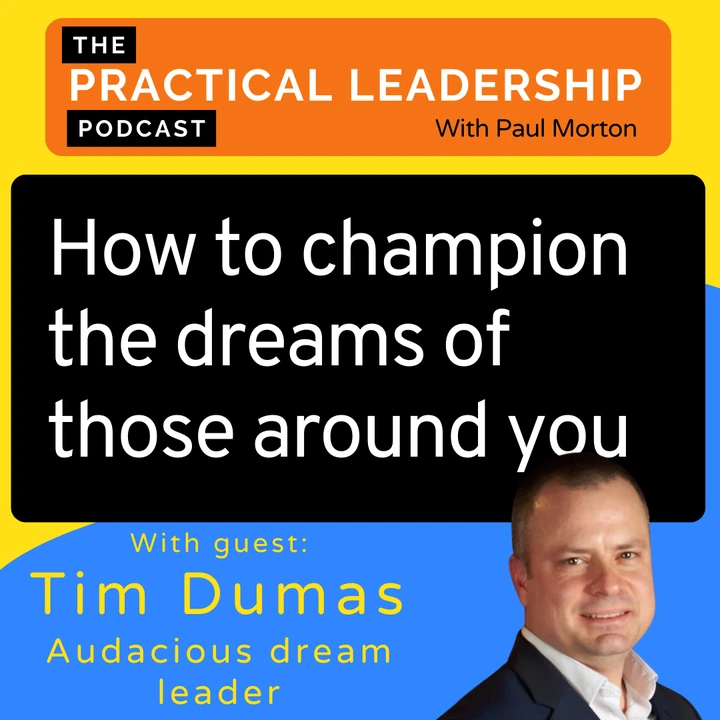
How to champion the dreams of those around you
with Tim Dumas
Show notes
In this inspiring episode of our podcast, we had the pleasure of speaking with Tim Dumas, an expert in fostering champion mindsets. Tim shared profound insights on how true leadership involves striving for personal greatness while bringing out the greatness in others, a concept he encapsulates with the term “magnanimity.”
Tim elaborates on practical methods and frameworks that any leader can apply:
- Personal Mission Statements: Emphasizing the importance of having a clear personal purpose that aligns with one’s professional activities.
- Dream Audaciously: Encouraging leaders to not only set grand visions for themselves but also to champion the dreams of their team members.
- Operationalizing Love in the Workplace: Discussing how to embed a culture of care and commitment, transforming standard business operations into a more supportive and engaging environment.
Throughout our conversation, Tim reinforced that the essence of leadership is magnanimity—aiming for greatness and enabling others to achieve their best. Here are a few standout quotes from our session:
- “Leadership is magnanimity, the spirit of striving for greatness by bringing out the greatness in others.” – This captures Tim’s philosophy on the true essence of leadership.
- “Dream audaciously and champion the dreams of the people around you.” – Tim highlights the importance of supporting others’ aspirations as a cornerstone of effective leadership.
- “Operationalize love in your workplace to see magical results.” – A call to infuse daily business operations with genuine care and support for colleagues.
These insights are invaluable for anyone looking to enhance their leadership skills and foster a more dynamic and supportive workplace.
Join us in this enlightening conversation to learn how you can transform your leadership approach and champion the dreams of those around you.
Transcript
Automated transcript. Speaker labels and spellings may contain errors.
Paul
When I'm loved and cared for, I do better at work, says the Harvard Business Review. Magnanimity, the spirit of striving for greatness by bringing out the greatness in other people. Let's see what my guest today has to say about the champion mindset. Hello, and welcome to The Practical Leadership Podcast. I am your host, Paul Morton, and we are talking about leadership, management, and the various lives that surround it. It's my joy, delight, and privilege to bring into my studio some of the smartest, wisest people I've been able to find for your delectation and enjoyment, and I hope that you do get a lot out of the conversations that we have here. When you realize that your management team has grown too fast or you've inherited a new team and the fastest, best lever you have for growth and improvement is attached firmly to those managers, get in touch.
I help you run management coaching and training programs that'll make a big difference really quickly. You can find me at the Practical Leadership Academy website and on all the usual social channels. Tim Dumas, expert in building of champion mindsets, possibly related to Alexandre Dumas, but we could get into that. One of the Three Musketeers, the founding father. Thank you so much for just joining me.
Tim Dumas
Ah, Paul, such a pleasure to be with you today.
Paul
[laughs] We'll see what we get into. So is it true then, I mean, Auntie says you are possibly related to Alexandre. Does that make you one of the models of or were you modeled on? Was it Pathos, Athos, Porthos? Pegu... What were the Three Musketeers? I can't remember their names.
Tim Dumas
Uh, I'll just say yes. Absolutely. [laughs]
Paul
Oh, God.
Tim Dumas
As, when we were coming into this, I said, "Yes, that, that's my last name, and there's a rumor that we're somehow related to him, and I guess way back we probably are. And my aunts tell me I am, so we can't actually show the data line of how it gets A to B, but let's go with it." He's, he wrote some good books.
Paul
That's something that's one f- uh, all for one and one for all. Isn't that the fact something that leadership is into? That is.
Tim Dumas
It is. It is.
Paul
Oh. If, if everything goes well, it's your fault. If everything goes badly, it's my fault. That's the way it should be.
Tim Dumas
It's really what a coach is, right? I'll take it on my shoulders, and I'll deflect, deflect the g- the grace when we win, and I'll take it on my shoulders when we lose.
Paul
That's the best one. The, the best ones is that. How did you then first become a people manager? What ended up happening to you?
Tim Dumas
Well, I, I think I really fell, fell into it. I, I started managing people in, in the family business, and, and I realized quite quickly that I didn't know what I was doing. And this is someone who had like... I'd read leadership books. I, I knew what leadership was. I was, I was a leader, a captain on, on many teams throughout high school and, and university. But I realized pretty quickly I didn't know what it was, so I went to managing this, um, th- this restaurant in my, in my 20s, and I thought I would be a great leader. And I walked into that first meeting with all these people, and I sat in the room, and I was gonna address them, and I was gonna bedazzle them with this speech on leadership. And as I spoke to them, the speech wasn't all that bad actually.
But they looked back at me, their mouths were open, their eyes were wide, and they just said, "Why? Why should I follow you?" And it hit me, I didn't have an answer for that. So I left that meeting. They weren't all that inspired. I was down in the dumps. I figured out I needed to understand what leadership was, so I went on a mission. And it took me a little bit more than a decade to figure out what the definition of leadership was. I went to all the gurus. I went to the dictionary like a great child of the '80s. And do you know what the dictionary says the definition of leadership is? The act of being a leader. Like, how can you possibly define a word by the root of its word? If you don't know what the word means, it makes no sense. So I learned pretty quickly that didn't make any sense, so I went to all the gurus, and I still struggled to find the exact definition. It wasn't until I met a gentleman about five years ago now named Alexandra Harbard, and he wrote a book called, uh, Virtuous Leadership,
another book called The Power of Magnanimity. That's magnanimity. When he said it to me, I had no idea what it meant. It took me almost these full five years to learn how to say it, magnanimity. But he said, "Tim, the greatest definition of leadership is magnanimity." And I said, "That's fantastic, but I don't have a clue what that means."
Paul
[laughs]
Tim Dumas
"Well, Tim, I can help you with that. I have the definition. The definition of magnanimity is the spirit of striving for greatness by bringing out the greatness in others." The spirit of striving for greatness, myself, by bringing out the greatness in others. And he looked at me across the table, we were having lunch together. He said, "Tim, isn't that the true definition of what any leader is trying to do? Strive for greatness yourself by bringing out the greatness in the people around you." And to this day, I haven't heard a better definition of what leadership truly is.
Paul
I've heard one, which I think actually there's two parts I think, and they both fit like pieces of a beautifully crafted jigsaw into exactly what you just said. The first, uh, I heard f- uh, from a great, uh, leadership guru, writer, author, thinker, and a former, uh, guest on this podcast, Joe Owen in here in the UK. And he said, and I think he's quoting somebody else, he said, "It's the, it's the act of getting people to a destination they would not otherwise achieve on their own." And then the one that I think sums it all up is, is I love the Greek word, uh, is agape. Agape. It's one of the four loves. You have philia love, brother love, family- Philia, philia. The, the family love. You have storge, uh, eros, and you have agape. Agape is this selfless act, the, the willing of good for others.
So the willing of good for others, the magnanimity, the spirit of striving for greatness for other people, for the greatness of others, for bringing out the greatness in others. That's super-
Tim Dumas
So Sammy, I'm so happy that you brought up the four loves too, because a- a- another friend of mine, uh, Steve Farber, wrote the book called Love Is Ju- Just Damn Good Business. Love Is Just Damn Good Business. And in the book, he talks about trying to bring the word love back to the workplace.
Paul
Oh, yeah.
Tim Dumas
I'm sure it's similar for you. Your experiences are the same. When you say it, utter that word love in the workplace-
Paul
Whoa, fluffy nonsense
Tim Dumas
... all of a sudden... Well, number one, fluffy nonsense. Number two, you're probably getting a call from HR-
Paul
Yes
Tim Dumas
... and getting fired.
Paul
That's it. Yes. [laughs]
Tim Dumas
[laughs] Hey, Paul told me he loves me. Now, I don't know-
Paul
[laughs]
Tim Dumas
I might not know anything about anything, but I read the Harvard Business Review study. It said, when people feel loved and cared for at work, they do better work. Now, I don't know if that comes as a shock to you, but I've asked many people if that comes as a shock to them, and they're like, "No, no, that's not surprising. If I feel loved and cared for at work, I am gonna do better work." I said, "Fantastic. Why then is it a dirty word in the workplace?" And I know, I understand. It's because we, in the English language, do not understand what the word love means. We think it means, as you mentioned in the four loves, eros or erotic love. That is not, absolutely not what we're talking about as it relates to the workplace. We're talking about philia, love, great love between a brother, sister, cousin, great friends, and then ultimately agape love.
Imagine if in your workplace people had your back no matter what, and they had that agape love. We are going to build you up. When you fall, I'm gonna build you up because I know one day I'm gonna fall, and you're gonna be right there to pick me up. Imagine if our workplaces actually utilized that word love. I've only been in a few, but there's been a few that first described it, because I don't, I don't... You know, I'm not saying go into your workplace tomorrow and start professing your love to everybody. They will not understand. [laughs] And you will get a call from HR, and you may not have a job tomorrow. However, if your organization start to operationalize it, understand what that means, and, and put that out to the greater team, that's when the magic will happen.
Paul
Without question. Without question. I think it's where... I mean, one, one of the, one of the great things about friends, the, the philia, is when you screw up, not if, but when you screw up and you make a fool of yourself, they don't think you've done a permanent job. That's it. And when you fall over, not if you fall over, but when you fall over and your head hits the dirt, you need to pick yourself up, somebody's there to give you a hand. It's the old story of the guy falls in the well, and the priest walks past, and he says... Priest, "Father, help me." Guy writes a prayer, throws it down the well. He goes, "Okay, what's that for?" Doctor runs past. He says, "Doctor, Doctor, I'm down this well. Help me." Doctor looks down the well, writes him a prescription, throws it down the well. And finally he sees his best friend walking past.
He says, "Charlie, get a ladder. Get a rope. Get me out of this well." And Charlie jumps in the well with him, and Charlie says, "Right." You look at Charlie, and he says, "What are you doing down here?" He says, "Don't worry, I've been here before. I know the way out."
Tim Dumas
[laughs]
Paul
He's there with you to lift you up. Your friends are there with you. The agape there is this, this, the willing of good for other people. But the question, the but is, how do you operationalize it? You said, and when you operational- op- when you operationalize magnanimity, when you operationalize agape love in the workplace, miracles happen, and they do. They absolutely do consistently, and I've seen it, without question. But how? Honestly, is, is that the right place to start? Is it why? Is it not how?
Tim Dumas
Well, you know, I, I think we do have to understand the why, and the, the why really is... There's a great quote by Jim Collins that we begin with the end in mind, and I think many people have been attributed with that quote, right? But when we're in a workplace, often we don't truly think about why we're doing what we're doing, and I know people say, "Well, we're doing what we're doing to make a living and, and, and to make money." And that's all great and fantastic. I still have never met, in my life, one person who can honestly and truly say they go to work to increase operating profit. Now, before you turn this podcast off and you start running for the hills, hear me out. Not even the owner is there to increase operating profit. What he or she is there for is what that can do for them and their dreams in their life, their ultimate why. I might be looking to increase operating profit so I can send my kids to university, so I can buy the house of my dreams, so I can live the life of my dreams, so I can support
others, maybe a charity, et cetera. Employees in an organization, their why is to increase operating profit maybe so they might be able to make a little bit more, so they might be able to support the dreams of their family, of their children, of people around them, to buy their, the, the car of their dreams. But one of the big issues that we have is we actually, when we go into a workplace, we take that number, that operating profit we're shooting for, we just tell everybody, we say, "Well, we're going for X, and we're gonna get X, and that's why we're gonna get X." And they don't really understand why, and when we don't understand the why of why our employees might want to help us get there.
So for example, one of the magics of operationalizing love in the workplace, and, and, and I'll start with the second one. I'll come back to the first one. The second one is dream audaciously and champion the dreams of the people around you. When you're an owner in an organization, you're in a partnership group in the organization and, and, and you're one of the leaders, you probably talk about that often. "Why are we doing what we're doing? I'm doing that, you know, it's my, my dream that my family might be able to go on a vac- great vacation next year if we can hit our operating profit goals." But with our employees, we rarely ask them, "What are your personal dreams, and how can I support you to achieve them?" Is that not why you're in this job? I mean, I, I hope they're in this job for a greater why to, you know, help the community, et cetera, et cetera, and they probably are. However, why do they show up for work every day?
And we rarely ask the employee that. That's really the, the second step of that magnanimity, that loving them in the workplace, realizing that that's the key. I'll, I'll tell you a great story about dreaming in the workplace. In, in organizations I'm involved with, we implement dream sessions. So when we do a performance review ... quarterly, sometimes semiannually, we'll come in and first we'll talk about what are your personal dreams and how can I support you? And now some people step back and be like, "Hey, Tim, nobody wants to tell me about their personal dreams." I'm like, "Okay, I'm just going to ask." And they have full license not to talk about them if they don't want to. However, here's one thing that I know, is I tell people I'm not very smart, so I might be able to figure out 6 of the 10 things you need me to know.
There's no way I'm figuring out the other four. So if you don't tell me, how am I going to help you? So if you truly want support on your dreams, let me know and I'll see if there's any way I can support. Maybe there's not, maybe there is. But if nothing gained, nothing ventured, right? So I went into this, this, um, this, this performance review meeting with this person and asked them, "What's your biggest, boldest, most audacious personal dream?" And the person could- told me they'd, they'd never dreamed in their life before. Never dreamed in their life. This person said to me, "Well, Tim, you know, I, I really just was hoping to have a job. I had a tougher upbringing. Um, it was difficult. My parents, they, they'd sometimes had difficulties holding down a job.
We had to move often. So I just, I'm happy I can hold down a job." And I said, "Well, if you were to dream bigger, what would it be?" And this person c- couldn't tell me. It took a few weeks. But I said, "Great. Every time you and I check in, I just want you to check in with me to see if you've figured it out." One day, this person figured it out, came to me and said, "Tim, I realized what it is. It's to buy a new car." And to most people listening to this, you've probably bought new cars, multiple new cars maybe. This person had never owned a new car and never thought they would be able to own a new car. And this person said, "Well, I've been, you know, I've been driving around these beaters for a long time.
I have a hard time getting to work. Sometimes it breaks down. Imagine if I could just own a new car." And he said, "But I, I couldn't possibly. I don't make enough." And I said, "Okay, just prove it to me." So I sent them to the, the car dealership. I sent them to the finance manager and said, "Can you prove to me that you cannot buy a new car?" Well, it wasn't a week later, grabs me by the arm, runs to the parking lot, and there's a brand-new Mazda sitting in the parking lot, all because we champion the dreams of that person. Now, what do you think's going to happen when we get into a tough conversation about budgeting and now we have to, you know, we're trying to hit the next target in operating profit or, or whatever our target is that quarter? Well, that person's our corner because they know we're supporting them with their personal dreams so that we can dream bigger as a company.
So the second one is dreaming. Back to the first part is really, uh, one of my favorite books by a, a good friend of mine is, is called Your Oxygen Mask First by Kevin Lawrence. Your Oxygen Mask First. And really, how do we operationalize love in the workplace? How do we operationalize magnanimity and bring that type of leadership in? Well, we put our oxygen mask on first. We gotta do it for ourselves before anyone else is going to understand how to do it themselves. Now, I'm not saying you gotta be perfect, because that's not part of the equation. But what is part of the equation is striving for greatness daily. What is part of the equation is striving for greatness daily. What is part of the equation is operationalizing love in your workplace. You might not use the word yet, but when people screw up, you're gonna have their back.
There's a great story of a, a banking boss in the UK where, um, uh, one of the employees came in and they lost... They, they screwed something up, and they lost £2 million. Walks into the boss's office, confesses that, and says, "Well, I'm gonna get fired now, aren't I?" The boss looks at, looks at him and says, "Are you kidding me? I just spent £2 million training you. [laughs] Are you kidding? I'm never gonna fire you now." Now, I don't know if we could actually do that for, uh, on that scale. I sure hope I could.
Paul
[laughs]
Tim Dumas
I- I'm, I'm thankful I've never had to make that decision. However, imagine if we had that what I call growth mindset, that each hurdle along the way is an opportunity for growth, and we got your back to grow. So it's never a problem to make a mistake. The problem is not learning from making the mistake over and over again. So if we have to put this into practice, how do we put our oxygen mask on first, and then number one, and then how do we support the personal dreams of the people around us?
Paul
Okay. So you're looking after yourself first. And honestly, when I, when I talk and I coach people individually, one of the first things we look at is the foundational stuff. It's, it's, uh, you said what exercise you get. You know? When you'd ask outside or whatever it is, how do you look after you? 'Cause you don't look after you at a physical, fundamental level, you know?
Tim Dumas
Uh, uh.
Paul
How are your kids? Oh, I don't really see them that much. Well, let's fix that first, and then we'll work, you know, you work up. So you put your own oxygen mask on first. I love that. I've always loved that, that, that... When you hear that, and we just come back from a little holiday, this isn't my natural color. I normally rust. I'm a little bit tan, right? My Scots would be saying I go from the gray to pink to lobster. And you hear that in the airplane. They say, "Put your own oxygen mask on first." And I'm sitting next to my son and I'm thinking, "You know, that I'm not doing. I'm gonna look at..." Well, actually, you know what? Yes. Okay. Get it. Dream audaciously. Champion the dreams of others. Next.
Tim Dumas
So those are the two real table stakes, and we started talking about mindset now. So if we're gonna bring in this mindset of leadership in the workplace, of championing the dreams of others in the workplace, there's four ways that we can do it. Table stakes are, number one, putting our oxygen mask on first. Number two, dreaming audaciously and championing the dreams of the people around us. And once we've set up those table stakes, there's four ways we'd do it. Now, we've, we've already alluded to some of them, but they are these. They're number one, win the day, and that alludes to a lot of your oxygen mask on first, and we'll put that, talk about it in a minute. Number two, the 100-0 principle. Be 100% responsible, make 0% excuses for everything that happens to you always, 100-0.
Number three is neutral thinking. I'll define that in a moment. And number four is sometimes you win and sometimes you learn, knowing that every stumbling block is an opportunity to learn. And if you put those into an acronym, it actually spells WINS, W-I-N-S. And I know the I is actually the 1 for the 100-0. Uh, but win the day, W. 100-0 is the I. N is neutral thinking. And as is sometimes you win, sometimes you learn. We already talked about the sometimes you win, sometimes you learn about that banking boss. So we'll, we won't allude to that all that much. We go back to win the day. That's really what all your action mask on first is. Do you know that when I speak to organizations, I ask people, I said, "Can you tell me if your organization has a mission statement or a purpose statement or vision statement and values?" Ninety-five percent of the hands go up.
"Absolutely. Yeah. Yeah, we, we certainly do." Whether they know it, live it, something different, but almost everyone has it, almost every company. And I say, "Fantastic. Um, how many of you personally have a personal purpose statement, mission statement, and personal values?" Ninety-five percent of the hands go down. And I said, "This is actually fantastic. Can you just go back to your boss at work and tell them the way you live your life is that work is way more important than your personal life? They'll be thrilled." [chuckles]
Paul
[laughs] Right.
Tim Dumas
Maybe if, if, if, if they're a great magnanimous leader, maybe not. But that's a bit of the joke. We really... There are many people in life that live rudderless. So really what win the day is about is ask yourself, "What was the first thing I did this morning? And did that set me up for success today?" Whatever that thing was, whether it was exercise or meditation or prayer or stretching or, uh, having a good breakfast, whatever those things were, did that sort of set you up for success? Because here's the one thing I know, is that it's almost impossibly the same tomorrow as I was today, the same today as I was yesterday. The fine line of being the same is so fine, I know I'm either gonna get better or I'm gonna get worse.
And if I don't intentionally do things to make myself get better, the opportunity to get better is more like winning the lottery. I might just get lucky. And I don't know about you, I don't know too many people that have won the lottery. So if you're not doing that, you're just getting lucky. So what are the purposeful things you're doing today to live your purpose and live your priority? That's win the day. Number two, a hundred zero principle, hundred percent responsibility and zero percent excuses. I think many people have heard something like this before. They might not have heard it, um, stated this way, and I heard it first from Dr. John Izzo, who's written multiple books which include this, um, this topic.
Really, when we go into workplaces and we bring in the a hundred zero principle, imagine what happens because normally what happens is we go into a, a, a work group. Let's say it's the, their weekly, their weekly meeting, like the, you know, the economy's bad, the, uh, you know, the, the, the people down the street are selling it for cheaper than us. There's so many excuses and reasons why we're not doing well. Someone else is out sick. When we just throw that out and we say, "I'm not devoid of hearing what's happening, but I'm only interested in it as it relates to what we're gonna do to, to make it better tomorrow." So, um, people joke with me. They're like, "Tim, you're the, you're the person that cares the least, that cares the most." And I know that doesn't make sense, but when I walk into these meetings, people make excuses. I just simply say, "I don't care. If you didn't hit your targets last week, last month, I don't care. What I care about is what you're going to do to achieve them tomorrow." And I don't know what the exact right answer is 'cause there's multiple potential right answers.
What I care about is that we're using the data to understand what to do tomorrow to get to our ultimate goal, and that leads to neutral thinking, which is simply the Stockdale Paradox. Many people know the Stockdale Paradox. The Stockdale Paradox simply states, understanding the brutal facts and the brutal reality of where you are today with unwavering faith that you will achieve your success tomorrow, tomorrow being sometime in the future. And when you understand that, you do the things that you need to do today to succeed in the long term. I'm not gonna worry about the past. I'm gonna understand the brutal facts of the past. I'm gonna do today what I need to do with unwavering faith that I will get to my version of success in the future.
And in a nutshell, in a minute or less, that's how to describe neutral thinking. So win the day, hundred zero, neutral thinking, and sometimes you win and sometimes you learn.
Paul
So you just thought on, on the neutral thinking. I think it's like you could... It's like rebasing, zero-basing every day. The zero excuses are like y-you don't care what happened yesterday. It's from, it's from where you are. It's rebasing yourself at point beginner's .0 whatever, so you can build on every day, right? 'Cause I think getting worse is actually quite hard. It's quite hard to get worse every day. I mean, you've gotta forget things. No, you've gotta eat three times as much as you did the day before, or whatever it is, you've gotta work hard to get worse at something. But you don't have to work very hard at all to get a little bit better, and it's that beautiful com-compounding thing you see as well.
Tim Dumas
It's the, you know, the atomic habits of getting one percent better today. If you get one percent better per day, you, you know, over, over the year, imagine what that is, everyone. The best way to describe neutral thinking too is by the, by the story of the Apollo 13. Uh, everyone now has seen that movie Apollo 13, where they take the rocket and they're going up to the moon, and they lose all their power, and they, and they can't get back. Basically, what they did in Apollo 13, they have no power. Their engine's not working. They basically have, like, uh, bubblegum, a little bit of tape, and a shoestring, and they gotta get back to Earth. So there's three ways they can think there. They can think negatively. "We're all gonna die. Why should we try?" Which probably is the most logical, but doesn't really help anybody.
Number two, you could think po- hyper-positively and say, "Hey, back at NASA, we have the smartest people in the world. Don't worry. They'll get us back. Well, let's sit back, and those smart people will get us back." Also somewhat logical, but they didn't do that. What they thought was neutrally They just said to themselves, we need to get back home. We have no power, no engines. Here's what we have. What do we need to do day after day after day to see if there's any way we can find to get home? And really, that's the best story of neutral thinking.
Paul
Fix the problem in front of you one at a time, one at a day, one team. I think it was, uh, Churchill's beautiful two, two lovely lines from him, probably misattributed all the way because he's so badly quoted, but he's a wonderful guy, thinking, wonderful thinker. Uh, and it was, "When you're going through hell, keep going," and, uh, KBO, which stands for, if you'll excuse me, keep buggering on. That's it. Keep buggering on one day at a time, one foot in front of the other. Neutral thinking, I do like that. So this then is the operationalization of, you're having trouble saying magnanimity, I'm having trouble saying operationalization. The operationalization of magnanimity, the spirit of striving for greatness by bringing out the greatness in others, the concept of agape, selfless love, the, the wishing for good in
others. You operationalize it by having your table stakes i- in place, putting on your own oxygen mask first, looking after yourself, dreaming audaciously because there's no point in having mediocre average goals, winning the day, having a personal mission state- personal value statement, uh, intentionally doing things right to get better, taking 100% responsibility for your own actions and putting up zero excuses, neutral thinking, and accepting that sometimes you win, sometimes you lose. Okay. This is a, a, a fairly comprehensive plan for a positive, active, well-lived life, is it not? It's not just business, is it?
Tim Dumas
I, uh, is it, is business really not a microcosm of life, right? Um, what we need to do in business, the little steps to get better, we just talked about it. What are the little things we can do to get better each day? I really don't see business and life as a, a- as a waffle, the breakfast, the waffle, right? Where it's all, there's, there's different compartments. It's really like a bowl of spaghetti where it's all intermixed, right? When I'm having, when I'm doing well at home, I'm usually doing a bit better at business, right? When I'm doing poorly at home and there's some difficulties happening, I struggle to make that, to take, take that out of my head in business. The old theory of people walking in the door and saying, "Leave all your problems at the door," that's a really nice thing to say. I have not seen it operationalized all that well. Some people can do it better than others, but if we really have a difficulty in our personal life, do we or can we not bring that to work?
And generally, the answer is no, we do bring that. So what workplaces, the leadership in workplaces is how can we create great people? You know, it's, it's now widely known that the number one asset in organizat- uh, in an organization is its people, and we know in the data that w- if we have 90% or more great people, great things are going to happen most of the time. So when we actually invest, and not necessarily money, a little bit money, but a lot of time, energy, effort, and mostly care into those people, that's really when the magic starts to happen.
Paul
And it is the simple things. It is the simple things. I think it's the, the basics are magic, Jim. You know, this, this, the simple acts, the simple tasks, the simple skills done very well, I think, turn the managers, the leaders around you into this great big lever you have for growth that if you pull it in the right way, magical things happen. Is there, amongst all of the different titles and, uh, books and things that you've mentioned over this conversation, is there one perhaps that you recommend or gift more than any o- any other?
Tim Dumas
That's a great question. Some of those that I mentioned today, Your Oxygen Mask First, is one that, that I gift very often. Um, the other one about the power of magnanimity is the one, is one I gift often because it's really a word that people don't know or understand, so really understanding that is helpful. In the business world, um, you know, really the, the business book of building like this really comes down to, uh, Jim Collins' Good to Great-
Paul
Wow
Tim Dumas
... and Scaling Up by Verne Harnish. And so those are really the operationalizing of the nuts and bolts of business, and the others are really how to build that into your personal life and your business, the, The Power of Magnanimity and, um, and Your Oxygen Mask First, On First. And, you know, the other book that I mentioned that's really impactful is Steve Farber's Love is Just Damn Good Business because at the time when I read it, I just hadn't heard love in the business world all that much. So it's actually, you know, it hits you like a ton o- ton of bricks that this is actually what's expected of me. I'm expected to love the people I work with. And, you know, my wife jokes sometimes that she's like, "Hey, my vow said I need to love you, not like you all the time." And so that's when she's, you know, uh, not as happy with me. But it's, isn't the same thing in the workplace?
Someone says, "Well, I don't really like that person." I'm like, "Well, I don't really care. You can still love them." Love is an action. It's not a feeling. So really understanding that, and now I think about all the people that I've worked with in the workplace that, let's say we're not so alike, but when I ask them about their dreams, I put any judgment aside and I say, "What are your dreams?" They're not the same as mine. Because if people come into, to an organizat- j- uh, organization and say, "This is the way to live life, and this is the way to run an organization," number one, that doesn't, it just doesn't work, right? I call it the, uh, the six kids syndrome. My wife and I have six kids, and we have a great life, uh, together. Very, very happy. But if I were to come to you, Paul, and say, "Well, the way to be happy, Paul, is to just have six kids," people laugh all the time. It's completely ridiculous.
Paul
Mm-hmm.
Tim Dumas
Yet, every day we come in and tell people, "You know what? If you wanna live a great life, you should do what I do." Well, all we really come in when we ask people to dream audaciously is say, "I'm coming in with no preconceived notions and no judgment. What do you want to be known for in your life 25 years from now? What do you want to have achieved? And what is it, what's that thing for you which is different for every person that's ever walked the planet?" And that helps stir, it starts to stir the magic sauce of great mindsets and great cultures.
Paul
One last question before we wrap up. If I gave you 10,000 billboards, and you could write on that, those billboards one thing, what would it be?
Tim Dumas
I've been asked a lot of questions in podcasts, Paul. This, this is the first one, time I've been asked this. You know, you know what it'd be? It would be champion, champion the dreams of the people around you.
Paul
Other than that, nothing to add. Thank, thank you very much indeed for your time.
Tim Dumas
So, so grateful, Paul. Thank you.
Paul
And that's a wrap. I hope you enjoyed the show. Thank you for joining me. If there's ever anything I can do to help you on your journey, then do please reach out. You can find me on LinkedIn and all the usual sources. Do please subscribe, leave me your five-star review, and most importantly, get in touch with your comments and feedback. It's really how I grow, and that's what I'm doing this for. Thanks again. [outro music]