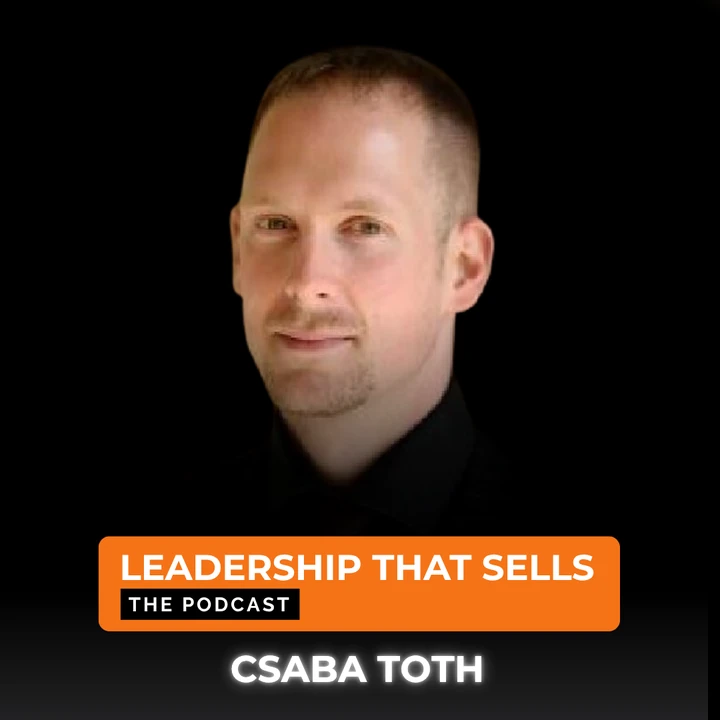
How to Build Teams That Decide Better
with Csaba Toth
Show notes
I can see what the top biller brings in. What I can’t see so easily is what the rest of the team stops contributing because of their behaviour. That’s the calculation I want before deciding we can’t afford to lose them.
I push Csaba Toth on whether psychological safety tells us anything useful about commercial performance, and why his framework is more than another personality label. We get into the trap of mistaking agreement for commitment, why another workshop may change nothing, and my own mistake of hiring people from different backgrounds who largely thought like me.
In this episode
Here’s what I’d put to work:
- Measure psychological safety and motivation before and after leadership development. A well-liked workshop isn’t evidence of better performance.
- Assess the top performer’s impact on colleagues, not just the revenue beside their name.
- Speak last. Give quieter colleagues room, then check whether they feel safe enough to challenge you and motivated enough to bother.
- Look for different ways of thinking when hiring. Different backgrounds don’t automatically give you that.
- Ask what motivates each person. Stop assuming everybody wants what you want.
Episode highlights
[02:24] A joint venture that worked on paper, until the CEOs had to work together.
[07:12] My objection to stalled execution: why is the answer always to add something?
[16:32] Before I worry about losing the top biller, what are they already costing the team?
[21:42] I’ll tick the boxes. Why should a personality label change anything?
[27:54] My hiring blind spot: different backgrounds, much the same thinking.
[31:55] I suggest inviting the quiet person in. Csaba explains why that isn’t enough.
[36:47] Am I seeing clearly, or am I just looking down a tunnel?
Links and resources
- https://gamechangersbyicq.com/
- Linkedin: https://www.linkedin.com/in/csabatothinterculturaldisc/
- Instagram: https://www.instagram.com/icq.global/
Thanks for listening. I’d appreciate a rating and a review. Follow the show and share this episode with a founder or MD who’s trying to get more from the team they already have.
Transcript
Automated transcript. Speaker labels and spellings may contain errors.
Paul
[upbeat music] My next guest lost his first business because he believed good intentions, qualifications, and common sense were enough. Now, this failure then sent him on a much deeper study of why smart people misunderstand each other, and hopefully he's gonna share that with us today, 'cause I tell you, we could all use it. Now, that study then eventually led him to build leadership frameworks that are now used by more than 900 teams across 51 countries. Welcome to Leadership That Sells. This is the podcast about the real conditions where leadership and sales actually work and where they quietly break down. I get to talk to founders, chief executives, sales leaders, operators, people who've made decisions when the effort was really high, the pressure was really on, but the playbooks that they had in their
pocket didn't quite m- fit the bill. Now, we're not here to trade slogans or frameworks. What we're trying to do is to surface patterns, repeating patterns, things that consistently create momentum, try and identify what gets in the way, and then what experienced leaders eventually learn to stop doing. So if you are responsible for results, not just ideas, you're in the right place. Csaba Toth, thank you very much indeed for joining me.
Csaba Toth
Thank you so much for having me.
Paul
So you lost your first business. Now, it was what you, you were in the shopping center one day. You put your business down, you walked away, and when you went back, it wasn't there anymore. So you lost your first business because you relied on good intentions and common sense. What was the commercial decision that you made or that you failed to make that directly led to that business closing?
Csaba Toth
I don't know if it was commercial, because there is a story to it, and technically that failure became the foundation of my next company, the current one. So, um, I started a, a company after the university, and it was a restaurant booking site. You book a table, we get the money, but it was a bit more exciting than that. We started with 35 restaurants in Brighton in UK.
Paul
Mm-hmm.
Csaba Toth
And in f- in one year, we had 5,500 all over the UK. It became the fastest growing and biggest restaurant listing, and it turned into a joint venture with a software company. On paper, it made a lot of sense. In reality, it didn't, because I couldn't get along with the other CEO, who was French. I'm not saying that was the problem, but definitely didn't help. And we got to the point where we had to get out of the business. We sold the shares. It is still online, but we are not involved anymore. But this is when I started my research, because it didn't make sense. That was the exact topic of my dissertation, Eastern and Western European joint ventures. I had years of experience. The department where I studied is number one in the world in its category. Harvard is number two on that list. How come I couldn't put that theory into practice? So looking back now, that was a great experience.
That time it was horrible, but I wanted to understand what went wrong and how we could fix it. So I got certified in a lot of different things like psychometric leadership, intercultural leadership models. And my assumption was that if all of these models are overcorrect, there must be a huge overlapping part, and that's what I'm interested in. There must be a structure beneath the surface. There must be a blueprint of why people think and behave differently, and it turned out that there is one, and that is what we call now Global DISC, and it's available in 50 something countries. And that's exactly our topic now, that we focus on the human side of transformation because we focus a lot on processes.
Paul
Mm-hmm.
Csaba Toth
But when it comes to people, there's a lot of guessing, hoping, assuming, and that's when things go wrong. You put really smart people in a team hoping to create synergy. In reality, it turns into painful liability. But there is a blueprint. You can fix it, and that's why I lost it. So I don't know if it was a commercial decision-
Paul
Mm-hmm
Csaba Toth
... but definitely a painful one.
Paul
Okay. I mean, you find ... I mean, I've, I've got stories from people I've, I've, I've met and personally as well. You put a lot of smart people in the room and you hope for the best, and sometimes if your business isn't busy enough, frankly, these really smart people end up doing other things to use their intelligence, and those things tend to go for the negative. You know, they tend to be those really smart people end up, um, you know, being really political or they end up inventing problems to, to make your life, you know, to make their lives more interesting. So you've got ... I mean, this was your, your, it's a good backstory there. You've got then to the point where you're trying to identify what these, these challenges are, what these issues are.
If you then come to a chief executive-
Csaba Toth
Mm-hmm
Paul
... a senior leader in a company, and you say, "We're gonna talk about psychological safety," they're gonna go, "Yeah, yeah, okay. Oh, sure. Okay, next." It's a buzzword. Is there a number in that person's P&L or on their pipeline or is there, is there a KPI you can point to that's gonna show that they've got this cultural friction problem? I mean, when you were doing your restaurant piece there, what was the thing that eventually said to you, "This isn't working"? Was it a number?
Csaba Toth
So may- I, I completely agree with you. So when you talk about psychological safety, there are some people think that it's some kind of kumbaya and, you know, nice-
Paul
Mm
Csaba Toth
... be nice to people and be polite. Other people think it's connected to the DNI field, but, you know, it's something that is good, but we don't need it. So that's not how I start. Because the leaders are interested in what? Profit, money, growth. Okay. So that's the language they speak. So I ask them, "So what do you think that the number one trait of high-performing teams is?" And they come up with a lot of things, but Google research shows that it's psychological safety by far. The number one trait of high-performing teams is directly linked to money, profit, and growth. So next question, where is your team on this dimension? Probably they are good. Okay, so where was your team before you invested in a leadership program, or where was your team after that?
No idea.
Paul
Hmm.
Csaba Toth
99.9% of people cannot answer this question. Would it make sense to know that? And then we can get into the topic because it affects everything.
Paul
Hmm. So if it does affect everything, if the psychological safety is then as, um, the, the Google study... This is a few years old now as well. It'd be interesting to have that repeated in the world of, uh, remote work. But if that holds up and you are then looking at, uh, uh, an early stage failure, right? So you've got a $20 million company-
Csaba Toth
Mm-hmm
Paul
... um, and execution has, has just stalled, okay? It's not... We're just not working as well as we should be. Now, the first thing that your leadership is gonna do, they're going to change targets. They're gonna-
Csaba Toth
Yeah
Paul
... train their salespeople, replace their salespeople. They're gonna add some management. They're gonna, they're gonna do things. People default to doing things, you know?
Csaba Toth
Yeah.
Paul
It's a very rare leader who does what I think is the major solution for most problems, which is doing fewer things, you know, removing things. The default is something must be done, so let's do something-
Csaba Toth
Yeah
Paul
... because I can be seen doing something. If I take things away or I reduce, it's a negative. But execution is stalled. People try to change their targets. They replace things. They add management layers. How do you go and prove to a founder or an executive that the problem is in fact behavioral friction rather than their flawed strategy?
Csaba Toth
I think you-
Paul
The decision you make are wrong. The problem's over here
Csaba Toth
... and, and th- I think this is really logical that people react to what they see.
Paul
Hmm.
Csaba Toth
But often the visible issues are not the real ones. They are not the root cause. So often those people solve a problem that is not the real issue, and then they get results accordingly, and that's not ideal. So more than 70% of transformations fail because of people.
Paul
Yeah.
Csaba Toth
But less than 5% of the budget goes to people, the human side of transformation, and maybe even those resources are not up to date, or they measure something that doesn't really matter in that context. Because often the most engaged teams are the most resistant to change, so that's not ideal. Now, that's the reason why we focus on the three invisible forces that make or break a team, and one is psychological safety. The other one is motivational drivers, and the third one is cognitive diversity, which is technically the immune system of a team-
Paul
Hmm
Csaba Toth
... the invisible layer, and that is rare. But the benefits of diversity are not automatic. You cannot unlock it by relying on common sense and good intention. So this is exactly what we focus on. We can measure the nine biomarkers within those, and we know exactly what to do in order to improve performance. So we've done more than 900 teams in over 50 countries. The interesting thing is that the patterns are very similar. They're not really industry specific, not even country specific, because companies face very similar challenges. How they deal with them, that's a different story. And if we can back it up with case studies, we can create a certain level of certainty for the CEOs, then they are much more willing to focus on this.
Because if you look at companies, they talk about, you know, psychological safety, motivation. They have a keynote speech. They have a webinar. Fantastic. Does nothing. Often it make things worse because they talk about that, you know, workplace should be like this, but that's not how I feel, and then people become even more disengaged. Fantastic outcome. But it's easy to dismiss this idea if you think it's abstract. But as soon as we can quantify it, as soon as you can see the report in front of you, we can make it tangible and practical, we bring it alive. Now they can deal with it. Now it's easier to do that. Without that, it's very difficult. And I also agree with you that it's easier to do something than stop doing something because, you know, you can eat a pizza, 2,000 calories, and you can run for half a day, or you just don't eat the pizza.
Paul
[laughs]
Csaba Toth
That makes much more sense.
Paul
[laughs] I like that. Yeah, it's true. Yeah. Uh, when... I mean, you, you, you look at any... As you said, this has been done across countries, across teams, across businesses, and when I look at any business I, I work with, there are only really three things they try to do, and that's either they want to cut costs, increase revenue, or manage risk. That's it. Everything is within one of those. And then there are really only two things you can do with the people you're working with. One is to add incentives, or one is to add friction, okay? And then around that you can talk, train, coach, educate. So I think you've got a frame where people are trying to understand themselves, they're trying to understand their business, but they're not really in a position to
pull a lever because they don't know what happens when they pull it. They don't know which one to pull. And if you're in a position to give them, as you said, your nine biomarkers, that sounded great. Your nine biomarkers, this is some sort of KPI dashboard type thing that says, "That one here, this is a lever to pull. If you pull this, this happens That's a surprising, surprising. That's a challenging, um, take. Right?
Csaba Toth
It's also possible. So I agree with you that, you know, you can make more money or you can spend less. But we can make it a bit more nuanced because companies can see how much money they make, but often they cannot see how much they are losing.
Paul
Hmm.
Csaba Toth
Because often that is invisible. Disengagement can be invisible.
Paul
Hmm.
Csaba Toth
When people don't speak up, when they don't bring up an idea, that they don't care, you don't see that, but you're losing a lot of money as a company, and that's exactly what we can reveal. Having said that, we can make it very concrete. So for example, we had a client, Fortune 500 company in the US global leadership team. In six months, we improved psychological safety by 30% and motivation by 25%. They are leading thousands of people. They made a lot of money.
Paul
Hmm.
Csaba Toth
That's concrete. It's transparent. It's measurable. Because if it's not, it's not a result. How much people enjoy the workshop doesn't really matter. Are you getting the results? Because if you can, we can measure it in a transparent way. That's really important. But this is also terrifying sometimes because you know exactly that numbers can be empowering or intimidating. You can step on the scale, and then you can say that, "Oh, this is fake news. I don't like it," or you can go on a diet. You can make an informed decision. How you react depends on your self-esteem. And that's why I liked your intro as well when you said that it's... this is for people who are responsible for the success of the company.
Paul
Mm-hmm.
Csaba Toth
And sometimes those aren't [chuckles] not necessarily leaders or not HR. It depends, but we need the people who care about the future of the company.
Paul
Yeah. Okay. You've got... You're talking about people who care about the future of the company, and you get... Sometimes you get people who deliver the future of the company but perhaps are not necessarily, um, invested in it. You've got this lovely concept, and I have to pronounce this very carefully, authen toxicity.
Csaba Toth
Mm-hmm.
Paul
So your concept of authen toxicity, and I... If I get this right, you describe people hide behind, um, this, "Well, this is just who I am," right? It's a statement of, "This is who I am. You have to accept me as I am." And they do that so that they don't have to change. Now, in the world, the commercial world, there is typically, in every sales team or in every leadership team, there's some person who is top performer, top billing, delivering great operational results, whatever it is, somebody who exhibits this toxic set of behaviors, but they keep hitting the number. They keep doing well. How would you do about that? The goal, of course, you want to fire them, right? But if you fire them, you lose a lot.
But maybe that's not a big deal.
Csaba Toth
This is who I am. This is who I am. I don't want to change. I'm fine. It's not me, it's you. So one thing is that, you know, every single good idea can turn into a bad one if you overdo it. Authenticity is exactly like that. Being yourself is fantastic, but if you turn it into a glorified fixed mindset, that's a problem. Because, you know, I accept everyone. I want you to accept me. I want the freedom of speech. But if you say something I don't like, oof, you canceled. Well, it should be a two-way street. Your level of [chuckles] freedom should be matched with the level of responsibility you are willing to take, then it would be a very different world. But, you know, we don't like that part. There's a Statue of Liberty. There's no statue of responsibility. That's too much hassle. So this pick and choose attitude is not ideal, and that's why we talk about authenticity because it's very popular to say that, "Oh, just go to work.
Bring your whole self." No, no. Don't do that.
Paul
No.
Csaba Toth
No. [chuckles]
Paul
Please don't do that. [laughs]
Csaba Toth
Be professional. You know, you shouldn't be suppressed, but at work, be professional.
Paul
Yeah.
Csaba Toth
That's a very different thing because there are limits, there are standards, and there are norms that we do need to conform to, and the employer has the right to say something about it. Let's be honest. So the level of that inclusion can vary. That's true. When it comes to the high performers, and I think Amy Edmondson calls them the, the brilliant jerks as one of the archetypes-
Paul
Mm-hmm
Csaba Toth
... then yes, the impression is that, "Oh, we are going to lose so much money." But what if you don't? What, what if we are already losing money because a lot of people are underperforming because of them, so the average would be probably the same? And this is what she said, that if you look at, for example-
Paul
Yes
Csaba Toth
... the... So for example, we do the, the scan, a team, and then let's say that you have the four quadrants, and if they score high on safety and motivation, they are in the growth zone. If they are lacking both, that's apathy. Then you also have comfort, and this is where they just burn out, in the anxiety zone. So if everybody is in the growth zone, that's a good place. You're making money. But even if you have one outlier not in the growth zone, it can affect performance by 30% or 40%. That's a lot of money. So this is what I said, that companies often don't see how much potential they are losing. They can see how much they are gaining, how much they are spending. But how much potential they are losing because of these invisible team dynamics, that's much more difficult to quantify.
That's exactly what we can do.
Paul
Csaba, that was just quite an insight you had there. The fact... And it's, it's, it's one of those blinding insights of utter common sense. Of course, this person's toxic, right? Fine. And the f- one thing that you have to do if you have a, a low performer is to act quickly and deal with it and get them out because the low performer is dragging down the ... performance of other people. Why? Because they're not performing well. Are they toxic? No, they might be the nicest person on Earth, but they're still dragging the performance down. The toxic person, the authentic but toxic person, you know, bring your whole self to work as long as you're not an asshole.
Csaba Toth
[laughs]
Paul
In which case, leave the asshole at home. Um, that's gonna be dragging down performance. Duh. Of course it is.
Csaba Toth
And it's also interesting, once I had, um, that kind of person in the US, so that was years ago when we did a workshop there, and there was a sales guy, and he was like a superstar. You know, like a lonely wolf. Really smart, really educated, very successful. But we had a group exercise. So he came in, you know, long hair, confident. He said, "I'm not going to participate. I'm just going to contribute at the very end." I thought, "Hmm, okay, so this guy is ready, but I'm not going to fight fire with fire." So we did the exercise. There were, I think, six or eight people. We almost finished, and I had a chat with him in front of everyone. I said, "So you're really successful." "Oh, yeah, I won so many awards." I said, "You did a lot of courses as well." "Oof, I'm very smart." "Okay, so is there a reason why you're not willing to share your knowledge with your colleagues?
Why you are withholding information from them?" And that's when the people around him just, "What? What's going on?" So it's just like turning up the heat around him and said, "I'm not fighting. Now you deal with this." After that, we were the best buddies. Probably that friendship wasn't honest, but he really changed quickly.
Paul
Hmm.
Csaba Toth
So it's just about turning up the heat around them because people do what they get away with. So if you have a toxic employee, as a leader, how do you contribute to that situation? That's not a question that they usually ask.
Paul
Yeah.
Csaba Toth
But they should.
Paul
It- I think it's one of those, um, self-reflection things. You want to know, you want to understand the world, you want to understand humanity, first look in a mirror. First look in a mirror. Um, and w- why is my team failing, and why are you failing them as a leader? You know, what, where's your... What's everybody's first reaction I think, f- both, both from my kids to myself, to people everywhere I meet. It's going really well because I've worked so hard and I'm very clever. It's going really badly because the macroeconomic environment and everything outside of me is stopping me, right? It's a very male thing, actually. I think women are a little bit better at it, but not much. [laughs] They're a little bit better at recognizing that, well, actually I'm maybe a, you know, I might have a contribution factor to this. The negative side, I think, for a lot of women is that they say, "Well, it's going, it's going really well.
It's not actually my fault. It's, it's other people did it well." You know, that's the negative side. We, we swap it over. That's, that's a really fascinating insight. You talk about the, the quadrants there, and, uh, you're talking about the, the global disc framework. Now I've, I've worked for companies, um, who, who had their own disc framework as well, and I've done, uh, Myers-Brigg, I've done DiSC, I've done the Big Fives, Gallup strengths, all these different things, and there's one of them that I think is decent, but most of them I think are fairly noisy. And yeah, okay, you want me to do one of these things? Fine. I will tick the damn boxes, and I'll drag the sliders, and you can tell me that I'm a blue-hatted, extrovertive jerk of a m- m- empathetic whatever it is.
That's nice. And I won't change a damn thing.
Csaba Toth
Yeah.
Paul
Why is a busy chief executive gonna trust your version of the global, the, the disc framework over the dozens of other tools that are out there?
Csaba Toth
This is a common issue because people look at the name Global Disc, "Ooh, I know what it is." They don't. They just assume that it's a slightly different version of the one that they tried before. It's not. Because if you look at the concept of the four personality types, it's been around for two and a half thousand years. Started with Hippocrates, he came up with the four temperaments, uh, and then hundreds of researchers came to the same conclusion. There are four different types, and we are all a combination of those. They use different colors, metaphors or, you know, bodily fluids and other revolting things.
Paul
[laughs]
Csaba Toth
But the underlying concept was the same thing. But what's missing from all of those psychometric assessment is the 50% that determines how you behave, and that's when they start paying attention. What do you mean by 50%? Well, your personality determines how you want to behave, but culture determines how you have to behave.
Paul
Mm-hmm.
Csaba Toth
That's why you can never, ever separate them. So it's nice to get into psychometric assessments, but you don't exist in isolation. You exist in relation to other people and your environment. So for example, you and me could have an identical Global Disc report. Doesn't mean that we behave the same way. It means that the underlying values and drivers are very, very similar. But you face very different challenges than me. You found different solutions than me. And also, when you grew up, how much could you be yourself, or how much did you have to pretend in order to be accepted? Because we all belong to 15 or 20 cultural groups at the same time. That's your gender, generation, country of origin, a lot of different things. They determine what is considered normal and acceptable, and most people conform to certain norms.
So, you know, it's nice to say that, "Oh, you just have to read the behavior." Active, reactive. Ooh, ooh, yes, but at that point, you have no idea if they behave like that because of who they are, the personality, or because of the environment they conform to, which is much more likely. So Global Disc focuses on this. It goes into the three different layers of your identity. What you do, how and why. It's not enough to talk about the behavior. We have to talk about why you do what you do. But our 95% of our actions are driven by values and beliefs we are not even aware of, but we think that we are so objective and logical. No, we're not. We know our own stories And then we make choices to support our narrative.
So now it feels real. Fantastic. So what happened? But that's exactly the problem with the standard psychometric assessments. I'm blue, you red, so what now? We managed to widen the gap. We don't do that because everything is relative. So you take the assessment, we do the debrief, we get into this, and we can separate what is natural to you and what is normal to you. But that's a starting point because then we can also see the mindset gap between you and me, you and your team, you and your environment, because it's all relative. The bigger the mindset gap is, the more triggering it is, the higher the cognitive diversity is. That's exactly where the potential lies for success or disaster. It depends on your skills and your awareness.
We can see the blind spot of your team. We can see the cognitive diversity of your team. And also, once we did the workshop or even the coaching, then you can have access to a program which is based on your global disc result, 21 real-life missions. Each of them is going to push you out of your comfort zone just a little bit more, step by step, because learning is practical, it's emotional, it has to be experiential. So we are not using it as an excuse, but we help you escape your personality trap by expanding your comfort zone and enhancing your behavior flexibility. So again, there's no point in talking about this in the beginning because people just jump to conclusions. So I just ask them that, "Do you want at least three times more value than you are getting now with any psychometric or intercultural models?" "What do you mean by three times more value?" "Come on, let's sit down.
Now we talk about it."
Paul
You mentioned there a thing that, um, we make choices to support our narrative, and people think, "I'm so rational. I'm such a rational person," and we're not. Humans are not rational at all, which is why economics has to have the word science after it. It's an economic sci- any, any science, like behavioral science, right, has to have the word science in it. It's not a science.
Csaba Toth
Or intelligence, like emotional intelligence. Not really a science.
Paul
No, it's not. Nothing to do with it.
Csaba Toth
[laughs]
Paul
We are, we are a rationalizing species. So I would even suggest that rather than we make choices to support our narrative, we invent our narratives to support our choices. So why did you buy the red car? Well, because it has the highest safety results, and it's got, you know, you know, good fuel efficiency and all. No, red cars are faster, and I want a fast car. And then you make the decision up that gives you the... It's a sales thing. You know, you have to have the rational and emotional. This is how you sell things. And then your point, you're talking about the, the diversity of thought, the diversity of experience, and this, this... 'Cause this is a true diversity. It's always thought... I've always found it [laughs] deeply racist, DE&I, deeply, deeply offensive that we're going to need to hire more women or Black people because we don't have enough.
It just makes me want to vomit. You mean the bucket that somebody comes in defines who they are and what they're capable of? How disgusting [laughs] is that? The diversity that you want is the diversity of the contents of the bucket, not the bucket itself. You want these experiences. You want this cognitive diversity. I hired... I used to... We used, um, uh, not the Myers-Brigg, but a kind of a g- an, an archetype of the Jungian personality types, and it turns out I'm an ENTP, but I had hired 30, uh, ENFPs or something like that. They were all the bloody same, okay? And I was actively trying to f- find a diverse workforce. So I had lots of girls, I had lots of boys, I had lots of people from this background and that background, all around the world, except they were all essentially the
same middle-aged Scotsman, just in a different bucket. [laughs] What a waste of time and energy that was, and that cognitive diversity, knowing that this is different, knowing that this is the true, one of the true drivers of creativity, of innovation, that, that's-
Csaba Toth
It is, but not on its own. So-
Paul
No, no, not on its own.
Csaba Toth
I agree with that. And then, you know, I always had a very similar opinion about the DE&I field. And even years ago when I told people that this is going to fail really badly, they said, "Oh, that's not right." And it did because they promised a lot. There was a lot of passion and a lot of anger, but not a lot of results that they promised. But in terms of equality and equity, it is true that often the first obstacle is how you look. That is true. So, you know, that can be a problem. So if you are rejected because the way you look, that's a problem. If you get hired because of your look, well, that's the other side of the same coin.
Paul
Yeah.
Csaba Toth
But that's also a problem because it should be merit-based, but you shouldn't be rejected. But what you describe is called homophilic diversity, one of the strongest forces in team dynamics. And, and we have plenty of case studies where you have a bunch of different looking people who think the same way. And it's absolutely normal because, you know, you can force people to say that you celebrate diversity. Yes, but your brain doesn't because by definition it means unpredictability, and that's the last thing that your brain wants.
Paul
Yeah.
Csaba Toth
But if I'm willing to embrace science and reality, then I know what to do to get better results. Because the more you understand yourself, the more you understand other people who think and behave differently, the more familiar and predictable they become, and now we can turn differences into synergy. Without that, it turns into painful liability. And I had that saying that wasn't too popular, that in the DE&I field, the, the I stood for it's my turn, not inclusion.
Paul
[laughs]
Csaba Toth
Because lots of people were really passionate about a tiny segment of the diversity wheel, which was often based on their lived experience, and I don't want to discredit it or discount it at all. It's-
Paul
I do. [laughs]
Csaba Toth
But-
Paul
Sorry, go on
Csaba Toth
... you're not an expert. That's my point.
Paul
Mm-hmm.
Csaba Toth
Because they are really passionate about it, great. But That's the same kind of tunnel vision that they are fighting, and they turn into the same dragon that they are chasing. And the results didn't follow that. And the companies realized, uh-oh, that's not good. It doesn't make sense.
Paul
Mm-hmm.
Csaba Toth
So when I talk about this, then I'm not against diversity at all. I'm all for inclusion as well.
Paul
Mm-hmm.
Csaba Toth
Because that is the invisible force that unlocks the benefits.
Paul
Mm-hmm.
Csaba Toth
Without that, unfortunately, if you are just forcing diversity, you are creating more tension, and it turns into liability, and we saw the result of that.
Paul
The biggest inclusion, I think, is people who are ... don't speak up. You can have big brains behind a mouth that doesn't open. And if you don't s- if somebody doesn't speak up in, in a team meeting, then you're missing that. You're missing out. The team's missing out. And if you've got somebody, inevitably, who does speak up, they get 80% of the talk time. And I've seen it. I've looked, I've looked at the results of, of any number of team meetings, and you have the talk time per person, and it's loud. Quiet person has, has, has a, just a little bit of talk time. The loud person has a lot of talk time. And the job of the leader is to say, "So, John, what do you think then?" "Well," and you ho- you hold everybody back and let John speak.
You know? That's, that's the inclusion.
Csaba Toth
Yes, but, and, uh, this is something that we can back up with data as well, that yes, it's the right thing to do. But that's exactly why we focus on psychological safety and motivation.
Paul
Mm.
Csaba Toth
Because maybe John can speak, but he doesn't want to because he doesn't care. He's not motivated enough, or he doesn't feel safe enough. Or that's why he's going to agree to everything. Well-
Paul
Mm
Csaba Toth
... the action happened. The result is not great. So that's exactly what we can measure in team dynamics because this is not something that you can necessarily see. Because when there's too much agreement and too much harmony in a team, then usually it means two things. One is that they are way too similar, or there's no psychological safety at all, so they just agree and comply, but then nothing happens. So we have case studies where, for example, you have this quadrant. You can see the team result, but you can also see the individuals. Of course, without name, so we don't know who is who. But you can see how polarized a team is, and that's the interesting part. Because how is it possible that now if we talk about psychological safety, of course, it exists on a team level, and most of the research is about that.
But if a team is polarized, then how is it possible that within the same environment, under the same leadership, some people are like fish in the water and others feel rejected and demotivated? That maybe it's not the environment, but it's you, how you interpret the situation, the meaning that you assign to something, your own inner narrative. Because if you have a corporate PTSD from the previous job, it doesn't matter how inclusive they are, you're not going to believe it. Your perception is your reality and is going to determine how you collaborate, contribute, and innovate. But in that case, the solution is different. So it's not about shaming the company into inclusion, but it's about providing extra support to that person.
That's the lever that we have to pull.
Paul
Hmm. What do you think is the most common behavioral mistake you see experienced team leaders making?
Csaba Toth
I mean, like Simon Sinek said, leaders speak last.
Paul
Mm.
Csaba Toth
That's one thing. But there's also more to it because, you know, you talked about the leaders taking credit for everything, and if they're successful, but not responsibility if something goes wrong. Have you read the Extreme Ownership by Jocko Willink?
Paul
Ja- yes. Yes.
Csaba Toth
You remember that example with the boat?
Paul
I think so, yes, but remind us.
Csaba Toth
There were six or eight people in one boat, and it was, I don't know, six or seven or eight of them, and one was always really bad. That was the last one.
Paul
Mm-hmm.
Csaba Toth
So they changed the leader on the boat, just the leader. Same people, same task, and it became first one. Same people, different leader.
Paul
Mm-hmm.
Csaba Toth
And that was a really interesting case study, that you create that environment. You set the example, and that's really important. But that's exactly the topic where common sense and good intention can backfire. Because a lot of leaders tend to be, you know, extroverted. They, they are more visible.
Paul
Yeah.
Csaba Toth
But statistically, at least 20 or 30% of the people are more, much more introverted in your team. So if you try to motivate them based on what you need and what you want, it's going to backfire because maybe you love doing something they cannot stand, and that's exactly the problem. Good intention, bad impact.
Paul
Good intention, bad impact. Oh, we have to bring this in for a landing. We could go on for quite some time on this. This is fascinating stuff, Csaba. Fascinating stuff. If we had, then, the opportunity to put one message in front of all of these wonderful people out there, I gave you a very large pen and a huge number of big billboards, one at every train station, one at every airport, what one message would you put all around for everyone to see?
Csaba Toth
In that case, maybe ... That's the one that helped me the most because this is where I made the biggest mistakes, and this is, like, the condensed version of that experience. That don't try to be right. Try to get things right. That's a very different mindset, and I think a lot of leaders make this mistake because the ego and then the status quo is based on, "Yeah, I'm smart. It's my decision. I know what I'm talking about. I'm right." Yeah, but if you're a leader, you have a team. You have that collective knowledge and wisdom and cognitive diversity. Can you tap into it? Are you sure that you see everything? Because the problem is that often the leaders, or even just normal people, have this kind of clarity, and they think that, "Oh, yeah, because, you know, I've got that vision. Because I've got the right amount and quality of information." But they don't realize that they have the clarity because of the tunnel vision they have.
It feels the same, but one is much more useful. So aiming to get things right instead of trying to be right. That's probably one of the hardest ones, but that's the foundation for unlocking the benefits of cognitive diversity.
Paul
And there we'll have to leave it. Csaba Szot, thank you very much indeed for joining us.
Csaba Toth
Thank you so much. [upbeat music]