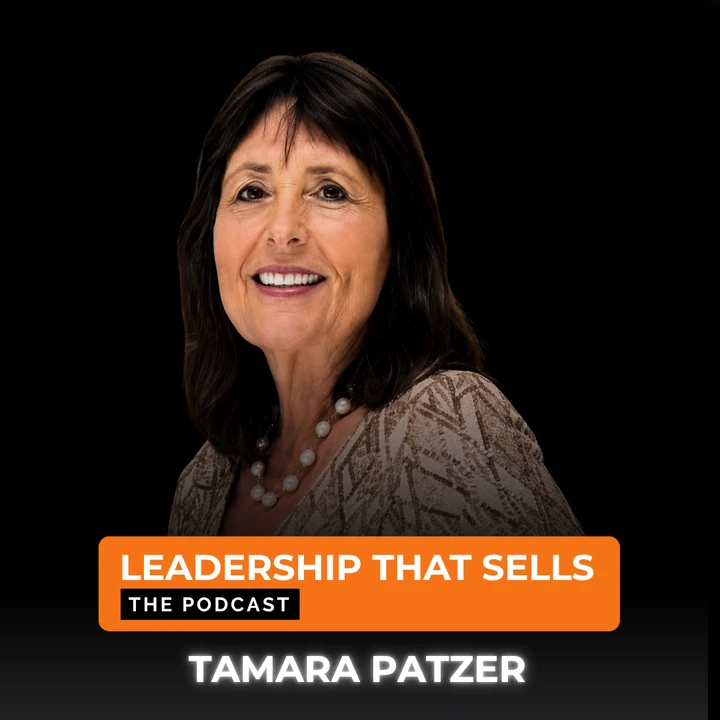
How to Build Sales Trust in the Age of AI
with Dr. Tamara Patzer
Show notes
Most of the AI conversation is happening at the wrong level. We’re debating tools, prompts and productivity hacks when the real question is much older and much harder: what does it mean to be human?
In this conversation with Dr Tamara Patzer, we explored AI visibility, trust, leadership and why discernment matters more than ever. We talked about the shift from a visibility economy to what Tamara calls a selection economy, where AI increasingly decides what gets surfaced. But the thread that kept coming back was this: leaders who outsource their judgement will struggle, while leaders who strengthen it will thrive.
In this episode
If you’re serious about leading in an AI-powered world:
- Learn the difference between being visible and being selected
- Use AI to challenge your thinking, not validate it
- Build trust through experience, judgement and human presence
- Stop delegating critical conversations to AI proxies
- Develop the discernment needed to separate useful suggestions from noise
Episode highlights
- 04:09 Why Tamara believes we’re leaving the visibility economy and entering the selection economy
- 08:21 My biggest concern with AI: tools that flatter us make poor thinking feel intelligent
- 12:14 The practical prompt Tamara uses to force AI to expose weaknesses in her ideas
- 14:33 Why the best AI users are often the most deeply grounded in philosophy, rhetoric and critical thinking
- 21:27 The controversial case against sending AI proxies to meetings and webinars
- 27:36 Why nobody is actually being replaced by AI, they’re being replaced by people who use it better
- 39:35 The Pandora’s Box lesson that leaves us with a reason for optimism
Links and resources
The tools will keep improving. That’s inevitable.
The question is whether we improve alongside them.
If you enjoyed this episode, follow the show, leave a review, and share it with another founder, MD or senior commercial leader who’s trying to make sense of what leadership looks like in an AI-shaped world.
Transcript
Automated transcript. Speaker labels and spellings may contain errors.
Paul
[upbeat music] My guest today is a Pulitzer Prize-nominated journalist turned AI visibility strategist who helps leaders become the voice in their teams and AI turn to first. She's the founder of the Daily Success Media Network and the creator of the AI Human Protocol™ trademark. She blends storytelling and technology to amplify that thing that we all crave, trust. The thing that we're all trying to wield, influence, and the person we're all trying to be, ourselves, with authentic leadership. Welcome to Leadership That Sells. This is the podcast about the real conditions where leadership and sales actually work and where they quietly break down if you're not paying attention. So I end up talking to founders, to chief executives, sales leaders, operators, the people who have actually had to make the decisions when the effort was real, the pressure was real, and the real
usual playbooks that they brought with them don't quite fit anymore as we're finding more and more stuff just doesn't work the way it used to. We're not here to trade slogans or frameworks. What we're trying to do is surface patterns, things that consistently create momentum, what gets in the way, and what the experienced people we have around us eventually learn to stop doing. If you are responsible for results and not just ideas, you are in the right place. That leads me to then say, Dr. Tamara Patzer, thank you very much indeed for joining me today.
Dr. Tamara Patzer
I'm happy to be here, and I'm excited to expand on my latest adventures in the research in AI.
Paul
Well, I, um, I ... What, what more is there to talk about these days? I mean, I was at a trade show fairly recently, and I swear if the, the, the words "with AI" was not on every stand, I don't know. I think there, there's something missing. The thing that I think most people are missing is they're trying to talk about AI without talking about impact. They're talking about AI without talking about outcomes. Um, and where's the value in the human in the piece, in that missing piece, and I think it's judgment, frankly. But we'll get to that, I'm sure. You've got, and you've said that the best leaders today are the first answer that people turn to, whether that's a team member or even an AI. How can, for example, sales leaders then actually become that go-to voice?
Dr. Tamara Patzer
So the first thing that you ... I wanted to clarify about AI and humans-
Paul
Mm
Dr. Tamara Patzer
... because no matter what people think, AI is here to help humans, leaders, and it is designed to please the human. So always keep that in mind. It does not think in terms of how a human thinks. So you, as the human, as the leader, you are the guide, the director, the human being behind any of the output that AI produces. And so you have to use your discernment, your accountability, uh, to make sure that AI is being used in the ethical, proper man- manner that, that it needs to be. And that's part of what I call the, uh, human AI protocol. It's all about the ethical use. And every leader, um, again, don't think of AI as coming to get your job. And the, those companies that are thinking they can replace humans with AI, they're going to be, let's just say, sadly mistaken when they find out that AI cannot function without direction.
So, so that's the first thing I want to make clear. And another thing, being the first answer, w- we're moving out of the visibility economy and into what I call the selection economy. AI has officially become the gatekeeper before humans ever get to even know anything. Our human-to-human, like, talking to each other like this, you can never take that away, that, that human-to-human connection. We're using technology to make it so that I'm in Florida, you're in south of London, you know, we're able to have this great conversation using technology. But AI cannot take over the world without that human direction. So what I mean by first answer is if AI has literally become the designated gatekeeper in the online world, you, we as human beings, we have to understand not only how to speak our human languages,
we now have to learn the language of the machine. And the language of the machine is very rigid and, for example, to a machine, it's looking for an entity. An entity can be a person or it could be a business. It's looking for that. It's looking for any type of trust or verifying information, um, about this human being or this company, such as does the name match? Does the address match? Does the phone number match? Does the website match? Really boring, boring infrastructure things. I call it dark matter. It's, it's all of the stuff that we cannot see because as humans, we're all about- The human interaction of who is seeing me, who's clicking on me, who's recognizing me. So you have to stop and say, "Wait a second. Humans are humans." For example, humans can recommend.
AI is AI. AI cannot recommend anyone. All it could ever do is suggest based on the probabilities of you are this person connected to all of this information, and, and that's where what, what I've determined, um, and I actually coined the word AI suggestibility back... It was literally a year ago in May of 2025 when I realized that AI was the gatekeeper and, uh, that human beings, um, are literally being either erased or amplified.
Paul
I wonder if it's not so much that AI is gonna replace the- their job, but we're gonna be replaced by somebody who's using it better than we are. And I think that the challenge is not so much that, um, you've got people looking to AI first. And I... Let me back up here. I want, want, want, wanna try to say the... Do you know the Turing test, right? The Turing test that we assume people have, the, the, the AI tools these days have passed. Can they simulate a conversation? Is that a conversation? Are they human? It goes to the essence of what does it mean to be human. It goes to your saying the, the, the, the tools... It's, it's such a big topic. I don't think the tools are, or awareness of the tools is enough. I think we lack confidence in what it means to be human,
where you've got that trust thing. AI flatters us now. The prompt, my go-to prompt is, "Your, your job is not to agree with me. Your job is to disagree. It's to find flaws. It's to dis- It's that." 'Cause when the AI comes out and says, "Oh, Paul, that was a great idea," you start to feel that little dopamine hit, and you say, "Oh, whatever it sells me must be good." Okay? So that's a thing.
Dr. Tamara Patzer
Mm.
Paul
It's a real thing, and we can be manipulated by the tools. Um, I think the, the, the question where we... Is, is, is it enough? Is it... You said the difference between recommending something and suggesting something is that we can recommend because we've experienced, and hu- AIs have no experience, and all they're doing is surfacing based on an algorithmic prediction. What is the likelihood of you enjoying whatever it is I'm talking about? This frying pan is more likely or not to be the sort of thing you're looking for. We are basing that on intuition and knowledge and experience and stories and trying things. AI is basing that on a mass of data. What's the difference? You know?
Dr. Tamara Patzer
Well-
Paul
So the, the, the soul of the question is what it means to be human, right? Not, not the v- not, not how it does it, but do you trust the other person's recommendation? Do you trust them? I don't trust AI until it comes up and tells me, "Well done, Paul. What a clever an- question that was. Let me..." You know? "This is how you make a bomb and destroy the neighborhood. Well done. That's a great idea."
Dr. Tamara Patzer
Well, I know that they have built-in guard, guardrails for the, the negative things.
Paul
Mm.
Dr. Tamara Patzer
But what you bring up about what does it mean to be human, um, and I have a real story that happened to me, um, about, oh, I don't know, 10 years ago now. But the... I had a, um, mentor, and he literally said to me, he said, "You're not human. You are only always thinking about business." And I literally [laughs] went and looked up, what does it mean to be human? And because it was so upsetting to me, because I am so human that I feel other people's pain. You know, I'm very empathetic. And so when he said that to me, I literally looked it up at the time. And the question, again, humans and AI, um, I... About a year ago, I actually started waking up in the middle of the night, and I, having these dreams.
And what I did is I grabbed my phone with ChatGPT. At the time, ChatGPT was my, um, AI of choice, and I started to talk to it and record what my dreams were. And what I discovered was that it had something called a reflection mode or a mirror mode, 'cause it would reflect back to me what my dream was, and then I could go, "Oh, that's what that means." So that's how I started to use it. And what I discovered about the AI, again, as a tool, it helped me to become more human because I was able to take these dreams I was having, uh, ideas that would pop into my brain, you know, um, and I would note it, and then it would, I, you know, basically transcribe what I said, and then it would reflect back, and my job as a human is to say, "Yeah, I like that.
No, I don't." But to your, um, to that concept of AI going, "Oh man, that's a great idea," the, what I do, um, to counter that is I will actually tell it ... exactly what you said. I will say, "I want to know the gaps, um, in this idea. Who else thinks about this the way I do? Tell me who else is talking about this. Um, what is the research?" I mean, I force it to give me real concrete sources and information that I can go look at as a human, and then again, I can discern on the level of accuracy. Because it, like you said, AI will lie to you. Um, y- again, humans, um, most of us have, you know, the BS detector built in, but a lot of times we don't trust it. And what I'm finding is that AI has actually helped me to develop that. Like, like, I now, because of my, I, I guess it's my expansion that, that AI has helped me to get all this ideas out of me into a written form so I can actually read what I'm thinking.
Um, and I call that creation at the speed of thought, because I'm able to, as, you know, as quick as I can get it out of my mouth and transcribed, I can get feedback. And again, it's not AI giving me what it thinks, it's reflecting what I said, and then I discern from that. So, people, human beings, as human beings, we all are different thinkers and, and I didn't know this about myself until AI, that I am what would be called a pattern thinker. And so I see things, the, the, the connect the dots of, that other people may or may not see, and I didn't even know how to describe that, but I've lived my whole life... Um, when I was two, I told my mom I was from Mars [laughs] because I knew I was different, but I didn't have words. So I can honestly say that AI can help people become more human.
Do, I mean, do you think I'm onto something with that?
Paul
I think that the most proficient users of the tools that I know are fundamentally grounded in their humanity. They are well-educated. They understand the difference between truth and beauty and lies and the, the ugly. They understand, they are well-read. They have a background in, uh, the classics and they're creative thinkers, they are critical thinkers. Everything that the tools that I've experienced with extended use remove from the human experience. You can ex- you can effectively, most effectively use these tools when you have that background, when you have that foundational human knowledge, a classical education. And by that, I mean rhetoric, I mean philosophy, I mean an understanding of the psychology of the human. You look at yourself in the mirror and it interests you, not from vanity, but from the exposition of the human soul.
You have a faith. And as these things are driven out of us, they're worn out of us like a carborundum plate or like water dripping on a stone, as we excessively use these tools, as our creativity diminishes, as our criticality to critical thinking diminishes, we will become and are becoming more and more reliant upon the tools to do the thinking. And you then look at the younger members of the world, um, who are going straight at them without that baseline of knowledge and experience because they simply don't have it, haven't had got to it yet, if they ever will, and I'm concerned. If you think about how people, modern, modern liberal thought acts and reacts to the world around it, and it's the patriarchy, it's the, the, um, the, the, the capitalist world that we find ourselves in, and people rail about that.
And you're able to rail about that on your expensive device and with your latte, matcha, whatever, because of a thousand years of thought and refinement and honing of the soul to the point where your greatest concern is should you have the green or the yellow matcha, right? You're not worried about, "How do I start fire?" So we've lost that and are continuing to lose that, and that's a huge concern for me.
Dr. Tamara Patzer
Mm.
Paul
Which is the macro version of, I've got salespeople writing emails using AI, and they're trash.
Dr. Tamara Patzer
Oh, yeah.
Paul
And the email's trash.
Dr. Tamara Patzer
I always tell, uh, an AI email a mile away. You know, I-
Paul
[laughs] No
Dr. Tamara Patzer
... "I hope you are well." Uh, to, to your point about the ancient history, uh, a- and I'm smiling because, um, I actually have... I do have a background in creative writing and, and philosophy and everything like that, and what I've actually done is I have written... Uh, I went back and I looked at Aristotle. I, I looked at fairy tales, fables, the Bible, mythology, and I'm actually writing, um, books, uh, using the ancient myths and Aristotle and applying it to AI today- How those stories are literally being reflected in how AI algorithms work, and how the Bible stories, the lessons, everything that you just said about being a human h- has been literally documented over thousands and thousands and thousands of years. And you're right, most of us, um, don't have any, uh, background.
Like, like most people, like for example, law, they don't know that Justin back in, you know, 500 BCE, um, cataloged the, all of the, uh, thousand years of law in ancient Rome that our laws are based on today. Most people, unless maybe you're an attorney, would never know anything. And we've all heard of Aristotle, uh, we've all heard of the... But heard of and immerse- and immersion is a totally different thing. But what I'm finding in looking at Aristotle and the myths, you know, the, the Greek mythology and everything, and the fairy tales. I mean, I'm talking about Mother Goose, um, the Norwegian fables, the, the fables of the world.
Paul
Mm-hmm.
Dr. Tamara Patzer
Um, and I'm applying them to my AI suggestibility, my human protocol, to humanize the language. Because what I'm finding is when I try to explain what AI is doing, most people, their eyes roll back in their head. And so through storytelling, um, that is exactly how I'm explaining the concepts of being a human and how to get yourself on the record so that you are not one of the people that ends up being erased out of history. Because a lot of my work is helping people write books and to capture their moment in time with their legacy. I work with a lot of professionals who, th- they think about visibility. They, they wanna be out there. They want people to buy things from them. They want to sell them things. But like you said, they, the people trying to sell something, um, in this new, uh, uh, selection economy, again, you have to speak the language of the human and then you have to speak the language of the machine
so that the machine will surface you and put you in front of your ideal client or patient or, or whomever you're trying to reach. And again, as a human being, w- we have to embrace that humanity and protect it, just like you say because you cannot turn your entire life over to an AI. And here's a good example. Um, webinars. People are sending their, I call them, um, proxies, their AI proxies, to meetings and not showing up. Well, if you've ever tried to sell anything to somebody in a webinar and they're not there and their AI-
Paul
Interesting. [laughs]
Dr. Tamara Patzer
... proxy's there taking notes and reports back, it, they're not gonna buy because they're, they get an email, there's no emotion, there's no call... The, the AI doesn't know what a call to action is. The AI doesn't feel the energy or, or feel the other people in the room experiencing the lesson of being in that webinar or that training. And when you assign an AI, I re- I literally have told people, I, "If you send AIs and I show up to do a demonstration or a presentation, I will cancel the meeting because I'm not presenting to robots." Because an email-
Paul
Oh
Dr. Tamara Patzer
... uh, an email summary, a written summary does not provide what you need to discern the answer. And if you wanna show up in person with me, great. I'll spend my time and, and you'll c- go away with real, tangible, functional, you know, real stuff-
Paul
Yeah
Dr. Tamara Patzer
... that's gonna make a difference. But if you send your note-taker or your AI proxy, then I'm sorry, I'm, I'm not in it. And, and that's a firm line for me because I, I did a presentation and out of 10 people, seven were the note-takers. So that told me that they were not interested enough to be present as a human being. And so I, after that experience, I, I made that decision. And I think those listening, they need to start thinking about are you sending an I- an AI to be, represent you when it should be you going to the meeting and not some, a, an AI note-taker because-
Paul
I love it
Dr. Tamara Patzer
... if you're, if you're allowing-
Paul
Never heard that one. That's good
Dr. Tamara Patzer
... an AI to go do your job, then you do deserve to not have a job.
Paul
[laughs]
Dr. Tamara Patzer
Because you're not doing your job. A- and I'm, I'm adamant about that because again, if we allow the AIs to, to literally become us, what do they need us for? Y- you know, are you off on the golf-
Paul
Electricity
Dr. Tamara Patzer
Are you there on the golf course while the AI's taking notes and you read the summary of the meeting and, and you're like going, "Well, that doesn't sound like they did anything." But you missed the nuance of something that somebody said that was the key that unlocked this entire, maybe it's a multimillion dollar project. Maybe it's, um, customer service that... And the client who calls in and says, "I didn't, I didn't order this. How did I get this?" Or I have a client that called me the other day and they said, "We're spending all this money on, on Meta ads, and, um, out of every hundred, only three people even remember, uh, filling out the form." And I'm saying, "Well, okay, three, three out of a hundred." Uh, but I, but I say, "Well, what about that other 97 people who don't even remember?" I said, "Well, how do you know that that wasn't a robot that clicked the button, filled out the form?" Because with Openclaw and the agents, they're, they
can do that stuff, and you cannot let humanity give away their jobs. It... Yeah, it's easier. Why not? Why not go, "Oh yeah, my AI can take care of it." No, your AI can't. It, it doesn't think. It, it, it's, it's... A robot has no emotion, and all it can do is document, and then it can't discern, it can't read the room, it can't feel the, the tension in the air. Um, you know, humans are a very unique, um, creature, just like a cat and a dog or any, any living thing, even rocks. Rocks have more going on in, [laughs] than, than AI.
Paul
Than humanity.
Dr. Tamara Patzer
[laughs]
Paul
The rock of humanity. No, I like that. I mean, there's a thing about, um, m- uh, number one, most AI, too, most of the li- large language models are trained on the sewage of the internet, right? So they're trained on the sewage of the internet. Well, basically the internet is sewage, right? So they're trained on the internet, which is mostly sewage. Um, and even when you get to things like video, which you would think would be, uh, a little bit more human, they're trained in the transcripts of it, okay? They're not trained on the nuance and the pauses and the, the humor and all that. It's in the transcripts. And we know how difficult it can be to get a message across in writing versus in person, especially in short form. And so things are summarized.
So they compact conversations, they summarize, they summarize, they summarize. And I've seen that done where I've put a couple of word- couple of words or lines into, uh, the Gmail and it says, "Write me the email." And it goes bloop and expands it. So my response is, "No, sorry, can't. Try Thursday." And it expands as, "Dear Charles, I'm very sorry, but I'm unable to attend on Wednesday. Would you be available on Thursday instead?" Boom, sends it, right? Very polite, my tone of voice, lovely. I am certain that Charles on the other end says, summarize. Boom. "No, sorry, can't. Thursday?" And that's what the output is. [laughs] Nobody reads it. It's like your massive... Your, your, your, your, your bot summarizing your webinar.
They're... N- nobody's ever gonna read it. They're not gonna read a transcript or even a summary. They're gonna read the summary of the summary. Um...
Dr. Tamara Patzer
Yeah. A- and again, the only way... A- and the only way that AI can take over the world or take your job is if you allow it. As a human, again, it goes back to that simple thing that I said, um, humans recommend, AI suggests. Meaning that humans are... W- we have the, a brain, we have a soul, we're connected to everything, you know. Um, I mean, you can mirror the human body to the universe, you know, the, the networks-
Paul
Mm
Dr. Tamara Patzer
... and everything. I mean, if you really looked at the way everything is put together, we are literally a mirror of the universal structure. We're a mirror of plants. We're a mirror of everything out there. And if we allow AI to become our proxy presence, that's our fault.
Paul
Yeah.
Dr. Tamara Patzer
A- and a- and-
Paul
Absolutely
Dr. Tamara Patzer
... nobody will be ever able to say, "Oh, AI took over the world." It, it, it's just like every other thing in hu- humanity when we allow things to happen by turning a blind eye. You know, like the Holocaust and, and is a real thing that happened. People allowed it to happen for whatever reason, and then they wanna deny it. Things happen, we see with our own eyes, we hear with our own ears. Uh, we are humans. We see it, we process it, we witness it, and we allow it to happen for whatever reason. So if it happens that AI does become something that, you know, overlords [laughs] the, the humans... You know, if you go back to mythology, um, with Zeus and, and all of that where they created humans as the slaves, think about that.
Paul
Mm.
Dr. Tamara Patzer
I mean, you can literally map old mythology into the world of AI a- and it is surprisingly terrifying, yet accurate. But at the same time, humans, we h- we're so complex that it's just, again, we're all busy, we're, we're, we're being pushed to do so much. Back in the '80s, I, um, went to work at a little weekly newspaper, and that was when RadioShack came up with, uh, TRS-80s. Do you remember those?
Paul
Mm-hmm. Yeah.
Dr. Tamara Patzer
The first computers. [laughs] So I go to work at this little weekly newspaper, and we were... We had manual typewriters.
Paul
Wow.
Dr. Tamara Patzer
We're typing on recycled newsprint, manual typewriters. I brought my electric typewriter from home. Um, and they get the TRS-80, um, and they say to me- We want you to type in all of the stories for this weekly newspaper into this little TRS-80 that had one line, and send it over on a telephone line. And I tried, and I said, "I can't input a whole week's worth of, you know, of a newspaper, a 25-page newspaper, um, copy, uh, into this," and, um, I just can't do it. I... It's not sophisticated enough. So they literally tried to go from manual typewriters, news print recycled, and a paper bag courier system to transferring information over a TRS-80 and a phone line, thinking that that was the answer, that it could be done, um, and that a whole weekly paper could be input by one person. Okay? And I think back at that [laughs] and that's kind of where we are now, is everybody thinks everything is instant.
They think that the AI, uh, everybody's talking about be the first answer, um, have ChatGPT recommend, suggest you, have Gemini suggest you, have Claude suggest you, Perplexity, su- you know, the whole gang.
Paul
Mm-hmm.
Dr. Tamara Patzer
I call them the gang of AI. Um, and Google of course, and Bing. And people don't understand that, yeah, you can, you can engineer it, 'cause I do it all day long. I know how to do it because I talk to AI and then I also ask Google and Bing and everybody, "What are you looking for?" And then I built it, um, on the back end. But people think it's gonna be instant. No, in real life it can take weeks for all of those little robots to go through and find you and do its matching. And I found out that some of my work, I f- I got a doctor's office put into the first position for, um, back pain in his, in his town-
Paul
Mm
Dr. Tamara Patzer
... in about 15 days. And when I did the report and I asked all the AIs separately, um, what did that mean? And it came back, it said, "Well, typically it can take six months to a year to get out of Google Business Profile sandbox. So it shows that what you did, you know, overrode the algorithm." And so I'm going, "Wow, that's cool." [laughs] Because I didn't... You know, I just did what I w- determined was how do you do it, and I did it, and then it worked, and then it got verified independently by all those different AIs. They... And I did it in an incognito window so that... You know, I did everything I could do to make it so that they didn't know who I was asking the question, and that's what I got back.
But people, again, back to the human AI protocol, you have to be transparent about your use of it.
Paul
Mm-hmm.
Dr. Tamara Patzer
You have to, um, understand that, um, all of... ChatGPT, the last training model closed, um, I think it was, um, October of 2025. Other ones are still... Claude keeps on telling me it's 2024. Uh, you have to actually tell these AIs the ac- the date, 'cause they will go to their, whenever their training cutoff is.
Paul
Yep.
Dr. Tamara Patzer
And most people don't realize that they're not getting information in real time, so you actually have to force them by going... Like, like, it'll give you a wrong answer, it'll talk about 2024, and you're going, "Why are you talking about 2024 when it's 2026?" And then it'll come back and it'll go, "Oh, blah, blah, blah, blah, blah." [laughs] Y- you know, because it, it literally is a machine, uh, working on the last training data it received. And, um, so everyone, they need to understand to be a human you have to be a human, and you are the person who is in control of the AI and the tools that you use. So it's your responsibility to be accountable, to, to be transparent, and to know enough that you don't allow it to flatter you.
You don't allow it to lie to you, because it can give you misinformation. I do a lot of work examining laws-
Paul
Mm
Dr. Tamara Patzer
... and it will tell you, like, the law as of its cutoff date, and you go, "No, the law just changed January 1st." A- and then, then it'll go and find, "Oh, oop, my bad." [laughs] And, and or it'll lie to you and it'll actually come up with excuses on why it lied. Y- you know-
Paul
Yeah
Dr. Tamara Patzer
... it'll actually try to, um-
Paul
Well, it was-
Dr. Tamara Patzer
... explain
Paul
... trained on the human-produced internet and we're surprised that it lies? Well-
Dr. Tamara Patzer
Well, I guess I... What I'm surprised at, I'm not surprised that AI lies, but I'm surprised at how the real world lies. [laughs] L- like laws wh- and words, like the word "shall" and "may" and "must", and how a law that starts out to be a perfectly really good law that could help a lot of people is stripped of all accountability-
Paul
Oh, man
Dr. Tamara Patzer
... by removing the words "must" and "shall" and replacing it with the word "may".
Paul
Mm.
Dr. Tamara Patzer
Because when you do that, now nobody has to do anything. Uh, we have a law in Florida called the Tristan- Um, Murphy Law, and it's supposed to help mentally ill people who get, um, themselves into, um, criminal situations. And I was excited about it, um, until I went and looked at the law, and they stripped all of the musts and shalls for the government down to may. And then the only person in the whole law that has to be accountable is the mentally ill person. They shall, and then they did a big PR stunt. Um, and the mom of the, um, per- mentally ill person that it's named after, who actually committed suicide while in prison, while being paranoia and all this other stuff, she, she thought that the law made a difference, that her son's life made a difference.
Paul
Hmm.
Dr. Tamara Patzer
And I cried for that woman-
Paul
Yeah
Dr. Tamara Patzer
... because she drove up and down the road to Tallahassee to talk to the, you know, the Senate and the people in the power. And then it turned out it was just a photo op, a PR stunt for the governor. And that, I cried, I mean, real sobbing tears of pain for that woman who thought her son's life made a difference, and they stripped the law down to mean nothing. No sheriff has to do anything. Um, out of the whole state, 57 counties, only 13 ever applied for the grant money that's available to help with this program. Uh, the counties I live in, one in 18 years has never even applied for a grant to, for the help, and it was the county that the incident started in, yet they never even applied to get money to make a mental health program.
So it's just like, wow, that's the real world. A- and I'm... I guess, you know, younger people won't know the term, but they call it being a Pollyanna, seeing how, the good in the world and not recognizing the, the, the evil in the world. 'Cause I really thought that everyone was wanting the best for humanity, and, and that's why everything you've talked about, about what does it mean to be human. And, and again, what does it mean to be human? It, it means that you are capable of discerning right from wrong, truth, you know, the nuances.
Paul
That's beautiful.
Dr. Tamara Patzer
And then in the AI world, you know, you have to be accountable.
Paul
I don't know where to take it from here. I'm hopeful.
Dr. Tamara Patzer
[laughs]
Paul
I call myself a skeptical optimist. A skeptical optimist. So I have great hope in human potential, and I have great hope that these different tools will allow us to unlock human potential-
Dr. Tamara Patzer
Well-
Paul
... if we use them wisely.
Dr. Tamara Patzer
Remember what was l- left in Pandora's box?
Paul
Mm-hmm. Hope.
Dr. Tamara Patzer
Hope.
Paul
Dr. Tam- Tamara Patzer, I hope that people will enjoy this episode. I've certainly done so. Um, and we will put a link to your outstanding corpus of work into the description here, uh, as well as your latest books. Thank you very much indeed for joining me.
Dr. Tamara Patzer
Thank you. I, I appreciate the opportunity to, to share, um, my thoughts. And thanks for, um, that thought-provoking concept of what does it mean to be human. Thank you. [outro music]