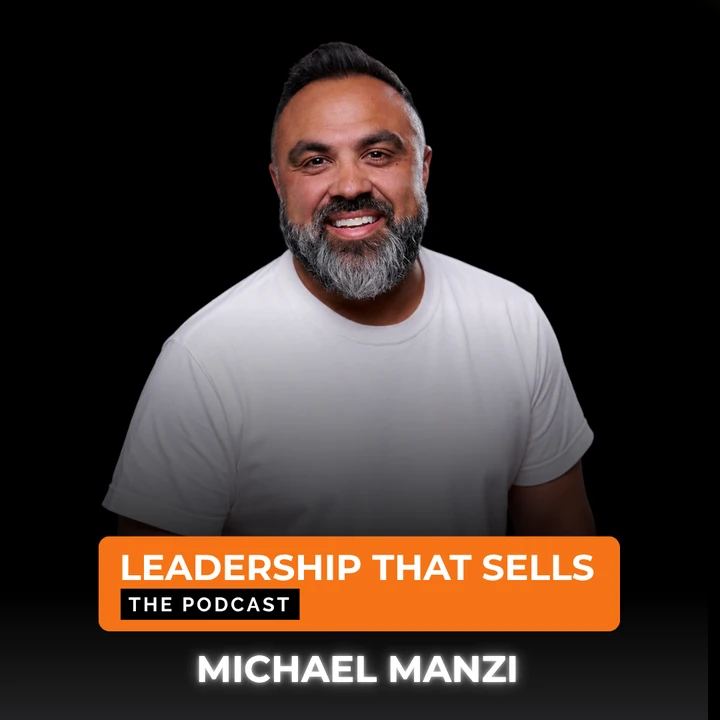
How to Build Sales Systems that Scale
with Michael Manzi
Show notes
Most commercial leaders think they’ve got a pipeline problem when they’ve actually got a systems diagnosis problem. This conversation with Michael Manzi gets into the difference between copying tactics and actually understanding what drives performance. There’s a massive difference.
We talked about why most sales playbooks fail when they’re transplanted into a new business, how leaders accidentally drive top performers out of the door, and the one variable Mike found that doubled a sales team’s win rate in 30 days. If you run a revenue function, there’s a lot in here worth stealing.
In this episode
A lot of leaders confuse tools with strategy. That’s where things start breaking.
- How to separate a real playbook from recycled tactics
- How to identify the single variable actually driving revenue
- How to stop over-managing your top performers
- How to remove excuses before diagnosing performance issues
- How to create buy-in before asking a team to change
Episode highlights
- [03:59] Mike admits he drove a top performer out of the business by overcorrecting into rigid management
- [05:00] The idea every commercial leader should steal: make deposits before making demands
- [09:04] Why most “playbooks” are just random tools duct-taped together from previous jobs
- [13:22] The surprisingly brilliant curling analogy for leadership and performance management
- [17:22] The data exercise that uncovered the one variable driving an 87% win rate
- [20:00] How one strategic change doubled sales effectiveness in 30 days
- [28:03] “On your forehead it says: I can fire you” and why great managers never forget it
Links and resources
If you enjoyed this one, follow the show, leave a review, and share it with someone carrying a revenue number on their back right now. These conversations are for people trying to build something real, not just sound clever in a board meeting.
Transcript
Automated transcript. Speaker labels and spellings may contain errors.
Paul
[upbeat music] Most sales leaders don't fail because they lack effort. What they fail for is because they've inherited a broken system a lot of the times. They've got unclear expectations and, and no real guidance on what is actually gonna drive the revenue that they then need to deliver. And my guest today has spent his entire career stepping into that chaos and turning it into the thing that we all dream about: repeatable, scalable performance. So welcome to Leadership That Sells. This is a podcast that talks about the real conditions where leadership and sales actually work, and when they don't, when they all break down. So I end up talking to founders, chief execs, sales leaders, and operators who've had to make the decisions when the effort was high, the pressure was real, uh, the usual playbooks that we've got in our back pockets from that last job we did 10 years ago didn't
quite fit or don't fit anymore. Now, the job is we're not here to try and trade slogans or, you know, medics or stuff like that. What we're trying to do is suffer- surface patterns, things that consistently create momentum, look at what it gets in the way, and look at what experienced leaders eventually learn to stop doing. So if you are responsible for results and not just ideas, you're absolutely in the right place. And it then leaves me to say, Mike Manzi, thank you and very much indeed for joining me.
Michael Manzi
Thank you so much. I'm happy to be here.
Paul
Great. Um, now you've been dropped into multiple sales environments where you've got an expectation of immediate performance, and I think most of us have had that. It's like, "Welcome on board. Can I have $10 million worth of, uh, pipeline, please?" Yeah, nice. Okay. What's the toughest situation that you faced when that number was at risk? What did you get wrong first out the, out the door?
Michael Manzi
Yeah. There, there was the company that I was working with where they were essentially at around, like, $500,000 in revenue, but they'd gotten a bunch of funding and we had the core six group of sales reps who all had been doing things their way, six different ways, and showed success because it was inbound, so they also had a lot of entitlement around how they should be doing things. And I was brought in to say, "We don't want the sales team doing six different things in six different ways, and we do not want them to have entitlement. And we're not gonna be sending them 100,000 leads a day. So truly, what they should be doing is about 10 times what they're doing today, and fix it." So this is really challenging when you come into an organization as an outsider. I was also moving from New York to Boston, so it was a little bit of like a, "Who is this guy from New York?" And I'm coming in as a VP when the previous person was the CRO.
Paul
Right.
Michael Manzi
So essentially everybody was reporting to a lower level person. They all thought they were perfect. All they'd been doing is winning because there were no goals in place. And, um, all of them are doing things their own way. So how do you take this team of people that are, um, succeeding and say to them, basically, "You're not succeeding, and we have to do things completely different from how you're doing it"? And so I made the mistake that I think a lot of people make, which is I made a blanket approach-
Paul
Mm-hmm
Michael Manzi
... on everybody. And we had, like every organization, it's a bell curve. So we had our two people that were truly rock stars, and we had our two people that were really kind of duds, and then the two in the middle. So I have a playbook that I've used everywhere, which includes these pipeline reviews, and the pipeline reviews go one way typically. With the top rep, I ran the pipeline reviews that one way, and, uh, she didn't like the way that I was doing it. She felt like it was, it was more, too micromanagy.
Paul
Hmm.
Michael Manzi
Um, the other thing I did was I, at the previous company that I was at, was a little bit too friendly. And so in this company I swung the pendulum a little bit too hard, and so I was a little bit too tough. And fast-forward, I think it was maybe six months, our top rep left the company. And to this day I know, and she said at the time, that a major deciding factor was because of Mike was my manager. How disappointing to be like, we literally lost probably millions of dollars because of, uh, losing th- this rep. So what I did at that point, once I had that exit interview summary with, with HR and realized sort of how much of that I owned after taking, letting my ego get to the side and say, "It wasn't me," was I, I really truly realized that I had been scared as a leader of a team.
And so instead of using my, um, personal skills and using my knowledge of how people work, I just leaned on system.
Paul
Hmm.
Michael Manzi
And I just said, "Whatever it is, I'll just, just do the system and run it exactly how it says to, that, that you've decided of how it should run, and don't take into consideration nuance, people, personalities, relationships, uh, the importance to a company." So after that moment, what I did was I realized who on the team was so critical, and I started using a nine-box matrix-
Paul
Hmm
Michael Manzi
... where we look at potential on one level and performance on another, another level and try to see, do we retain this person, train this person, or remove this person? And the person who I didn't like the most on the team was the person who I needed to retain on the team. I think we often see our top performers are, uh, most frustrating.
Paul
Toxic.
Michael Manzi
Yeah.
Paul
Toxic.
Michael Manzi
Top, the, the top is often toxic. Now, um, and so what I then did was I spent a lot of time figuring out with every person on the team, and I do this to this day, what are some quick wins? What are things I can do to make deposits every week and every month, like get rid of a field, get rid of a policy, remove them from a meeting, make some new thing where people can't talk to you that are outside of our team. Get rid of the annoying things for those sales reps so that later when I needed them to do something or I needed to ask for, let's say, what they would consider a favor- What I would consider an important change in the business. There's less pushback, and it felt like this is an equal relationship. Not Mike tells me to do stuff, Mike never helps, but Mike helps, and I still- I need to keep up with how much he's helping with me by doing stuff for Mike or for the company or for the business just, like, i- in, in general.
So ultimately, we ended up getting that business to 7 million bucks a year, um, in about a year and a half or two years, and we ended up retaining all of our top reps, um, that were not toxic. 'Cause a- af- after we got some more cash in the business, it then was okay for us to actually get rid of the toxic rep who, who truly wasn't gonna be a team player. Um, but in that first six months to a year, we actually needed the cash in the door more than anything else. So that's why... That, that was a very tough situation, but I'm glad I got through it.
Paul
I like that. Making deposits in advance of making the, the, the demands. You're... I, I like the concept of you, you, you know you're going to go through a tough time, so in advance of doing that, you build the team. You build them up to the point where you've, you've, you've given them all life jackets. You've trained them in self-defense. You've fed them up.
Michael Manzi
There.
Paul
You're gonna go through a rough time of starvation and violence.
Michael Manzi
[laughs]
Paul
You've got to be ready for, for, for how you're gonna deal with that. It, it speaks to the, the, the idea that people don't really care about what you say until they know that you actually care about them. You know, that sort of thing. I like that. Mm. So now, now that then is quite an interesting position for you as someone who talks about playbooks and systems. So you turn around and you say, "Well, aye, about those playbooks and systems, kind of not really the thing. It's more of the people side of us here." And that's, that's ac- actually my whole piece is like leadership that sells. You wanna sell, you know how to sell. You wanna lead, you know how to lead. How do you do it in a context where it is the most measured, most under-the-microscoped part of any business?
Because everybody's got a number in their head. Have you hit it? No. Then you're not succeeding. Have you hit it? Yes. Then you're succeeding. How did you hit it? They don't care.
Michael Manzi
Sure.
Paul
They could not give two craps how you did it-
Michael Manzi
Right
Paul
... as long as you did it. And there are quite literally two sorts of sales leaders, the ones that hit and the ones that miss. Guess which ones you want to be, ladies and gentlemen, right? So you position the ideas of playbooks and systems as the solution to sales leadership chaos. Okay. What is it that breaks? What is it specifically that breaks when people rely on those, as you just did, without understanding the underlying mechanics, not necessarily the emotional people side, but the underlying mechanics of a business? So you come into a new business and you're thinking, "I know what this is. It's one of them. Playbook number six B, apply." What, mm, what breaks?
Michael Manzi
Yep. So there's a difference between playbooks and tools, and this is where I think a lot of people get things wrong.
Paul
Oh, okay.
Michael Manzi
So the, the, the playbook is the general direction that we're heading and the avenues that we wanna take to get there. The tools are the actual things that we're doing. So for example, the playbook is, let's say, how do I forecast? And when I think of forecasting, I believe that there's a public forecast, there's a personal forecast, and there's a professional forecast. So those are the three avenues I wanna go down. Now, the tools I use are pipeline reviews, coaches room meetings, and, uh, forecast categories. Now, if I go to every organization and I say, "I have to use this pipeline review. I have to use this forecast category. I have to use this coaches room," it's not gonna work. If I think of those tools as a playbook, I'm going to try to insert yesterday's stuff into today's situation.
This house is, um, designed into this house's world.
Paul
Mm.
Michael Manzi
It doesn't work. But when you can zoom out and go, "Hey, what I'm recognizing here is that when it comes to, in this example, forecasting, um, I realize that there are some pressures that make you have a different public forecast than more of a private or personal forecast. There's, um, a private forecast that you can give by understanding each of your deals, and there's a bit of a pressure that make forces, uh, with forecast category that forces you to decide is this deal going to come in or not going to come in." And it's really all of those things that paint this picture. Um, but at a different company, I maybe wouldn't use coaches room. I maybe wouldn't use pipeline review. I maybe wouldn't use forecast category. But I would use a different form of a public, a private, or public, a personal, um, uh, what, in a, in a private forecast.
And I would just use different tools to, to do that. So I think where people get stuck is they use the tools as their playbook as opposed to the high-level understanding of, of, of a playbook. When you first start out, what you're doing is you're stealing tools. I always call people duct tape sales managers. You are duct taping tools from your last boss, your previous boss from, from three years ago, the LinkedIn message that you saw that made you feel insecure, um, the thing that your boss told you to do because they just read, listened to some podcast and they said you gotta do this. And you're duct taping all of this together, but never actually creating a system because like when you're eight and you're learning to play a sport, you know I swing, I run, I throw, but you don't know why you're doing any of those items.
As you get, um, more tenured and you start to see why things work and you can see the patterns, that's when you realize, oh, it's not the throwing that does it. It's not the pipeline review that does it. It's the inspection, um, of these certain questions, uh, in a private setting. So that can be done in a variety of ways. It's the, um, public pressure, which could be a leaderboard, could be an email. Doesn't have to be a meeting. Um, it's then that you can actually have a playbook versus tools, and that's when things break and when you don't do that.
Paul
I like that. A playbook master's tool. This, it speaks to, I think, um, it, it's almost like how you can structure or talk about how you lead in general. Um, I like talking about curling. It's the only sport that Scotland is any good at in the Winter Olympics. Curling is where they, they throw the stones across the ice.
Michael Manzi
Sure.
Paul
All right? So I like to think that, um, the job, your leadership job is you do all the training, you do all the p- positioning, but the performance piece, 'cause sales is a performer's profession, right?
Michael Manzi
Totally.
Paul
The performance piece is where you are the wee guy with the brush, and you're running ahead of them. You might call it a quarterback in the US. I'm sorry, I don't know what that is.
Michael Manzi
Sure.
Paul
But you're ahead of the, the, the, the curling stone, and you're sweeping everything out of the way. But what you've done is you've set the guidelines. This is the direction we're going in. No further than this, no further than that, okay? That is the way we're going. I've, I've done my best to level the playing field as much as I can, and given you the right weights, and trained you as mu- up as much as we can, but it's up to you to send them on their way.
Michael Manzi
Right. And i- in your analogy, imagine if you're, if, if instead of having that as your thought process, your thought process is I use the X1 280 brush.
Paul
Mm.
Michael Manzi
And it's like, well, on this ice, we need the X2 340.
Paul
Yeah. Fair enough.
Michael Manzi
And so your idea of just I must use this brush is, is actually incorrect.
Paul
Mm.
Michael Manzi
Your idea should be, I need to move things out of your way. I need to always be ahead of you.
Paul
Absolutely.
Michael Manzi
Right?
Paul
Sure.
Michael Manzi
But not I need this brush. Today we use that brush, tomorrow we use a different brush.
Paul
That's a... I love that. That, that's, that's quite profound, I think, as you've got-
Michael Manzi
My first profound curling analogy. Perfect.
Paul
You made a profound curling analogy, Mike. It's, it's, it's-
Michael Manzi
Sweet
Paul
... it's, it's a gift that we give everybody who comes on this podcast, is a profound curling analogy. [laughs]
Michael Manzi
Amazing. Thank you very much.
Paul
Um, so you, you, you are, uh, I think you're just, you're paying attention to context. You're paying attention to the people you're working for, the environment you're finding yourself in, the situation that's around you, and trying to find the best tool for the job. Best, best tool.
Michael Manzi
That's it.
Paul
Yeah.
Michael Manzi
So if I could give someone advice as it relates to creating playbooks-
Paul
Right
Michael Manzi
... what we wanna do, and obviously w- with people on my program, we've got a, a playbook for all of these different things. But really what you wanna do, um, is you want to think about all the things you've done. Like, if you could write out all the things that you've done, write out all of the success that you've had, which ones actually succeeded, and then zoom out to figure out what are the two or three categories of things that I'm doing here. For example, I thought through all the different things I've done to create a great culture, a high-performance culture in a team. And then I can look at that and say, you know what this really is? This really is I've shown people that I care, I've shown people it's about numbers, and I've shown people that I'm gonna help them.
Those three things are my buckets. Now, I can do those in 10,000 different ways in 10,000 different companies, but I know that if I were to grade myself, I wanna look at those three categories, um, to know if I'm doing well. And if I'm interviewing for a job, I wanna be able to say I have these categories, I have this playbook that I wanna follow. Um, it also helps me, um, when I'm in a job to dig to the bottom of the barrel as opposed to think, "Hey, how do I become better as a sales manager?" I can look at those three categories and go, how can I be better as it relates to showing them that I care, showing them I'm, I can help them? Um, so those, that high-level view categories of what you've done is what's gonna help you craft a playbook so you can more easily insert your tools and become more effective.
Paul
Okay. So you're looking, you're looking at the category or the, the, the, the, the effective moment of leverage that you've got, rather than the activity that you're trying to perform here.
Michael Manzi
Yes, sir.
Paul
And I think that, that splits out what I would say is the signal from the noise, because if you think most, um, most, uh, execs, most investors, whatever, they don't really care what you do, right? It's like they don't really care. As, as long as you hit the number, good for you. Well done. How did you do it? La, la, la, la, la. Not listening. Don't care.
Michael Manzi
No, don't care.
Paul
But in order to do that, you have to then make those high-leverage decisions. So you, you've had a number of different roles here. So you've been what, Time Doctor, you were Workable. You had these, like these d- interesting companies. What were the highest leverage decisions that actually moved the needle?
Michael Manzi
This is... I'm gonna tell you a decision that, that I made that I have now used this microcosm, if that's what it's called-
Paul
Mm
Michael Manzi
... to take to every company to find this high-leverage decision. Just let, let me, let me say that again. Let me, let me tell you the decision I made in this company and how I'm now using that decision as a formula to succeed in every company that I've been at thereafter, and why I've been able to be a fractional VP, you know, 100-plus times now. What I did was I looked at every variable possible that I thought could have an impact on win rate and deal size. So we looked at, um, how big the deal ended up being, who brought the deal to us, how big the company was, how much revenue the company did, um, how many people started doing the trial, how many people in the trial continued going on with the trial, so on and so forth. How many dials we made, everything. And I cross-referenced those variables against each other to say, oh, you know, what was our win rate when it was a s- small company and our deal size was under X?
A big company and our deal size was under X, right? So I cross-referenced all these things, pulled 100 pivot tables to see, uh, three, three pieces of information. How many leads did we get or generate? How many customers did we close? And how many dollars did we close those customers for? When I do that, I now know the win rate and the deal size of every vari- var- variation. Now, there's one more step I need to take here that is, I guarantee things that nobody in your audience is doing today because I made it up, but you guys probably have some version of this, which is I created 100 score. 100 score is 100 times your win rate, times your deal size. And I did this because if I look at how many... W- what is our win rate and deal size for big customers?
And, um, or sorry, how much revenue do we get from big customers? Well, a mil- million dollars. How much revenue do we get from small customers? $100,000. Big customers wins. But what if I told you that we got 10,000 leads for big customers, and we got 100 leads for little customers? Then suddenly you realize, "Well, wait a second. How did we only make a million dollars from 10,000 leads, and we made $100,000 from 100 leads? I, I actually think that there might be an issue here." Maybe the small leads are better, we just didn't happen to get this, that, as many of them. That, that, that we put together, we had 100 leads. 100 leads times win rate times deal size spits out how much money would we have made had we had 100 leads in this category.
So once you see that, you can stack rank which ones are the best and which ones are the worst. And so with this one company in particular, what we found when we did this was if we got 10 people into a trial in the first week, our win rate was over, uh, 87%. It was like 88% was our win rate, and all the other ones were variations of 30, 40, 50%. We didn't have this visibility at first because we just thought, "Oh, we have like a..." I think it was like a 37% win rate. So at that moment I was like, "Okay, everything we do is around 10 pe- 10 people getting in the trial. That's all we're doing." We put it on the website. We gave SDRs a coupon code. If you can get them to use your coupon code, if they sign up within a week and get seven people in, in the, the trial, they get 10% off. We reversed the demo. So instead of us doing the demo and sh- sharing our screen, we had the customer share the demo on their screen, and we drew on their screen by doing things like, "Hey, click here and actually add, add your
first person." We, um, after the first call, instead of having like, "Hey, we'll follow up in three days," we ha- we had a, a one-week check-in, a 10-day check-in, and a two-week check-in. And one-week check-in was just like, "Hey, you don't have everybody in there yet." 10-day check-in was, "Hey, we still g- need to get a couple more people in there." And the two-week check-in was, "Holy cow, did you see what you just, you know, uncovered?" Um, and our win rate went from something like 30 something percent to 67 or 68%-
Paul
Nice
Michael Manzi
... in a matter of 30 days. So w- we, we, we effectively doubled the effectiveness of the sales team in 30 days by making really one strategic change. And now every organization I go to and every single person I coach, I try to find what is that, um, outlier variable that's hidden that we can exploit if we had access to it.
Paul
Oh, very nice. Very nice. 100 score, I like that. So oppor- number of leads, number of opportunities, times deal size, times win rate. That's good. Do you know what? If you take that and then you divide that by your sales cycle length, you end up with a sales velocity, right?
Michael Manzi
Sure.
Paul
You end up with your day, you end up with the, the revenue per day. So you've got that as a baseline, which is impacting what you've discovered, that one le- that one lever that's actually gonna impact things. And then, so that then gives you, okay, so that's a really nice metric. I like that, 100 score.
Michael Manzi
Sure. Steal it.
Paul
Um, steal it. Stolen. Stolen.
Michael Manzi
Perfect.
Paul
If we go to, um, your Playbook Starter Kit, officialsalestips.com, what do we get?
Michael Manzi
Yeah, so you're gonna get the true starter kit that I give to everybody and that I use personally. Um, this is exactly... This is not here's cool ideas or here's a, a general overview. This is here's the exact template to use. So the most important one you're gonna get is the scorecard. Right now most people use as a dashboard, and the dashboard shows you where you are. Maybe you're fancy and have a gas gauge here or there. Half the time it's out of date, half the time, um, it doesn't show you everything you need, and you have four dashboards, and this one called final, final, final, actual one. This one for real. So what this does is it just says-
Paul
Oh
Michael Manzi
... it puts in your goal, you put in your actuals, it spits out your percent to quota. Nice and simple. But it includes not only your revenue goal, it includes your win rate goal, your deal size goal, your number of deals goal, your activities goal, your contacts goal, your contact to ac- opportunity rate, your activity to opportunity rate, so that when you are going, "Oh, shoot, we're missing our number," you're not having to make up some crazy story to your boss about why it's, A, not your fault and, B, not gonna happen again. You can actually look at the numbers and say, "Hey, I'm seeing right here where the failure is. It's in contact to activity rate," or c- sorry, contact to deal creation rate or activity to deal creation rate. This basically gives you a magnifying glass on every area of the pipeline to diagnose the problem without you having to go listen to 10,000 calls and spend 100 hours talking to, to your sales team.
That's the critical bit. The other bit that you get is the managing, and the third bit is the people. So on the managing of people, if you run your one-on-ones right, which I know makes everybody's eye roll. But I have a whole system for one-on-ones, and I have probably all my... I've, I've, I usually get about $5 million, I mean, $5 million, 5 million views a, a month, and most of them end up talking about my one-on-ones. Um, you, you wanna get this correct, and there's the framework for running it, the template to actually put the information in that you do need to, to put in. None of it's that hard. Um, it's all normal stuff, but this is what, um, getting the one-on-one right is what creates consistency and reinforces the culture so that people actually work hard for you, uh, all the time versus sometime.
And the third thing is the people. We all know this. Like, a lot of times you go, "We had a great month or a great year." Why? You say 'cause of all your training and all of your great stuff that you did, but you're like, "It was Timmy. Timmy, Timmy carried the team." So what we have here is we wanna make sure we have the best people. So I give you my exact hiring scorecard, which gives you a weighting on every question you should be asking, so you can see a score for every single person. It gives you the exercise you have to give them to actually test that are they good at their job or are they just charismatic. And it gives you all the comp plan that you wanna provide these people with, with accelerators and everything else to make sure that they're motivated. So truly, how do I bring a team in, how do I manage them once they're in, and how do I track all the numbers is all included in this, and it's nine bucks.
Um, that way you guys can get started, see results, and start to see how good you can run a sales team when you run it through the primary heartbeat of a playbook.
Paul
The, I think you've got a, a website title there. I mean, I, I like the one you've got. No, that's pret- that's pretty good, you know. It's, uh, uh, official sales tips. But I think the, the, the nine-buck playbook, that's, that's, that's snazzy. You, you can have that for free. [laughs]
Michael Manzi
I'll take that. Stolen.
Paul
Last question for you, 'cause we need to wrap this up.
Michael Manzi
Sure.
Paul
How do you know when a sales problem is in fact your problem, a leadership problem, rather than a systems problem?
Michael Manzi
Well, so the first thing I like to do when I'm coming to an org is I want to fix the systems and see, uh, what things actually can be resolved from a will or skill perspective. So of course, any time you go into an organization, the first problem that we have is, "It's stupid that we have these meetings. It's stupid that we have to fill out the CRM this way. It's stupid that the CS team requires us to do these things." And the sales team tells you, "These are all problems. If, if only these things were fixed, then I can, I could run t- to the moon." Now, what I love about getting this information is this is my... These are my quick wins.
Paul
Yeah.
Michael Manzi
So in the first 90 days, I am just driving through quick wins for the, for the team. I'm talking to CS, I'm canceling meetings, I'm changing systems. Now, for the sales team, this is to let them know, "I got your back," so they wanna work hard for me. But the other thing is all this stuff is out of your way now, so there are no more excuses. So that, that, it, it... Once I've gotten rid of the system problem for the most part-
Paul
Mm-hmm
Michael Manzi
... that's when I know that we can move to the, i- in the other direction, and it's truly gonna be my fault if it's a systems issue. Um, the, the next thing, uh, I do is I watch that hundred score, like I mentioned, over time. If the number of leads is down, my revenue will go down. So is that my fault or is it marketing's fault? This is where you yell at marketing. If revenue, if, let's say you're a, a chief sales officer, chief revenue officer. If revenue goes down but it, it's not the sales team, it's CS's churn, is that your fault? Well, no, that's kind of CS. But when you look at the hundred score, this is to say, are we generat- Forget the number of leads, especially if what we're doing, we're getting inbound leads.
This is just win rate and deal size. And if the win rate and deal size is going up, and the hundred score therefore is going up, I know the effectiveness of the team is going up, um, regardless of systems or anything else. So I'm s- I'm s- scouring that or I'm staring at that number to know, is this a will issue? Meaning it's go- the, the number is going up, the hundred score is going up, but we're not getting r- more revenue, so we're not getting enough stuff through the, the pipeline. Or is it a skill issue? Even though we might be getting more leads or getting more, more, more efficient, um, from a systems perspective, we're not seeing the win rate and deal size go up. So that's how I identify if it's pretty much, uh, let's call it my fault or, or not my fault. Though, at the end of the day, of course, everything's your fault. You need to either create more relationships across the org to solve with other departments-
Paul
Uh-huh
Michael Manzi
... or, um, within your, within your department to help them do better.
Paul
There you go. Mike, lastly then, um, if you had thousand billboards and the biggest Sharpie you could imagine-
Michael Manzi
Sure
Paul
... what's the one message you would leave with all these poor sods who have this majestic job of trying to lead the ballerinas and opera singers that are most of our sales team?
Michael Manzi
Uh, I think what I would say is, "On your forehead it says in flashing lights, 'I can fire you.' And don't forget that." And I say this because what every manager I, I work with, and when I bring up the idea of feedback, they're either not giving feedback because they're afraid 'cause they s- they, they see that sign and they don't realize that sign gives them power, or they're, uh, they don't know that sign exists.
Paul
Mm.
Michael Manzi
And so they are rude or a little bit tactless when it comes to giving feedback, and this causes people to run away from them. But if you can recognize, like, I have this power of authority, um, given to me implicitly, which means I can push people, but also I have this power that can hurt people, so you don't wanna overuse it. Um, that will allow you to be a really good manager. So yeah, a big picture of someone that says, "I can fire you" on my forehead, so that you treat people appropriately, both respecting their future performance and make, helping them be the best version, and also respecting who they are as human beings and not overusing your power.
Paul
There we go. With great power comes great responsibility.
Michael Manzi
Indeed.
Paul
And indeed, Mike Mancey, thank you very much indeed for joining.
Michael Manzi
Thank you, Paul. [upbeat music]