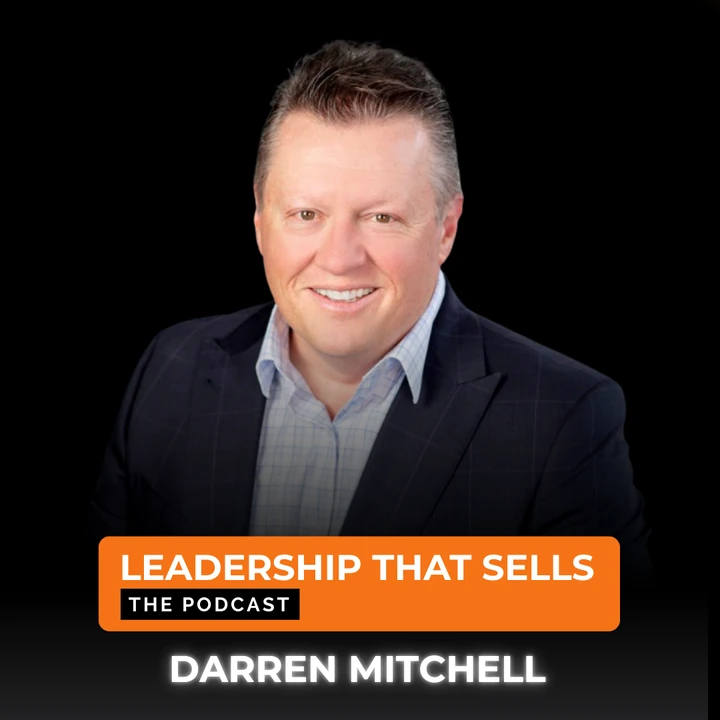
How to become an exceptional sales leader
with Darren Mitchell
Show notes
If your best rep walked out tomorrow, would you lose just a number… or a method? In this episode of Leadership That Sells, I welcome back Darren Mitchell sales leader, coach, and host of the Exceptional Sales Leader Podcast to dig into a painful truth: most sales organisations are built on individual heroics, not systems. And that’s costing you.
We talk about what really happens when top reps get promoted, why sales teams aren’t teams at all, and how to finally stop “renting” revenue from your best players. Darren and I rip into the leadership traps that stall performance from public pipeline beatings to pointless President’s Clubs and lay out a smarter, more scalable approach: codify what works, coach for contribution, and turn your sales force into a learning organisation. Expect strong opinions, sharper insights, and a few very uncomfortable questions for the old guard.
How to protect your sales IP and turn top-performer secrets into team success
- Stop building hero culture – If your top rep leaves and takes their method with them, that’s not a people problem, it’s a leadership failure.
- Record everything – Use Zoom, Teams, even your phone to capture real sales conversations. That’s your goldmine.
- Codify what works – Use AI and human analysis to extract patterns from top performers and build a playbook that evolves.
- Reward sharing, not just winning – Add a “coach’s badge” to your President’s Club. You’re only elite if you help others win too.
- Separate the levers – Keep deal inspections, coaching, and team learning as distinct meetings with distinct goals.
- Don’t confuse presence with performance – The loudest person in the room isn’t always the best coach. Create space for real development.
Timeline summary
[01:12] – Sales teams aren’t teams. They’re golfers on their own course.
[04:39] – “Would you lose their method too?” – the hidden IP risk in sales
[06:32] – Why top performers often can’t teach what they do
[07:50] – The double failure of promoting your best rep to manager
[09:16] – Codifying excellence: how to use AI to extract the playbook
[13:34] – The case for rewarding contribution, not just revenue
[16:24] – Flip the sales meeting: learn together, don’t punish publicly
[19:07] – The 3 types of meetings every sales leader must separate
[21:03] – Coaching is the highest ROI activity – and the first to get cancelled
[25:01] – Do we even need President’s Club anymore?
[26:14] – Should we stop paying commission? (Yes, we went there)
[30:39] – We’re renting success from individuals instead of building systems
[35:00] – The power of giving: build a team that shares, not hoards
Links & resources
- https://au.linkedin.com/in/sales-leadership-coach
- 🎙 Listen to The Exceptional Sales Leader Podcast
Transcript
Automated transcript. Speaker labels and spellings may contain errors.
Paul
[upbeat music] My guest today, for the second time running, is a seasoned sales leader turned coach. He's a man who's led $100 million teams. He's trained thousands, I think 5,000 people, and more importantly, he's hosted something like 700 and yumpty-tum episodes of the Exceptional Sales Leader podcast. And if you haven't listened to it, then you're an idiot.
Darren Mitchell
[laughs]
Paul
Go and do it now. The link is down below. Do it now. Bookmark it. Off you pop. He's had a crazy career. He's, uh, worked with Optus, he's worked with Telstra, other global brands, and what he's doing now is he's helping sales managers leading with clarity, with consistency, and with confidence. And with that, I'm telling you, welcome to Leadership That Sells. We're here because most sales leaders think that they are busy building a high-performance team, and they're not. What they're doing is they're managing a collection of golfers all playing golf, but on their own course. And because you're treating them like some football team, trying to get them all to work towards one goal, you're bleeding revenue. Your A players are hold- hoarding their tactics. They're all trying to win President Club.
Your middle tier is stagnant because the knowledge from the A players never transfers. And if your top rep quits tomorrow, their secret sauce just walks out the door with them, right? That, my friends, is not a leadership problem. That is a systemic intellectual property risk. Now, what I try to do is not just train managers. We're trying to install the practical team, parallel team operating system. And that's like a team audit to try and capture that unwritten how those top performers de-risk your revenue engine and turn your sales force from this collection of individuals into a scalable dynasty. If you're ready to stop relying on your heroes and start building a system, check out your risk level with our sales IP audit at the Practical Leadership Academy. With that, Darren Mitchell.
Thank you very much for joining me, sir.
Darren Mitchell
[laughs] Paul, it's an absolute pleasure. What an introduction, mate.
Paul
Oh, my God.
Darren Mitchell
And that was straight off, straight off the top of your head. How good's that?
Paul
It's, it's miraculous. It's miraculous. It's almost as if I knew what I was talking about, mate.
Darren Mitchell
Mate, you're a master orator.
Paul
[laughs] That's another word for a bullshit artist extraordinaire-
Darren Mitchell
[laughs]
Paul
... who hasn't been caught out yet, isn't it?
Darren Mitchell
Well, it's, it's, it's... We're, we're sort of, um, cut from the same cloth, although we've got a slightly different accent.
Paul
That's it.
Darren Mitchell
Um, my wife says exactly the same. When her friends and when her colleagues ask, "So what does your husband do?" [laughs] And she says-
Paul
Sure
Darren Mitchell
... "He's a bullshit artist." [laughs]
Paul
Then the Scottish version of that is like, is 'cause it's a pattern merchant, right?
Darren Mitchell
[laughs]
Paul
It'd be somebody who's, who's going the bar, taking a barrel of, you know, dodgy produce down into the marketplace saying-
Darren Mitchell
[laughs]
Paul
... "Get your bananas here. They're ripe." You know, it's like, um... What is it? Uh, I can't remember. The Bunco merchants, they're trying to sell pink salmon, you know? But it's not pink salmon.
Darren Mitchell
[laughs]
Paul
It's white salmon. It's albino salmon. It's cod.
Darren Mitchell
[laughs] Yeah.
Paul
It's albino salmon. [laughs] Totally.
Darren Mitchell
It's just been left in the sun for a while.
Paul
[laughs] It's, it's ripe. It's ripe.
Darren Mitchell
[laughs]
Paul
Oh. Right. I got a question.
Darren Mitchell
No, glad to be here, mate.
Paul
Ah, man.
Darren Mitchell
Glad to be.
Paul
Good. I, I wouldn't... There's nobody I'd rather try this out on. And if you're listening, I'm about to try something, uh, and, and, and work here with Darren on a brand-new shiny idea that I'm trying to work out here, and it's based on the fact that we, we have to go back in time and think that m- most managers of any team have no clue because they've never been trained. It's something like you get your first training 12 years into the management job.
Darren Mitchell
Yeah.
Paul
Which then means that all you're doing is what you've seen other people do, which then means that what other people have done has not been trained for 12 years. So nobody knows what they're doing. There's no apprenticeships. There's no concept of-
Darren Mitchell
Yeah
Paul
... how you do this job. Then you talk at sales manager level, and sales manager, sales leaders have done what's been done to them, which is bad, and nobody's ever given it any thought.
Darren Mitchell
No.
Paul
You think that you're trying to build this cohesive team and have people do group hugs, which isn't gonna work, okay? You think you should be putting competition in there, leaderboards, competition, which isn't gonna work, and there's reasons why not. Um, and then y- there's just so many things you're doing, doing wrong when your job is to try and facilitate a purchase, not push a, pu-push, push a sale, you know?
Darren Mitchell
Mm-hmm. Mm.
Paul
But then you take the step up, and the step up is when we talk about, people talk about talent a lot, but the harder question I think is about asset value, right? So bear with me on this. If your number one revenue generator, your top salesperson, walked out the door-
Darren Mitchell
Mm-hmm
Paul
... we'd lose a pipeline, right? Okay, we know that.
Darren Mitchell
Totally. Yeah.
Paul
But would you lose their method? Is this the, the special secret sauce of the how, the thing that they know how to do? Is it codified in any way, shape, or form that the rest of your team could use tomorrow, or is it locked-
Darren Mitchell
Mm
Paul
... in their head? Okay. From people you see, which is which? Codified, locked in their head.
Darren Mitchell
It's a, it's a really interesting question, and I think there's elements of both. What I do see is, and you mentioned it before, parallel teams and the fact that sales... I've always thought that sales teams are a little bit of a fallacy anyway because they're a bunch of individual contributors. And you described it really well. You've got a bunch of golfers that are trying to get the best score. They're competing against each other. But you've got a sales manager who's like the, let's just say, the group coach of the bunch of golfers trying to get everybody to try and get to the 18th hole with a reasonable score.
Paul
Yeah.
Darren Mitchell
The interesting thing about the, the codification is if you ask a lot of people who are, let's just say, high performers within sales or in any discipline, and ask them the question of how they do things the way they do, very often they'll have no idea because they've got this level of unconscious competence. So it's almost, in some cases, impossible to try and deconstruct the strategy because they don't even know what they've done. [laughs]
Paul
Mm.
Darren Mitchell
Because they've just either got this intuitive skill set or they've seen something and it's just become a habit, but they can't necessarily articulate it. So when somebody leaves, um, yeah, we've lost a, a, a great individual contributor, but we also lose some of the information as to how they do it because often they don't know themselves how they've done it.
Paul
Yeah. Yeah.
Darren Mitchell
So the other problem of course is they get promoted and we ... You talk about the asset.
Paul
Mm.
Darren Mitchell
We've now lost an asset that is revenue generating because we give them the bestowed, um, a title of leader and they now have to drive the sales team and the team, and the executives are expecting the team [laughs] to basically repeat the behavior that they've been generating. And when it doesn't happen they think, "What's going on?" Well, the guy doesn't know how he was successful, so how can he teach his team how to be successful? Because there's no model.
Paul
And he's got no clue about how you lead teams.
Darren Mitchell
No.
Paul
Right. So-
Darren Mitchell
Because you said it
Paul
... double failure
Darren Mitchell
... tra- training 12 years after.
Paul
Exactly. It's a double failure. So you've lost not only your top performer who's now sitting trying to re- lead a sales team he doesn't know how to do.
Darren Mitchell
Mm.
Paul
Trying to pass on his worldly wisdom, which let's say he's an analytical person and he's trying to pass this on to half of his team who are relationship types, okay?
Darren Mitchell
Mm-hmm.
Paul
Not gonna work. And you've lost your pipeline, you've lost your top performer. He doesn't know how he's supposed to be doing this, and he's gonna piss off the rest of his sales team and they're gonna quit. Congratulations.
Darren Mitchell
Great. And guess what? In the process, Paul, because he sees he's got the pipeline that's drying up, he now turns back into the super salesperson, so he tries to actually get the numbers up at the expense of everybody else in the team.
Paul
Okay.
Darren Mitchell
So they become, he becomes the super salesperson.
Paul
Of course, which typically is this, is the player coach because that's the most common-
Darren Mitchell
Yeah
Paul
... route to failure. It's not the most-
Darren Mitchell
Mm
Paul
... I think it is probably one of the more common sales management types, but it's genuinely the more common route to failure. If somebody's-
Darren Mitchell
Yeah. I would agree
Paul
... carrying their own quota. End-
Darren Mitchell
Yeah
Paul
... of the quarter, end of the year, they're gonna, "I'll just lean in and put my shoulder to the wheel and I'll make it happen," says the hero. No.
Darren Mitchell
That's right.
Paul
It's just no. So my challenge I think is how do you then help those people, how do you help those organizations with those people capture and codify that knowledge when the people you're asking, you go to them and say, "I'll interview my top salespeople," fill your boots because they have no fucking clue. Sorry. They've no idea how they do what they do.
Darren Mitchell
[laughs]
Paul
So I, m- my concept here, most organizations are now recording calls. Okay?
Darren Mitchell
Yeah.
Paul
You give me 50 calls with a mixture of your top performers and your middle performers, and then using the mi- miracles of artificial intelligence, what, what, what she is actually meant for, content creation not being one of them by the way, please stop doing that-
Darren Mitchell
Yeah
Paul
... is you can extract the very essence and the framework o- that the high performers are using and pull out the stuff that they do that the middle performers do not.
Darren Mitchell
Yeah.
Paul
Right?
Darren Mitchell
Yeah.
Paul
And that is the basis of your codified playbook.
Darren Mitchell
Yeah.
Paul
But it's an evil- it's an evolving playbook, okay? So what I'm trying to, I'm working out if it's of value would be something like a chief playbook officer-
Darren Mitchell
Mm
Paul
... or somebody who would come along, me, for a enormous retainer and work out-
Darren Mitchell
[laughs]
Paul
... how to do this with you. Capture that, build that, and keep the damn thing up to date.
Darren Mitchell
Mm.
Paul
Together with putting those elements in play that need to be there like this is how you manage a sales team, you fool. Okay?
Darren Mitchell
Mm.
Paul
That sort of stuff. So that's, that's kind of my, my, my thinking now.
Darren Mitchell
I love that. And what, what's your thoughts? Because there's, there's a lot of, um, obviously there's a lot of salespeople that, that run their sales calls, discovery calls, qualification calls, closing calls, um, on Teams, on Zoom.
Paul
Mm.
Darren Mitchell
Um, how do you, how do you do that face to face? Would it be, um, having them recorded, getting customer permission to record those calls for coaching and training purposes only so you can actually codify that? Um, but I think it's a great idea because if the person who is really good at closing or really good at taking a customer through a buying cycle or a sales cycle, if they don't know how they do it, they just intuitively do it, having somebody, somebody like you and an AI engine to break it down and look for patterns and similarities will start to then extract what are the key milestones. At what point in the sales process based on certain language patterns does the salesperson perhaps offer an assumptive close or an alternative or go and close, close the sale?
So you start to see some consistency. Um, and that would help, I guess, the organization try to understand what does make this elite salesperson, this exceptional salesperson better than, I guess, the average, and what do they do that the others don't.
Paul
Yeah.
Darren Mitchell
So you can start to build some gap closure strategies.
Paul
So that I think is how you start to protect that organization's IP, how you extract it from the head of the top salesperson.
Darren Mitchell
Yeah.
Paul
Because if you think of the models that we've had to date ... Now n- your question is basically how do, was how do I record something face to face. I haven't had anybody push back when I put my phone on the table and say, "Do you mind if I record this?"
Darren Mitchell
Yeah. Okay.
Paul
Just to get the tran- because it's, I'm getting a transcript.
Darren Mitchell
Yeah.
Paul
Of course you're getting a transcript.
Darren Mitchell
Yeah.
Paul
You'll get it too. I'll sh- I'll share it.
Darren Mitchell
Yeah.
Paul
No problem. And it's just-
Darren Mitchell
Yeah
Paul
... it's, it's speed that's, it's ... You won't have to explain yourself to anyone else because I've got my notes and I can pay full-
Darren Mitchell
Yeah
Paul
... like I can give you my full undivided attention is a phrase that I use.
Darren Mitchell
Yeah. I love that.
Paul
I'm not gonna try and make notes. There you go.
Darren Mitchell
Yeah.
Paul
So you've got- The, the, the, the, the thing we're trying to do with this middle, this, um, un- unloved 60% that's providing like, you know, 10% of your results versus the 10% that's providing maybe 80% of your results, is we try to move them up the chain, right? And we do this, so there's companies that do things like President's Club. So it's the top performers get to go to Maui-
Darren Mitchell
Mm-hmm
Paul
... for the week or something.
Darren Mitchell
Yeah.
Paul
So you ha- you put this highly competitive situation into play, and guess what? I've done five years' worth of research on five years' worth of CRM data from a mid-sized company, and they never move.
Darren Mitchell
Mm.
Paul
The performers in the middle, I, I saw, I think we added, it was like 80-odd performers on this team. One of them got better.
Darren Mitchell
One.
Paul
One out of the middle bunch got better. The rest of the top performers remained the top performers.
Darren Mitchell
Yeah.
Paul
People who are good are good.
Darren Mitchell
Yeah.
Paul
So why didn't the middle ones get better?
Darren Mitchell
Mm-hmm.
Paul
And I think they didn't get better because the top performers didn't share. The criteria for membership of the President's Club for getting a suntan on the beach in Maui with your husband or wife was, did you hit your number? Yes.
Darren Mitchell
Yeah.
Paul
Yes, yes, yes I did. I did. So what we need to do is add the second part to that, which is, uh, the, it's, it's, it's, it's the coach's badge.
Darren Mitchell
Mm-hmm.
Paul
And I'm not asking you to turn into a coach. I'm just-
Darren Mitchell
Yeah
Paul
... asking you to turn into somebody who shares.
Darren Mitchell
Yeah.
Paul
So the second criteria is, were you voted most sharing person? Did you add the greatest number of things to our collective playbook? Did you contribute to other ways of doing things as a whole?
Darren Mitchell
Yeah.
Paul
So we can capture this programmatically, but then institutionally, we can change the mindset to say, "I'm not just gonna win. I'm gonna share my ideas. I'm not gonna..." You don't need to be a coach, 'cause that's not the, the, the-
Darren Mitchell
Mm
Paul
... gig here. But this worked for me. If you can make it work for you, fill your boots. And you then change the way that you have your meetings as a salesperson, as well as a sales leader.
Darren Mitchell
Yeah, absolutely. How do you, how do you think, and just thinking out loud here, how do you think big organizations, um, who are used to that internal competitive tension, particularly chief revenue officers who perhaps are, quote unquote, "old school" where they think, "You know what? The President's Club is designed for the crème de la crème. We want to actually create the internal mechanisms to get the internal competition so that we can actually blast our numbers out of the water." And maybe the top 2% or the top 5% or the top 1%, depending on the size of the sales force, are the ones that get through. How do you think they all go in terms of changing the narrative a little bit to say, "We still want to drive the number, but we're gonna put some weighting on your ability to now share how you get the number. What's your methodology? What's your thinking behind it?" Do you reckon there's an appetite out there?
'Cause I'm, I'm, I, I fully concur with that, right? 'Cause we need more and more salespeople sharing how they go about it, and we need more and more sales leaders driving their sales team to be more based on servitude and sharing and helping their team members, not just looking at what's in it for them.
Paul
There's a couple of angles there, I think. Now, one is that you, as you said, you weight the membership of the President's Club. You just add this concept I'm calling the coach's badge. So it's like-
Darren Mitchell
Yeah
Paul
... you know, you're in the Boy Scouts. You get to have a badge sewn on your jerkin that says, "I helped out," right?
Darren Mitchell
Yeah.
Paul
So top performer is the top performer, but top performer can only be in the President's Club if they are also a top sharer. Okay?
Darren Mitchell
Yeah.
Paul
So that's how you do it. Then the thing for the sales leaders themselves is to tell them to do something that is really weird and wacky. And you know your sales meetings, right? You know you have these... You got, let's say you've got a team of six or eight sellers, and you get them all together, and you publicly berate them for lack of performance and drill into their details and their deals. Basically, people are there in a queue waiting to be punished, and they're thinking-
Darren Mitchell
Yeah
Paul
... "Oh, when is it my turn? When is it my turn? Oh, great. It's my turn. Here we go. Yippee-ki-yay. Lay into me, why don't you? Why hasn't it closed?"
Darren Mitchell
[laughs]
Paul
And my concept is to shift that and do that privately. You're investigating data in your CRM. So you're saying, "This deal you've got here, it's been in stage two for 15 days. That's five days longer than normal. Convince me it's gonna close."
Darren Mitchell
Mm.
Paul
"That's what I want to know. I'm investigating the data."
Darren Mitchell
Mm.
Paul
"I'm interrogating the data." But in your sales meeting, nobody else gives a shit about that.
Darren Mitchell
No.
Paul
I don't care about your deals.
Darren Mitchell
No.
Paul
So I'm sitting here waiting for you-
Darren Mitchell
No
Paul
... to be punished and waiting for my turn to be punished. Why don't we flip it and we say the sales meeting is there to learn together, right? So if you're brave enough, and eventually you get there-
Darren Mitchell
Mm
Paul
... "This is what I didn't do well this week. This is a challenge I had. Can anybody help me with it?"
Darren Mitchell
Yeah.
Paul
"This is what worked for me this week. Does anybody want to try it?"
Darren Mitchell
Yeah.
Paul
And that, again, also then starts to feed into your rolling playbook of things that bloody work.
Darren Mitchell
Mm. Yeah. I love that. I love that. As you were talking there, Paul, I'm thinking, man, do sales leaders still do the individual interrogation a- in front of [laughs] their entire team? 'Cause I was, I was always brought-
Paul
Oh, man.
Darren Mitchell
Man. [laughs] One of the things that I always did for my own sales team, and I'm going back a few years now, is I always used to remember, criticize in private but praise in public.
Paul
Praise in public.
Darren Mitchell
So unless there's something that applies to the entire team, never single out a person trying to make an example of them in front of everybody else. Have that conversation in private
Paul
Mm.
Darren Mitchell
I mean, I just don't, I just don't get that. Um, and maybe that comes back to the fact that, as you mentioned before, the average sales leader doesn't get training until they're 12, 12 years into their, [laughs] into their role, which is-
Paul
Having spent-
Darren Mitchell
... unpleasant
Paul
... the last... Yeah, they've spent the last 12 years doing what didn't work for the last person who had 12 years of experience, doing what didn't work for the person before them, before the person before them, right?
Darren Mitchell
Yeah. Yeah.
Paul
And I think the big thing there is, is that people are then trying to... They're mixing the business inspection with the rep development.
Darren Mitchell
Yeah.
Paul
You've got a one-to-one with somebody maybe.
Darren Mitchell
Yeah.
Paul
Uh, even if you don't have a sales meeting, I won't lie, but you-
Darren Mitchell
Mm
Paul
... let's say you don't have a sales meeting, your one-to-one then turns into, uh, just the business inspection.
Darren Mitchell
Mm.
Paul
Or maybe you try and coach at the same time. And when you do that, what I find is that kills your truth of your forecast because your reps are hiding the bad news to avoid the lecture. It poisons-
Darren Mitchell
Or they're trying to justify.
Paul
Yes. Exactly.
Darren Mitchell
[laughs]
Paul
So you separate them out. You've got the sales team meeting, which is a learning gig.
Darren Mitchell
Yeah.
Paul
You've got-
Darren Mitchell
Yeah
Paul
... the deal inspection, the business inspection, and then you've got your one-to-one where you're doing the coaching-
Darren Mitchell
Mm
Paul
... you're doing the personal development.
Darren Mitchell
Yeah.
Paul
And I'm adding things into, into the sales leader's job here because it-
Darren Mitchell
Yeah
Paul
... is their gig. It's what they're supposed to be doing.
Darren Mitchell
That's exactly right. I think that's a, I think that's a... I'm gonna say a, a common base approach that is not common. And if you talk to most sales leaders, and if you ask most sales leaders in terms of how they run their meetings, well, I'm staggered. I, I'd love your take on this. I'm staggered at the number of sales leaders that actually say, "I very rarely have a one-on-one."
Paul
It is the one lever you have.
Darren Mitchell
Yeah.
Paul
You have so few levers to, to move your business forward.
Darren Mitchell
Yeah.
Paul
I mean, in any executive position, right? And a sales leader-
Darren Mitchell
Yeah
Paul
... is an executive position because your job is to direct and execute. Allocate capital.
Darren Mitchell
Totally. Absolutely.
Paul
You've got so few leader- levers you can pull.
Darren Mitchell
Yeah.
Paul
And having a one-on-one where you talk about, you connect with the individual, you're coaching them, you're moving them forwards day by day.
Darren Mitchell
Mm.
Paul
Just on a shared sheet, just have a shared Google Doc, what did we do last week? Just, just write it down.
Darren Mitchell
Yeah.
Paul
Talk about it.
Darren Mitchell
Yep.
Paul
It's insane. Half an hour a week. It's your bloody job. Find the time. M- that is your time. You shouldn't be doing anything else.
Darren Mitchell
Well, unless you've got a ... Exactly right. Unless you've got a team of, like, 20 people, there's no excuse not to spend half an hour per person per week where you're coaching and developing your team. You can also have a separate one where you do the interrogation of the numbers. But what's really interesting is we know through, I guess, lots of research that's been done by a lot of different organizations, that coaching of salespeople is one of, if not the most important lever to drive higher performance. But it's also the first thing that either gets rescheduled or canceled.
Paul
Yeah.
Darren Mitchell
And often it's because we're not setting up the sales leaders with the tools on how to coach and even give them some basic definition as to what is it to coach. It is not to tell them what to do. It's to actually help develop them and hopefully teach them resourcefulness, not give them the answers.
Paul
What's your favorite coaching questions?
Darren Mitchell
My favorite coaching questions. [laughs]
Paul
Everyone's got some. I've got the same. I've used the same f- like four or five since forever, basically.
Darren Mitchell
Um, I just like using really, uh, really basic, basic questions such as, um, you know, what, what are you, what are you looking to achieve? What, what are you looking to achieve in the next 30 days? What do you love about your role? What are some of the challenges you're currently experiencing? All general open-ended questions-
Paul
Mm
Darren Mitchell
... that encourages the person to start talking. It's not, "Hey, your numbers look a bit behind. What's your gap closure strategy?" [laughs] I, I don't ask those, those questions. They're very conversational. [laughs]
Paul
Love it. I love it.
Darren Mitchell
[laughs]
Paul
Oh. So listen, um, the last thing here is about, going back to this President's Club thing. So-
Darren Mitchell
Mm
Paul
... when, in your experience then, we're spending, you know, collectively millions of pe- millions of pounds on this President's Club thing to re- try and reward-
Darren Mitchell
Yeah
Paul
... the result, the revenue. But again, I think it just incentivizes the, the, the top players to hoard their secrets so they can win again next year. What do you think we can do? What's the way you would incentivize those top people to do that, to share that how, to do that coaching badge thing?
Darren Mitchell
That's a really interesting question because it points into, I guess, the motivational factors that drives a lot of these salespeople. And I reckon it may even, might even start before that, and when we start to think about the recruiting of these people in the first place in terms of what drives them. Um, a lot of these guys are ext- extrinsic, and I've seen it myself when, in companies that I've, I've worked with, where they're motivated by running across stage, getting the big, um, the big, uh, the big trophy, right? The President's Club trophy, the big photo with the CEO, um, all about me. Um, you know what my answer is? My answer is maybe we need to start thinking about what are the characteristics that we want in a high-performing sales team that is balanced between the numbers, but also do we have people who are more geared around serving others and helping others?
Now, that might sound-
Paul
Mm
Darren Mitchell
... a bit motherhoody, right? And I get that, 'cause people are listening to this and saying, "Well, you've got to drive the numbers and you've got to drive the profit. Drive. So we've got to have internal competition." But as a sales leader, as a builder of teams, what are we looking for to bring in to this organization, to this team, that will create the foundation for sustainable success? So how do I get somebody that comes in and wants to leave the team in a better place than when they found it? And how can I measure people on how they contribute to others and take something away from the personal performance or the personal reward? Now, whether we ... Here's a concept. Maybe we don't have a president's club.
Paul
Mm.
Darren Mitchell
Maybe we have something else. Maybe we say it's not about the number, because if you look at what motivates most salespeople-
Paul
That's one way
Darren Mitchell
... research will say it ain't the big-
Paul
Mm
Darren Mitchell
... dollars and it ain't the big pri- It's nice to have and I'll take it, but really, what changes? And you said it before, you're doing all the CRM investigation over a period of time, nothing really changes.
Paul
No. No.
Darren Mitchell
So is it worth having a president's club in the first place?
Paul
Do you want something even more controversial? Now, if you're listening out there, nobody can listen, you have to turn off the podcast right now, okay? Don't listen.
Darren Mitchell
[laughs]
Paul
Maybe we shouldn't pay commission.
Darren Mitchell
There you go. Now, that's an interesting-
Paul
[gasps]
Darren Mitchell
'Cause there's gonna be people out there that literally have, have dropped the microphone and say-
Paul
[laughs]
Darren Mitchell
... "Paul, Darren, how can you possibly say that? Don't you realize that salespeople are driven by the almighty dollar, by the almighty pound?" But there are more and more organizations now who are building great cultures, great sustainable performing cultures, where they do not have individual commissions.
Paul
Yeah.
Darren Mitchell
They have a set of KPIs. A lot of those KPIs are based on the contribution to the team-
Paul
Mm
Darren Mitchell
... contribution to the business, customer satisfaction type results, not just bottom line or top line revenue.
Paul
Yeah.
Darren Mitchell
Um, and there's gonna be schools of thought for both, and I think th- there, there's gotta be ... It's gonna take a paradigm shift because many people probably listening to this who are in big business, big sales organizations that have been around for a while, probably don't know any better because they've gone through the system where there's always been the top 10%, there's always been commissions. So it's what they get used to. So it's a bit of a paradigm shift for many people, but it's worth exploring. It's worth thinking, you know what? Does that mean we can now expand the pool of talent that we can bring in, where we don't bring in people who are driven by attack, win at all costs, get the number so I can get the accolades, and more towards how
can we make a contribution that might reduce the n- the number of maybe profit or top line revenue, but we have a longer term sustainable better communication and better conversation and better relationship with our customers and all the, all the key stakeholders? It's worth, it's worth thinking about.
Paul
I think we could ... You'd probably be able to research or find it in things like family firms, family businesses-
Darren Mitchell
Mm
Paul
... something like that.
Darren Mitchell
Yeah.
Paul
'Cause if you find most commercial organizations, I, I don't think you'd find one who would take the risk.
Darren Mitchell
Yeah.
Paul
You wouldn't take the risk of not paying commission. I mean, it's crazy, huh?
Darren Mitchell
Yeah. It is.
Paul
'Cause I mean, any, any incentive program you put in place there is gonna get gamed. Of course it gets gamed, right?
Darren Mitchell
100%. 100%.
Paul
But how ... If you're gonna fake ... Not fake, but if you're gonna play towards getting a particular result, so if you're gonna pay me on the number of pink widgets that I present to my customer in the process of a sales process, guess what? I'm gonna take a bucket load of pink widgets and I'm gonna show them to whoever the ... It's got nothing to do, nothing to do-
Darren Mitchell
[laughs]
Paul
... with what my job is. But by God I'm getting paid for it, I'm gonna do it.
Darren Mitchell
That's it. That's it.
Paul
Incentives, friction, and-
Darren Mitchell
Yeah
Paul
... risk management really, you know? That's it. You can, now you can create incentives, you can remove or even create friction, and you have to then deal with the risks that come with that.
Darren Mitchell
You do.
Paul
I think the reason that you use revenue is because frankly, you can game it and do whatever the hell you want because I'm gonna get more top line dollars through the door.
Darren Mitchell
Yeah.
Paul
Good for you for gaming that. Well done. Have a slice. You know?
Darren Mitchell
[laughs]
Paul
Cheese on top.
Darren Mitchell
It's 100% correct. 100% correct. And I mean, if you look at most sales organizations, they've got a history of this. They've alwa- they've always done the same, the same thing. So you've got chief revenue officers who were sales leaders, who were individual contributors, who were maybe customer success managers, who have gone through the system and they know no different. So when they get into organizations at the top echelons of those organizations, they think, "We've gotta put in an incentive program. We've gotta have ... We maybe not call it president's club. We'll call it something else. [laughs] We'll call her, it his Majesty's-
Paul
King's group
Darren Mitchell
... patronage or something." [laughs] Something like that.
Paul
[laughs] Oh, man.
Darren Mitchell
But we've gotta have something. Gotta have something.
Paul
So-
Darren Mitchell
But it's worth, it's worth exploring, 'cause you think about, um ... I mean, the, uh, the sales organizations and the sales industry is continuing to evolve, right? And when you ... And then we talked a little bit about AI and how AI is gonna play even more of a part in sales. You know, the whole structure of sales teams and our go-to-market strategies may change, so it stands to reason that organizations also need to look at, well, how do we remunerate our teams? How do we incentivize our teams, and how do we measure our teams? Is the old top line, bottom line profitability, EBITDA type of measurements still relevant, or can we introduce some other maybe non-hard metrics-
Paul
Mm
Darren Mitchell
... to drive the behaviors we want that will serve us well as an organization well into the future, and increase the pool of the t- type of people that we want in this organization to be of service to the organization that can then lead to clear differentiation against our competitors? So how do we almost lead, lead the, lead the industry in that? It's, it's something that a lot of organizations probably need to seriously consider moving forward, rather than I just want a slice of that big pie 'cause it's a, they think it's a finite pie.
Paul
Well, I think, yeah, the, the, the finite pie piece I think speaks more to the s- the, the societal and business- ... uh, drivers, which are, I've got a quarter, I've got a half year, I've got a year. And the, but what am I gonna measure-
Darren Mitchell
Mm
Paul
... in your performance that's gonna show me a result in a quarter, a half year, or a year? Well, nothing for a start.
Darren Mitchell
Mm-hmm. Yeah.
Paul
Nothing. But I have to at least pretend that that's the case-
Darren Mitchell
Yeah
Paul
... because that's the environment that I'm working within. And at the moment-
Darren Mitchell
It is
Paul
... we're renting our success from these individual heroes.
Darren Mitchell
Mm.
Paul
We're renting some magic that's in their head that we don't understand, that they don't understand-
Darren Mitchell
Yeah
Paul
... rather than going back and building this systemic revenue engine that captures this high performance that, that documents the behaviors and then helps you to scale.
Darren Mitchell
Mm-hmm. Mm. Yeah.
Paul
Um-
Darren Mitchell
Well, going back to what you said in the first place, I think, excuse me, that's the, the, the way of analyzing what they do, codifying it, breaking it down, identifying what those key behaviors are, and then training, developing, mentoring, coaching on those behaviors will enable the people who perhaps are the core performers now or who are missing maybe some steps in the process to actually increase their level of, um, education-
Paul
Mm
Darren Mitchell
... competence. And through that confidence, it'll be interesting to see what then happens to the, to the top performers as to whether they continue to, um, be the top performers or whether the pool of performers will start to get bigger because we've now got some consistency through the application of those behaviors.
Paul
There you go. There you go. You know, okay, I think we've changed the world. We're done. [laughs]
Darren Mitchell
We are. What a p- what a perfect way for sales leaders to start really thinking about launching into 2026.
Paul
Mm-hmm.
Darren Mitchell
Get rid of President's Club, don't pay commissions, right? And maybe start-
Paul
Don't blame me
Darren Mitchell
... looking for talent somewhere else.
Paul
Blame him.
Darren Mitchell
[laughs] That's right. And he can say, "Well, some Aussie called Darren, [laughs] he was the one that suggested it." [laughs]
Paul
Brilliant. But I think a, a decent way to start off the year at least is to say, "Look, we're not just gonna pat you on the head when you've done your number. You have to share," right? "We're not-
Darren Mitchell
Yeah
Paul
... just gonna t- t- t- to hammer you in our sales meetings or your, your, your pipeline meetings. We're actually gonna coach. We're actually gonna learn together." You know? These-
Darren Mitchell
Yeah
Paul
... it's understandings how these sorts of teams, or rather collections of people, because they're not a team, they're a parallel team.
Darren Mitchell
No.
Paul
They're not a, they're not a-
Darren Mitchell
No
Paul
... horizontal team where they're doing different things. They're all doing the same thing, but in different pitches.
Darren Mitchell
Yeah. Correct.
Paul
It's-
Darren Mitchell
And it's, and it's almost like, um, not collaboration. It's almost like coopetition.
Paul
Yeah, it is.
Darren Mitchell
So it's, and, and how do we... 'Cause we know that if we wanna drive certain behaviors, we've gotta put focus on those behaviors.
Paul
Mm-hmm.
Darren Mitchell
So you'll get, you'll get the focus based on the, the energy you're putting to certain behaviors. And if sales leaders can start to identify what those behaviors are, bring it, and keep it top of mind literally in every one-on-one conversation, every team conversation, you'll start to get some cut-through-
Paul
Mm
Darren Mitchell
... and you'll start to get people to say, "Oh, so are we saying that I want to get, I'm gonna get some, um, global recognition," when I say global, team recognition-
Paul
Mm
Darren Mitchell
... "for sharing my greatest win or my greatest challenge and unpack that for Paul and the rest of the team? I'm gonna get recognition for that?" Yeah, that's right. "Oh, I'll do more of that." So I'll get a bit of, hit of dopamine, bit of serotonin flowing through the brain.
Paul
And that, I think, is actually what probably motivates more people than not.
Darren Mitchell
Yeah.
Paul
Yeah. It's the pat on the back. It's, it's, it's purpose. It's feeling special.
Darren Mitchell
Yeah.
Paul
Yes, write me a big-ass check. Fine. Of course. I love that.
Darren Mitchell
[laughs]
Paul
But, um, the number of people where I can make money, there's quite a lot of them. But the number of people-
Darren Mitchell
Yeah
Paul
... who actually look after me and think that I'm special and tell other people that I'm special, not, not stupidly, but just gives me purpose, gives me that ability to improve and feel like I'm developing, feel like I'm growing.
Darren Mitchell
Yeah.
Paul
Something we all want.
Darren Mitchell
Yeah.
Paul
Something we-
Darren Mitchell
Well, it's a perfect time of year, Paul, when you think about it, right? So, um, think about, I mean, there are probably people that listen to this who, who may not celebrate Christmas, but just the concept of, of Christmas and, and we've come off Thanksgiving in the US, and it's all about giving.
Paul
Mm.
Darren Mitchell
And when you think about it, how, how, how well do we feel, how good do we feel when we receive a gift from somebody as compared to when we give a gift to somebody and we see the look on their face when they open it, particularly if we've given some thought to that particular gift?
Paul
Mm.
Darren Mitchell
We get more satisfaction out of giving, and I don't care who you are. That's a human trait, right? So if we can translate that type of feeling into how do we create that in our sales team, mate, magic can happen. And guess what? The numbers will take care of itself.
Paul
That's where we leave it. Magic can happen, and the numbers will take care of themselves. On that profound yet beautifully articulated point, we'll leave you. Darren Mitchell, thank you very much indeed for joining me.
Darren Mitchell
Paul, absolute pleasure, mate. Great to see you again, and have a wonderful holiday season and Christmas, and enjoy that break.
Paul
Absolutely. Happy Christmas.
Darren Mitchell
Cheers, mate. [upbeat music]