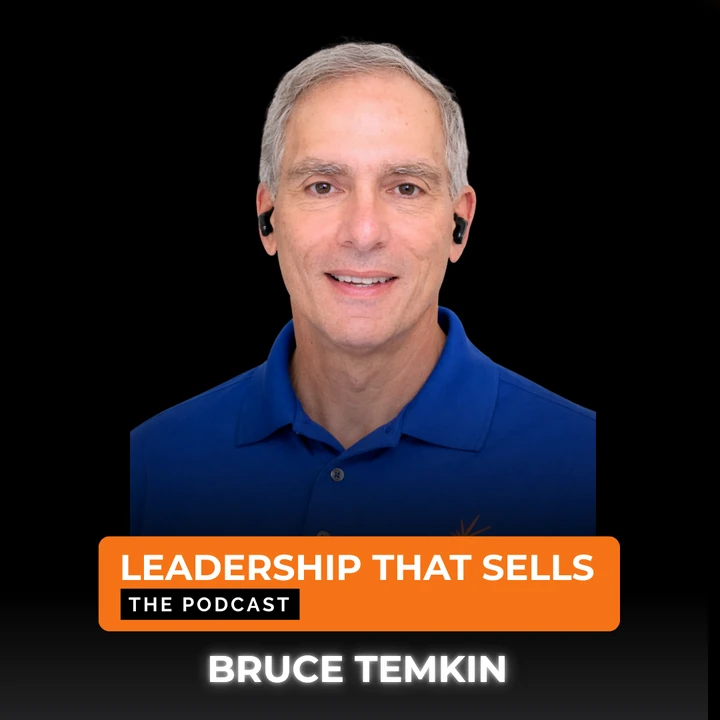
How to build unshakeable trust in your team
with Bruce Temkin
Show notes
My guest this week is Bruce Temkin – founder of the XM Institute, host of Humanity at Scale, and often referred to as the godfather of customer experience. Bruce has spent decades helping global leaders humanise their organisations. In this episode, we bring that wisdom straight into the world of sales leadership.
We break down what it means to be a human-centric leader – someone who doesn’t just drive outcomes, but does it without leaving a trail of emotional destruction behind. If you’re managing a team under pressure, leading remotely, or just trying to build loyalty and performance without burnout, this one’s for you.
We cover trust, empathy, digital charisma, and how to lead without being a robot. Get ready for practical ideas, deep insights, and a much-needed reminder that sales leadership isn’t about controlling people – it’s about creating space for them to succeed.
How to lead with empathy, trust and purpose in a messy, remote world
-
Start with purpose – Purpose gives direction. Without it, people scatter. Define where you’re going and why.
-
Practise empathy – It’s not about being soft. It’s about understanding the human impact of your actions – especially when giving tough feedback.
-
Build trust through ability, benevolence and integrity – Your team will only follow you if they believe you’re competent, care about them, and behave consistently.
-
Adapt your leadership for remote teams – You can’t rely on proximity anymore. Build digital charisma. Be explicit with empathy and trust-building signals.
-
Pause and reflect – Use the power of metacognition. Daily and weekly reflection helps you lead with intention, not reaction.
Timeline summary
[02:52] – What human-centric leadership really means
[06:20] – The three foundations: purpose, empathy, trust
[09:13] – Trust explained: the leap of faith your team takes every day
[10:59] – The trust triangle: ability, benevolence, integrity
[14:09] – Why proximity matters – and what to do when you don’t have it
[17:03] – Build digital charisma and make empathy explicit in remote settings
[21:19] – “Invite the unspoken” – asking what people aren’t saying
[23:32] – Stop watching yourself on video – it’s draining your empathy
[30:03] – The leadership superpower: pause and reflect
[32:00] – Most people drift. Leaders who reflect, win.
Links & resources
Newsletter: https://humanityatscale.substack.com/,
LinkedIn: https://www.linkedin.com/in/brucetemkin/,
Website: https://temkinsight.com/
Transcript
Automated transcript. Speaker labels and spellings may contain errors.
Paul
[upbeat music] My guest today is a pioneering voice in human experience management, and he's often called the godfather of customer experience. I like that. One of my favorite movies, The Godfather of Customer Experience Part 2. He's shaped how leaders across the globe think about loyalty, about empathy, about purpose. Uh, he's submarine systems engineer. He's the founder of the XM Institute and podcast host of Humanity at Scale, having guided Fortune 500 companies through complexity by keeping humanity at the center of their universe. Welcome to Leadership that Sells. This is the podcast for you if you want to understand everything that is to do about how you lead sales teams that are not really teams. They're what we call teams in parallel. They're working in a similar way, but they're not just working with each other 'cause that's not what they do, and most sales managers and leaders are still leading like they've got a football team.
In reality, what they've got is like a group of golfers, and the mismatch between what they think they've got and how they manage what they've got creates all kinds of pain. Poor coaching, bad pipeline meetings, burned out managers, and reps who just drift. And what we've built is a lightweight reset to help your managers lead them in the right way, setting clear expectations, building identity without fluff, coaching people for autonomy without going hands-off. It's not training. When you shift to a model that fits your team, performance scales a whole lot easier. Now, if that sounds like your world, grab the free Parallel Team Playbook at the Practical Leadership Academy website. It's short, sharp, and made for senior people with teams of managers just like you.
Now, on with the show. Bruce Temkin, thank you very much indeed for joining me today.
Bruce Temkin
Thanks for being here, and although I'm called the godfather of customer experience, don't wor- worry, there won't be any horse heads in your bed.
Paul
That'll be good. A, and a very experiential horse head, you know?
Bruce Temkin
Yeah.
Paul
I thought it could be the, the, the head of an ex-customer or something. No, let's not go there. This is, this is an entirely different conversation. Um, you talk a lot about human behavior, about human-centric leadership, and in case you've not noticed, the people that you are trying to lead, ladies and gentlemen, they're all human, and they're all messy and flawed individuals, uh, just like us. What is, what is human-centric leadership? How do we take account of human behavior? We think we are. We think we're doing it. We're not, 'cause we're telling you you're not. How do we know? What do we do?
Bruce Temkin
Yeah, so I, I think that, um, what- whatever field you're in, if you're a, a sales leader, if you're an MBA operations leader or strategy leader, you've been taught a bunch of skills and capabilities, but most of them deal with the structure and the processes of doing your job. Very little of it is an understanding of how the people you're, you're acting with influencing and trying to get on your side actually think, feel, and act. So human-centric leadership is really understanding the impact that you have on all the people around you and behaving in a way that actually drives the outcome you want without leaving a wake behind of, you know, upset, crying, crazed people, right? Um, you know, I, I talk about it of, of really thinking about your future self. Future self is a behavioral science term, but it's really about if you think in the future what your legacy is going to be.
Human-centric leadership is about creating a legacy where you succeed at your job and leave behind a better world.
Paul
With bells on. I mean, you talk about a wake, and there's two. You know, there's the wake you go to when somebody's died, right? So there's the, the wake that you want to go to after your leadership has moved to a higher plane and you've, you're burying the old you, right? But there's also the, the y- the trail of destruction that I'm conscious of having left in my wake of having gone through and just being genuinely being horrible to people without knowing. You know? You think that you are the, the great I am, and you're wandering through, "I'm me, me, big boss. You listen to me," and you just destroy people. You can really damage them if you're not paying attention.
Bruce Temkin
Yeah, and I think it's, it's, it's interesting to talk about. Uh, obviously that wasn't the wake, the first one-
Paul
No
Bruce Temkin
... one of those wakes I was talking about. But the second wake is, I think, an important thing, right? Because, um, when you're gone or when people are about to go, they never say, "I wish I had treat- treated people in a more difficult way. I wish I was harder-
Paul
[laughs]
Bruce Temkin
... on the people around me. I wish, I wish I was like a real more of a son of a bitch than I was in the past," right? That's never what people think at the end of their lives. So if somehow we can get pe- the way people think at the end to be more influential on what they do right now, that's a form of humanity at scale too, right?
Paul
It is. It's ... I was reading a wee thing the other day, and it's, um, uh, time travel. Now bear with me, right? You know when you travel back in time, as we all do, the last thing you want to do is meet your granddad because you might kill yourself because you step on an ant or something. You don't want to make a microscopic change in the past because it could make a vast change in the future, right? But nobody thinks about making just small changes today that would therefore accumulate and make huge changes in the actual future. So it's these small things you can do today that make all the difference in the world in one, two, three, five years' time, you know? So when you're thinking about the human-centricness of how you can lead, how you do things better, you talk a lot about trust, about empathy, and about purpose.
How do these things- impact performance and relationships? How does that-
Bruce Temkin
Yeah. So let's take them each one at a time. Um, let's do purpose, empathy, and trust. Let's go in that order.
Paul
Good.
Bruce Temkin
So, um, purpose to me is the, um, guidepost you use to focus on where you're heading, right? Without a strong purpose, you wander, right? And if you think about a leader who's wandering with a bunch of people following them, what does that look like? You know, people spread all over the place. No one's going... It looks like a, a bunch of, like, l- little kids playing your football, our soccer, right?
Paul
Mm-hmm.
Bruce Temkin
They're just all over the field. No, there's no pattern. There's no anything. That's what happens when a leader doesn't have a purpose. A purpose is clarity on where we're heading and why we're heading there that's shared amongst the people who we wanna go with us, right? So that's the power of purpose. It aligns people, and it keeps the energy and the direction of a group of people, not just yourself, going together. That's purpose. Um, empathy is, you know, at the end of the day, we are succeeding or failing because of the behaviors, um, and the attitudes of the people around us, right? So empathy is... It's not about being nice to people. Like, like let's, let's first of all separate that. I'm, uh, you, you don't have to be nice to everyone. What you do have to do with empathy is understand their needs as human beings and deal with that accordingly, right?
There are some times when someone does something wrong and you're gonna have to tell them, "You did that wrong." But empathy is all your actions should be done with the knowledge of the impact you are having on other people. So you talked about, right, like if you yell at someone in public, and we talked about that ear- earlier before the show, right? If you yell at someone and that might be the message you wanna get across, but what does that do to that person, right? What does that do to that person's ability to help you succeed in the future, right? So that's empathy, really making sure that you understand the impact that you're having on all the people around you. Um, and then trust. So I, I... Trust is one of those things that I find is, um, misunderstood. People think of trust as this abstract thing. To me, trust is pretty, um, clear.
And I like to use... There's a... And I, I tend to be on a little on the academic side even though I'm not academic, but I, I'll defer to a really good a- academic def- definition of trust. It's the willingness... And it's by, uh, Mayer, Davis, and Schoorman. They're like the, the, the foundational researchers on trust. Um, and they define trust as, "The willingness of a party to be vulnerable to the actions of another based on the expectations that the other will perform a particular action important to the truster irrespective of the ability to monitor or control that other party." In other words, what trust is about is how do you get people to take a leap of faith with you when they have no guarantee about what the outcome's going to be?
And if you, if you, you internalize that and you think about your life as a leader, you are asking for leaps of faith on every single day-
Paul
Every day
Bruce Temkin
... of every single week-
Paul
Every day
Bruce Temkin
... of every single year.
Paul
Every day. Every day. It is, it's, "I'm ask- I'm, I'm asking you to trust that my judgment is right. I'm asking you to trust that my decision-making, my discernment is, is, is valid. In fact, is in some cases more valid than yours because you would make a decision to do X, and I'm saying we need to do Y." You say, "Why?" "Trust me." [laughs] You know. "I've either got the experience, I've got the knowledge, I've got the accumulated reflection upon the experience based on the knowledge. I'm wiser. I have something that you don't, and there's something that I have is your trust because we can't get to that point unless you trust me to get us there."
Bruce Temkin
Yeah.
Paul
And that's the thing.
Bruce Temkin
And it's interesting 'cause so when, when I think about trust too, I, I think about the, the three components of, of building trust. Um, and, and you talked about that relationship, right? As a leader, you have to trust, trust that I have this knowledge, um, and trust this and that. To me, it's, it's in order to build trust, the trustor, which is the person who is going along for the ride, and the trustee is the person who's trying to get that trust. Um, and so the trustee needs to demonstrate ability, right? If you think about a leader, right, they have to... Like, if I think you have no skills and you are terrible at your job, well, you fail the ability, um, component. The s- the second part is benevolence. Um, I have to believe that you care enough about me that you will make decisions that align with what my needs are and what I would want.
So that's benevolence. And if in the past you've treated me terrible and, you know, you've never sort of shown any accountability to my needs, you fail the benevolence test. Um, and the third is integrity. Um, you have to be consistent in your adherence to a s- a set of principles, whatever those principles may are, so that I can, um, expect that you would act in a way that I can expect that you'd act, right? So if you're, like, way over the board and you just behave in strange ways all the time, I can't trust you. So if you wanna build trust, you have to demonstrate ability, benevolence, and integrity. Um, and those are the foundations of, I think, building trust.
Paul
I would ask if there's an, uh, an underpinning in this modern remote or hybrid world that we find ourselves in As there's one foundational one, which I would say... One foundational thing, which I would say is possibly proximity. And you actually have to be there because so many of the conversations we have are remote or text-based versus us sharing a same physical space. And I think there's just something human about being in the same place. I find it possible to trust people that I don't, um, haven't met, but I've only spoken to on video. I think it makes it a lot harder. I don't know if there's something there. I'm just... It's just popped into my head. Proximity.
Bruce Temkin
Yeah. No, I, I think it, it's interesting. So, um, one of the areas I, I sort of talk and research and write on lots of different areas, but one of the areas I've, I've looked at is, um, and talked about is the notion of empathy 2.0, which is, um, on the empathy side, which is consistent with sort of the benevolence and, and integrity side of the discussion we have, been having here, that, um, our natural empathy was built by proximity, right?
Paul
Mm-hmm.
Bruce Temkin
Cavemen-
Paul
Yeah, yeah
Bruce Temkin
... uh, built empathy-
Paul
Around the fire
Bruce Temkin
... because they could look at y- yeah, around the fire, collectively killing the buffalo, right? It was built on an immediate neurological response to other people's feelings, right? If, you know, that's why if, if you see someone, like, hurt, step into a wall and, and grab their arm 'cause it's hurt, you are gonna naturally... Yeah, the response that you just had, which is to cringe simultaneously, is a neurological system that's built into us. Now, that system breaks down when we're not looking each other in the same room, right? And so empathy, while it still exists, becomes much harder in a distributed remote environment. And so my argument around that is because some of the natural strength of being together is lost, leaders have to be more implicit and explicit in how they build that empathy.
And think about questions like you raise, which is, how do we establish and grow trust in an environment that does- isn't naturally suited to be able to do it very well?
Paul
Yeah. Yeah. Uh, I th- I think if you're not... I've read quite a bit about this. I mean, I start- I've been working with remote teams for, uh, oh, I don't know, nearly two decades, with Webex, things like that, you know, the tools. Um, and then the teams are all over the world, and there are different time zones, different currencies, different whatever it is. And trying to pull people together, you realize it's quite challenging when you eventually get your leadership team in one room, and they know each other and they work together, but they're still dancing around the... Dancing around the handbags is, is, is the expression, because they've never actually spent a lot of time physically together.
So, in the British context, you take them all out to the pub and you get them all a bit pissed. You know, [laughs] you just have some good time together. You could become human. But that lack of proximity, I think, causes so many problems. Um, and, and you, you don't, you don't want to trust someone that you don't actually care about, so you have to bring them together. You have to have that time. I don't know.
Bruce Temkin
Well, it, it's interesting because I, um, I try and stay away from the notion of you have to do anything. Um-
Paul
Yeah. Okay
Bruce Temkin
... because, be- because I think once you go down that path, you know, people go, "Well, we can't bring people together," so then we give up on the entirety of, of the argument that you have, right? Um, so I, I would... I, I agree. It's, it's better and there is a strong case for bringing people together and, and building trust. But don't give up if you can't.
Paul
Mm.
Bruce Temkin
I think that, you know, you just have to think about the medium itself, right? The, you know, if you're very transactional in your interaction in person, people can still pick up on signals, right? You can put a hand on their shoulder. You can shake them. You can look them in the eyes. You could be a little transactional, but they can still feel comforted and cared about, right? So you have to say, okay, if I'm... You and I are remote here, right?
Paul
Yeah.
Bruce Temkin
So what are the things we can do in this setting to showcase empathy and build trust? I can ask about how you're feeling, what really is important to you, right? I can pause before jumping in with answers, right? I can behave in ways that are explicitly trying to build that empathy as a foundation of trust, right? But it, it's, it just, it's... W- whereas leaders have traditionally sort of, um, built on their natural in-person charisma-
Paul
Yeah
Bruce Temkin
... uh, they have to think about what is your digital charisma? What is your remote sort of, um, sort of disparate approach to that charisma? And you have to think about it differently, right? You know, it's not... Th- there's no big handshakes and smiles and patting on the back when we're sort of remote.
Paul
Mm.
Bruce Temkin
So you have to think about what's your equivalent show of empathy to other people in settings like this.
Paul
The... I think there are some pretty good takeaways that we've come up with. I mean, the one, the one guy that I, I liked reading was a, was a leadership writer that I had on the podcast a few years ago called Joe Owen, and he wrote a piece bang in the middle of, uh, COVID Which was, how do you work remotely? What's the best way of doing this stuff remotely? And he said, "Get people together." You know? [laughs] That's it. You need to get people together. You can, you can continue the relationship remotely, but if you can, get them together because that's where you build, that's where you grow. You grow closer together. And then when you're apart, you can then stretch that. You can, you can rely on that. And it's like any situation. If you know you're going to be going through a tough time with your team, you build it up. You build it up so you've got credits in the bank, so when you're going to stress them and ask them to work late and do all sorts of weird and wonderful stuff, you've got the credit in the bank.
The bucket has been filled. There are the stuff that you can do, um, and I, I like this. There's, there's the one... Two things in particular. One is [knocks twice] so, and you're just [knocks twice] you're making a noise here. You're just like sharp noise [knocks twice] right? You're just, "Oh, I, um..." And it just kind of, like, pulls, pulls things together. The other is, you know, your reason you shake hands, of course, is to show my hands are empty. They're... And I don't have a weapon. So some people don't like doing it, but you wave. "Hi, how you doing?" On a video. "How are you? My hands are empty. I don't have a spear here. I'm not trying to hunt your buffalo," you know? Um, just one, one, one second please. One second. I'm just gonna turn to a blank page in my book.
You see my book? I'm turning to a blank page here so I can give you my undivided attention. So, and you're making a show of it. There's the, the, the things you're doing to make a show that you are important to me. I have given you my un- undivided attention. [knocks twice] I'm calling this conversation to order. [laughs] There's that sort of stuff that you can underpin technique with, but then you have to have the desire to build the trust. Then you need to go for the, the, the credibility. Then you need to go for the empathy. Then you need to try and build that trust up. I think, I think that's-
Bruce Temkin
Yeah, no, I, I, I like those. I, I'd also put in, um, if you think about the parts of the interaction that you'd have that if you're in person, right?
Paul
Mm.
Bruce Temkin
If, if we're in person, I probably can sense that you have disconnect with my words or you're not completely bought in, which gets lost in a visual interaction like this. So think about that. So if I'm not getting the right signal because of we're not in proximity about whether you're on board or understand that, then, um, take the time to ask, "Okay, does that make sense? What feels unresolved?"
Paul
Mm.
Bruce Temkin
[coughs] You know? Ask, you know... One of the recommendations I have is called invite the unspoken, right?
Paul
Yes.
Bruce Temkin
Whereas you, you, you get the signals of the unspoken if you're together, but you have to get more explicit about it if we're in a different medium.
Paul
If somebody's in the corner of the room and they're just like, "What, really?" But they're not saying anything. How do you pull that out? Now, in a one-to-one it's okay. I mean, heaven help us when we have nine people in a Teams call. You get no chance. The videos are microscopic. There's just... You just don't have that ability. I mean, I don't know what the magic number is. I would sug- suggest it's, like, six people in a call before you can... You start to lose all sense of empathy, all sense of humanity, believe me.
Bruce Temkin
I... So let me say, I, I wish people could do it with six people in a-
Paul
Okay, no
Bruce Temkin
... in a Zoom. Yeah, it, you know, I, I, I think you lose sight of it once there is, like, more than two.
Paul
Yeah.
Bruce Temkin
Um, and, and, and because one of the other things we have is that, uh, on a Zoom call, right, if you... One, one of the things you can do to improve your Zoom calls too is take yourself off of video. Um, there's a lot of... Because-
Paul
Off?
Bruce Temkin
What you don't understand is it's off. Take your... Your video for you, just your self-view. You should view for them.
Paul
Ah, right, right. I get you. Yeah.
Bruce Temkin
What happens is when w- we, we are very attuned to our own self-preservation, right? So I won't go into it, but the brain has two parts of its brain, right? The subconscious and the conscious, right? And the conscious does a lot of the logical processing and is the stuff that keeps us on board, and is sort of like our, our, our great aunt who's keeping us doing the right thing in general. Um, now if we have our pictures on, we tend to spend a lot of our cognitive conscious ability trying to look at ourselves and make sure we're doing something else. And if we're doing that, whatever... Yeah, whatever part of our brain, our conscious and subconscious brain at this point, is focused on how we look, that's diverting the attention away from the other people that you want to have there.
Paul
Oh.
Bruce Temkin
So I would... You know, one of the things-
Paul
Interesting
Bruce Temkin
... I would do is get yourself what... You know, start off so you get, you know you're in a good picture, but then take it off. Take yourself off. They don't... People don't know whether you, whether on your view you're on or not. But take your picture off your own view so you're not wasting the cognitive cycles, um, keeping track of your look.
Paul
That's phenomenal advice, and I've been... I've got right on my screen here just now, in this Zoom call I have are two pictures up because that's what we're recording and that's how it works. But I've also got floating over my head so I can see you my notes. So I can't see me, so I'm just focused on you. I didn't realize that. I just went, "Oh," I didn't realize I was doing that. But that is immensely valuable, 'cause I do find myself checking out, you know, do I have the hairline? Am I wearing a tie, or whatever it is. That, that's really, really valuable.
Bruce Temkin
Well, yeah, and if you think about it, in person we don't have any of that, right? Like, the, the way human-
Paul
Oh
Bruce Temkin
... interactions were set, they would never... Like, th- think about it, you know, I go and I shake your hand in person. I'm, I'm not... Like, there's not a picture of me beside your face that I'm also trying to look at simultaneously as shaking your hand and trying to look you in the eyes.
Paul
It's almost like a vanity thing, isn't it, I suppose. If you had, if you had a mirror y- behind you, I'd be looking at me just to make sure.
Bruce Temkin
Mm-hmm.
Paul
I suppose so. That's fascinating. You have a great podcast. You have a great podcast, Humanity at Scale. What are... Uh, what would you say is the, the, the top couple of things that you've learned from your guests? 'Cause I always, always, always take away things from the conversations I have.
Bruce Temkin
Yeah. No, I've, um, I've had amazing guests. I, I, I often say that my, uh, my podcast is for me, and if other people enjoy it-
Paul
Totally
Bruce Temkin
... that's great.
Paul
That's it.
Bruce Temkin
That's great.
Paul
I'm, I'm utterly selfish about it. I wouldn't... Now, don't get any ideas, but I totally think I should pay, pay for my guests, you know?
Bruce Temkin
Yeah.
Paul
Because it's like a free masterclass on humanity at scale, on X, Y, and Z. It's brilliant.
Bruce Temkin
Ex- exactly.
Paul
People just turn up and talk to me.
Bruce Temkin
Exactly.
Paul
It's so cool.
Bruce Temkin
[laughs] It's wonderful. So, um, I've been spending a lot of time on things like, um, morality on one hand. So if you think about the world, you know, there's, uh, uh... I've looked at a lot of why there's conflict and c- you know, look at things, conflict from the Middle East to the boardroom, right?
Paul
Mm-hmm.
Bruce Temkin
Um, and one of the great things, uh, guest Kurt Gray. Um, I have a lot of professors and, and, and researchers, and that's... And, and f- big thinkers. Uh, um, that w- so one thing I, from that episode that really stuck with me is the fact that, um, we are all more alike than we think, um, and that most of what people do is trying to, um, avoid risk, uh, and pain. So when we're fighting, it's o- it's not that we have a different moral background, it's that we see different risks. So if you take the left and the right, you know, in general around the world, right? The, the right pe- the people all the way on the right see immigrants as a risk. The people all the way on the left see the loss of democratic norms, um, and social benefits as a risk.
So it's not that we're morally inconsistent, it's that we see different risks, and we're all trying to minimize those risks on behalf of us and our families. So that was one big thing I try to get across, right? We're all more alike than we aren't. Um, the other one I'll point to is, um, I had a great episode with a guy, Faisal Hawk, who's... Uh, you know, AI is a big theme on my, um, my podcast, as it should be, right? Because how can we talk about the future of humanity without acknowledging and including AI as parts of the model we have to think about? So Faisal Hawk, who's one of the world's leading thinkers on AI, was talking about... And, and this was an area I hadn't really given a lot of thought of. If we just think about what AI does, in a lot of cases it eliminates entry-level jobs. In lots of industries, it's doing the very basic limit jobs.
And, and the best models of sort of AI doing those entry-level, assistant-level things, and experts in the field working alongside it in partnership, right? So the, you know, the best, the best chess players in the world are an AI with a chess master, right? Working together, unbeatable, right? When they use a com- combination. But the one thing I hadn't thought about that, that he rai- raised my awareness to, right? Which is that that's great, but if we don't have people in those entry-level jobs, then over time, because people become experts through mentorship, through trial and error, through learning, we're eliminating all of those learning paths to becoming the experts. So we're actually creating a future of a lack of expertise across multiple fields where AI is helping to bring in, um, and take over some of the entry-level jobs.
So those are some of the, the really interesting discussions, and I could go on and on.
Paul
Fantastic. Well, I, we just have to recommend that everybody goes off and subscribes, uh, to the Humanity at Scale podcast with Bruce Temkin. There'll be a link in the notes, uh-
Bruce Temkin
Thanks
Paul
... to this episode to that as well. So you've been building trust, understanding behavior, leading human-centric change. Now, I think this is particularly relevant to sales leaders, sales managers who are looking to lead teams, deepen customer loyalty, um, adapt to highly complex, fast-moving environments and things like that. Do you have a particular insight that you think might help somebody in one of those roles move from being transactional to being more relationship-driven?
Bruce Temkin
Yeah. So my, my big advice, um, and it's sort of like my, my core advice to becoming more human-centric is to pause and reflect.
Paul
Mm.
Bruce Temkin
That, um, I think that pausing and, you know, the notion of metacognition. So my last guest, um, on my podcast talked a lot about metacognition, which is thinking about thinking.
Paul
Yeah.
Bruce Temkin
Um, right? That the only way we can ever get meaningfully better at something is taking the time to think about what we're doing- And deciding whether we wanna do something differently, right? And so take, if you're about to have an interaction that doesn't feel well, pause. Um, if you're going to... If you wanna get something done, if you want something from someone, pause and think about what the best way is given all the stuff you have. There's, there's a, there's a area of psychology called c- um, cogniti- cognitive behavioral disorders, CBD. Um, and what it teaches you is the... And this is the way they teach people who have mental problems like anxiety to deal with the world, which is to stop when you're about to do something, name the feeling that you have, and have some behavioral actions you take based on that.
The same thing holds for, for leaders, right? Identify where you fall down. Is it that you sort of in the heat of the moment overreact to a person that works for you when they've done something wrong? If that's the case, look for when that's about to happen, name it, say, "I'm over... Think about it. I'm overreacting," pause, and do something different. So that's one pause. The other pause is, you know, take time every day and every week. That's what I recommend. Every day, at the end of every day, I don't care, spend five minutes or 10 minutes, that's all you have to do, and reflect on how did you interact with the people around you, and was it the way, and did you get out of those interactions what you wanted and what they wanted?
Do that reflection once a day for a small amount of time and once a week and look back on the week, and that notion of reflecting is a powerful redirection of your actions and behaviors.
Paul
There's the idea that most people just drift through life.
Bruce Temkin
Yep.
Paul
They drift without purpose. They drift without reflection. They drift bouncing from situation to situation, good or bad, indifferent, in a gray porridge of mundanity. And I think the superpower that you named there of reflection, of using our God-given ability to think, actually intentionally using it, the metacognitive step of where am I? Who am I? What am I to these people around me? What am I trying to achieve in this moment, in this weekday life that I've lived? And that alone puts you at the top tenth of a percent of most of humanity.
Bruce Temkin
And, and it's interesting, right? 'Cause, like, you know, your, your audience probably doesn't care about the word, or wasn't thinking about here about metacognition, but the ability for human beings to be metacognitive is one of the things that, that absolutely separates us from every other entity, including AI.
Paul
Yes.
Bruce Temkin
Um, and so it's, it's, it's something that is uniquely human, and we should lean on a lot more.
Paul
Yeah. Real is all that's left.
Bruce Temkin
Mm.
Paul
Thought is all that's left. It's wonderful-
Bruce Temkin
Meaning-
Paul
... stripping
Bruce Temkin
... is all that's left.
Paul
I think then on that, Bruce Temkin, I have to say with meaning being all that's left, humanity at scale, thank you very much indeed for joining me.
Bruce Temkin
It's a pleasure. Thanks for having me. [upbeat music]