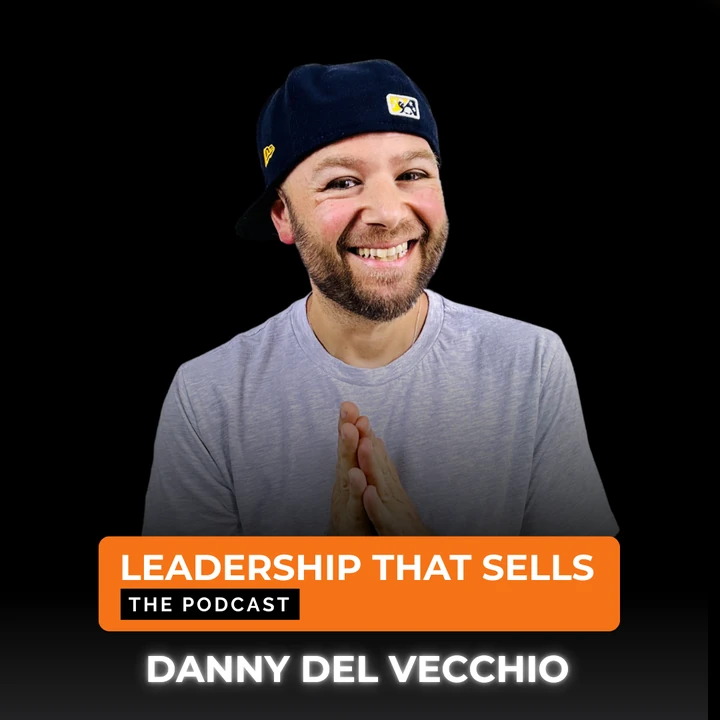
How to use video to sell
with Danny Del Vecchio
Show notes
What if I told you that the most powerful sales tool you’re not using is sitting in your Zoom recordings and sales calls? In this episode of Leadership That Sells, I sit down with Danny DelVecchio – sales leader turned content strategist – to unpack how your everyday conversations can become the foundation of a trust-building, pipeline-driving content machine.
We get straight into it: why most salespeople avoid video (and why that’s costing them), how to make content creation stupidly simple, and the unfair advantage you get when prospects say “I feel like I already know you.” Whether you’re camera shy, time-poor or just don’t know where to start – Danny breaks down a no-fluff, no-fuss approach to video-led content that actually works. Plus, he shares how video testimonials are the most underrated conversion tool in your kit.
How to turn everyday conversations into trust-building video content
- Record your sales calls, workshops or client consults – that’s your raw material.
- Clip 20–60 second moments that speak directly to customer problems.
- Repurpose those clips into written posts, newsletters, tweets, infographics and more.
- Focus on conversational content – it’s easier, more authentic and faster to produce than “talking head” videos.
- Use tools like Fathom to extract pain points, objections and desires from transcripts – this becomes your content strategy.
- Build trust by showing up as you – not some influencer version of you.
- Use video testimonials from real clients answering: Why you? What was it like working with you? What changed as a result?
Timeline summary
[02:20] – The 3 big reasons salespeople avoid video (and why they’re wrong)
[05:33] – “I feel like I know you” – the trust shortcut video gives you
[07:32] – Why video is the foundation for all content, not just another channel
[13:35] – The real reason your content isn’t converting: you’re guessing
[16:13] – The 2 types of video content (and which one works faster)
[20:00] – Set up a side camera – you’re already saying smart things on calls
[22:09] – The AI tool that turns every sales call into a content roadmap
[27:12] – Video testimonials: why they boost conversions 30–40%
[30:19] – Want a good hook? Spoil the ending and reverse engineer the “how”
Links & resources
- My LinkedIn https://www.linkedin.com/in/dannydelvecchio/
- My Instagram https://www.instagram.com/danny.delvecchio/
If this episode gave you a nudge to finally press record, do us a favour: follow, rate and share Leadership That Sells with someone who needs to hear it. Let’s help more sales leaders lead first and sell more.
Transcript
Automated transcript. Speaker labels and spellings may contain errors.
Paul
[upbeat music] You know what? I think video is the present and fact- and frankly, the future of B2B sales. And my guest today is a top-performing sales leader, turned a video strategist, a content strategist. He's coached hundreds of founders and to help people turn their story into $20 million in pipeline. However, doing so without those poor souls becoming influencers, right? 'Cause I'm not cool enough to be an influencer. He's got a background in leading high-performing sales teams, and now he's helping teams build trust and drive revenue in under 60 seconds of screen time. Welcome to Leadership That Sells. This is the podcast that helps you to lead first and sell more. Now, most sales leaders, they're leading the wrong kind of team, and they don't even know it. They think they've got a football team, but the reality is they're running a golf club.
Each player's out on their own course. They're chasing a similar trophy, but they never pass the ball. And then we force collaboration, and we slow them down. And then we drive competition, and nobody learns. And worst, when we think that we're empowering people, we actually step back, and we abandon the biggest lever for growth that we actually have. I'm Paul Morton, I'm your host and the founder of Leadership That Sells. It is a leadership power-up for sales leaders. It's a light, fast reset that gives your team the simple, practical shifts they need in how to lead, so they can finally lead the team they actually have. If you're ready to fix the model, grab our free Parallel Team Playbook at thepracticalleadership.com.
Danny Del Vecchio, thank you very much indeed for joining me.
Danny Del Vecchio
Ah, it's my pleasure. Thank you so much for having me.
Paul
So you are the consummate content connoisseur. You've generated millions of dollars in pipeline through video, th- through content. Now, there's a lot of people out there who are thinking, "Yeah, mate, but I sell to enterprise. I sell to the grownups. You know, I'm not on TikTok because my clients are not on TikTok. I'm not doing video." Why are they not doing video? Why, why is that a wrong approach, Danny?
Danny Del Vecchio
Oof. So that's a, that, that's a very in-depth question, but mainly there's three primary reasons why people don't do video. Uh, number one is because it makes them uncomfortable. [laughs] That's number one. They don't feel like, you know, they feel awkward talking to camera. Um, number two is because they don't have time. They're running a business. They are leading a sales team, or they're a sales rep. They have meetings, they have prospecting. They have all the things that they need to be doing. They don't have constant time to be messing around making videos. Um, and then number three is because they kind of just don't know what to do, right?
Paul
Yeah.
Danny Del Vecchio
There's a lot that goes into making video content. It's kind of like, well, where do I post it? Do I post it on TikTok? Do I post it on Instagram? Do I post it on LinkedIn, Facebook, right? Or, you know, how long do my videos need to be? Can I keep them under 60 seconds? Can I do three minutes? Can I do five minutes? Can I do 10 minutes? Can I do 20 seconds, right? So people don't really understand, um, you know, all the things that going into ma- go into making a video that they just decide just not to do it instead. 'Cause it's just, it's kind of, it's kind of overwhelming and complicated for them.
Paul
I think the default, as when you're selling anything to anyone, the default is inaction. The default-
Danny Del Vecchio
Yeah
Paul
... default is the status quo, right? And the status quo-
Danny Del Vecchio
Mm-hmm
Paul
... is working so well for everyone right now. Not, okay? There's no one out there that I know right now in this economic environment that has a full pipeline. And frankly, anything that's gonna give us an edge, I think, is worthy of consideration. There's a big thing that I've got, which is all marketing needs to lead to a conversation, right? Sales happens through conversations, and it's-
Danny Del Vecchio
Absolutely
Paul
... human conversation. The only edge we have as salespeople, as communicators, is our ability to do that at a human-to-human level. Really one-to-one. Challenge is how do you get to that one-to-one conversation? How do you prove that, A, I exist, I have something you want, and B, when you, we eventually talk, you'll be able to trust me or vi- you'll even pick up the phone and call me 'cause you think I've got something of worth. You've got, you've got so- I can solve a problem you might have. Content. Now, you shifted. You said that just as we're chatting before. You shifted from being, uh, Mr. Video to being Mr. Content, right? So you've now gone from Video On Easy Mode to Content On Easy Mode, and I love that.
It's a nice, simple, flowing title here. Why did you make that shift, and why are you talking about content rather than video?
Danny Del Vecchio
So for number one, I believe that video is still the best form of content because I think it is the most effective in terms of building trust, building rapport, building connection and familiarity. When I get on a sales call, I, I hear this phrase a lot, "I feel like I know you." And that's an unfair advantage.
Paul
Yeah.
Danny Del Vecchio
So anybody that has been doing video content and has an audience that they've built from creating video content has an unfair advantage when they get on a sales call with somebody who has seen them multiple times through their content because there's a little bit of a more of a comfort level. So typically, when you get on a sales call with somebody that you've never had a, any interaction with before, defenses are high But when people have seen your video content over and over again, and they feel like they know you, and they feel like there's like, you know, they, they kind of understand your personality, and they feel a little bit connected to you, the defenses come down on a sales call.
Paul
Yeah.
Danny Del Vecchio
And that is the big advantage to having, um, your video content. So I do believe that although I'm sh- I'm shifting from Video on Easy Mode to Content on Easy Mode, video still needs to be the foundation.
Paul
Right.
Danny Del Vecchio
Video should be the foundation of all of your content. But there is so much potential for what you can do with your video content. And you can take this video content, and you can turn it into other things, right? So you could take your video content, and you can turn it into a written post. You can turn it into a email or a newsletter or a blog article, long form written style content. Or you can turn it into short and sweet tweets for Twitter or Substack or Threads or any of these kind of, you know, short, quick, uh, quick hitter type platforms. You could turn it into infographics. You can turn it into lead magnets. You can turn it into workshops. The video content should be the foundation of, of all the content that you build on it.
So over the last two years, I've been helping people just with the video part. And the reason that I shifted from Video on Easy Mode to Content on Easy Mode is because, like I said, there's so much more potential, um, when you have this video content as the foundation. And what I'm building for my clients and what I've built for myself, and I'm actually even turning this into a full on SaaS product right now, is where you can take a conversation that you've had, whether it's a sales call, it's a client consultation, maybe it's a podcast appearance that you were on, maybe it's a workshop that you were on, that you ran, and you can take that transcript, and you can plug it into this new SaaS product or whatever, and you can turn it into all of your content.
Paul
Hmm.
Danny Del Vecchio
So that all of your content now comes from your conversations. And in a world where everybody is just creating AI content right now-
Paul
Oh, please
Danny Del Vecchio
... having, you know, using AI, but using your voice and your insights and your thoughts in a extended interview like this, or again, in a sales call, or, you know, i- in a setting where you're just being yourself and you, you... The AI-
Paul
Hmm
Danny Del Vecchio
... is able to capture your language, it's able to capture your tone, and it's able to capture your words, and then using it to create more content. 'Cause like what most people do is they're like, "Oh, I got a couple of ideas. AI, write me this idea." And it doesn't have any soul to it.
Paul
Yeah.
Danny Del Vecchio
But you can still use AI, you can still use all these tools available to save you a ton of time and a ton of stress and headache, but at the same time, if you use your video content as the foundation for that, you are going to get a hell of a lot better result. And that's what I've learned over the last year, and that's what I'm really doing to help all of my clients right now and all the people that I'm working with, and, you know, again, expanding that out to more people, you know, once this SaaS product becomes available.
Paul
Well, we will watch this space to, to see what you come out with, Danny. I'm sure it's gonna be interesting. The challenge I've found with, uh, all of the AI tools, all of them, absolutely all of them, is that content creation, I think, is possibly the worst use case for, for them. Because they derive their inspiration, if you can call it that, from the material upon which they were trained, and the material that most of the, if not all of the AI tools out there were trained is the sewage of the internet. It's, it's slop. And if you go to an AI tool of choice and say, "Write me a thing," it'll do it, and as you said, it'll be soulless. It might be neatly structured and following a three-part framework that for you, whatever you want.
But I think the differentiator we have today in the world of automation of everything, and what was it something like 80% I saw? 80% of the content of the internet is AI generated and has been added in the last two years. What? Really? Yeah, and it's all shit. Really? Yeah. And the differentiator we have that video plays so well into is we can be real. You cannae fake this. I can't fake talking to Danny in a long form conversation. It's not that long, but it's long enough.
Danny Del Vecchio
Right.
Paul
And the value we get out of that is you get to riff off each other. You get to make a connection and have that conversation and build trust. And I, I think the trust thing is huge. Like you said, when you got onto that call the first time and somebody says, "Do you know, I feel like I know you. I love the way you get your hat like that on all your videos." Right? Different hats, but it's, it's your thing. Okay? And I recognize it, and it, it just connects. And I know your background 'cause I've seen it on your other stuff. I feel at home talking to you. I trust you
Danny Del Vecchio
That's it.
Paul
Yeah.
Danny Del Vecchio
That's, that's it. That's the unfair advantage. That is the unfair advantage that any, whether it's, you know, the founder of a company, whether it's one of the top executives, or whether it's somebody from the sales team-
Paul
Mm.
Danny Del Vecchio
You can give yourself an unfair advantage by having this content.
Paul
Yeah.
Danny Del Vecchio
And especially, especially video content.
Paul
Yeah.
Danny Del Vecchio
And, you know, the reason that I really like to derive that content from your everyday conversations is, again, if it's, it's, it's gonna be more real that way, right? But it's also, it's, it's coming from, like, the clients and what they're asking, and it's coming... It's, you know, you're, you're understanding the language that those clients are speaking, and you're speaking it back to them in those words, right? So, like, you're using, like, what, uh, my friend Ken calls the voice of the customer, right? And, um, and that really helps pe- you know, people, like, build that, that deeper connection to you and make sure that the content is relevant. Because the... You know, I, I s- I did, ran a survey recently, and I think I had about 90 people respond to the survey, and I asked the question is, is like: What is the biggest struggle that you have with content? And the number one thing is that, "I put out content all the time, but I never get any business from it."
Paul
Mm.
Danny Del Vecchio
And the reason is, is because you're not talking about the right things that resonate with your audience, because you're guessing what they wanna hear instead of actually pulling what they wanna hear-
Paul
Yeah
Danny Del Vecchio
... from your conversations with them. That's the idea. That's the idea, is what are you doing every day? And let's take all those things that you're doing every day, and that is your content.
Paul
There you go. And using, using the language of the problem that they have. Yeah. In their own words.
Danny Del Vecchio
Exactly.
Paul
And just feed it back at them. "So you said that..." "Yeah, I did." "Oh. Would it be interesting if that could go away?" "Would it?" "Well, you know what we should talk about-" "Where do I sign?" You know, you want them to be pulling this stuff out your hand. So there's a lot of focus. You said right at the beginning there, you said a lot of people don't want to do this because they feel shy or uncomfortable, or they don't want to appear on camera, camera, right? So I mean, I've got a face for radio, so hopefully this won't be watched, but it'll be listened to.
Danny Del Vecchio
[chuckles]
Paul
That's all right. Um, but how would you, given your experience and the way that you've been coaching hundreds of different people, different founders, how do you help sales leaders, sales reps in particular? 'Cause this is a selling tool we're talking about here. How do you use the, the tools and the techniques that you've built up to build that trust?
Danny Del Vecchio
Yeah, absolutely. So, um, you know, you have to overcome that, that fear of talking on camera basically, right? And-
Paul
Yeah, that's just tough. I-
Danny Del Vecchio
There's a couple of... It's not as tough as you think. Let me explain this to you here.
Paul
Go on.
Danny Del Vecchio
All right? There's two types of video content. Uh, there is what I call the lecturer style of video content-
Paul
Mm
Danny Del Vecchio
... where I am going to look directly into the camera, and I am going to give you my top three tips to make more sales, uh, in today's market, right?
Paul
Yeah.
Danny Del Vecchio
That is, you're directly speaking into the camera. That takes a lot of practice.
Paul
Mm.
Danny Del Vecchio
And that takes a lot of time before you get to be, like, really good at that, to where it feels natural, it feels authentic, and it's com- and it feels comfortable for you, right? It feels natural and authentic to the viewer and comfortable to you. But there is another style of content, which is the more what I call laid-back style of content, which is conversational.
Paul
Mm.
Danny Del Vecchio
It is capturing conversations that you are having. And if you look at all of the content, and, like, you look at some of the big, you know, entrepreneur content creators that are out there, the Gary Vees of the world, the Hormozis, uh, Cody Sanchez, these types of people, right? If you've looked at what they've done, you know, in the past, you know, two years ago, one even, you know, one and a half, two years ago, and what they're doing now, most of their content is them having a conversation and clipping that conversation-
Paul
Mm
Danny Del Vecchio
... and clipping those best parts of that conversation that are most relatable to their clients and to the problems that the clients have. And if you are just having a conversation and there's, there's somebody on the other end, you can create amazing a- and better content without any practice, without, without having to, like, overcome that fear of like, "Oh, I need to do it perfect because I need to deliver it to camera perfectly." You can o- y-you can be... You can make a great video on your first video ever-
Paul
Yeah
Danny Del Vecchio
... if you do it that way, right? So, and this is the whole principle of, like, what I built my, my business on, which is essentially I interview experts, I ask them questions directly related to their expertise and to their, you know, client language, the voice of their customer, and we just kind of have these conversations, and then we clip the best parts of these conversations, and that's what then becomes these, these people's video con- c- uh, video content and the foundation for all of their content, right? Is these, is these conversations. So- Uh, obviously, you know, there's always practice makes perfect, [laughs] right? And, you know, if you do, if you do it all the time and you show up often, you are going to get better and more confident.
Or you could just do the conversational style where you don't need to practice at all.
Paul
Yeah.
Danny Del Vecchio
Just be yourself. Talk to somebody else. Capture that. Make it happen.
Paul
And if you are a communication and persuasion professional, as every salesperson out there should be, you're having conversations every day.
Danny Del Vecchio
Exactly.
Paul
So you're already a professional. You're already an, an expert in opening your mouth and trying not to insert both feet, you know? You're already good at framing something. So you said you've got this problem here. Why is that a problem for you? What's causing this, and how much is that costing you? And you're just having the sales conversation. It's a discovery call leading on to a positioning, leading on to... And capture that and chop it into bits perhaps.
Danny Del Vecchio
100%. 100%. If you, if you can run... And I do this on every call that I'm on, whether it's a sales call, whether it's a, a workshop or a client call. I have a separate camera that sits over here, and that camera is capturing my content or my conversations in the background while I am on, on the Zoom call talking to the client or talking to the prospect.
Paul
Mm-hmm.
Danny Del Vecchio
And then at the end of that, I have a couple of different options that I can do with that. I have the transcript now when... And I can take that transcript and I can plop it into my kinda, you know, my new SAS tool, and I can get a bunch of content ideas. Or I can clip it. I can clip what parts I want from that conversation, you know? Like, "Hey, I really like what I said here at, uh, five minutes and 42 seconds."
Paul
Yeah.
Danny Del Vecchio
"Uh, I, I think it, I think my audience would really get a, a lot out of it. Let me, let me put that up as the content."
Paul
And you know it's-
Danny Del Vecchio
So-
Paul
Yeah. Go on.
Danny Del Vecchio
You should have a camera running all day. If you could have a camera running all day.
Paul
[laughs]
Danny Del Vecchio
And you don't need, you don't need to be Gary Vee and have somebody follow you around with a camera all day. Just set one up on the side. Get a nice little, uh, Insta360 webcam or, you know, set even your phone. Just set up your phone. Let it record you while you're on a, on a call. It's a beautiful thing. It's not, it's, it's not hard to do, and you can capture so much content. Everything is content. It's beautiful.
Paul
I am 100% certain that you listening on your last sales call said something magnificent, and that you regret not being able to perfectly recall what it was because when you said it the other person went, "Oh, that's brilliant. I want three. Can you start Monday?" And then you thought, "Oh, must use that again," but blow me, can you remember what it was you said? Now, with the Danny Del Vecchio method, we've got it on tape or on disc or on transcript, and you can clip it, teach it to yourself, or even just use it as content. I like that. I like that a lot. It's very clever.
Danny Del Vecchio
Yeah, I mean, like, and there's all these tools now. There's all these, like, really great... And this, again, this is where, like, AI comes in and-
Paul
Mm
Danny Del Vecchio
... like, you know, again, like, like AI is ruining a lot of things, right [laughs] right now.
Paul
Yeah.
Danny Del Vecchio
But also AI is also enabling people that are using it correctly. So, you know, I use a tool called Fathom-
Paul
Yeah, wow
Danny Del Vecchio
... to record all of my Zoom meetings, right? And this tool is unbelievable. I mean, it, it, it literally can, it does an entire transcript of everything, and then it actually also, I can go to Fathom and I can say, uh, you know, I can use these different like, uh, I think I have the paid version, which is, like, 100 something dollars for the year. It's, like, well worth the money. You could take any sales call and you can break it down by all the different sales methodologies. So they have BANT, and they have MEDDPICC, and they have all these different, all of these different things. And what I like to do is, I think it's the MEDDPICC one. I forget which one it is. I like to click that button, and what it does is it gives you all the customer's objections, and it gives you all of the desires that they have. And it gives, it breaks it down, like, what-
Paul
Wow
Danny Del Vecchio
... if they, if they talk about their budget, like, it'll tell you what their budget is. It automatically breaks this down for you. For $150, it's, like, 10 bucks a month you get this. And, like, every sales call gives me, like, a detailed description broken down by these sales methodologies. And, and one of the things that they say is, like, you know, "What are the customer's biggest challenges and what is their, um, objections?" And then there's another one that's like, again, "What is it that they're looking to achieve?" Well, their objections, what they're looking to achieve-
Paul
Oh, wow
Danny Del Vecchio
... and their biggest challenges is your content right there. That's everything that you should be talking about so that you can attract in the right people, right? [laughs]
Paul
Yeah.
Danny Del Vecchio
Um, so tho- these tools are so valuable nowadays if you use them right.
Paul
Yeah. That's the piece, I think if you use them right. I mean, I was talking before that content creation I think is... And I, I'm still convinced of this, that going to a tool and saying, "Write me a thing," is just a terrible way of doing it. Going to a tool and feeding it something and then saying, "Take this thing that I have given you and turn it into something." What is somebody saying here? What are the key points? Using my tone of voice, use, reposition, repurpose. That I think is powerful.
Danny Del Vecchio
Yeah.
Paul
But just whatever you're doing-
Danny Del Vecchio
Taking that piece of content-
Paul
Yeah
Danny Del Vecchio
... like, taking that piece of, of what you said. Taking your-
Paul
Yes
Danny Del Vecchio
... voice-
Paul
Yes
Danny Del Vecchio
... your insights, your thoughts in your words and telling it, "All right. I need a really good hook for this to get people's attention."
Paul
Mm.
Danny Del Vecchio
"Give me some ideas," right? It's, it's gonna pull it from your... It's gonna pull it, again, from, you know, from what's popular and what's new, and also take your voice into account and then say, "Okay, cool. Now we got this, like, really good hook. Um, now we, we, you know, we can grab people's attention. Just take what I put together here and format it in a way that, you know, people like, but also use my language at the same time." And instead of getting some very generic kind of bland thing, what you end up getting is a really strong draft that's, like, 85 to 90% of the way there. And then you go in, you make a couple tweaks, you make a couple edits, boom, boom, boom. Make sure that it sounds like you, add the right call to action, you know, whatever you need to do, but that's it. It's, and so this is how you really, you know, streamline...
And this is easy mode. This is [laughs] this is, this is how you put your stuff on easy mode, but it has to come from you. It has to come from you. It has to originate with your video content, and that's why I s- I believe that video content is the foundation to everything that you need to, to build a, a brand for yourself and a persona for yourself online, and do that to, again, attract in new clients and nurture them.
Paul
As I said, I think it's the present and future. It's the present and future of, uh, even enterprise sales, frankly because-
Danny Del Vecchio
Totally
Paul
... if you have a long sales cycle, what's the one thing you want to have happen for that sales cycle to be shorter? What are you trying to shortcut? Trust. You're trying to shortcut trust.
Danny Del Vecchio
And I'll tell you one other way to shortcut trust too. Video testimonials.
Paul
Oh, beautiful.
Danny Del Vecchio
Huge. Um, we have been doing video testimonials for our clients, and this isn't even... This, like, this is a service that we have been doing, but, like, we haven't even really marketed it too much, more of just marketed it internally to my existing clients. We basically do an interview of the client, and we try to find out three things. Number one is why did they hire you? [laughs] Of all the people that they could have chose, why did they choose you? And then number two is what was the experience like working with you? How was the communication working with you? How was the, um, you know, uh, you know, what, what, uh, educational, you know, impact was there? What did you learn, right? And then the last thing is what was the big impact and what was the big change that resulted as of your work together, right? So those... You capture those three things from a client perspective, and we, and we call and we interview.
We do these interviews with your clients, and we make them super conversational. So again, it's comfortable for the client, [laughs] and they're just spilling all the good stuff. And then we put together, like, a really cool video with, with, like, all the best highlights from, from, like, what five or six different people have to say about you.
Paul
Mm-hmm.
Danny Del Vecchio
And now you've got this piece of content that you can share with every single one of your prospects that doesn't, that doesn't need to do anyb- Like, that you don't have to do any convincing. That does all the convincing for you-
Paul
Totally
Danny Del Vecchio
... because you've got social proof from a bunch of different people that say, "Hey, Danny helped me do this, and Danny helped me do this, and Danny helped me do this, and I, I achieved X, Y, Z." And video testimonials are the most underrated form of content right now on the planet. They don't get a lot of views. They don't go viral or whatever, but-
Paul
Yeah
Danny Del Vecchio
... they help you to sign clients. I- every single proposal that I send out, I include a v- a testimonial video. I, I've, I have a bunch of testimonial videos, and I look for, hmm, what is a trait that this person has that one of my other past clients had that they addressed it in the testimonial? Or what is a problem that this past client had that, that, uh, was also addressed in this testimonial? Boom, here. That increased my conversion rate. My own conversion rate, it increased it, like, 30 to 40%, and I've seen that from a lot of clients too, where it's increased their conversion rate by 30%. I've seen people close, you know, five-figure deals from one video. It's, it's, uh, the video testimonials is super underrated thing that people are missing out on right now.
Paul
You know what? That's a good takeaway. The one other question that I know you're particularly hot on is the hook. Getting people beyond the first five seconds.
Danny Del Vecchio
Yes.
Paul
Talk to us about the hook. What is, what's the core of it? Is, is it a, is it a magical structure? 'Cause I, I hear 25 different ones a day, right? What is it?
Danny Del Vecchio
Let me... Let's put it this way. The harder you work on the hook-
Paul
Mm-hmm
Danny Del Vecchio
... the worse it's probably going to be. [laughs]
Paul
[laughs]
Danny Del Vecchio
Um, and I know this from my own experience, right? So, like, I've had... You know, I've brought in experts to, like, analyze my content and see, like, what's, what am I doing well, what am I doing wrong. And, um, basically what this one guy told me was, he's like, "Your first sentence sucks. Your second one's the hook." [laughs] Because you're trying to, like, set it up, and you're trying to make it perfect, but then you really get to the point, right? And, and I think what, what people do is, one, they add way too much context.
Paul
Yeah.
Danny Del Vecchio
Right? You don't need to have a lot of context. Get right to the point because you, again, you don't have a lot of time to capture people's attention. The other thing is, is you... When you create a piece of content, especially a short-form video, you need to kind of look at it the opposite- Of what you, the, of like, of a movie, right? So if you watch a movie, the way that a movie works is, you know, there's an introduction and then there's like a build up and build up and build up, and then you've got this big thing that happens at the end, right? The big climax of the movie at the end. But with content, and short form especially, it's the opposite. You put that big climax outcome right at the beginning, and then you reverse engineer into how you got there.
Paul
There you go.
Danny Del Vecchio
So instead of like, you know, "I did this, this, this, and this and this, and then I made $700," or whatever, or whatever. It's, "Here's how I made $700 in the, in an hour. I'll, let me walk you through the steps."
Paul
Yeah.
Danny Del Vecchio
And that's a really bad example. Like, who cares about $700? But like [laughs]
Paul
Your impact, your impact is upfront. So this is the impact that you've made. So this is what happens, which is what every... I mean, this, this what I've spent most of my life trying to teach people to do, is not to sell the thing, but to sell the thing that happens after the thing has been used. Way after the thing has been used. The impact. You sell the impact, and then you talk about the thing.
Danny Del Vecchio
Yeah. It's like spoil- You know, like, you know, it's like spoiler alert.
Paul
Yeah.
Danny Del Vecchio
No, it's the opposite. Like, give them the spoiler. [laughs]
Paul
Yeah.
Danny Del Vecchio
And then go, and then work your way backwards on how you got to that, you know, outcome.
Paul
Yeah. Nice. Nice. What are you working on right now, Paul? Your, your SaaS product. When can we see that?
Danny Del Vecchio
That's the big, that's the big thing that we're working on right now. Um, I'm not sure when this is gonna release, but it, it could, the SaaS... The, the first iteration of that SaaS product could be released by the time this comes out. Um, or if not, it could be, like, within the next couple of weeks. And if you wanna get on the wait list, all you gotta do is just message me on LinkedIn and, uh, I could put you on the wait list for that. Um, but yeah. And you know, again, we're working on video testimonials. That's a big thing that, uh, we've been working on for our clients that, um, you know, has provided the, the best ROI. I haven't had one client that did video testimonials that didn't get an ROI within the first 60 days, right? So, um, that, that's, that's a big thing. Um, and then obviously just helping people make video, make their video content, make that foundational video content.
Um, you know, whether that's, again, executives or, or, or founders. Um, just helping them make their fi- that, uh, that foundational video content for LinkedIn. That's what I do.
Paul
There you go. And we can find you on your website?
Danny Del Vecchio
Uh, yeah. I mean, the best place to find me is on LinkedIn.
Paul
Mm-hmm.
Danny Del Vecchio
If you just find, uh, Danny Del Vecchio. Um, or you can go to, um, coachdannyD.com. That'll take you to my email list. Um, or contentoneasymode.com is coming down the pipe soon, uh, with the, uh, with the app and everything on there. So-
Paul
Great
Danny Del Vecchio
... uh, key... If... It, it may be up, like I said. It could potentially be up by the time you're hearing this.
Paul
There we are. Well, we'll make sure all these links are in the description for this episode.
Danny Del Vecchio
Well, thank you so much.
Paul
And, uh, we'll make sure that goes out in the promo when we, we're sharing this with, with our, our vast, vast audience out there in the world of LinkedIn. If I gave you my magic Sharpie, the biggest Sharpie you've ever had in your life, and thousands of billboards strategically located all around the world, what's the one message you would share with the world?
Danny Del Vecchio
Yeah. It's, it's, it's to lean into who you are and show up as much as you can.
Paul
There you go.
Danny Del Vecchio
And, you know, just to give you, like, a little bit of context, you see me, I got the, the backwards hat on, right? A lot of people look at my stuff and they're like, "It's not for me." And that's okay.
Paul
Mm.
Danny Del Vecchio
That's okay. Um, because this is part of me. This is part of who I am. This is part of my brand, and this is what a- attracts in the people that kinda look at it and like, "I, I like the style. I just... I, I don't... I, I may not even like the style for myself, but I, I get it and I like the way that this guy does his thing. I like the way he does his business," right? So, um, lean into who you are and show up as much as you can and, uh, good things will, will come to you.
Paul
And on that, we say, Danny Del Vecchio, thank you very much indeed for joining me.
Danny Del Vecchio
So thank you so much, Paul. It's been a pleasure. I do appreciate you, uh, having me out today.
Paul
Thank you. [outro music]