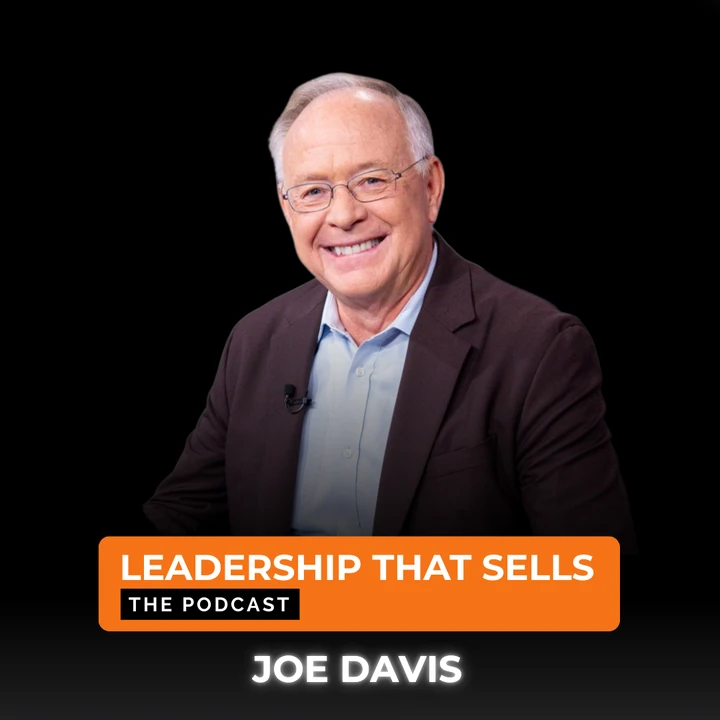
Leading with Generosity
with Joe Davis
Show notes
In this episode of Leadership That Sells, I sit down with Joe Davis, former Head of BCG North America, transformation expert, and author of The Generous Leader. Joe shares a refreshing, clear-eyed perspective on what it means to lead well under pressure especially when you’re juggling high-performance targets and a stressed-out sales team.
We talk about how generosity isn’t soft it’s actually a strategic edge. Joe lays out exactly how a leader can be both supportive and tough on performance, why inclusion needs to go far beyond demographics, and how vulnerability builds real trust. It’s practical, honest and powerful. If you’ve ever struggled with how to push your team without breaking them, this is one for you.
How to lead with generosity and still drive accountability
Here’s how Joe Davis defines and applies generous leadership:
- Generous leadership is about giving of yourself freely — without expectation of personal gain — to help others grow, develop and thrive.
- Inspire and develop your team if you want them to truly “hum” for you — not just chase numbers.
- Listen to learn, not to reply. Real listening builds trust and shows respect, which in turn drives performance.
- Inclusion is not tokenism. Pull different voices into decision-making — not because they tick a box, but because they add value.
- Be human, not heroic. Vulnerability, humility and honesty unlock more from your team than pretending to have all the answers.
- Accountability and generosity are not opposites. Hold the line on outcomes — but be shoulder-to-shoulder in helping people get there.
Timeline summary
[02:59] – “Generous leadership is giving of yourself freely… to help others grow and thrive.”
[04:43] – Joe’s wake-up call as a 24-year-old manager: “Why didn’t you tell me this two weeks ago?”
[07:06] – “The fastest trust builder? Listening. Not hearing — really listening.”
[08:51] – Inclusion done right: “When you invite me into that room, I want to give you everything.”
[10:45] – “Leadership is a learned performance. You don’t have to be Churchill to lead well.”
[13:26] – Vulnerability in action: “I don’t know, either.” How that one sentence unlocked a stuck team.
[19:04] – “This isn’t about being nice. It’s about outcomes — and how you get there matters.”
[22:04] – Generous inclusion: “It’s not demographics, it’s contribution. Invite, include, then ask.”
[25:10] – Joe’s billboard message to the world: “Listen with curiosity. Listen to learn. Have grace.”
Links & resources
- The Generous Leader by Joe Davis
LinkedIn: https://www.linkedin.com/in/joedavis1313/ Instagram: https://www.instagram.com/joedavistgl/ Facebook: https://www.facebook.com/joedavistgl - Practical Leadership Academy: leadershipthatsells.com
- Get the free Parallel Team Playbook: leadershipthatsells.com/playbook
If you enjoyed this episode, please rate, follow and share Leadership That Sells. Reviews help more people find the show — and they help your fellow sales leaders lead better.
Transcript
Automated transcript. Speaker labels and spellings may contain errors.
Paul
[upbeat music] My guest is a renowned leadership strategist, and he's the former head of BCG in North America. He's helped bring the 50th anniversary Super Bowl to San Francisco. He's led some of the biggest transformations in consulting. He's launched new offices, built public sector practices, and all sorts of inclusion movements, of which he's very proud. Father of four, grandfather of eight. Today, he's on a mission to bring generosity back to leadership, and his new book, The Generous Leader, is reshaping... It's certainly reshaping how I want to lead under pressure. Welcome to Leadership That Sells. This is a podcast that helps you to lead first and sell more, because most sales teams today are not really teams like we think they are. They're what we call teams in parallel, and most managers are still leading them like they're a football team, when in reality they've got a team of sprinters or, or golfers.
And that mismatch is just the root of some of the biggest problems out there. Your coaching doesn't land. Your pipeline reviews feel like interrogations. We built a leadership power-up for your managers. It's not another heavy training session to learn. It's a light, fast leadership reset that just gives them a simple model to follow and lead the team they actually have. Set the target with clarity. Build the flag with shared identity, and hand over the map to coach for autonomy. If you're ready to fix the model you think you're working under, grab our free Parallel Team Playbooks. Short, sharp, and built for senior leaders like you. You can find it at the Practical Leadership Academy. [upbeat music] And with that, Joe
Davis, thank you very much indeed for joining me.
Joe Davis
Thank you, Paul. Thank you. Thanks for that nice, nice introduction.
Paul
Well, you have a book and it's called The Generous Leader. What a warm-hearted title, I think. You couldn't find a better one. And it speaks very much to, uh, servant leadership, I think, although you may well disavow me of that. And it talks a lot about heartfelt actions, collaborative actions. Now, I work a lot with senior salespeople, senior sales leaders. Now, they are constantly balancing this highly microscopically aggressive target at the same time as trying to look after their team. From your book, you've got these different principles in there, seven different principles. How can you apply your principles, this generous leadership principle, to sup- build a supportive but high-performing sales culture at the same time without compromising either, either one?
Joe Davis
Well, obviously, I'm gonna say I think that's quite easy. [laughs] Why wouldn't-
Paul
So glad
Joe Davis
... I think, let me tell you, it's very int- what, to me, generous leadership is quite simple, and it's, you just said the version of it. It's really about as, as a leader, giving of yourself freely without expectation of direct personal benefit to help others grow, develop, and thrive at their full potential. You know, a lot... And I think about, you s- talk about sales, and I was at Procter & Gamble sales rep my first six years, but my s- brother's been in sales forever, and it's so interesting. In software sales, he'll call me and just tell me how the manager or the boss just pounds on him for the numbers. Pound, pound, pound, pound. And nothing about, you know, "Dalton, maybe do this versus that. Maybe you ought to try to..." And it just [laughs] when I listen to your stuff and reading your ... So this is exactly the problem. Sometimes in these hard-hitting, edgy, get the numbers now because, you know, you just get lost in the numbers and you manage maybe well, maybe
poorly, and you tend not to lead.
Paul
Mm-hmm.
Joe Davis
And I think, as you said, people need, want to be inspired, then they really hum for you. If, you know, it's got to all come together. They have to get developed. They have to learn, but they wanna be inspired and be motivated to move forward with I- which is what I think of a generous leader. It's not given a nice paycheck. That's important. It's not a raise. That's important. [laughs] It's about really helping others grow. And, you know, by definition, if they're all humming, you as a leader will benefit. And now, if it's your intention, you're in trouble. But if it's not your intention, but it's just I will get the r- you know, reap the fruits of that, uh, development of my people, you win too.
Paul
Well, I think you just nailed the number one misconception with people. Regardless of their tenure, seniority, you can have people who are in their 20s who know this and people who are in their 60s who do not. When did you first realize that leading teams, leadership in general, was not all about you?
Joe Davis
[laughs] Yeah, it's funny. I'll tell you, I was, um... I mentioned I was at Procter & Gamble, and I got promoted to a manager two years in. It was that kind of thing to... And, um, I had three reps working for me, and I used to ride with them every two weeks. Well, there's four. Three of them were career sales reps. All they were going to do was sell. Well, one of them was a manager track person, too. You could teach, treat that person differently a bit. I rode with these people every two weeks. I never said a thing. I was scared. I was 24. What did I know to tell? I thought they were old guys. They were 40. But, you know, to a 24-year-old, that's pretty old. And I'll never forgot- forget when I did the annual review, and I r- you know, I wrote down everything they should work on because now I had my chance, you know? [laughs] And it was behind, hiding behind paper.
And I started launching to the review with this fellow, Rich. Uh, maybe three minutes in, he says, "What the blank, Joe? You ride with me every two weeks, and you've never told me any of this?" And of course, I was mortified and, oh, I didn't know what to do. But it's interesting because when I reflected, and I'm, I think I reflected over the years, to be fair, Paul. He, you know, he didn't think I'm some snot-nosed kid that knew nothing. He actually said, "Well, shit, you're riding with me every two weeks. Why don't you tell me some ideas?" [laughs] You know? So even there's a 40-year-old that was, you know, he wanted to learn and develop, and here I was, I was all about me. Mainly scared and what am I gonna do, and I don't know anything. But I was caught in my own head and not at all understanding, "Wait a minute, my job is to actually help him grow." But I didn't know that at 24, [laughs] let me tell you.
But that was an interesting lesson for me.
Paul
So if you were able then to... And that is a bit of a sticky question, right? You s- you go back and you're giving the 24-year-old you riding around in this guy's car Um, you're gonna say, "When you observe something, tell them what you see." Okay?
Joe Davis
Yeah, of course. [laughs]
Paul
Right. Duh.
Joe Davis
Duh. Yeah. [laughs]
Paul
Let's start there, shall we? But from the, the, the, your, your, your concept, this, this heartfelt collaborative concept, the generosity that you want to bring into leadership, what's one of the features, the framework elements that you would say would immediately build trust for a leader inside a high-pressure team?
Joe Davis
Um, well I always go to this. I have s- three that I think are important, but I go to the same place. I think the highest trust builder right away is being a good listener. So being-
Paul
I'm sorry, what did you say? I, I just tuned out.
Joe Davis
Be-
Paul
I'm sorry, I think I ... I couldn't hear you. What?
Joe Davis
[laughs] Be- listener-
Paul
Ah, sorry. Sorry. I, I, I can't help myself.
Joe Davis
No, no, I know.
Paul
Oh.
Joe Davis
But it's not just, Paul, hearing the words, it's actually what the heck is that person thinking? You know, why are they saying what they're saying? Where are they coming from? What do they know that I don't know? You know, how can I learn from that? There's two benefits. One, you learn more. You can be a better leader, come up with better answers. That's another duh. The other one that I think is duh, but it's not so ... That's right, is when you actually listen really, you show respect. I mean, what you just did, like I als- I thought blank you, you know? It was actually disrespect. [laughs] I won't say what I thought, but what the fuck, you know? So-
Paul
Exactly
Joe Davis
... as opposed, "Oh, Joe, tell me more," I would've thought, "Oh wow, look at that. He cares about me." No, but it was a very good little example. I hope someone sees it on video. 'Cause-
Paul
Hope so
Joe Davis
... you know, you show respect, which when you just talked about the generosity part, show 'em respect. Then all of a sudden, oh wow, Joe actually cares, or Paul actually cares. Well, let me tell you more, or let me work harder for you, or-
Paul
Mm
Joe Davis
... you know, et cetera, et cetera. Uh, can I tell you one little story on this? Of-
Paul
Please.
Joe Davis
Uh, Ju- when I was running North America, so that was many years later at BCG, I'm very good ... Well, I, well, very good's not the right word. I like to make sure I bring different people into my meetings, not just the senior guys that surround me and my junior people. And one fellow told me, "You know, Joe, when you bring us in, it is so incredible. I mean, it's scary as heck. I hope to God you don't ask me a question, but you always do, which I appreciate. But I get to see what's going on, I hear the broader picture, I feel included, I feel respected. You know, when you do that, I wanna take my role and figure out how else I can help well beyond my role." You know, and he didn't say but comma, without asking for more money, without asking f- you know, for b- time off, without asking for more help.
And I thought that was interesting. I said, "Wow, just showing that respect." They actually wanna figure how to go above and beyond, and you don't have to ask them to go above and beyond.
Paul
Yeah.
Joe Davis
Talking about a way to get better numbers without having to do anything other than [laughs] inviting people into a room and including them, um, I thought it was a pretty cool lesson. Now, you know, that was like 40 years into my work career. [laughs] Would've been nice to have been learned that much, much earlier, but so be it. You learn when you learn.
Paul
I, I, I say that there's a, a trail of damage and destruction in people's careers that I've left behind me and all the nonsense that I got up to when I was trying to work out how to do this.
Joe Davis
Yeah.
Paul
And I constantly apologize. If you're listening and you're one of them, I'm so sorry. But i- it is just, um, it's an experiential performance profession, and I had a, a very late, well, late on in my leadership career, but e- e- early on-ish, I had a great manager who got me to the point of understanding that leadership management, as you want to look at them, are things you can get better at. You c- they are learned skills because you look at Churchill, you look at whoever it is as your l- your leader of choice, and you think, "Ah, charisma coming out of his nostrils." And it turns out that you- they're half drunk, they're-
Joe Davis
[laughs]
Paul
... terrified, they're whatever their problems are. But in the moment, it's a learned skill that they put on. So they put on, if not necessarily a facade, but they perform, they do the things that leaders do. You talk about bringing ... Not necessarily bringing your whole self, but authenticity-
Joe Davis
[laughs]
Paul
... vulnerability. Talk to me about that.
Joe Davis
Yeah. Well, well that ... You know, when you said what are the things, I just th- I go to listening first 'cause you do that, it's so great. But I think the other critical thing, and you ... There's a lot of words we can use, but you know, people n- especially nowadays, I think things have changed. Technology changed the world, anxiety's up, you know, stress. And people, it's just ... We can go through the history, but the BlackBerry started it, and the phones continued it, and social media.
Paul
Yeah.
Joe Davis
So people ... And COVID. You know, we ... So people need and want to bring some of their human self to work. They just do, and they want to see that you're a human. I'm not saying tell them everything that happened last night and the fight you had with your 13-year-old. They don't need that, unless you have a good friend and you wanna talk about it with them 'cause they have a 13-year-old. But, but bringing some humanity, some personal self to your work. And you know, can I tell two stories? But-
Paul
Please.
Joe Davis
Maybe I'll tell, I'll, I'll tell a couple where I kinda got this as interesting as a little ... I do cry in front of people, [laughs] so I'm not afraid at all. One time a friend of mine said, "Oh, Joe, like you're a white male, 60-year-old, you're head of North America. You can cry. It doesn't cost you anything." So I know it's a little trickier depending who you are and where you are. I'm not ... I'm self-aware. But my wedding, I, um, got married when I was 22, and we get to the vows, and I cried through the entire vows.
Paul
Mm.
Joe Davis
My wife's strong as heck, and boom, boom, boom. And I couldn't ... My ... The minister had to say three words and I repeated them, then three words and I repeated them. [laughs] But I have to ... And of course as a 22-year-old kid, I was embarrassed. Like, oh my God, I'm supposed to be stronger than that. You know, what's a guy do? Well, the number of people who came up to me after that said, "Oh my, the emotion in the church, the love, I could just feel it." You know, and it was my crying that ... So you, you know, you're smiling. It's a nice thing, but it was also a powerful lesson. Ah, exposing a bit of yourself. I was embarrassed. It was just the opposite. It inspired people to feel better. So you know, so you don't have to do that. I'll t- now I'll go to another story. You know, being vulnerable or honest or hu- humble or human ...
can be in the business world as simple as saying, "I don't know" when you don't. And I had a good colleague and I asked him, you know, "When did you kinda cross your line into something vulnerable for you?" And he said, "Well, Joe, I'll never admit to my team, or I'm afraid to admit I don't know something." And he was a Black guy, so it's a little bit wrapped up in all that too, you know, in, in my country at least. Um, and he said, "What- if I was in the room with the team and they were getting stuck, and I could tell they were gonna turn to me and ask what I thought, and I didn't know the answer, I'd leave the room."
Paul
Mm-hmm.
Joe Davis
How is that good? Now all of a sudden they're just be stuck longer, you know?
Paul
Mm.
Joe Davis
He said, "Finally one time I thought, well, this is ridiculous. I better suck it up." And he said he waited. They asked him, "Well, what should we do?" He said, "You know, everybody, I don't know anybody. I don't know either." And he said it was stunning. There's like this burst of energy came, "Oh, you don't know? Oh, the boss doesn't know? Wow, none of us know? Okay, let's all brainstorm together and start to solve it." So, you know, this simple vulnerability unlocked them 'cause they were stuck, you know? And they didn't wanna ... They couldn't figure how to get out of it either. And you can take that to someone's just afraid to say something that's got 'em stuck 'cause they don't wanna admit it, and then they sit there in their office by themselves wasting time. So, you know, that's a vulnerability in my opinion, but it's a very simple one.
Paul
Mm.
Joe Davis
And it's very powerful. Sorry, it's a long, long two stories, but it just illustrates. You know, to me I had a lesson early. It's okay to expose a bit of yourself. If it's honest, if it's heartfelt, it fu- it motivates people, and you can be as sim- It, it's just really the important part is when you show a little humanity, you unlock others to show some of theirs. And really if they're in the business context, if they're stuck, they're afraid, whatever, they'll come and talk to you about it, and now you can help them move past it as opposed to lose time, lose productivity, et cetera.
Paul
Uh-
Joe Davis
That was a long, that was a long answer, I apologize. [laughs]
Paul
No. No, it's a, it's a very good one. I think the word you used there that really resonated with me is honesty because I've seen people who are ... who know that they should be vulnerable and use the same damn story again and again. "Well, once I stubbed my toe-
Joe Davis
[laughs]
Paul
... in the bath, and then it was a ..." And you hear the same thing again and again from them because that's the only part of them they would ever want to reveal. That's them being vulnerable because I was on a course who ... what taught me-
Joe Davis
[laughs]
Paul
... about it, right? And I think as you, you, you mentioned, you talk about honesty, you talk about the, the productivity gain from honesty-
Joe Davis
That's a good point
Paul
... from, from humanity. And when we are now faced with a world where technology purports to be human, except it's not, it's not even close, and anybody who uses this stuff really and thinks about it, it's not. It's useful, but it's not.
Joe Davis
It's not.
Paul
And the power, the productivity comes, I think, when you have humans together. And then COVID for me, we did a lot of Zoom calls, video calls, and they're okay. You know, they're all right. It's nice. It's okay. And you don't go back for quite a while, and then all of a sudden you do go back, and you realize that having an in-person conversation isn't just a bit better than a Zoom call.
Joe Davis
That's incredible.
Paul
It's exponentially differ- It's, it's 1,000 ti- times better because you get to smell the other person. You get to see the twitch in the back of their neck that you don't-
Joe Davis
Yeah.
Paul
There, there's so much more, and that's the humanity. That's the relationship that it'll be a while before a computer gets anything close to that.
Joe Davis
Oh, yeah. Yeah, yeah. You know, when you men-
Paul
The heart it gives other people.
Joe Davis
You mentioned, just mentioned the technology. I just think when people ask about AI, I mean, you just said it, it's ... I think the fact that a leader in particular, or what's gonna separate a leader more and more is how they, if they can bring humanity and realness.
Paul
Mm-hmm.
Joe Davis
'Cause I remember about three years ago or four years ago, the CEO of ... We had global meeting and we didn't wanna fly to get together. Maybe it's ... So there's three different Asia, America, and Aust- and Europe. And he Zoom- he had a hologram or whatever. He was there, you know? It was this image of him on the stage. [laughs] It was incredible. And you thought ... But it wasn't. It was fake. Now, so, you know, so pretty soon that will be what's happening, and then people are gonna say, "Well, wait a minute. Where the blank's the human? Where's the person?" So the leader ... Now, I'm not criticizing him. He had to be in three places at one time. That's not the point. But the point is pretty soon your leader may Zoom in by, you know, [laughs] by Zoom or by, you know, like a hologram, tell you what to do, and leave.
And you say, "Wait a minute. I wanna have a conversation." I want ... Just what you just said.
Paul
Mm.
Joe Davis
I need to talk to you about where I'm stuck or what I gotta do. So this human element is going to separate, I think, the, the most exceptional managers from the most exceptional leaders. You know, we'll see, but I think so.
Paul
I think when you look at anything, you've got the A, Bs, and the Cs. In a sales team you've got the A players, the B players, the C players. The C players are on their way out or some- on their way somewhere else. The B players you want to accelerate into being the A players. And the A players, you want to make the most of them, and you give them a- all access to this technology, and the As become A+, the Bs become A-, and the Cs become D- because you end up magnifying failure.
Joe Davis
Yeah.
Paul
You can be worse but louder.
Joe Davis
[laughs]
Paul
And, and, and more of it. There's more worse-ness, you know? It's just ... You're just worse bigger. Um-
Joe Davis
Yeah
Paul
... the, the, the big aspect of that, I think.
Joe Davis
Also important, your point, which is off the topic of generous leader, but, you know, usually you'd think the best resist new stuff because they know I already got it solved, except they're just the one- they're the ones that grab all the new stuff immediately, right?
Paul
Yeah.
Joe Davis
They grab it immediately and then make themselves even better.
Paul
Wow. I need to drive a lot of accountability. The people who work in the roles that I help with are all about accountability. How ... What aspect, what's a way that you can show generosity while still driving accountability?
Joe Davis
Um, yeah. Well, you know, [laughs] let's... And that's something, a good point you said. I'm never saying, and y- your question sort of, you know, not implies it, but a leader still has to get outcomes. You don't get results, you get fired or demoted or don't get promoted. I mean, it's, it's t- [laughs]
Paul
Yeah
Joe Davis
So there's nothing about not getting outcomes. That doesn't change one bit. I think the important other part about... So the other part, part here is this isn't about, we're talking a lot about humanity. It's not just about being nice. I mean, that's not help- be a nice, a nice thing to do. But if there is times where, "Hey, the numbers are this and this and this, and you're falling short, buddy. Now let's talk about how we're gonna get you there." And i- but, y- you know, if you just say, "You're falling short, buddy, get your act together," that's not being a generous leader. "You're falling short, buddy. Let's talk about how we get you there," that's now stepping into what a leader should be doing, which is, "Okay, now it's my job to help you grow, develop, figure out," we don't need, you know, [laughs] figure out how you actually hit those numbers.
But I, for one second, I'm not saying... So that's, I think, the important part is if you, of course, if they aren't delivering, you're bottom third, you know, you don't have to fire them like Jack Welch did.
Paul
No.
Joe Davis
But you gotta move them on, [laughs] you know? You don't have to... But they do move on. I mean, BCG was an up or out place. If you weren't-
Paul
Mm
Joe Davis
... gonna fit there, you were gone through different thresholds. But I think the critical part is that as a generous leader, you're really thinking about, "Okay, they're accountable for this or that, but how do I help get them there? You know, I'm not doing it for them, but how do I help getting there? What does Paul need to do to make sure he gets this? What does my brother Dalton need to do to... You know, and that's my job to think about who you are, what you're great at, what you're not great at, and work with you to get there." So I think that's the generous part with the... The accountability, the business part doesn't go away. I'm not saying it goes away. I know that's a very good answer, but I think it's just, you know, it's not... It's reasonably simple. You still have to get your numbers. That's part... But you as a leader gotta make sure they all are humming to get their numbers.
Paul
You mentioned, um-
Joe Davis
Mm
Paul
... pulling people in that may, and put to conversations that may not normally, uh, attend certain meetings. And I think the whole concept of diversity and inclusion has been beaten around the bush a lot and misused. Um, and we've been doing, we've been misusing it by thinking about demographics rather than the contents of people's-
Joe Davis
Yeah
Paul
... heads and hearts.
Joe Davis
Right.
Paul
Now, you talk about generous inclusion as one of the seven elements in your book, and you talk about being inclusive to invite collaboration and to show respect. Now, you're not inviting collaboration because she's a girl or he's a boy from a different part of the world or whatever. You're inviting it because you think there's gonna be value. You, you want them to step up for the next time. What... Talk to me about how, how you've seen and used this concept, this generous inclusion.
Joe Davis
Yeah. Yeah. No. So you did just say it. I mean, when I think of inclusion, I mean, we could talk about DE&I type inclusion. That's important too, but this is, this is actually including people on your team, ideally from different departments, if you wanna say it that way, different levels-
Paul
Mm
Joe Davis
... into your key meetings, into your decision-making, into your thinking. For one very obvious reason for you, they know more than you do 'cause they're coming from different parts of the place [laughs] than you're spending time on.
Paul
That's it.
Joe Davis
So a lot of people don't like that, but that's a fact. But as I said earlier, it also inspires and motivates them. I mean, it's interesting. I, when I talk to executives for this, the book I wrote, every single one of them, and it's a little cliché, but they all said it. They all said, "You know, I really like to ask questions of someone four layers down. I invite the finance analyst in my office and ask where the numbers came from." Not, not, not the vice president who, you know, is now massaging number six. They didn't, not lie on them, but, you know, made them, [laughs] you know. Said, "I'd like to get that." Or I'll, or I'll literally walk the halls, you hear this all the time, and grab the person that's in such and such department and ask, you know, "What are you doing? How it's going?" And they all point out they learn so much more.
Paul
Mm.
Joe Davis
Now, that's a simple version of inclusion, but that's all it is, is actually engaging and inviting people from different levels and different parts of the organization. Now, also to your point, if you have t- people that work in different parts of the world, that could be interesting to you.
Paul
Mm.
Joe Davis
Into your, I don't know, into your sphere, I guess I'll say. I mean, I mean, it could be all kinds of different contexts.
Paul
Mm.
Joe Davis
But the important thing I say, when you invite them in, you can't just have them come into a, a room, a Zoom or whatever, and be a token person. You know, you have to ask them a question. Otherwise... And the minute you ask them a question, by the way, sorry, I'm starting to lecture here a little bit. But also and everyone else in the room goes, "Oh, geez. Joe just asked the most junior person in the room. He said hi to them first, and he asked them a question. None of us bosses are, what does that mean?" All of a sudden they're like, "What does that mean? You know, am I supposed to talk to those pe-" You know, I'm sort of s- [laughs] I sound rude here, but-
Paul
What, what you were trying to tell me here.
Joe Davis
Yeah.
Paul
Yeah, yeah, yeah.
Joe Davis
They might, yeah. And they're, "Well, gosh, they might say something I don't want to hear." So that's the other important part. It's not just invite them in, but you have to include them. I think actually never thought about it. If you don't include them, it's probably more hurtful, 'cause now they are a token.
Paul
Yeah.
Joe Davis
And nobody wants a token.
Paul
That's it. I mean, I've [laughs] it wasn't that long ago, I mean, less than 10 years ago, that I was in a room in an office, shall remain nameless, and somebody asked one of the young ladies if you'd sort the coffee out, please.
Joe Davis
Oh, God.
Paul
And the young lady stood up and said, "With pleasure. Would you take milk, sugar, whatever it is you like?" She did it totally quietly, very, very professionally. Nook didn't blink, 'cause she was the first one presenting, senior vice president of who gives a, right? But she was more than happy to make coffee. You know?
Joe Davis
Mm-hmm.
Paul
And the guy who was asking was some vendor thing was going, "Oh."
Joe Davis
[laughs] Oh, that's... I've, I've heard my stories like that too. I won't repeat them 'cause it's the same thing, but I-
Paul
Yes
Joe Davis
... I, I love those stories [laughs] when you, when... But that what she did, it was quite class. That's pretty class.
Paul
She's very class. French lady. Love her.
Joe Davis
Very classy move. [laughs]
Paul
[laughs] Oh, it's magnificent. Let's say we've got the largest Sharpie ever created.
Joe Davis
Largest Sharpie. Okay.
Paul
The largest Sharpie, and the biggest billboard-
Joe Davis
Oh, big
Paul
... at every airport in the world, 10,000 billboards, and one message from Joe Davis. Everybody's gonna see it. What is the message? What is it you're gonna write?
Joe Davis
Well, I'm not a marketing guy, but I would write, "Listen with curiosity. Listen to learn." And if I have room, "Have grace to understand where they're coming from." That's my-
Paul
Listen with curiosity. Listen to learn. And have grace-
Joe Davis
Have grace to understand where they're coming from
Paul
... and have grace. Grace to understand where they're coming from.
Joe Davis
This would be important in my country right now, Paul, but that's a different topic [laughs] altogether.
Paul
Grace, I think, is, uh, a beautiful, a beautiful concept.
Joe Davis
I know. I use that on purpose 'cause, you know, too many people, I don't care what they think. I'm not asking you to care. I'm saying you have grace to listen, you know? That's all.
Paul
That's it.
Joe Davis
And maybe when you listen, you might care a little bit. [laughs] We'll just hope, you know?
Paul
That's it.
Joe Davis
Or at least you'll understand the different... Why someone's coming from a different place. So that's my... And in the business world, of course, you learn something new. It's, you know, it's actually benefit to you.
Paul
Lovely. Well, gracefully put. Joe Davis, thank you very much indeed for joining me.
Joe Davis
Thank you, Paul. This was fun. [outro music]