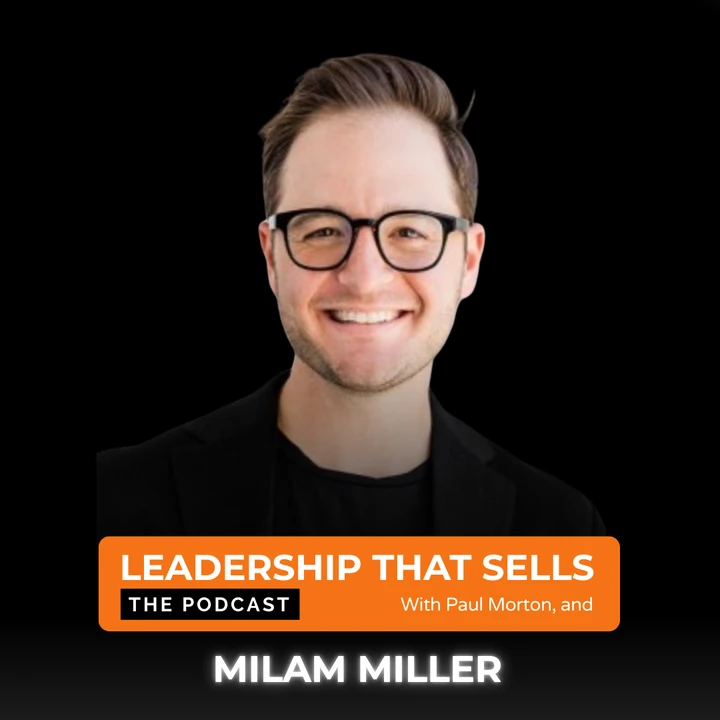
Show notes
In this episode I sit down with Milam Miller — author of The Charisma Craft and founder of Be Confident and Kind — to dismantle the myth that charisma is innate and to show how it can actually be a powerful, learnable leadership skill. We unpack what charisma really is (spoiler: not glittery and extroverted, but human connection), why it matters for sales and leadership, and how to build what Milam calls your “Riz factor” — your likability, trustworthiness and presence that turns connection into commercial advantage. Expect a practical, no‑fluff framework, real talk about what works, and a challenge to show up with intent.
If you lead a sales team (or want to), manage reps, or sell yourself as a leader — this conversation is a must-listen.
How to craft charisma that helps you lead and sell more
Here’s how you can start turning charisma into a reliable tool — not a luck-of-the-draw trait.
- Think of charisma as a craft, not a birthright. It isn’t about being loud or larger‑than‑life; it’s about human connection that builds likability, competence and trust.
- Lead with authenticity. Use your own voice, stories and values. Don’t mimic scripts or try to be someone else. Your genuine self resonates.
- Be bold enough to ask. Confidence matters: call the meeting, make the call, take the risk. But boldness without humanity falls flat.
- Stay curious about people. Ask questions, listen, learn what drives your colleagues or clients — and respond to that. That curiosity underpins strong, lasting relationships.
- Combine confidence with kindness. Confidence shows you know your stuff. Kindness shows you’re human. Together they create what Milam calls the “like‑know‑trust” platform.
- Lead with service, not quota. Shift your mindset: selling isn’t about hitting numbers, it’s about helping people solve problems. When you show up for them, results follow.
Timeline of key moments
- [00:02:04] — “That’s a lie.” Milam debunks the myth that charisma is innate — you can learn it.
- [00:03:11] — Charisma framed as “the art of human connection” rooted in empathy, warmth and clarity.
- [00:05:39] — The “L‑K‑T” test: Likable, Knowledgeable, Trustable — the essence of likability in professional relationships.
- [00:09:32] — The two core engines of charisma: intention (why are you showing up) and attention (who are you listening to).
- [00:16:14] — The ABCs of charisma: Authentic, Bold, Curious — a simple, actionable framework.
- [00:18:13] — Distinction between courage and bravery: courage is acting despite fear; bravery is absence of fear. Both matter.
- [00:23:03] — The big takeaway: “Be confident and kind and develop your charisma craft.”
Links & resources
- The Charisma Craft by Milam Miller — the book that underpins the frameworks we discussed.
- Be Confident and Kind (Milam’s organisation) — for more tools, training and sales‑enablement resources.
- If you want to test this on your team: grab the Parallel Team Playbook from Practical Leadership Academy
If you’re ready to stop leaning on charm and start building connection as a repeatable skill, this episode gives you a clear path. Try being intentional, curious and human in your next interaction — the results might surprise you.
If you enjoyed this episode, please rate, follow, share and review the podcast. It helps more sales leaders discover leadership that sells.
Transcript
Automated transcript. Speaker labels and spellings may contain errors.
Milam Miller
[upbeat music] Uh, look good for a TikTok video that they lose sight of what it really is, and charisma is really about them. It's about the other person. It's about your audience. It's about your prospect, your potential client or customer. So when we engage them, we actually are perceived as somebody that's likable, knowledgeable, and let's call it trustable. I think I just made that word up, so maybe Oxford English languages will, will let me add that one. But in other words, it's, it's an LKT pa- factor. Do I like this person? Do they seem knowledgeable or competent? And can I trust them? Are they, uh, someone that I, I, I want to do business with?
Paul
How, how do I become likable?
Milam Miller
[laughs] Great question.
Paul
I mean, knowledgeable, I can go off and learn stuff.
Milam Miller
That's right.
Paul
Trustable, I can do things that I say I'm gonna do. But likable?
Milam Miller
Yeah.
Paul
What if I'm just a bit of a dick?
Milam Miller
But it is this likable piece that is so interesting, 'cause that's where first impressions come in, is that charisma really is the ability to be decent, the ability to be human, and the ability to be responsive. So that's where the likability factor comes in play. Ask yourself, "What's the impression I'm trying to make, and is it authentic to me?" Which we can go deeper on. [upbeat music]
Paul
A former global sales exec turned leadership coach, he's negotiated over $100 million in deals across sports and entertainment, built teams on three continents, and now teaches leaders how to turn human connection into commercial advantage. I love that. He's known as the real-life Ted Lasso. He's the founder of Be Confident And Kind, and he's the author of Charisma Craft: A Modern Leadership Guide to Enhancing Your Rizz Factor. Thank you for joining me here on Leadership Sells podcast, for teams of people who like to lead first and sell more. Most sales teams today are not actually teams. They're what we call teams in parallel. They're working in a similar way, but not with each other, and most sales managers are still leading like it's 1984, like they've got a football team when they've really got a group of golfers.
Now, that mismatch creates, creates all sorts of pain. Poor coaching, bad pipeline meetings, burned out managers, and reps who just drift along. We've built a lightweight reset that helps your managers lead them in the right way, set clear expectations, build identity without the fluff, and coach for autonomy without going hands-off. It's not training. It's a shift in the model that fits the team you've actually got, and your performance will just scale a whole lot easier. Now, if that sounds like it's your world, grab the free Parallel Team Playbook at the Practical Leadership Academy website. It's short, sharp, and made for senior folk with teams of managers just like you. Milam Miller, thank you very much indeed for joining me.
Milam Miller
You are so welcome, Paul. It's a pleasure to be here with you today.
Paul
It's g- grand. I mean, I'm really looking forward to digging into the rizz factor.
Milam Miller
Oh, yeah.
Paul
It sounds like something that's, it's gonna be quite profound. On the subject of things that are profound, charisma, okay? You're just born with it, right? You're born with it, and you've either got it or you don't have it. Charisma. Gray hair. It's one of those things. What, what... Talk, talk to me about this. What's the one charisma myth that you love debunking?
Milam Miller
Yeah. Well, you just said it, Paul. Um, I hate to break it to you. I hope you don't perceive this as getting off on the wrong foot, but that's a lie.
Paul
Excellent.
Milam Miller
You have charisma. I have charisma.
Paul
You're done. Get off my podcast.
Milam Miller
That's right. [laughs] Yeah.
Paul
[laughs]
Milam Miller
Everyone can develop the skill of charisma.
Paul
Ah, I love learned skills. I love them.
Milam Miller
That's it. So instead of thinking of charisma as an inborn personality trait, I like to tell my clients charisma is actually a accessible and learnable skill, and I provide them a framework to figure out how to access that, um, that skill.
Paul
Available at good bookshops near you.
Milam Miller
[laughs]
Paul
Go on. You're gonna give some of it away today, I hope, okay?
Milam Miller
You better believe it. I have my book, The Charisma Craft, here with me. It's my debut book, and it's really been informed by a lifetime of learnings, Paul. Um, first and foremost from my late grandfather, who was a used car salesman. I don't know if that profession carries the same stigma in the United Kingdom as it does here in-
Paul
It does
Milam Miller
... in, in North America. But he, um, he showed me that charisma isn't just this larger than life, gregarious personality trait, but it's actually something far more subtle and nuanced, and it really is the art of human connection.
Paul
Beautiful. Okay. So charisma is the art of human corre- connection, right? Now, this, uh, conversation is hopefully going out to, you know, at least two listeners, one of which is my mother.
Milam Miller
[laughs]
Paul
How can-
Milam Miller
Who I saw was on your 100th episode. Yeah, so-
Paul
She was on my 100th episode
Milam Miller
... she's, she's loyal, and, and charisma actually helps build loyalty, I'll have you know. [laughs]
Paul
Well, there we go. How can it help? How can it help all the sales leaders, all the sales people who are listening to this, or leaders in general, how can it help them to manage their teams better? How can it help you sell better? What is it really-
Milam Miller
Yeah
Paul
... this human connection, this charisma?
Milam Miller
So let's start there. What is it?
Paul
Mm.
Milam Miller
I think for many listeners, maybe you grew up hearing about this, uh, this, this ineffable or mysterious trait called charisma. And back in 2023, Oxford English languages named rizz the word of the year. Now, this word of the year beat out swifties for all my Taylor Swift fans. She just got engaged yesterday. I'll be interested to see when our episode airs. Um, but every-
Paul
She's still engaged.
Milam Miller
Yeah, r- right. Exactly. And I wish them well, to, in all honesty.
Paul
Of course.
Milam Miller
Um, but it's this idea that while Taylor Swift can take the world by storm, so did this word rizz Now let's break it down. Charisma is three syllables. It's very uncommon for a word to make it into our cultural zeitgeist with the root word being in the middle. We have influenza, it, which we call the flu, for example, and charisma really took a foothold with Gen Z. This is the group that's rising through our workforce right now, and many of them are sales reps or they're being tasked to go out in the field. They're being tasked to pitch products, services, solutions. And what often happens is-
Paul
Themselves. Themselves and their ideas
Milam Miller
... or themselves too.
Paul
Mm.
Milam Miller
And often what happens is they get so caught up in all the noise, trying to build their brand or, uh, look good for a TikTok video, that they lose sight of what it really is. And charisma is really about them. It's about the other person. It's about your audience. It's about your prospect, your potential client or customer. So when we engage them, we actually are perceived as somebody that's likable, knowledgeable, and let's call it trustable. I think I just made that word up, so maybe Oxford English languages will, will let me add that one. But in other words, it's, it's an LKT pa- factor. Do I like this person? Do they seem knowledgeable or competent? And can I trust them? Are they, uh, someone that I, I, I want to do business with?
Paul
Likable, knowledgeable, I'm writing this down-
Milam Miller
[laughs]
Paul
... and trustable. Trustable is a definitely a good word. Okay.
Milam Miller
Right. [laughs]
Paul
So now we know what it is. H- how do I become likable?
Milam Miller
[laughs] Great question.
Paul
I mean, knowledgeable, I can go off and learn stuff.
Milam Miller
That's right.
Paul
Trustable, I can do things that I say I'm gonna do. But likable?
Milam Miller
Yeah.
Paul
What if I'm just a bit of a dick?
Milam Miller
Yeah. I love this. So let me work backwards 'cause you touched on something. Trust takes time. I think you'd agree-
Paul
Mm
Milam Miller
... Paul. Um, trust is something that it's playing the long game. Being, in our case, a man of our word, um, practicing what we preach, following through. Knowledgeable, as you said, you can become competent and go out and study something in this age of information, whether it's a YouTube video, uh, an AI tool. But it is this likable piece that is so interesting 'cause that's where first impressions come in. And if we go back to caveman days, there's things that we knew or learned or developed then that we've actually lost sight of now. And I'll give you an example. You and I have never met in person. We're here in a virtual environment. The first thing I do when I join a Zoom call is show my hands to showcase I have nothing to hide.
Paul
No weapons.
Milam Miller
No weapons. Nothing hidden behind my back-
Paul
Mm
Milam Miller
... a spear. The same can be true in business. You know, across cultures, there's different ways to greet people, whether it's a firm handshake-
Paul
That's why we shake. That's why we shake hands, mate. I can't shake your hand if I've got a wei- a weapon in it.
Milam Miller
Precisely. Or maybe COVID days, it was a elbow bump when I lived in your country based in London, or maybe in other cultures it's bowing.
Paul
Mm.
Milam Miller
But the, the whole idea is we like people that show us that element of reverence or respect. In other words, human decency. So there's a lot of mounting research that charisma really is the ability to be decent, the ability to be human, and the ability to be responsive. So that's where the likability factor comes in play. Ask yourself, "What's the impression I'm trying to make, and is it authentic to me?" Which we can go deeper on.
Paul
Okay, what's the impression I'm trying to make? But that, that, I suppose that, that requires the thing that I, I, I rail about so much, is a moment of reflection. You actually have to be conscious that you're trying to develop this. And most people drift. Most people just drift through life. And if you take that 30 seconds just to say, "What am I doing?" Then that alone, that question elevates you. Even if you don't answer it, just the pause. What am I doing? Where am I? What is this conversation about? What is, what is my goal here? I'm just gonna go in and talk to these people, and hopefully we'll all get on. Well, who are they? What's important to them?
Milam Miller
Mm.
Paul
What energy are they gonna have? How, what energy do I have? How am I gonna show up?
Milam Miller
Yep.
Paul
How do I turn up still and calm or energetic and enthusiastic? What's right for this audience? And matching that, I think.
Milam Miller
That's right.
Paul
It is a really hard thing to do.
Milam Miller
It is hard, but it's possible.
Paul
Yes.
Milam Miller
And I say that to encourage listeners-
Paul
Yes
Milam Miller
... because simply what you're pontificating on and pondering, and I love this, this train of thought, Paul, is the simple question of, "Who do I want to be?"
Paul
Mm.
Milam Miller
Or if we take it a step further, "Who do I need to be in this moment?"
Paul
Mm-hmm.
Milam Miller
And the best sellers are intentional.
Paul
Yeah.
Milam Miller
They ask that question, "Who needs to show up in this meeting and why?" So I wanna break it down for listeners that might be more visual. There's two aspects to this mindfulness piece, and that's the first thing we're trying to access to become more charismatic is a mindset. There's the intention piece, number one, and the attention piece, number two. And what underpins that, in other words, our intention going into a setting, uh, it can be a social setting, professional setting. Business happens everywhere. We've gotta practice this skill. So let's practice the intent behind it and make sure that it's, it's, it's for good, 'cause charisma is powerful.
Paul
Mm.
Milam Miller
Right? The opposite of charisma is coercion and manipulation-
Paul
Yeah
Milam Miller
... and I wanna make sure I make that very clear.
Paul
Yeah, yeah, yeah. Mm.
Milam Miller
So what's my intent and how do I practice it, and then where's my attention going? And this is where the refinement piece comes in. So through intention and attention, we can practice and refine the charisma craft.
Paul
Okay. Now, I did like your, your, your public safety announcement there, your health warning. I mean, I've s-
Milam Miller
[laughs]
Paul
... I've studied influence and persuasion for very, many, many years. Um, so everything Norman Vincent Peale, Napoleon Hill, Robert Cialdini, all these guys, even some hypnosis. And Cialdini is very clear that this stuff just works.
Milam Miller
Mm-hmm.
Paul
So you can use it for good or for ill. My take is that you can use it for good or for i- you can use it for ill once.
Milam Miller
Yeah.
Paul
'Cause once you get caught, you're done.
Milam Miller
Yeah.
Paul
Right? As soon as you're caught, the bubble is gone. You gotta leave time.
Milam Miller
That's the T, the trusty roads. The trusty roads.
Paul
You gotta leave time. You gotta leave time, right? So I think, as you said, like, you need to be conscious and intentional about what you're doing. Now we've decided what we're doing, and what sort of attention... Do we need to decide what sort of attention we want? Is that the other side of this?
Milam Miller
Intention and attention.
Paul
Hmm.
Milam Miller
And let me back up real quick, 'cause I, I'd be remiss not to say it, uh, Dr. Robert Cialdini, he actually endorsed my book.
Paul
Oh, wonderful.
Milam Miller
And his wor-
Paul
Yeah.
Milam Miller
And his work on influence and persuasion truly changed my life. Because if we treat charisma as a skill that can help us deepen that human connection, then we start to think of sales as an act of service-
Paul
Yes
Milam Miller
... not something I need to do to hit my quota-
Paul
No
Milam Miller
... or to make a big year-end bonus.
Paul
No.
Milam Miller
Because if we fixate on all those things, if that's where our attention goes-
Paul
Yeah
Milam Miller
... the selling starts to get really difficult.
Paul
Mm-hmm.
Milam Miller
It starts to become a grind. We start to doubt ourselves, second-guess, uh, maneuvering and positions, and wonder if, if we're even doing this for the right reasons, or wonder if we're in the right profession, or, um, doubt what we're selling. I, I know so many people who've been in, uh, some form of sales that hate, literally hate, loathe the product or service they're being asked to sell.
Paul
Hmm. Yeah. And-
Milam Miller
And that's 'cause they're so fixated, their attention's going towards that thing. They're not... It's not going towards the customer. What do you need? What are your pain points? What do you want? I might have it, I might not. I'm just gonna shoot you straight. And it's that humanity where you start to develop your like, know, and trust factor.
Paul
There is... I mean, the whole concept of service, um, is something I can talk about for far too long, but we're not here to listen to me. We're here to listen to you. But the idea of the service, the servant leader in that... And of course, the, the, the best exemplar of that is, uh, you know, Jesus himself, uh, out there selling his story with the sandals. So as the ultimate servant leader, and exhibiting to get his message across and sell his news, which was good, there are... C.S. Lewis says there are four sorts of love, and we don't talk about love in business. But you are allowed to talk about this one, 'cause you have storge, you have philia, and you have eros. So you have the love of you to your brother, you have the love of you to your friend, you have the love of you to your wife.
But then you have agape, which is the divine one, right? It's this, um, it's this selfless desire for the good of the other person, and that's the one you're aiming for in service. And if you're aiming service to your buyer, to, to your world around you, you can't really go far wrong, because that's the externalization of your desire for the benefit of the other person. Not to your own. You're not setting yourself on fire to keep somebody else warm. That's daft. But if you're selling with the benefit of the other person in mind, then you're not focusing on the buying. You're not focusing on the, the selling. You're not focusing on the journey. You're focusing on the, the benefit of the individual. Right?
Milam Miller
That's right.
Paul
And that turns you, I think, into a charismatic person, well on the journey at least, because your desire is there for their benefit, for their-
Milam Miller
That, that's 100% it. And I... It's, it's, um, I find it fascinating you're bringing religion into this, 'cause if I think about Jesus being the ultimate steward of-
Paul
Mm
Milam Miller
... of selling, the idea he was selling is the golden rule, "Do unto others as you would do unto yourself."
Paul
Mm. Absolutely.
Milam Miller
And I, I have another colleague who I admire and respect. He's an author out of Canada, uh, by the name of Shed. That's what he goes by. Steven Sh- uh, he's got a long name, Shedletsky. And Shed has the platinum rule, or he features the platinum rule in his book, which is, "Do unto others as they want done to them."
Paul
Ah, yes.
Milam Miller
And that's the mindset of a servant-hearted seller-
Paul
Yes
Milam Miller
... of someone of, what are your needs? What are your wants, wishes, dreams, fears, motivations, ambitions, right? We could peel back so many layers of the onion-
Paul
So good. So good
Milam Miller
... in order to connect with the person.
Paul
Mm.
Milam Miller
And charisma is that conduit to connect.
Paul
Yes. Conduit is a good word. It's conduit. As you are, I think... I, I mean, a lot of this comes down to asking questions.
Milam Miller
Yeah.
Paul
Listening to the answers.
Milam Miller
That's it.
Paul
You know?
Milam Miller
Let me give you a framework, Paul, because I think-
Paul
Go for it. This is what I wanna get, so come on, give me your, give me the framework. How do we do it?
Milam Miller
Right. Because, because when listeners hear this, they're like, "Okay, I need to ask better questions." I hear that all the time. I can, I can hear younger reps maybe that don't have, uh, time on their side or the, the level of maturity or sophistication-
Paul
Mm
Milam Miller
... getting frustrated or flustered. And I really wanna simplify it, because when I rose into, uh, management and then senior leadership, I saw this all the time, g- the, the flustered, the, the brain trash and the anxiety creeping up-
Paul
Pretty much
Milam Miller
... that we couldn't just take a deep breath and calm down. So I'm gonna provide a simple framework, which is the ABCs of rizz. What is it? Your it factor? It's, it's your charisma craft. So the ABCs are this: A, you've gotta be authentic. You've gotta stay true to you. Don't sell the script or the playbook. Yes, I'm sure a lot of these blueprints work, but make it your own. So use your vocabulary, your personal stories. Make sure that selling is authentic to you to connect with your audience. B, you've gotta be bold. You've gotta ultimately make the ask. You've gotta be brave to make the calls, to get the meetings, to... There's so much boldness that is required in order to be a proficient seller. But the most important of all these ABCs is the C, and this is where you were leading us, Paul. It's curiosity. You've gotta stay curious about the person it is that you are serving, the, the people you are trying to reach.
Um, stay curious about your existing clients 'cause their needs are gonna change. And we know in sales that attaining new clientele or customers costs far more than retaining existing ones.
Paul
Yeah.
Milam Miller
Studies by Deloitte prove that. I just saw one come out from Shopify. It doesn't matter how transactional the sale is or relational the sale is. Uh, that's my background. It's really high-end relational sales that is ... It's a longer sales cycle.
Paul
Mm-hmm.
Milam Miller
You have to stay curious, otherwise you'll lose 'em.
Paul
Totally. And it's one of the big things, I mean, I'm hiring right now, and it's one of the big things I hire for. So I hire for smart, so, and somebody who's actually intelligent. You hire for courage to be able to ask the big questions, and curiosity. Courage and curiosity, the two, two big ones. I love that. Big boldness, courage, yeah.
Milam Miller
Yeah.
Paul
Oh, goodness. Authenticity, boldness, and curiosity. The ABCs. All right.
Milam Miller
Well, and for, for listeners, I wanna take that a step further because my own understanding, and, and I'd be open to, to having my perspective shift or change, Paul, you might see differently. I mentioned that bravery sits behind boldness.
Paul
Mm.
Milam Miller
Bravery is the absence of fear. It's like I gotta pick up the phone-
Paul
Mm-hmm
Milam Miller
... and know that I might get 99 nos and one yes out of 100 calls, right? But it, the courage piece looks different. If courage sits behind curiosity, courage is saying, "I'm gonna stay in this even if I am fearful of getting feedback from a client."
Paul
Mm.
Milam Miller
"I'm gonna..." It's acting despite the fear. Whereas bravery, you're just fearless.
Paul
Yeah.
Milam Miller
So I really think that, uh, don't, don't substitute one for the other. Let's embody both, right?
Paul
Mm.
Milam Miller
This is really about creating a holistic, um, craft that works for you.
Paul
Yeah. Yeah. I mean, I think the bravery, I think the absence of fear, the knowledge that there is, there's nothing that can harm you. The knowledge that you are, you are, you're safe. You are, you are loved, right? The, the courage is exactly as you said. It is the, the definition that the things around me are difficult, challenging, whatever, but I'm gonna go ahead regardless, you know? I think courage is smarter, right? You sometimes you see brave, bravery as bravado, which comes from the same root.
Milam Miller
Yes.
Paul
Right? But the, the, the courage is the, the, the, I think the intellectual application.
Milam Miller
Yeah.
Paul
It's, uh ... This, this is some, this is some heavy sh- stuff here, so I'm just gonna keep bashing on anyway. Uh, okay.
Milam Miller
I love it.
Paul
Right. So we've got charisma is a learnable skill. We know what charisma is. You need to be likable, knowledgeable, trustable. Being likable is, we think, maybe that'll be the hardest thing. You've got to think about your intention and get the attention. You're talking, uh, about this as a model for the ABCs of your charisma craft, the, the ABC of riz, chriz, charisma, authenticity, being bold, and being curious. And you mentioned there one thing about talking about leaders who are coming up and, um, this is actually, it's, it's, it's a challenge, I think, in our AI world in that so many of those early stage jobs are starting to disappear, and would not be looking for a graduate entry or job right now for love nor money because so many people are just looking and saying, "Well, I don't need to pay somebody
to scan my contracts. I can have some bot do it for me." So those early stage jobs are going. But if we're talking about a five-generation workforce, okay, five generations, how do you manage this? How do you interpret that really for a, a, a new, a new and upcoming sales leader who can use this human connection, this charisma as a competitive advanta- uh, as a competitive advantage?
Milam Miller
Absolutely. I think, if I'm understanding your question correctly, Paul, that no matter where you are in the generational workforce, you will carry a perspective on charisma.
Paul
Yeah.
Milam Miller
You might call it charisma or you might call it riz, and you might high-five a colleague and say, "You rizzed up that pitch. Like, you made it so much better." Like, you can use it as a verb too. It's, it's not just a noun, uh, to describe someone or something. Um, but I think what's most important is that we see the value in charisma as being, again, that conduit, that skill that can help us know our customers better and also know thyself better.
Paul
Mm-hmm.
Milam Miller
Um, I think sales is a team sport, so even if you have your own individual number to hit and you're out in the field, I have various tips, tools, and tactics for those sellers to really embody what I think is akin to executive presence, having a little bit more, um, polish, uh, or, or, um, what I like to call just that confidence. It's, it's-
Paul
Mm.
Milam Miller
It's ... That's why my, my business is called Be Confident and Kind. We're a sales enablement training facility. But you can't just be confident because if you're lacking the humanity or the warmth, in other words, what I call the kindness piece, then you might come across as too robotic, too forceful, too, um, prescriptive. And so I think leaders as they rise, they start to realize, "Okay, I'm confident because the proof is in the pudding. I see my track record." But really it's the leaders that lead with kindness-
Paul
Mm
Milam Miller
... that say, "You will figure this out. Trust me. I figured it out for myself. I can give you the tools, but you've gotta make them your own." Uh, they actually flip that scrit- script. Confidence takes the backseat and they lead with the kindness.
Paul
Excellent. Well, we've gotta pull this into a, a landing. I could go on forever on this. Uh, that's one of my favorite topics.
Milam Miller
Sure.
Paul
If I gave you the biggest marker pen you could po- possibly imagine, an enormous Sharpie and a great big billboard that the world would see, what would you write on it? What's your one message?
Milam Miller
It's a brilliant question, Paul, and I'm using the power of the pause to really make sure I'm answering it with-
Paul
You take your time
Milam Miller
... utmost intention. Uh, I think it would be according to the research out of Princeton University, out of the Fiske Lab, people who are competent and warm, or what I like to call in my formula people that are confident and kind, are charismatic. So I would write, "Be confident and kind and develop your charisma craft."
Paul
I love it. I love it. I love it. Thank you very much indeed for joining me, Milen Miller, author of The Charisma Craft. I have absolutely increased my riz being anywhere close to you, and I can highly recommend that you go and get the book. The link will be in the description of this episode. Thanks again for joining me.
Milam Miller
You're so welcome, Paul, and if I had ounce of your beautiful accent, then I think my riz factor would increase as well. [laughs] [outro music]