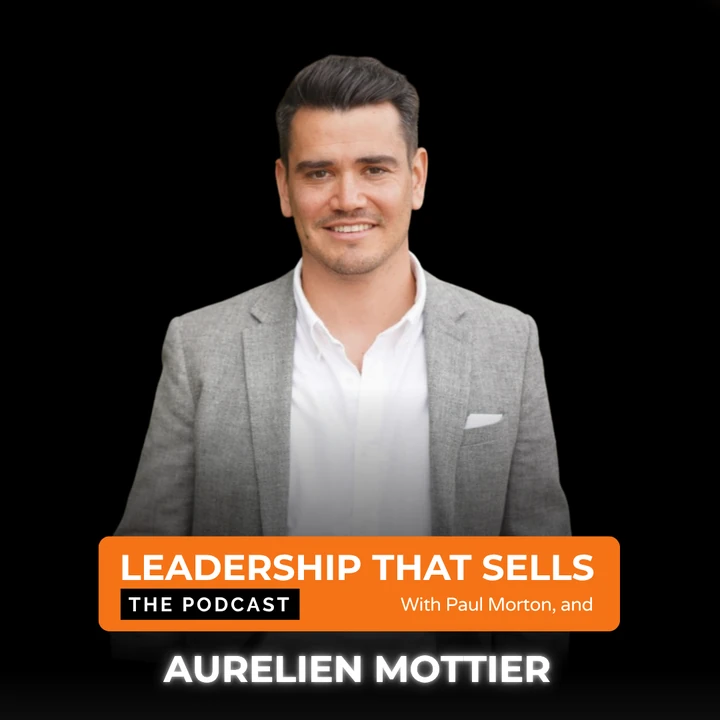
How to stop AI from killing your sales culture
with Aurelien Mottier
Show notes
In this episode of Leadership that Sells, I’m joined by Aurelien Mottier, President of MemoryBlue and a man on the frontlines of AI-powered sales. He’s scaled one of the largest outsourced sales orgs on the planet, and he’s not just thinking about how to use AI in sales—he’s doing it. At scale. Every day.
We get into the nitty gritty of how AI is changing the way sales teams operate—from call scoring to pipeline coaching to personalised messaging—and how not to let it turn your reps into lazy robots. If you’ve ever wondered how to keep your sales machine human while automating the grunt work, this episode’s for you.
Aurelien breaks down the tools, the tactics and the mindset required to lead sales teams through AI disruption, while keeping people at the centre of the process. There’s no fluff here. Just insight, experience and some hard truths about what separates good from great in this new era.
- Start with AI that boosts productivity, not complexity. Tools like ChatGPT can save reps 10–20% of their time by helping with research, drafting emails and understanding buyer language.
- Teach the tools—don’t assume your reps know how to use AI well. Without clear policy and training, you risk spam, laziness and brand damage.
- Pair humans and AI where it counts. Use machines for research, data and admin. Double down on soft skills like empathy, listening and building trust.
- Leverage AI to coach and develop talent. Use call transcripts and scoring to personalise feedback, track progress and create career paths.
- Invest in platforms that surface real insights—tools like Cluster and Gong can flag pipeline issues, coach managers, and help CROs focus on what actually closes deals.
- Avoid the ‘build’ trap. Partner with tech providers who are ahead of the curve, and stay agile enough to pivot when the next free tool drops.
- Lead with purpose, not panic. In times of change, be the calm in the chaos. Create safety for your team, but keep moving forward.
Timeline summary:
[02:22] – Why the hype around AI mirrors the early internet days
[05:29] – Why personalisation without relevance is just noise
[08:00] – AI isn’t about volume. It’s about relevance, research and respect
[13:01] – Pipeline ≠ revenue. Why you need AI tools that go beyond top-of-funnel
[17:03] – The “oil and engine” analogy: Data is the fuel, AI is the engine
[22:17] – Soft skills are your moat. Invest in what AI can’t replicate
[30:06] – What to look for when hiring in an AI world: coachability, curiosity, courage
[35:17] – AI for coaching: how to finally do meaningful call reviews at scale
[41:08] – Leading in crisis: how to create clarity and calm in an uncertain world
[46:13] – Aurelien’s billboard message to the world: “Be human”
Links & resources:
- MemoryBlue
- Gong.io – Conversation intelligence
- Mentica – AI-powered sales training
- Good to Great by Jim Collins – book reference
If this episode gave you something to think about, share it with a fellow sales leader. And if you’re loving the podcast, don’t forget to rate, review and follow Leadership that Sells wherever you get your pods.
Transcript
Automated transcript. Speaker labels and spellings may contain errors.
Paul
[upbeat music] He's a visionary sales strategist and an entrepreneur who scaled a global sales acceleration firm from the ground up, and now leads one of the world's largest outsourced sales organizations. He's personally known for building very high-performing international teams. He's driven growth you have to measure with a very big stick, and while he's at it, he's redefining what go-to-market excellence means for his thousands of customers. He's also an experienced podcast host, so no pressure on me, and he's an all-round good guy and passionate about helping sales leaders win in this mad, mad world. A warm welcome to Leadership That Sells. This is the podcast that helps you lead first and sell more. Most sales teams today are not really teams, and that's what we call teams in parallel, and most managers are still leading them like they're leading a football team, when in reality they've got a team of Olympic sprinters.
And that mismatch is the root of your biggest problems. Coaching that doesn't land, pipeline reviews that feel like interrogations, and A players who just operate as lone wolves. So what we've done is we've built a leadership power-up for your managers. It's not another heavy training manual to learn. It's a light, fast reset that gives them a simple model to lead the team they've actually got. We teach them to set the target with absolute clarity, build the flag with shared identity, and then hand over the map to coach for true autonomy. If you're ready to fix the model you've got, grab our free Parallel Team Playbook. It's short, sharp, and built for senior leaders. Find it at the Practical Leadership Academy. Aurélien Ray Mattier, president of Memory Blue, pipeline and revenue growth powered by people and AI you can trust.
Thank you very much indeed for joining me.
Aurelien Mottier
Well, thank you for having me, Paul. Thank you so much, and thank you for the very kind intro. I like it.
Paul
Ah, not at all.
Aurelien Mottier
I'm glad this is recorded.
Paul
Ah, there we go. Yes, of course. Every word of it. Now, in your, in your tagline there it says, "Pipeline revenue growth powered by people and AI you trust." Now, anybody who's selling anything, I don't care whether they're a plumber or a car mechanic, somebody who you're buying from you is gonna say, "Does it have the AI in it?" Right? It goes back to the point where you had your phone and somebody said, "Oh, I want the phone with the 3Gs." Nobody had a clue really what it's all about.
Aurelien Mottier
Yeah.
Paul
But they know that it has to have it. Now, more sophisticated buyers are looking at this and thinking, "I need to know what's going on here." And I know that you are asked on a daily, hourly basis, "Sales, AI. Hmm? What am I supposed to be doing?"
Aurelien Mottier
Yeah.
Paul
Talk to us. Enlighten us. You do this for a living, man.
Aurelien Mottier
I, I, I wish I'd, uh, I had all the answer, but I, I'll tell you where I'm at with all those things. So, um, first of all because this is about leadership, uh, I want to mention a book which is very old, but old is gold sometimes.
Paul
Yeah.
Aurelien Mottier
Uh, and it's a book called Go- Good to Great. I, I forgot the name of the author.
Paul
Oh, Jim Collins.
Aurelien Mottier
That's the one. Thank you so much. You're my safety net.
Paul
It's right there, yeah.
Aurelien Mottier
Uh, well, I, I had the audiobook, and I went for a run the other day and I listened to the chapter about the arrival of the internet.
Paul
Yes.
Aurelien Mottier
And who are the company that won and the company that lost in that space. I think, to your point, there is a frenzy around AI, for the right reason. This is super exciting. The technology is wonderful. It, it, it, it, it also grew at the pace of light. You know, you and I spoke in preparation of today of ChatGPT. ChatGPT a year ago versus-
Paul
Yeah
Aurelien Mottier
... ChatGPT now. Um, agent, the agent AI coming out with ChatGPT this week. I was, I was watching the video yesterday. I was getting excited. I was really... It's not part of my plan yet, but I'm expecting to have it by the end of this week.
Paul
[laughs]
Aurelien Mottier
I'm watching the YouTube video. I wanna use that stuff, and it's, it's extremely exciting. The, the, it's a technology that definitely will revolutionize the world. However, I think what you, what you get in the Good to Great book is, I think you need to sometime take a seat back and look at what's happening. Okay? Um, for us as an organization, we are looking at it in three pillars, and those three pillars have been influenced by great partners we speak to. We, we have the, the opportunity to have clients who are really involved in the world of AI. We have the opportunity to have partners who are consultants and help you to build machine learning engine, AI engine. That's company like Tomorrow.ai, T-O-M-O-R-O.A-I.
But we also have access to lots of clients who are out of digital transformation, AI visionary, and all that sort of great stuff. So if I take the feedback of all those people together, our take on AI is relatively simple. There is one player in the world that is literally blowing everybody out of the water, ChatGPT OpenAI. Okay? We are close to probably give everybody in the business a license to ChatGPT and, and move to ChatGPT Enterprise. I, I personally believe this is step number one. Okay? Why is it step number one? It's step number one because in the world of sales, in the world of business development, in the world, in the world of pipeline development, there is something that is really critical that the bad organization don't do.
It's called research. It's called being pertinent, and it's called being, um... And, and I use the word pertinent versus personalized because-
Paul
Yes
Aurelien Mottier
... I could personalize something-
Paul
Yes. Yes
Aurelien Mottier
... and be very, very painful, and I could, I could be relevant and pertinent, which is very, very different from personalizing something. Um, and AI is absolutely fantastic to save you time in doing all those things. Like, you could research a company in minutes. You could set daily reminder. You could, um, you could search individual relatively quickly. You can look at the, the tone of voice that you should use with people. You can use ChatGPT to help you to build an email that will be 80% ready. You know, it's saving you 10, 15 minutes around thinking, changing words. And imagine people like me who are doing that in English when English is not your first language. Sometimes you spend even more time trying to find the right word. So that's the sort of productivity that we expect to get from ChatGPT, that that will give 10 to maybe 20% prod- productivity
back to our guys.
Paul
Crazy.
Aurelien Mottier
That will help them to go quicker than Google, quicker than joining the dots between, uh, uh, a, a Glassdoor, uh, uh, a Jitu, a LinkedIn, um, and, and all those databases that we are using on a day-to-day basis to actually, you know, find out about companies. You can put a PDF of an annual return, which is pretty laborious to read. Get a summary. Give me the summary for the CMO. Give me the summary for the CTO. Give me the summary for the CIO. What does that mean for them? Oh, airlines. What's happening in the world of airlines? Oh, the price of kerosene is shooting, so they need to reduce cost. Okay, how can I then portrait or how can I translate the value proposition of my business into their business challenges so I can try to just-
Paul
And language. And language.
Aurelien Mottier
Exactly.
Paul
Yeah.
Aurelien Mottier
And, and that's why you can use the language. Say, "Look, can you just help me to build an email that will just correlate with the language used by the board?" And there is sometimes audios or calls that you can use as well, and you can get a transcript. And so that's number one, okay? It's, it's using ChatGPT, and that's how you use AI. You use AI by empowering your people, and you teach them, 'cause you need to teach them to use those tools, and you also need to have an AI policy-
Paul
Mm
Aurelien Mottier
... to make sure that people don't overdo it. So that 20% that you give in term of productivity, just don't make, make sure that they don't use it to be lazy. Make sure they don't use it to be, uh, uh, a spammer.
Paul
Yeah.
Aurelien Mottier
Make sure they don't use it to send a thousand emails and block stuff and, uh, damage your domain, damage your brand, damage your reputation by overusing AI and, and trying to, you know... Lots of people are saying sales is a number game. I personally disagree. I think sales is an art that require quality, particularly when you're selling the big stuff.
Paul
Yeah.
Aurelien Mottier
It requires quality. It requires timing. It requires patience. It require re- relationship building. It requires creating a consensus. It requires understanding the accounts. It requires moving from one person to the other, and it requires giving before you take.
Paul
It requires love.
Aurelien Mottier
Okay?
Paul
Requires, sales requires love, and machine-
Aurelien Mottier
Absolutely
Paul
... learning requires love. That's my take.
Aurelien Mottier
Fake love. No, I'm, I'm with you. And, um, so, so that's the first step. The second step that we are, we are using, and, and we are super blessed, Paul, to, you mentioned that in your intro, we are relatively large in our space. So, um, companies who are doing sales automation, marketing automation, database, uh, CRMs, you know, all those things that will evolve around the world of the BDI, DR, uh, BDR, SDR, AEs, marketing people, they are relatively close to us, and they wanna know what we need. And our customer success team and our product team are very interested to get our feedback in term of, in term of what we want to see.
Paul
Yes.
Aurelien Mottier
Because what we want to see is potentially what they want to build. And, and we have some really great partnerships. You know, we have partnerships with companies like Frontspin, uh, who are a sales automation platform, really good for agencies. Uh, and they allow you to, to, to create multi-tenancy in, in, in, in your, in your systems. Um, you obviously have organization like ZoomInfo, Cognism, who are more on the data front. Uh, but, but lots of other, you know, uh, that, that we are trying at the moment and we are doing trial with. Um, and then you've got the people who are recording calls, all the voice intelligence, the, the, the conversational intelligence. That's pretty cool because you could record all your conversation. But imagine when you are an agency like us, you know. We have over two and a half
thousand. So 2,500, sorry. I'm gonna get that right. I'm, I'm always... I'm starting to speak American now, so it's the 2,500 and things of that. 2,500 conversation a day. You know-
Paul
Wow
Aurelien Mottier
... meaningful conversation, conversation with a prospect a day, okay? Put all those transcript into machine learning, and you can probably pull a playbook. You can say, "Hey, if I speak to a CTO or in that industry, what are the key problematics or key issue that they are facing? What's the best way to approach them?"
Paul
Yeah.
Aurelien Mottier
So that's what we are working on with our partners. So it's, it's the buy versus build.
Paul
Mm.
Aurelien Mottier
Okay?
Paul
Mm.
Aurelien Mottier
We are not a tech company. I am not the CEO that's, or the president that can lead a, a dev team. Maybe one day, but right now this is not my job, and I'm going back to the good to great with a different circle.
Paul
Yeah.
Aurelien Mottier
Try to do things-
Paul
Yours is a people business. It's a, I mean, it's always been a people business. Uh, when we, we worked previously, I was always impressed by the caliber of, of the boys and the girls on the phone, right? The-
Aurelien Mottier
Yeah.
Paul
I mean, I've heard people use derogatory terms like phone monkeys, you know?
Aurelien Mottier
[laughs]
Paul
And no, these guys were absolute gorillas.
Aurelien Mottier
Yes.
Paul
The caliber of the people who've always worked for you has been impressive, so you run a people business. That is now, 'cause that's what it says behind you if you're listening. It says, uh, "Pipeline and revenue growth powered by people and AI you trust."
Aurelien Mottier
Yeah.
Paul
And that's huge. Sorry, go on.
Aurelien Mottier
Yeah.
Paul
Point two, partners that you trust.
Aurelien Mottier
So the partner that you trust, you develop with them. You discuss the roadmap. You, you bring things to life. You trial with great clients. We have some fantastic clients that we are problematic with because we don't see s- some aspect of the data or they wanna dig into something that we, we, we, we can't dig in or we need to dig in with a lot of manual power. Right? When you would have to put three weeks worth of work and it's too expensive. So really, we, we... The tools and our partners are helping us to make correlation, give more informations to our customers. Um, a tool that we really like is a, is a company called Cluster. So we do much more than just pipeline generation. We, we do full sales cycle sales for a fair few customers, and Cluster is, um, an AI forecasting tool originally. I probably, I probably don't give them justice.
Um, but they really help us to understand why pipeline is stuck. Why did I get some good interaction with the accounts, and there is an opportunity, but for some reason, then things stalls. And, and what they are capable of doing is, a- and it's a very simple deployment as well, which is great because it's super light touch. You can get dashboards very quickly to understand what's working, what's not working, and most importantly, understand what to do on a, on, on an opportunity. It's almost like the... It's accelerating the RevOps data analytics part of the work-
Paul
Yeah
Aurelien Mottier
... to focus on the consultancy part of the work. So now that I've got the data, what do I do with it? What are the recommendation that I would give you as a CRO? And by the way, CROs in our world, they used to have two years. You know, it was 18 months last year. It's around 14 months right now, the lifetime of a CRO in tech. Yeah. So-
Paul
Average. That's the average.
Aurelien Mottier
That's the average.
Paul
Crazy.
Aurelien Mottier
So the, the point that we've got to make here is that you don't, you bloody don't have time.
Paul
No.
Aurelien Mottier
What can you do in 14 months? What can you do in 18 months? It's not a lot. If you've got to do transformational change for a business-
Paul
And your, your-
Aurelien Mottier
... it's not a lot of time.
Paul
And your sales cycle is nine of those 14 months. [laughs]
Aurelien Mottier
Oh, yeah.
Paul
You don't even get time to see two deals through.
Aurelien Mottier
You've got one sales cycle. You've got one cycle.
Paul
It's crazy shit. I had Dan Thompson on actually as a guest ages ago. I need to get him back. He's a CEO at Cluster.
Aurelien Mottier
Oh, I like Dan.
Paul
He's, he's a good guy.
Aurelien Mottier
He is the CEO of Cluster. Yeah. He's, uh, he's surprisingly for a... We [laughs] took a week holiday in Crete during, uh, during our time, and he was in the same resort as me. So we-
Paul
Ah
Aurelien Mottier
... we managed. That's kind of how we, yeah, we, we got, we got, we got to do more together. But this is a tool that is super useful for us because you know what, Paul? Um, pipeline for our, our good meetings is not sufficient anymore.
Paul
No.
Aurelien Mottier
We've got clients who send me love letters. "Oh, we love you," and right, by the way, Paul on the campaign, to your point, an absolute gorilla, a great guy, fantastic. Our expectation was to generate $3 million of pipeline in 12 months. He generated $9 million of pipeline by 3X expected our expectation. You guys are fabulous. We love what you built. We love your model. We love your alumni and all those sort of things.
Paul
Love it all.
Aurelien Mottier
We love everything about you. But, but, but we've not closed any business over the last nine months.
Paul
Whoa.
Aurelien Mottier
That pipeline, which is brilliant, for some reason, is not progressing. And unfortunately, pipeline is not paying the bills. Revenue is paying the bills.
Paul
Yes, it is.
Aurelien Mottier
And for those reasons, it's with great regrets-
Paul
Ah
Aurelien Mottier
... that we have to pause our engagement with you.
Paul
Oh, Paul.
Aurelien Mottier
And that, Paul, is breaking my heart.
Paul
Yeah.
Aurelien Mottier
And that's why, um, uh, in itself, you know, I was sad about it for a period of time, so I did like, um, um, a Bridget Jones things.
Paul
Mm. [laughs]
Aurelien Mottier
Open a tub of ice cream, watched the movie, cried over. No, I'm joking. But, um-
Paul
[laughs]
Aurelien Mottier
... we, we, we, we just, we just got to fix it. And, and we need to take responsibility. Even if technically on man- on some program, it's not our responsibility to close business.
Paul
Mm.
Aurelien Mottier
We have to support our clients to find solution to close business because otherwise they would just, they would just leave us. And we, from a customer success perspective, we want to keep them. So that's the partner bit. The last part is what do we do on our own development around AI and machine learning, and here I want to speak about machine learning versus AI. Um-
Paul
Define your k- define your terms first because you're talking now about buy versus build, okay.
Aurelien Mottier
Yeah.
Paul
And machine learning versus AI. Define your terms.
Aurelien Mottier
So, so first step was equip everybody with ChatGPT kind of-
Paul
There you go
Aurelien Mottier
... you know, the stuff for the productivity. Second step is use your partner.
Paul
Yeah.
Aurelien Mottier
So it's the, it's the, it's the buy versus build because those guys are tech expert. They know how to develop stuff. They will do it quicker than you. But there is also a huge risk of developing something that ChatGPT or OpenAI will give, will give for free in one month from now.
Paul
Yeah.
Aurelien Mottier
Okay? And I think with Agent AI, that is coming out very soon.
Paul
Amazing stuff.
Aurelien Mottier
You have a lot of small little startups that will just disappear because, hey, you look, you are looking for someone to organize your calendar and respond to your emails and be in your Outlook. That's probably gonna come for free soon. So it, it's gonna be difficult for some of those, those startups. But there we go. The, the last part is the build, is what you build yourself, okay? And that's tough because you need to look at what you have, and how can you get value from it that nobody can replicate?
Paul
Mm.
Aurelien Mottier
'Cause you're not gonna... We're not gonna race with OpenAI. We're not gonna race with Google. We're not gonna race with all those guys. We don't. No, it's just their, their, their capacity of investment. We'll never build something better than them. However, you could use their machine learning capabilities to plug your own data in, and this is where. So-
Paul
That's the value
Aurelien Mottier
... so AI and machine learning, um, two things that are, you know, we, we can go into the definition, but I guess the point that I want to make beyond that is that machine learning, AI are the engine.
Paul
Mm.
Aurelien Mottier
Okay? Imagine an engine in a, in a, in a Lamborghini. You like cars.
Paul
I like my cars.
Aurelien Mottier
You probably don't like Lamborghinis. You, you like your classics, right?
Paul
I do. I do.
Aurelien Mottier
So imagine in your classic car, you've got the engine. That's the AI. To feed the engine and for the car to drive, you need petrol, gas, whatever. That's what data is.
Paul
Mm.
Aurelien Mottier
Okay? We are the Gulf, the, the, the, the, the Arabic Gulf for the, the, the, the, the, this part of the world that produce the petrol. And but we've got lots of raw data. It's, it's black. It's not refined yet. You know, you need to refine it, and then you can commercialize it, and so you've got all the steps. You've got to find it first, then you've got to categorize it and put it together, and then start to make sense of it. But that's our value. Our IP is the sheer volume of sales and marketing data that we are having in the market. You can think about intent. You can think about building playbook at scale. You could speak about building reports for companies to tell you, "Hey, you are a, a, a sales and marketing leadership training platform.
Well, this is what we're hearing in the market through the thousand conversation we had last month. And by the way, we can give you a report every month to tell you how things are evolving." So there is a ton of data that we have, and we are recording everything, okay? So we are probably sitting right now on 1.6, 1.8 million, uh, interaction with prospects or clients, okay? Recorded, transcripted, and everything, okay? So that's not a small amount of data. The question is, what do you do with it?
Paul
Yeah.
Aurelien Mottier
Right? So how do you use that petrol, and how do you build an engine that will make the most of that, the, the, the, the, the things you put in, right? Um, and that's what we're trying to figure out, and, and we've got some interesting stuff that I, I can't really speak too much about because these, these are pretty, um... They could be life changing for us, and they could, they could change slightly the way we operate. But I, I guess the point that I'm making is when you are gonna... an organization that, uh, have a, a richness in the data, you should think about bringing an engine-
Paul
Yeah
Aurelien Mottier
... to break down that data and, and help you to learn from that data, and then f- from the learning, then advising you on how to do the next thing in the future, okay?
Paul
Yeah.
Aurelien Mottier
Remember, AI is fantastic, and this is why we put people first. And I want to come back to your point now. People can do what we do, okay? What we are doing now, some of the things that we didn't have a ton of preparation, Paul. We spoke roughly about the context, and you know-
Paul
Yeah
Aurelien Mottier
... we, we're freestyling right now. We, we're not reading a script. And I'm probably giving you some information, or I may say stuff that I may never have said before, but they are just coming up as part of the conversation.
Paul
Yeah.
Aurelien Mottier
You may give me an idea, we may elaborate. We're gonna go through a brainstorm, and it's, "Oh, good. What about that? This is great." That's what AI can't do. AI can't create, okay? AI can't read your moods. AI can't really adjust. AI can't do the empathy that human can do. Uh, and yet, a- and I think AI, well, is yet to be seen because I've, I've, I've heard about some kids building relationship with AI on-
Paul
Yeah
Aurelien Mottier
... smartphones and stuff like that, so we, we'll see what the next generation do. But at, at least for our generation and for the next 10 years, 20 years that I can see beyond us, people will probably still want to have human interaction.
Paul
Mm.
Aurelien Mottier
Okay? Um, and that's what AI can't replace. AI can repurpose something that already exists. It can give you ideas and give you stuff based on trends that they are seeing through the data. That, that really helps people. But that level of creativity, that thinking in the moment, that changing tone, that psychology.
Paul
Yeah.
Aurelien Mottier
We don't even understand our own brain.
Paul
No.
Aurelien Mottier
I would... And, and maybe we will at some point, you know, and that's where we've got to be, that's where we, we, we've got to a science fiction type of movie. But that's where, that's, that, that's where we need to play right now. So people are really important. So use your people to develop their soft skills, all right? Which are listening, engaging, building relationship. To your point, love.
Paul
Mm.
Aurelien Mottier
Emotional bridges, very important, okay? And use AI to do all the stuff that is more, um, laborious, more of a time drain potentially, like data, research, organizations of things, prioritizations, all those sort of great stuff. So it's about maximizing those human moments in the sales conversation, uh, and, and you maximize them by automating the task via the machine.
Paul
So you, you're missing, I think, the spark of human insight that people can bring. So you've got floods of data, floods of gasoline coming through your little classic car, and a powerful engine that's gonna take you where you wanna go.
Aurelien Mottier
Yeah.
Paul
You have to know where you wanna go. You're speeding up the journey. Um, you're making the journey easier. But in the driving seat is your business logic. It is, as you said, it's like the questions we can ask. If you said to the AI, to an AI, "What can you extrapolate from this massive set of data?" It might come up with some good ideas. Probably will.
Aurelien Mottier
Mm.
Paul
But you need to have the, "And this is my intent. This is the outcome that I want to see. This is where I want to go. And you can help me get there faster or more d- or differently or using what- whatever insights you can bring." But I think the human, the map, the empathy map, the, the, the journey itself is still, there's great value in that human connection.
Aurelien Mottier
100%.
Paul
And you mentioned as well that you don't want people to be lazy using the tools. You don't want them to turn out to be, uh, 20% more productive. That's great, yeah, but you're shit at what you do.
Aurelien Mottier
Yeah.
Paul
Okay? Don't be shit at what you do. You've got- I think there's a couple of challenges here. You've got an A player using these tools, they're gonna be an A star. You got a B player using these tools, they're gonna be an A minus. You get a C player using these tools, they're gonna be a D player because they're going to amplify crap.
Aurelien Mottier
Of course.
Paul
You're gonna amplify failure, and you're gonna be fa- you're gonna, you're gonna fail faster. You're gonna be out the door faster. So that's the problem number one. Problem number two is, uh, you've been building SDR, BDR teams forever, and the differentiator, I think, for you, was that you didn't hire so many juniors straight in. You hired really good people to talk-
Aurelien Mottier
Yeah
Paul
... on the phone. And the typical SDR route is somebody straight out of college, straight out of school, straight out of university, picks up the phone, tries to sell whatever. That's kind of going, right? The whole, not in your model, but I think the, the entry-level roles are being taken by the tools.
Aurelien Mottier
Mm-hmm.
Paul
So where do people learn?
Aurelien Mottier
Well, that's what we are trying to change that actually. So our model in the US is, is a bit more, um, is a bit more, uh, grad focused.
Paul
Mm-hmm.
Aurelien Mottier
Um, and, and we're putting a little bit of an effort into that. I mean, you made a great point. If you have... I've got a few friends who have their kids in law firms-
Paul
Mm
Aurelien Mottier
... uh, or, or just about, like, in law schools just before law firms.
Paul
Mm.
Aurelien Mottier
And I think those, those really junior roles, the, the, the first couple of years, the paralegal type of things-
Paul
Yeah
Aurelien Mottier
... could be replaced by AI relatively quickly. All those people doing research, all those little, you know, ants going around and doing things. You ask someone to do something, 24 hours you get the information. Now, technically with machine learning, if you put all your resources in one place, you could search cases and do things very quickly, and get to the information relatively quickly. Um, and that's a very, very huge concern. Okay?
Paul
Yeah.
Aurelien Mottier
In fact, I think I was reading three months ago that the first fully automated AI legal firm has seen the light, and, and there's literally no lawyers. Like, in that firm, there is probably one or two partners. Obviously, they do the 20% beyond the things, but the rest of it is completely automated. Okay? So that, that's a concern and, and you... We, we believe that, you know, as part of our mission, we need to develop people, and you can use technology to actually develop people to learn quicker.
Paul
Yeah.
Aurelien Mottier
And for example, you know, you've got tools like, uh, Gong, MindTickle, uh, to mention a few. I think FrontSpin will do it very soon, just to mention a few, where you could have an AI coaching you.
Paul
Yeah.
Aurelien Mottier
Like, literally on the spot. You could have better than that. You know, with MindTickle, you can actually speak to an avatar.
Paul
Yeah.
Aurelien Mottier
I could create a CEO that is very nice but will never buy my stuff, and I can pitch him.
Paul
Yeah.
Aurelien Mottier
I could create a CEO or sort of CTO that is horrible with me, but he's really, really, really in the process of buying something that I've got to sell. I could create, um, you know, all those things and pitch them.
Paul
Mm-hmm.
Aurelien Mottier
And I can, I can actually train. You can really do a lot of training. You can really use AI to get people to get going quickly because that, that gap that we had, we're not looking for people that, uh, when we, when we last worked together and were people more experienced in the business, and we still have that of, of course, but w- w- when recruiting, we are not looking for people that have done the job before. In fact, most of them have never been BDRs. Yeah, that was their first time. But you recruit, you would recruit a teacher in the US.
Paul
Yeah.
Aurelien Mottier
'Cause there's no money in teaching in the US. You, we would recruit teachers. Um-
Paul
A barman. You know, somebody who's really good in a bar, right? Some-
Aurelien Mottier
A beauté
Paul
... bar, so-
Aurelien Mottier
Someone who is a good, a good receptionist. I mean, you'll be surprised-
Paul
Yeah
Aurelien Mottier
... by the amount of time we go around with the team. Uh, we had, um, just for, we had a, we had a little, we had a boat party on the Thames with the, with the London crew, uh, well, just a month ago or three weeks ago. Um, and then we went for a few beers on the rooftop. I was speaking to the bouncer, and the bouncer applied, and he's in his first round of interview as we speak.
Paul
[laughs]
Aurelien Mottier
He's, uh... I was speaking to the guy.
Paul
Poaching people as you go. I love it.
Aurelien Mottier
Yeah. And, and we just... But, you know, it's someone that straight away I sort of was like, "Okay, you seem smart." I ask him what he does. It's martial arts and stuff like that. He's taking me through some of the things he's done. So I say, "Well, you are coachable because you, you, you compete it at a really high level." Um, and I was like, "Are you resilient?" And then he's telling me about his background. He's someone coming from Ukraine-
Paul
Oh
Aurelien Mottier
... that then has to move, and it's bits and pieces and stuff like that. So he's telling me about some of... So you, you've got some of those things that you are looking for, coachability, smart, resilience, coach, um, um, um-
Paul
Curiosity. Courage
Aurelien Mottier
... and he was extremely curious because-
Paul
Yeah
Aurelien Mottier
... he was the one that approached me and said, "Who are you guys? What you doing here? You seem to having a lot of fun. By the way, can you just move that way because you are just having too much fun." [laughs]
Paul
[laughs]
Aurelien Mottier
But, uh, w- what's going on? And, and then we're in the conversation, and the next day, I, I, uh, yeah, I, I vaguely remember the conversation, but I had an email in the morning straight in, you know? I think he'd come back from work, 1:00 in the morning, whatever. Send, send me a note. Find me on LinkedIn. So it's also that proactiveness that you are looking for. So y- you still have those moments, but, uh, we, we were looking for people that would be able to jump on the boat relatively quickly.
Paul
Mm.
Aurelien Mottier
It's a little bit more difficult for a grad because I don't think school teach you resilience.
Paul
Mm.
Aurelien Mottier
I don't think school teach you, um, all those things, and curiosity, things like that. Coachability may come from your environment, the way you grew up, your social interactions. So- But what you can do with technology is very quickly assess if someone is good or not.
Paul
Yeah.
Aurelien Mottier
Okay? So you can use AI in the recruitment process. You can ask question. You can do psychometric test. It's getting better and better. You can show them what good look like. Um, and all those things really help you to find raw talents that have the capabilities inside themself, but it's almost like kryptonite. They don't know how to use it for the good of the world.
Paul
Mm.
Aurelien Mottier
So they've got it. You know that they've got it, but then you've got to help them to find the resources-
Paul
Unlock it
Aurelien Mottier
... to unlock it. And trust me, before that, that was tough because you would recruit a grad, and I think to, to your point, maybe two, maybe three out of 10 will actually crack the code.
Paul
Yeah.
Aurelien Mottier
And then the rest, you're like, "Wow, but that guy was great. I don't, I don't really understand why he didn't get it." But he wasn't machine coachability. He was not resilient.
Paul
Mm.
Aurelien Mottier
So he was really good at the job, but he can't take rejection, and he can't fight. He doesn't wanna do that 18 months, two years of BDR, SDR. His three months is enough. He wants to go back to doing something. He wants an easy life, but he's really clever.
Paul
Yeah.
Aurelien Mottier
And he's got the coachability, and he's curious, but he just doesn't have the resilience, or she doesn't have the resilience.
Paul
Right.
Aurelien Mottier
Um, you know, and i- it's always one of those things missing, but now you can really use technology to find those things, find raw talents, and then you can use technology to enable them, which is brilliant. And, and it's great to see those guys, um, to see those guys, uh, um, uh, pitching avatars and stuff like that, or I, I think they are called symbiotic prospect or some very funky name. [laughs]
Paul
Okay. Good.
Aurelien Mottier
Yeah. Yeah.
Paul
Sounds great.
Aurelien Mottier
But, but, you know, the, the biggest, the biggest, the biggest cancer of a early start in sales career when you are BDR, SDR is called re- reluctance. You are shit scared to pick up. You know, you're like, "Okay. Oh, God, Paul picked up the phone. What do I say?"
Paul
Mm.
Aurelien Mottier
"Uh, sorry, P..." Because they see you are a, a newbie.
Paul
Mm-hmm.
Aurelien Mottier
Or you are in your, in your career, and you're speaking to a CEO.
Paul
Yeah.
Aurelien Mottier
Right? You are 10 years in your career. You're like, "Right, CEO, breathe, eat, do all the things that the human do. If you cut them, there is blood coming out. They've got kids. They've got problems. They've got a life. They've got stuff. They are human, so we can speak to them as human, no problem." You put yourself at the same level. But at the beginning, you just see that, "Oh, sh- I'm so scared to speak to those people." Um, so it's how you build that confidence. That's, that's the, a big issue with call reluctance and people hiding behind emails and behind texts-
Paul
Oh, yes
Aurelien Mottier
... and stuff like that. Which, which by the way is terrible because if you are-
Paul
It's getting worse
Aurelien Mottier
... a BDR, SDR, or if you are leader having BDR, SDR team doing more than 15%, 20% of their activity on email or LinkedIn, just buy an AISDR tool. You don't need people. Literally, you don't need people. If they are just doing emails, don't do it. 85% of what we do, 85% of the outcome we produce for our clients, for, for the BDR, SDR team, not for the AE team, is over the phone, where you can qualify, when you can have a conversation, and, and you may do emails before. You may do a bit of social. You may use intent to find people and get the approval to get on the phone with them to have a conversation. But if you want to qualify someone, I can have a conversation with you. And most importantly, if I send you an email and you are, you are not in the process of buying, Paul-
Paul
Mm
Aurelien Mottier
... you are likely to not respond to me.
Paul
Sure.
Aurelien Mottier
Why would you respond to me?
Paul
Yeah.
Aurelien Mottier
"I am so sorry. I won't respond to you today because I am not in the process of buying."
Paul
Sorry.
Aurelien Mottier
Exactly. However, if I speak to you and you say, "I'm not in the process of buying." I say, "Okay. Can I ask you why? Can I ask you this? Can I ask you what you are using, and I'm just gonna leave you alone. I just want a bit of information, and also can we agree on should I give you a call in 18 months? Should I give you a call in two years? Should I give you a call in six months?"
Paul
Yeah.
Aurelien Mottier
"I don't, I don't wanna... I, I wanna give to you, and in the meantime, can I nurture you? Would you mind if I invite you for a podcast with my CEO? Would you mind if I invite you to a roundtable in London when we do something with people like you? Would you mind if I share some content with you? Or by... We've got some stuff that could be of interest. I don't wanna be too much, but if you give me some criteria of what you are looking for, I can be once a quarter, twice a quarter, sending you a little something that hopefully will help you in your research and will help me to remain stay top of mind for you. How does that sound?"
Paul
Beautiful. I'm sold. Where do I sign?
Aurelien Mottier
But you know, Guy, Guy-
Paul
I mean, this is why you're good at this shit. This is, this is why. [laughs]
Aurelien Mottier
But, but if you-
Paul
So good
Aurelien Mottier
... if, if we were, if we were to incentivize our BDR, SDR to have good conversation versus booking meetings, the world would be a different place, and we would all pick up the phone to people.
Paul
See, that's an interesting-
Aurelien Mottier
Because it wouldn't be so-
Paul
That's an interesting one, the incentivization for the good conversation, right? Now, in the olden days, you'd have to either listen to the, listen in or over the-
Aurelien Mottier
Yeah
Paul
... or review the call recordings. I wonder if there's... I'm sure that Cluster or some, one of those tools, um, is gonna be able to score the call-
Aurelien Mottier
Oh, yeah, yeah
Paul
... quality.
Aurelien Mottier
It's done.
Paul
And if you have-
Aurelien Mottier
Mightycall
Paul
... 10 scores over 20, 20%, you get your bonus.
Aurelien Mottier
Yeah. Mightycall, uh, Gong, uh, Chorus, which is now ZoomInfo.
Paul
Mm.
Aurelien Mottier
Um, all those guys can score calls. And, and that's what's great because, you know, we, we, we focus on the BDR, SDR, but you need to focus on the manager as well sometimes.
Paul
Yes. Yes.
Aurelien Mottier
Imagine you are a manager, and Paul is struggling. Paul is not hitting his number and not, not hitting his KPIs. What do you do? Well, 10 years ago, Paul, I had to... I could not even... We didn't do call recording. I had to literally plug a headset in your phone to listen to the conversation live-
Paul
Yeah. Yeah
Aurelien Mottier
... and score it on a piece of paper, and then review the things with you, and then we do a root cause analysis. Sometimes we may do a lunch and learn with those are people, and we just, we just listen to calls together.
Paul
Mm-hmm.
Aurelien Mottier
And we just speak about it to be a, to make it a little bit more social. But that was manual, right? Now, you can equip a manager with something like Gong, Mightycall, Chorus, Front Spin, whatever you wanna use. And you can say, "All right. I've got 20 people in my team. Those three, they need some support around active listening. They keep on interrupting prospect. Okay? Those two, they are shit at small talk, and clearly we've s- can see that the guys want to have small talk at the beginning to build relationship, and now that they, they are going, boom. Those guys speak too much about the product. They literally spend five minutes speaking about the product. They don't ask enough questions, so we need to train them on questioning." Da, da, da, da, da. Now, I can do a personalized training for you. If it's active listening, I can go back to you, take you and your three colleagues that need that, and spend 20 minutes to just speak about what you need.
Paul
Yeah.
Aurelien Mottier
And also tell you about what you are great at, which is very important. "Hey, you've done great at that, you've done great at that. You've done gr- " And you know the shit sandwich. [laughs]
Paul
[laughs]
Aurelien Mottier
So, "Hey, lovely bread, a little bit of shit."
Paul
[laughs]
Aurelien Mottier
"Oh, no, no. Let's, let's, let's talk about that in the middle." Um, and that's really cool because you can then ... We, we probably had classroom 10 years ago of training and developments where you're sitting down, you're, "Ah, fuck, I know, I know, I know, I know, I know." And if you start by the wrong things, by the time you get to the stuff you want to teach them that matters to them, they are disconnected people. They just pretend to be there, but it's just their body. Their mind may be somewhere else. If you're online, they may be doing email by that point, so they completely ... So that is pretty cool to manage, and to help managers to do root cause analysis-
Paul
Mm
Aurelien Mottier
... organize group, reorganize your, your learning and development. You could have personalized career development path at the back end, so you can plug that into specific solutions. So we use stuff like PersonalWise, very small startup. Um, uh, uh, ibob, which is more like a social tools where we-
Paul
Yeah
Aurelien Mottier
... go do all the things. But you can then have personalized career development path, so you move the con- Instead of having a conversation about, "Did you do this? Did you do that? Why you do this? Why you do that?" And do the root cause analysis, I can have a conversation about your career, Paul.
Paul
Yeah.
Aurelien Mottier
Where do you see yourself in six months? Oh, you want to become an AE?
Paul
Yeah.
Aurelien Mottier
Well, we can absolutely do that at MemoryBlue. We have a, an AE development path. But to be an AE, here are the scope of competencies.
Paul
Mm-hmm.
Aurelien Mottier
And here is your scope of competencies. We need to work on those three competencies.
Paul
Yeah.
Aurelien Mottier
These are the modules you need to take, and that's gonna take us nine months to get there. Can we sign off on the plan that we've got together? That's the conversation you want to have with your people. Again, it's a more of a love conversation versus you are in the police.
Paul
Yeah.
Aurelien Mottier
You've got the, the light in your face, and I'm asking you a question to understand what you've done wrong.
Paul
Mm.
Aurelien Mottier
If you knew what you had done wrong ...
Paul
You wouldn't have done it.
Aurelien Mottier
Exactly.
Paul
Would not have done it.
Aurelien Mottier
So it's, it's, it's, it's like a mute person speaking to a deaf person, this root cause analysis. And, um-
Paul
[laughs] Oh, love
Aurelien Mottier
... and so, so, so I think, I think a little bit of, a- again, I'm, I'm a big fan of buying those tools that can help do all sort of things versus, um, either doing it manually or trying to build something yourself.
Paul
One last thing. We've got to close this down, but one last thing.
Aurelien Mottier
Yeah.
Paul
The world is in constant crisis because the world is constantly changing because, because, because, because, because.
Aurelien Mottier
Mm-hmm.
Paul
Leadership in time of a crisis, right? How are you leading your teams in this AI, light speeds, crisis-imbued world? What is, what is your practices for keeping your execs, keeping your leaders going?
Aurelien Mottier
Yeah. Well, that's a good question. I mean, um, first of all, I think leadership in crisis is probably, uh, is probably one of the most, uh, exciting style of leadership. Uh-
Paul
It is
Aurelien Mottier
... y- leading, leading when everything is-
Paul
It's where you earn your money. It's where you earn your money-
Aurelien Mottier
Yeah
Paul
... when it all goes wrong.
Aurelien Mottier
Yeah. Lead- leading when e- when everything is fine is easy. Leading in crisis is, is a bit more difficult. And, and, you know, there is lots of great leaders, Nelson Mandela being one. You know, you've got lots of others that have, have, have, have led in, in terrible conditions and, and managed to do incredible things, and, and, and that's great. So the first thing is being selfless in this sort of, um, it can't be about you when it's crisis. Um, and you really need to create a safe space for the team, because you've got so many pings from outside. You know, there's a circle of, um, a circle of safety I think that Simon Sinek-
Paul
Yeah
Aurelien Mottier
... is speaking about, and stuff like that. But when the economical context and, and, and political context, and all sort of things, geopolitical stuff, context may be impacting you one way or another, and, and quite frankly, you've got no power over it, so you've got to be stoic, like Marcus Aurelius told us. Great name, that Marcus Aurelius.
Paul
Marcus Aurelius.
Aurelien Mottier
Like particularly, particularly the second part, the Aurelius, I really like. Um, the, the y- you can't do anything about it, so the only thing you can do is to create a safe space for your team so you can speak about those things.
Paul
Mm.
Aurelien Mottier
Okay? Um, not everybody is good in that environment.
Paul
Mm.
Aurelien Mottier
So you also need to look at who you've got in your team, who can take it, who can't take it, and you may have to make some, uh, difficult choices. Um, and then you need to create a culture of innovation. You need to move quick, right?
Paul
Mm.
Aurelien Mottier
You don't want to be Kodak. You don't want to be a dinosaur. You don't want to be, um, you don't want to be dying because you're not moving. But sometimes you also, to my initial point about good to great, you also need to watch before you move.
Paul
Yeah.
Aurelien Mottier
So you need to balance the two. Um, I, I think lots of people are concerned about their job.
Paul
Yeah.
Aurelien Mottier
And, uh-
Paul
Fear. A lot of fear
Aurelien Mottier
... lots of fear about jobs, and, and, and that's, um, fair. I believe that there is also lots of opportunities.
Paul
Mm.
Aurelien Mottier
And, and I think people may slightly change the way they operate, and we will be able to do more. Um, and better. So, um, you know, sounds like a cliche, but the invention of the tractors versus having horses pushing things and stuff like that. So, you know, you could, you could, you could mow your lawn, uh, much quicker, you know, 10 times quicker than you, you, you used to do it before, so you'd have more time to do some other stuff. Um, so, so that's the things. You know, there's lots of things changing at the moment, and it's how do people adapt through that? And our mission is to help individuals to be prepared for all those changes, to see it, and to still be relevant in the w- in a world that may be dominated by more technology doing more stuff for us.
Um, a- and that's difficult. And what's also difficult is to have conversation about finding level of productivity within the business.
Paul
Mm-hmm.
Aurelien Mottier
Because as soon as you do that, they say, "Well, is that, is that gonna put my job at risk?" It could or it couldn't. Maybe we can recycle. But it's about having the right attitude towards it because, you know, no mat- no matter what, the, the, the capitalistic machine is in play, right? So w- things are moving.
Paul
Yeah.
Aurelien Mottier
Um, so, you know, we, we, we have, you have to do something about it because if you don't do anything about it, you may take the risk of being left behind, and the whole boat will sink.
Paul
Yeah.
Aurelien Mottier
Okay?
Paul
That's it.
Aurelien Mottier
If you're trying to stay with it, you may have a few people jumping off the boat because whatever it is, you may have some people coming in the boat. Uh, we don't know. You may keep everybody on the boat, but at least the boat is still moving.
Paul
Yeah.
Aurelien Mottier
So for the mission of the business, for the mission of the team, which is the two things that we should put first as a, as all, uh, uh, navy salespeople in business, um, these are the right things to do. For the mission of the individual is why it can be tricky. And that's, that's the part that is difficult to manage because, of course, you know, um, we, we want to create jobs. We want to create opportunities. We want to develop careers. This is our why. This is who we are as a business. Um, but I think there is still lots of opportunities for us to develop people before we really get into the, into the, the slashing and, and, and machine replacing. Um, a- and I think it will drive a ton of productivity, so we will have to shift the competencies of peoples towards other stuff
in the business that will still be valuable. So, but yeah, it's, it's, it's a tough time, and it's, it's ... Uh, I find it fun to manage in crisis personally and to lead in crisis. Um, you know, COVID was one of my first real eye-opener in business, where I completely changed my management style, um, and for the best, I think, hopefully. And, uh, and, and I think right now it's, it's also changing, but it's not as harsh. It's happening ... It's, it's, it's quieter. It's, it's happening from behind. There is lots of us- uh, uncertainty, but there is also lots of opportunities.
Paul
Yeah.
Aurelien Mottier
So what we need to do is to focus on opportunities, look at the light, and look at the glass half full versus the glass half empty. And if everybody do that, you know, is there a way where we will create development paths for people to do stuff outside of the business and, you know, develop their soft skills and stuff? Maybe we will do that in the future. But look, it's, as I said, the train is moving, so we've got to, we've got to be on the train. You don't wanna be off the train.
Paul
I think that's a good message to end on. One last one for you.
Aurelien Mottier
Yep.
Paul
If I give you a very, very big pen and a big-
Aurelien Mottier
Mm-hmm
Paul
... billboard-
Aurelien Mottier
Mm-hmm
Paul
... and you can write one message that the whole world is gonna see, what is that message?
Aurelien Mottier
Um, be human.
Paul
There we go.
Aurelien Mottier
I know we spoke a lot about AI, so I just wanted to, to kind of meet that, that-
Paul
That's a good point
Aurelien Mottier
... I think we need to, we need to be human. You know, when I see what's going on in the, some of the world, in the world right now, and, uh, putting the news is so depressing. I, I, I put the news on this morning having my coffee. I had to turn it off because it's just ... I've got three kids under the age of eight, so usually I watch kiddie programs in the morning, but they are-
Paul
Safer that way. It's safer that way.
Aurelien Mottier
Yeah, yeah. I think, I think be human. Be human in, in everything. Be human in interaction. Don't overdo technology.
Paul
Yeah.
Aurelien Mottier
Um, be human with your clients. Be human with your prospects. Um, build relationship. Um, and also, you know, be human for the rest of the world. People fighting with each other, just, well, be good if they could, uh, stop that and, you know. So that's that. So yes, that's probably what I would say, and also speak more. It, it's not really leading, it's more ... It's, uh, if it's only the only thing that everybody can see, it's what they need to do.
Paul
That'll do. That'll do. Well, we'll finish there. Be human. Ray Moutier, President of Memory Blue, thank you very much indeed for joining me.
Aurelien Mottier
Thank you, Paul. [outro music]