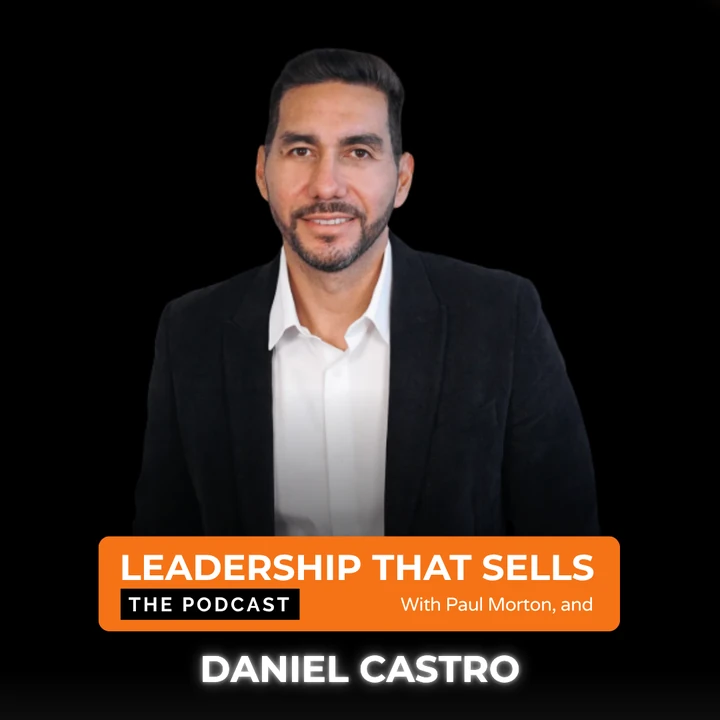
Show notes
What if your high performance is actually hiding a crisis? In this episode of Leadership That Sells, I’m joined by transformational coach and multilingual speaker Daniel Castro – a former finance exec turned burnout-buster. Together we explore why high-achievers often find themselves stuck, despite hitting all the targets, and how to begin the journey back to purpose.
We break down Daniel’s CASVI Method – a powerful framework that reconnects success-driven professionals with meaning, energy and clarity. If you’ve ever felt like you’re “doing well but not feeling well,” this one’s for you. We talk identity, self-leadership, burnout, energy management, and why true leadership often starts with simply stopping.
This is about transforming the way you lead – by transforming the way you live.
How to shift from burnout to purpose
- Pause – Start by stopping. High achievers rarely pause to question their trajectory. Clarity begins with stillness.
- Clarity – Understand your beliefs, motivations, values and what brought you here. Redefine success on your terms.
- Awareness – Stop drifting. Start noticing. From posture to thoughts, cultivate conscious awareness.
- Sense of purpose – Discover your unique strengths and apply them in service to something bigger than yourself.
- Vitality – Guard your energy. What you eat, consume, think and feel – it all affects your performance.
- Integration – Knowledge without application is useless. Take action. Make it real. Make it daily.
Timeline summary
[02:50] – Why burnout hides behind achievement
[05:54] – “Living slowly is an act of rebellion”
[07:10] – Redefining success: purpose over promotion
[10:12] – “The value isn’t in what I know – it’s in the questions I ask”
[13:54] – Unpacking the C in CASVI: Clarity
[17:35] – Awareness is the antidote to autopilot
[20:07] – Purpose through service: why giving is getting
[24:17] – Serve with no strings attached – the key to resilience in sales
[28:19] – Energy is fuel: protect your vitality
[35:03] – Integration: where transformation actually happens
Links & resources
- Daniel’s website: dannycasvipo.com
- Follow Daniel on Instagram: @dannycasvi
If this episode sparked something for you, please rate, follow and share Leadership That Sells. It helps other managers lead better and live better – starting today.
Transcript
Automated transcript. Speaker labels and spellings may contain errors.
Paul
[upbeat music] He's a transformational coach, multilingual speaker who went from corporate finance and real estate and towards guiding high achievers through deep personal reinvention. He built a career crunching numbers at Ernst & Young. He's led international finance team, and now he helps professionals break through burnout and rediscover purpose through his signature CASV method. He's a black belt in mindset shifts, and he's fluent in both English and Spanish, and brings clarity, energy, and meaning to the way that we work and lead. A very warm welcome to Leadership That Sells. This is a podcast that helps you lead first and then sell more, and that's because most sales teams today are just not really teams. They're what we call teams in parallel.
They're working in a similar way, but just not with each other. And what most sales managers and leaders are still leading like, they're leading like they've got a football team, and when in reality they've got a group of golfers at their best. Now, that mismatch then creates a whole load of pain, poor coaching, bad meetings, burned out managers, and reps who are drifting. So what we built is a lightweight reset to help your managers lead the right way, setting clear expectations, building identity without the fluff, and coaching for autonomy without going hands-off. If that sounds like your world, grab the free Parallel Team Playbook at practicalleadership.academy, the website. It's short, sharp, and made for senior folk with teams of managers just like you. [upbeat music] Daniel Castro, thank you very much indeed for joining me.
Daniel Castro
Thank you, Paul. Thank you for having me. I really appreciate this opportunity to be part of your podcast, and thank you for hosting me.
Paul
Oh, it's an absolute pleasure.
Daniel Castro
Happy to be here.
Paul
Absolute pleasure. Now, you're joining us from the delights of Miami, Florida, in His Majesty's United States of America.
Daniel Castro
Yes, yes.
Paul
Yeah.
Daniel Castro
Here from the heat of Miami. [laughs]
Paul
Oh my goodness. And as you're, you're floating down there, uh, enjoying some air conditioning, while we're here suffering here in, uh, just outside of London in, in crazy, crazy warm weather. We don't get the air con. You know, this is the one thing, right? This is the one thing I love doing when we go back to America. Everything's air conditioned.
Daniel Castro
Yeah.
Paul
Freezes your ass off, but it's, it's, it's, you know, reduces the temperature and lets your brain work.
Daniel Castro
Yes, yes, yes. That's something I, I really-
Paul
Oh
Daniel Castro
... I really love that invention. [laughs]
Paul
[laughs] Um, now you spend a lot of time working with really high achieving professionals, okay? And so you worked in Ernst & Young. You've built teams. You've helped people through reworking who they are, why they are. If I were somebody who was a high achiever and I was stuck doing really well, hitting all the numbers, but I'm just stuck, where do you start with me? What are the questions you ask? What, what do you need to know and where can you take me?
Daniel Castro
Well, I think that one of the characteristics or the main characteristic of, characteristics of high achieving professionals is that they're very results-driven. They work really, really, really hard to achieve all the goals that they have in their lives, and they work so hard that many times what happen is that they achieve all they wanted in their life, but they still feel that something is, is missing. And one of the reasons why is because they haven't had the time to really stop, to really pause, and really understand themselves and think, "Why am I doing what I'm doing? Is this really the correct trajectory that I should keep doing in my life?" And so many times what I have seen in high achieving professionals, and even
with myself, is that I was just living with, in, in emotions. I was just in a automatic, and I didn't have the time to really think about these things. And the first thing that I can help them is to pause and really clear their mind, have that moment of silence, of understanding themselves, of questioning how they get there, what is the next step look like, and align their, their values and what the things that are important in their life to what the next action is going to be. So the first thing is pausing. Pause is one of the most important things that is overlooked because we live in a society that is go, go, go. It's about performance. It's about achievements. It's about the next milestone.
There is pressure from, from our bosses and from the economy to, to deliver, and we don't have that time to s- to pause. And if we don't have that to pause, then we won't be able to make the right decisions or really understand ourselves.
Paul
I've read recently that living slowly is an act of rebellion. Taking your time is an act of rebellion. There's a lovely joke, it's one of the joke stories, and it's the McKinsey consultant or something like that, and he goes down to Guadalajara, and he's talking to an old fisherman, and he says, "Is that your boat there?" He says, "Yes." You know the story, right? Talked to the old fisherman. Says, "Is that your boat?" "Yes." "You could sell the fish, get another boat, and then sell the fish from two boats and get four boats, and sell the fish from four boats and get a fleet, and then you would have a multinational organization, and then you could do, and then you could, then you could..." And he said, "Okay, I, I could do all that, but then what would I do?" "Well, then you would sell everything." "And
then what would I do?" "Well, you come back to Guadalajara and go fishing."
Daniel Castro
[laughs]
Paul
Right. Okay. Right. So it's the pause. It's the living slowly. I think there's a lot of value in not just pausing, but it's pausing for a purpose, right?
Daniel Castro
Mm-hmm.
Paul
I mean, I think you're on the money in just saying simply enough, look, just stop
Daniel Castro
Yeah, just-
Paul
People who just take that mo- minute to just stop, they are way ahead of what? 50%, 80, 90% of the rest of the world?
Daniel Castro
Yes.
Paul
But then if you take this, the moment to stop and do something about, just, just, just reflect, think, ask a question. That's you. That's elite level.
Daniel Castro
Mm-hmm.
Paul
You know? You just stop, wow. But then stop and do something or rather not do something, or ask a question, wow. That's crazy.
Daniel Castro
Mmm. Totally. I mean, one of the things that you mentioned, that story. That, I remember that story because three weeks ago I did a presentation where I was talking about going from, from a results-driven success to a purpose-driven success.
Paul
Okay.
Daniel Castro
Because it, it's a new definition of success that I want to, I want people to really think about. And, uh, many people are focusing on the results, on the achievements. And they focus on, or they think that they're going to be successful when they have the money, the car, the house, the big business, the big promotion. Or like the story that you were telling, when you get all these boats and you sell them, you sell the company, and then you become a multimillionaire. That's when you think that you're gonna be successful. But the reality is that success is not the destination, it's the journey. And everyone has a different definition of success. It's like the fisherman. That fisherman was already living with purpose.
He was already living the ... He was already free from all those expectations and from all the things that society tells us that that's the way that success should be or-
Paul
Mm
Daniel Castro
... that a person should achieve for, it shoot for. And, uh, when you live with, when you find something that is really meaningful in your life, a purpose, a mission, a life project, something that really allows you to serve and help others-
Paul
Mm
Daniel Castro
... that's when you c- you can really think that, that you're living or you're having that journey of success already. You don't have to wait for the results to happen. Right here, right now, you can experience it every single day of your life.
Paul
That's it. That's it. But there's, um ... I had a conversation, and my son, who's 11, he was 10 at the time, was, he was listening to me, and I was talking about wisdom. You know, I was trying to be the, I was trying to be the wise father, right? I've failed miserably. But, you know, I was trying to be the wise guy. Um, and I said, "Well, what I think wisdom is, it's the knowledge that you've picked up," right? The books you've read, the videos you've watched, the, the life you've, the training, all that sort of stuff. And then the experience of putting that knowledge into practice. Now, most people do that. Most people go on a course, they read something, and they might try it out. So you've got a lot of people. And then many, many fewer people then take that knowledge and they try it out, and they then reflect
on what happened. So you've got lots of people with knowledge, okay? Some fewer people who have actually tried to apply the knowledge. Many fewer people who have actually looked at the results and wondered why. And he said, "No, that's not wisdom. That's just you sitting on the top of a hill, you know, thinking wonderful thoughts. Unless you share it, it stops to become wi- that's when it becomes wisdom." Right? And I can see, if you're, if you're listening in the podcast, you need to ... You're looking, you're listening in black and white, because this is very, very handsome Latin man here. His, his beautiful, you know, salt and pepper hair. Um, and I can see we're probably of a very similar age. And you get to this point in your life and you're realizing that actually the value that I have is not in what I've learned and what I can do, but it's in the
questions that I can ask.
Daniel Castro
Mm-hmm.
Paul
It's the questions that I can ask other people, and it's the responses that you elicit in the other person, right?
Daniel Castro
Mm-hmm.
Paul
And so you as the, the consummate coach, as this, this ... You're, you're really taking your CASV method, and you have to tell us where you get the CASV name from. You're trying to bring clarity to people. You're trying to bring energy into a conversation and find purpose out of somebody's soul. How'd you do that? Where'd you start? Tell us CASV-
Daniel Castro
Okay
Paul
... where'd CASV come from?
Daniel Castro
All right. Uh, the CASV framework. And I was telling you the, before, before we started the, the podcast that CASV basically is, um ... We live in a w- world of duality. Black and white, light and darkness, the ref- left and right. And I have my mother and a father, and they both have their last names. My, my dad's last name is Castro. My mom's name, my mom's last name is Viancha. And f- and then one, and then I realized that all my life I've been between the two families. They have ... They're so different. The Castro family is different than the Viancha family. The Castro family is more about, about really high achieving and being the best in college, very competitive. They're, they don't drink. They, they're more serious in, in certain areas, and they're careful who they associate themselves with.
The Viancha family, they're, they like to party, they like to drink, they're happy all the time. They get together and they make a celebration about anything. They're not that- Uh, high achieving oriented. And so it's-- And I've always been like that. I've been a combination of the two. The best in school, but also the one that loves to dance and, and drink and have a good time, and the one with the scholarships, uh, but also the one who likes to party. [laughs] I was like that for a long time. And the CASV method is a combination of the two things. This CASV stands for Castro and V for Viancha. And it also stands for the framework that, framework that I use in my life for my own personal development and my own journey.
And, uh, even before I start talking about the CASV method, there is one important thing that I want to mention, is that in order for someone to change their life, to transform themselves, they first need to have the desire to change. They first need to have that, that, that wanting of, of commitment and, um, and even assuming responsibility for their own life in order to start changing and being open to new information. Because it's hard for someone who thinks that they know it all in order to be open to new information if, if they think they know all-- they know everything already. And, uh, and that's the first thing for anything. And, uh, the, the C for CASV stands for clarity. And when I speak about clarity, it's not just the clarity about what you want for the future, what is the next step in your career or in your life. It's also clarity about what brought you here, where you are right now.
It's about being clear of who you are and what are those beliefs s- those beliefs that you have in your life. What is that-- What are those stories that you're carrying in your life that are either helping you or stopping you from being the person that you wanna be or achieving the goals that you want? It's about knowing what your values are and, and, and realizing if your values are aligned with the actions that you're taking in your life. It's about knowing what are your motivations, what are those human needs that, that are, uh, that are inspire you to make the decisions in your, in your life as well. If your human need is about, uh, significance rather than love and connection, is-- are you, are you being aware of that and, and, and looking at re- the results and how you feel outside
m- m- might-- that might be affecting everything that you're doing. It's also about having clarity of the different areas of your life and where do you wanna be in, uh, your, in your family, how you want to experience or how satisfied are you with your finances, with your health, with your spirituality, and, uh, with your career, with your purpose. It's about the having that clarity because many people don't ever think about these things.
Paul
No.
Daniel Castro
They only-- They don't think about any of, any of that. And, and something that I realized throughout my years is that everything or life is about self-discovery. Everything is about self-discovery. It's about knowing who we are, understanding more about ourselves. And, uh, and when we understand these things about ourselves, automatically we're going to be understanding more about other people. We're gonna be under- understanding the motivations that other people have. We're gonna become more compassionate because we already-- we know more. We, we know our motivations, we know our values, we know when we're get upset, when we get happy. And when someone gets upset, we might think, "Oh, maybe that person is going through a difficult time because I went through that." So it's more about self-discovery and, and clarity allows you to do that.
The next step in CASV is the A for awareness. And, and when I ta- when I'm, when I'm talking about awareness, I'm talking about paying attention. Every day most people live in automatic.
Paul
Oh, they drift.
Daniel Castro
They wake up-
Paul
They drift. People just drift through life.
Daniel Castro
Yeah, they drift. They us-
Paul
They drift through life.
Daniel Castro
I mean, it-- Exactly. They, they wake up in the morning. They do the same thing every single day. They go to work. They do whatever they have to do in automatic because that's-- I mean, drive the same way to work, eat the same food in the sa- in the same places. And life just passes by because they're using automatic all the time. And when, when you ha- when you're able to generate awareness or start paying attention and connection to everything about you-
Paul
Mm-hmm
Daniel Castro
... your body, your breath, your mind, your thoughts, your tonality, your posture, your emotions, and you start being connected to everything that make you, then now you're more aware of what is happening outside of you as well.
Paul
Yeah.
Daniel Castro
And, and when you have awareness, you can also-- instead of reacting to the world, you can respond to the world. Instead of getting mad about something that happened in your life, that you can actually slow down and, and recognize the emotion knowing that that's not you, and you feel it in your body, and then you step s- you stop, and then you respond.
Paul
The response versus react I think is very big. I'm talking-- I talk to my kids about that quite a bit. And, um, it's hard. You, you get-- You have some, you have some, uh, kids and they're going through hormone changes just because they're becoming teenagers and stuff. And they might yell or do something crazy, and you can just yell back or, you know, lash out or whatever. And for, as a parent, you take two seconds and you step back and you, you pause for a second and you think, "That's not, that's not my son or daughter. That's not them. That's just a chemical response. It's a reaction to the chemicals in their body."
Daniel Castro
Mm-hmm.
Paul
They're actually a lovely kid, lovely young person. So I'm just gonna give them a hug and say, "You know, it's okay. This isn't you. It's all right."
Daniel Castro
Mm-hmm.
Paul
"There's just something else going on here. Let's see if we can help you get through it." And they'll, they'll come through, they'll calm down. Takes a while. It's hard bloody work.
Daniel Castro
[laughs]
Paul
Hard work. And you get through the other end of this, and then you have the conversation that says, "Do you recognize that? Did you recognize that?" And sometimes they say yes. All these flags you've, you've, you felt, all this stuff you felt, uh-huh, that's not you. See when that happens next time? You have a res- You, you can now deal with it because you recognize it. And you deal with adults in the same way, you know? Somebody does ex- somebody does something out of character. You're thinking, "Whoa, man. Hey, whoa. What's going on here? Ah, craziness. Craziness. Is everything all right at home?" Rather than-
Daniel Castro
Mm-hmm
Paul
... slap, right? It's exactly as you said. What is actually the problem here? It's that my mother is really ill and I can't cope with you asking me for an updated time sheet in a different font. Okay. Oh, okay. Now I know. Now I can help you. Right?
Daniel Castro
Mm-hmm.
Paul
So it's a response rather than a reaction. I love that.
Daniel Castro
Yes, yes.
Paul
So important.
Daniel Castro
Yes, totally.
Paul
So important. Right. Okay, so we've got CAS. We're on to the S.
Daniel Castro
The S. The S stands for sense of purpose.
Paul
Okay. Right.
Daniel Castro
Mm-hmm.
Paul
Purpose is hard.
Daniel Castro
Yeah, s-
Paul
Purpose is really hard
Daniel Castro
... s- yeah, sense of purpose. Like, it's why you do what you do.
Paul
Mm-hmm.
Daniel Castro
It's finding your why, finding that thing that moves you, finding your passion or putting your passion into action. Finding that thing that make you unique. Those abilities, those gifts that you only, you're the only one who has them.
Paul
Mm-hmm.
Daniel Castro
Everyone in the world has a unique gift, something that n- you, that they do better than other people. And many times we, we have a hard time finding it because we think it's something extravagant.
Paul
Mm.
Daniel Castro
It's something, i- it has to be something like being a, a soccer player, like the best of them, like Messi.
Paul
Ronaldo.
Daniel Castro
That's the... You know, Ronaldo. We start comparing ourself with, like, all these famous figures that we need to have a gift like that or a talent like that. But at the end of the day, it's something like being able to listen, for example. Like, if someone is able to listen, that's a talent. Not, not a lot of people are able to listen.
Paul
Sorry, what did you say?
Daniel Castro
Exactly. [laughs] To listen, to organize, to organized, to be, to, um, maybe to take complex information and-
Paul
Simplify
Daniel Castro
... make it a simplify it.
Paul
Mm.
Daniel Castro
Any, many talents.
Paul
Mm-hmm.
Daniel Castro
And, uh, and when you f- are able to find this and being aware of it, then you think about a big problem that happens in the world.
Paul
Mm-hmm.
Daniel Castro
Something that is happening that, that I'm really connected with, and how I can use my gifts and talents and, and all, all my experience in order to help this problem, to solve this problem.
Paul
Mm-hmm.
Daniel Castro
And, and you can f- And then it becomes instead of, like, instead of what you were, your, your son was saying, instead of getting all this knowledge and all of these gifts that God gave us, that the universe gave us, for ourselves, now we start expanding and, and helping the world, helping, helping other people as well.
Paul
Mm-hmm.
Daniel Castro
And that's where purpose comes from is y- is by serving, you know, by, by selfless service. And that's, that's something that we, we practice in, in yoga and, and-
Paul
Mm
Daniel Castro
... scriptures and, uh, ancient philosophy-
Paul
Yeah, yeah. No, no
Daniel Castro
... is, is self- selfless service.
Paul
The, the heart of everything I try to do, and I fail... I, I call myself an imperfect follower of Christ, right? The heart of everything I try to do is to, to, is to be a servant leader. Service, but lead.
Daniel Castro
Mm-hmm.
Paul
Because people want leaders. People are desperate for leaders. But most people when they say leadership, they think of some bad teacher. That's really what their picture in their head is, is a bad teacher-
Daniel Castro
Mm-hmm
Paul
... who's yelling at them and telling them what to do.
Daniel Castro
Mm-hmm.
Paul
But the s- the idea of service in that my job is to make you successful, and I will move heaven and earth to make you successful, and help you to turn yourself into the best version of yourself that is possible, that I can do. And it's a really selfish thing to do, I think. Selfless and selfish because when you serve, you get so much back. You get more back than you give.
Daniel Castro
Mm-hmm.
Paul
Only, however, if you serve without expecting anything back.
Daniel Castro
Mm-hmm.
Paul
Right? So it's a complicated idea. You've got to serve. If you're feeling bad, if you're listening and you're feeling a bit of shit today, get outside and go do something for someone else, right? Go help somebody carry their bags. Go and, go and do something for someone else. Go serve. But serve for the purpose of serving. Don't serve because you think you'll get something back. But if you serve for the purpose of serving, I promise you you're gonna get something back And you'll get 10 times back what you get, what you d- what you delivered. I love that. Service, the purpose of service. Yeah. Okay. All right.
Daniel Castro
Yeah. Selfless, selfless service. In yoga we call it karma. Karma yoga.
Paul
Karma. There we go. Mm-hmm.
Daniel Castro
Karma yoga. And, uh, and when you're able... Yeah, you- what you were saying, when you're able to, to do this, you are... It has so many benefits from doing that-
Paul
Mm-hmm
Daniel Castro
... because it just opens your heart and you connect with other people. You have empathy for other people. You are serving based on of... With love-
Paul
Yeah
Daniel Castro
... because you're, you- because you are- you're not expecting anything in return. And you don't suffer dissatisfaction, because most of the suffering in the world is because we're expecting something back.
Paul
Mm.
Daniel Castro
We, we are ex- we're so attached to the results of our labor or the things that we do, that when we don't get them right away or when we want it, then we get... We suffer. And I think that your listeners that are in, in the sales, um, industry, many times they might do a lot of work in order to have those sales-
Paul
Mm-hmm
Daniel Castro
... done, but they don't get the results right away. And many of them might feel frustrated or maybe thinking about quitting or changing industries or doing something else because they are not getting the results that they want. And when you're able to... And I know people have to sell because they have to eat, they have to-
Paul
[laughs] Yeah. No sell, no eats
Daniel Castro
... they have needs. They have to make money, right?
Paul
[laughs]
Daniel Castro
They have to make money. But it's not about that. It's more about being detached from the results-
Paul
Yeah
Daniel Castro
... being detached from the outcome. That is going to stop-
Paul
Yeah
Daniel Castro
... the suffering and, and, and the, uh, dissatisfaction from doing what you're doing. And it's going to allow you to continue doing the thing that you're doing because now you're not de- uh, uh, attached to, to that, to that outcome.
Paul
And it's... I think you're then, you're touching on the, what you said at the beginning, which is it's, it's all about the journey. We're all on this journey, okay? It's all on this, this, the, the day-to-day. And the minute you start thinking about the, the outcome that you're trying to get to, the goal you're trying to get to, you're immediately a failure, right? Let's say I wanna lose 20 pounds, okay?
Daniel Castro
Sure.
Paul
I've eaten too much cake. I wanna lose 20 pounds, and I'm gonna start and I'm gonna lose 20 pounds. Well, guess what? I haven't lost 20 pounds, so I'm a failure. Oh, hang on. That sucks. But if I just decide to eat healthily and to exercise more and have a plan for this, so every day I eat properly, and every day I go to the gym, and every day and every day and every day, guess what happens? I don't lose 20 pounds, I lose 40 pounds.
Daniel Castro
Mm-hmm.
Paul
In which case my leg falls off, you know? But that, that's the, that's the journey. And it's the view-
Daniel Castro
Yeah
Paul
... of life that the, the life is about the journey, not the destination. Because the destination is ultimately the end, and you don't wanna get there too fast.
Daniel Castro
[laughs] Yeah. You get there when you are supposed to get there, get there. It's not when you wanna get there.
Paul
Yeah.
Daniel Castro
It's when you're supposed to get there. If you get there too soon, sometimes they send you back. [laughs]
Paul
[laughs] Return to sender.
Daniel Castro
I mean-
Paul
Address unknown.
Daniel Castro
Yeah. I mean, I mean, you have seen people who, uh, win the lottery, for example.
Paul
Yeah.
Daniel Castro
They become millionaires, and they w- it was easy for them, and then they lose everything after-
Paul
Mm
Daniel Castro
... six months 'cause they weren't supposed to. They didn't have the mindset, and they weren't supposed to have all that abundance-
Paul
They didn't learn
Daniel Castro
... at that time.
Paul
Learn.
Daniel Castro
They needed to learn. Yeah. They needed to learn to lose it in order to perhaps gain it back, or-
Paul
Mm
Daniel Castro
... there were lessons behind that.
Paul
Mm-hmm.
Daniel Castro
And, um-
Paul
So selfless service, and then we're onto the-
Daniel Castro
Then, uh, Kaz, V.
Paul
V.
Daniel Castro
The V stands for vitality.
Paul
Mm. Okay.
Daniel Castro
Vitality. And I relate it to energy.
Paul
Mm-hmm.
Daniel Castro
Because it's important for everyone to really understand where ener- energy comes from and how to manage the, our energy. Because it doesn't matter if you have all these goals and all these dreams and the things that you want to accomplish in your life if you don't have the energy to do it. If you're tired every single day, you know, if you don't feel like waking up in the morning, if you're getting sick. You know what? There are so many people who, who make so much money in order to spend it in their... Because getting better because they got sick.
Paul
Mm.
Daniel Castro
You know?
Paul
Yeah.
Daniel Castro
So at the end of the day is where does energy come from? It comes from whatever we put in our mouth, uh, through our eyes, through our ears, through our senses. So what we eat becomes ourselves.
Paul
Yeah.
Daniel Castro
We have to be careful with what we eat. We have to be careful and watch, be aware of what we watch. Like, many people are watching the news all the time, and the news are very negative and-
Paul
Bad for your health
Daniel Castro
... bad for your energy and for your health-
Paul
Mm
Daniel Castro
... because you're gonna be in a bad mood if you're not able to channel that, that ba- that, that thing that is happening, that you're watching.
Paul
Totally.
Daniel Castro
Or even music, you know? So many people listen to music that has a, a... If we think about energy-
Paul
Negative
Daniel Castro
... as vibrational frequency-
Paul
Yeah, yeah. Okay
Daniel Castro
... it's negative.
Paul
Yeah.
Daniel Castro
You know? So it's, it's about that. It's about working out, about moving your body.
Paul
Yeah.
Daniel Castro
About, uh, taking a break and sleeping correctly, properly, about breathing. How many people don't even know they're breathing?
Paul
[laughs]
Daniel Castro
Like, I mean, we take breath- breathing for granted, right?
Paul
[sighs]
Daniel Castro
There you go. [laughs]
Paul
And I feel better already.
Daniel Castro
And exactly. And, and being aware of your breath, being aware of what you eat, what you... The re- um, about resting, about what you put in your mind, about meditation, so you can- Be- create more room for, for happy, for happy thoughts and positive thoughts. That's where your energy is going to help you achieve the goals that you want. And if you go even further about energy, where everyone... Everything has energy, and we as humans, we have an elect- electro- electromagnetic field.
Paul
Mm-hmm.
Daniel Castro
What we think and what we feel is what basically our-- what creates our reality. And then if we are thinking and sending these wants to the universe and the-- or, or the things that-- the goals that we want, then our feelings are going to attract those things in our lives.
Paul
Mm-hmm.
Daniel Castro
And, and the energy that we carry based on our emotions are the ones that is g- are going to help us achieve those goals that we, that we really want. 'Cause m- here's the thing. Many people focus on the strategy. Many f- people focus on, on how, how to do the thing. What strategy I can use in order to sell more, in order to do more, in order to, uh, take less time, uh, achieving the goal that I want? But the thing is that if the strategy was the key, everyone will achieve their goals. Because you can just follow any strategy that someone did and then achieve the same goals that this, this person does. But a strategy is not everything. It comes from what is within ourselves. 'Cause at the end of the day, the, uh, the outer world is a reflection of our inner world.
And the way that we feel, the way that we think, uh, the stories that we have in our minds, the emotional state that we have every single day or that we carry every day, those are the things that are going to make the strategy work. And, and I can see that in a lot of people. And I mean, I mean, that happened to me.
Paul
Mm-hmm.
Daniel Castro
I was... Uh, I, I've been trying to... Or once I, I tried to, um, to be in this, uh, network marketing business, and I, and I followed the strategy that everybody was doing. But my mindset and my stories and the, and the beliefs about I don't think I can do it, that's too hard, I'm not enough, or that is too hard to do. Like, all of these negative things that I thought about myself, I, I didn't make a single sale, so [laughs]
Paul
Yeah. Well, the, the person that listens to us most is us, right? We listen to ourselves more than anyone else does. Much more. Yeah.
Daniel Castro
So imagine that.
Paul
Yeah.
Daniel Castro
Imagine that, like, if we're-- if we have that inner dialogue in our mind and that inner dialogue is, is negative.
Paul
Yeah.
Daniel Castro
You know? Like, people-
Paul
Mm-hmm
Daniel Castro
... can tell you. I r- I remember, I remember when I was in my 20s, uh, I, I moved to the US by myself, and I, I was having a hard time because I left all my family and moved to, to the US, you know, as an immigrant. And, um, and I started myself-- I started surrounding myself with, with people that didn't-- they weren't goal-oriented. They were just, we were just working in restaurants, drinking, and, and just having fun. And, uh, and I start... And then the conversations that happened at the time were very negative. They were very-- they were immigrants who didn't even think about staying in the US. They just wanted to make money and then going back to Mexico. And, uh, and I just started becoming like them. Until one day, one of, uh... A mentor came in and... Or I met this person from Colombia that was a professional guy, and he had a lot of experience in mentoring people.
And, and he... started to believe in myself. And he would tell me, like, "I believe in you. I think that, that you have a lot of potential." But I didn't believe it. You know, sometimes it doesn't matter if someone believe in you. It's-- It helps, but our inner dialogue is, is not, uh, is not helping.
Paul
Can be destructive.
Daniel Castro
So we have to-
Paul
Can be destructive.
Daniel Castro
It's, it could be destructive. We have to look into that. Yes, for sure.
Paul
All right. We need to, we need to wrap, so let's have the I. What's the last one?
Daniel Castro
Integration. There is integration.
Paul
Go on, then.
Daniel Castro
We have to integrate everything that-- new thing that we learn, all the knowledge, all the experiences. We have to put it in practice. There is-- If-- It doesn't matter if we have the knowledge, it doesn't matter how many books we read, how many conferences we go to. It doesn't matter if we don't integrate those things in our lives every single day. And that to have an action plan and knowing exactly what we need to do. Because through the integration, we become the new version of ourselves, and that's what the I stands for. Integrate and taking action.
Paul
It's, uh... I think information is always seen as the problem. Oh, I don't know how to do that. Well, you know what? YouTube. Hello? Google? Right? If, if information-
Daniel Castro
Or GPT
Paul
... was the problem. Well, exactly. Yeah, yeah. We'd all be millionaires with six-pack abs, right? 'Cause-
Daniel Castro
Yeah
Paul
... it's all out there, but nobody does that. So you integrate with the last piece. All right. You know what? I love CASBEE. I love it. It reflects very much how I think. If you are listening and you want to find Daniel and his CASBEE method, where can we find you?
Daniel Castro
Dani Casbee in all platforms. Dan- Dani Casbee, Instagram, Facebook, LinkedIn.
Paul
His Instagram's brilliant, by the way. You gotta go and see his Instagram. It's really, really good. I'll put links to all this stuff in the, in the, in the show notes below, so you'll see all of that stuff there. So-
Daniel Castro
Yeah. I, and the last one. I, uh, I just updated my... I had everything in Spanish, and then I just updated my website in English, and it's under danicasbee.podia.com. DannyKasvy@podia.com
Paul
Podia
Daniel Castro
And I, in, yeah, and in that, it's in English and it explains the Kasvy Method. It explains the type of people that work with me and what I do, and, and it's very, very, very complete.
Paul
Good. If you had one message that you could share with the whole world, big billboards all around the world, what's the one message you would write on the billboard for the world to see?
Daniel Castro
I think would be to really go within. Instead of, instead of just trying to move forward all the time, go within. Really understand themselves, really connect with their heart, connect with their mind, with their body, with, with their, with their true self. Because I feel that there is a lot of disconnection right now in the world. And, uh, with technology, most, most people are even disconnecting more f- from themselves, and we're losing our humanity. We're losing, we're losing that contact that we have with each other, but it's because we are losing the contact with who we really are. And, uh, if someone, if... And my message is that, is just think about going within. Do the healing work. Know yourself more, and that is just gonna help you to become a be- the better version of yourself and make this world a better place.
Paul
Go within, connect with yourself. I love it.
Daniel Castro
Mm-hmm.
Paul
Daniel Castro, Danny Kasvy, thank you so much indeed for joining us.
Daniel Castro
Thank you, Paul. I really appreciate it. Thank you for hosting, and, uh, for holding the space, and I hope I can see you again. [outro music]