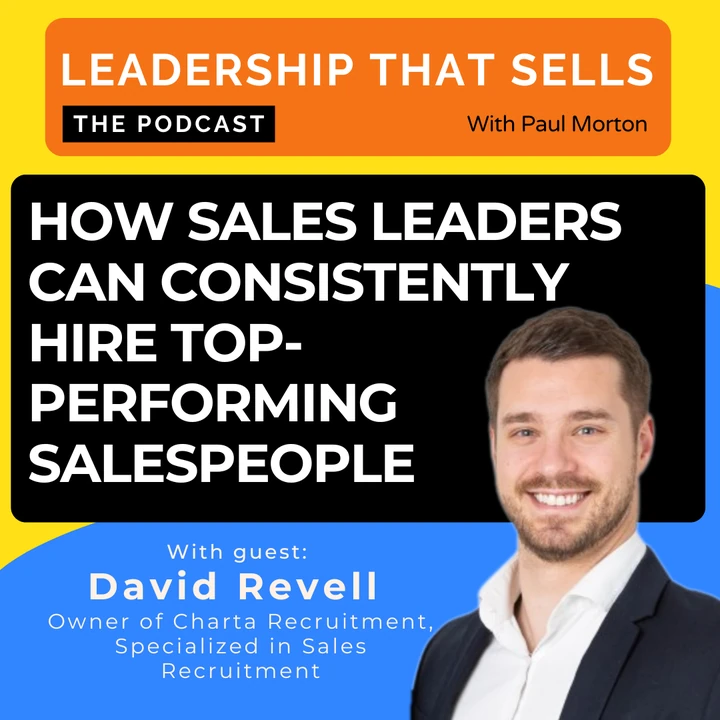
How Sales Leaders Can Consistently Hire Top-Performing Sales people
with David Revell
Show notes
Most sales leaders treat recruitment like an admin task. Big mistake. In this episode, I’m joined by David Revell, a specialist in finding, attracting and hiring top-tier sales talent in the cleaning and hygiene industry, to unpack why hiring is selling and why your job adverts probably stink.
David shares how most companies only ever reach the weakest 5–10% of the talent pool, why the best salespeople will never touch your generic HR-written advert, and how a simple shift to a marketing mindset can triple your response from the right candidates. He reveals the formula that took his ad conversion rate from 10% to 65% overnight, attracting top performers who weren’t even looking.
Forget tired job descriptions that read like professional ransom notes. This episode shows you exactly how to hook high-calibre salespeople, speak to their emotional triggers, and stand out from 10,000 other postings.
How to write sales job adverts that get results
-
Stop talking about your company — make the advert all about what the candidate wants.
-
Understand the difference between a job advert (front of the cereal box) and a job description (the boring back).
-
Hook both the emotional brain (lifestyle, freedom, control) and the logical brain (evidence, proof you can deliver).
-
Focus 90% of your copy on benefits the candidate will gain, 10% on your company.
-
Use benefits that filter for the right cultural fit (e.g. office buzz vs remote freedom).
Timeline summary
[02:19] – The biggest hiring mistake: treating recruitment as an admin task.
[05:26] – Why most adverts only reach the weakest part of the talent pool.
[08:13] – The tiny window when top passive candidates start looking.
[10:44] – How David’s formula boosted ad success from 10% to 65% overnight.
[15:04] – No one cares about your company — make it about them.
[17:20] – Writing to emotional and logical drivers to hook the right people.
[19:42] – Benefits as a bat signal for cultural fit.
[28:01] – Case study: rewriting one ad landed a £25m-per-year sales leader on a pay cut.
Links & resources
-
David Revell on LinkedIn: https://www.linkedin.com/in/david-revell-8b0929b6/
-
Charta Recruitment: https://www.chartarecruitment.com/
If you enjoyed this episode, please rate, follow, share and review Leadership that Sells — it helps more sales leaders find the tools to lead first and sell more.
Transcript
Automated transcript. Speaker labels and spellings may contain errors.
Paul
[upbeat music] He's a specialist in finding, attracting, and hiring top-tier sales talent in a very specific industry. With years of experience in recruitment strategy, he's helped companies build high-performing sales teams by ensuring they bring in the right people from the very start. Hiring is selling is hiring is life. He's a trusted advisor to sales leaders. He knows exactly what separates average hires from top performers, and how managers can win that game of talent. Welcome to Leadership That Sells. This is the podcast that helps you lead first and sell more. Great sales teams need great leaders, but too often sellers become managers without the right training and support, and that's why we built the Leadership That Sells playbook course, to share just what leaders need to know more.
Two 30-minute live expert-led sessions a week over nine weeks with coaching clinics wrapped in on top. Check it out at the Practical Leadership Academy. [upbeat music] David Revell, thank you very much indeed for joining me.
David Revell
Great to be here, Paul. Thank you for giving me your time. Uh, I think I've got some really interesting, unique things that maybe sales leaders haven't heard about before here which could really change their business and their team, so really glad to be here. Thank you.
Paul
It's... I was looking at some of the work you've been doing, and it's outstanding. It's absolutely outstanding what you've done, and it's so bloody simple. It just is so annoying. You are an annoying, annoying person because you're right and you're good at it. Okay? Um, and I hardly know you, so there's me coming straight out.
David Revell
[laughs]
Paul
Y- you've taken the idea that sales is everything, as we know, because sales is life, and if you haven't worked that out and you're listening to this, you're in the wrong podcast. And if you've sussed that out, you've sussed out that most human interactions is a form of persuasion, negotiation, influence, marketing, sales, something like that, and in particular recruitment. Whether or not actually you're looking for a job yourself, which is a selling process-
David Revell
Mm-hmm
Paul
... or you're looking for somebody to join your team, which is a selling... actually it's more of a marketing and then a selling process. Okay?
David Revell
Mm-hmm.
Paul
What, in your opinion, is the biggest mistake that leaders, sales managers types make when they're hiring salespeople?
David Revell
Simply that they treat the hiring process like an admin task when they should treat it like a sales and marketing task.
Paul
With bells on.
David Revell
That's it. Um, it's just a, it's just a shift in mindset. That's all it is. The problem that happens is, is that s- sales leaders, business owners, whoever they might be, they know how to sell and they know how marketing works. Those basics that we talk about there, what we're doing, for the most part we're trying to hack into somebody's amygdala, emotional response, and their prefrontal cortex, logical side of things. That's all we're doing. We know to do that with customers. You know, we know that's what we do. And the first rule when you speak out to, you know, when you call a customer is who, who do you not talk about?
Paul
Me.
David Revell
It's one person. Me. Why?
Paul
Nobody cares.
David Revell
[laughs] Right.
Paul
[laughs]
David Revell
So what do you think that companies do when they go to market with a sales role? Who do they talk about?
Paul
Work for Big Corp. We are fantastic. Big Corp does following 15 things. At Big Corp you can find...
David Revell
We were established in 1989.
Paul
[snores]
David Revell
Nobody cares whatsoever.
Paul
It's like the slide deck you see where the first five slides are, "Our founder went to this school, and when he was a little boy liked cheese and toast. And then when he was..." My God, please save us.
David Revell
They sit there. Now, the... imagine if you did that same type of process with your customers, what would happen?
Paul
They'd all leave or you wouldn't get any.
David Revell
Exactly. Your customers are human. When we're recruiting for a sales role, we're recruiting to a human. And by the way, I would argue that it's one of the hardest sales out there 'cause you're not just selling a product, you're selling someone's entire life change. One of the hardest things to do in life.
Paul
Mm.
David Revell
So it has a huge consequence behind it. But what they do is they don't approach it in that way. They approach it like an admin task, and often that's not necessarily the sales leader's fault. Um, they outsource it.
Paul
Mm.
David Revell
They outsource it to people who they think know what they're doing. Who o- who do they outsource it to? HR team.
Paul
No.
David Revell
Okay. So-
Paul
Oh
David Revell
... would you trust HR to write your copy?
Paul
No.
David Revell
What would it look like if you got HR to write your copy? [laughs]
Paul
It'd be a little dry.
David Revell
Right. So, and what is a company's most important asset?
Paul
Its people.
David Revell
Right. So you're trusting HR to attract your company's most important asset.
Paul
[laughs] Oh, I know where you're going.
David Revell
Right?
Paul
Keep going, yeah.
David Revell
It's madness, right?
Paul
Yeah.
David Revell
When you think, when you actually break it down, you're like, "This is crazy."
Paul
Oh, no, no, it's worse than madness. It's worse than madness. The definition of insanity is doing the same thing that didn't work again and again and again, and that is what they're doing.
David Revell
Totally. And it's, and it's not just HR, by the way, 'cause, uh, uh, you know, it might sound like I bash HR people a little bit here. It's not their fault. They're not trained sales or marketing people. They're trained in HR admin tasks. Their skill set is elsewhere. But if they're not giving it to HR people, they're also giving it to recruiters. And I can tell you, because I was trained by one of the biggest recruitment firms in the world that sets the standard for training recruiters, they don't teach you how to sell or market anything either. They teach you it like an admin task as well.
Paul
Yeah.
David Revell
So they're outsourcing it to one of those two types of people, and this is why, and you'll hear the same things, I hear the same things all the time. You'll see it on LinkedIn or wherever all the time. "I put a sales job up. I get irrelevant applicants, job-hopping applicants, people who've got no tenure, people who've not come from my industry, people who are just bad quality salespeople."
Paul
Mm.
David Revell
I hear that time and time and time and time again, and then you look at what they're putting out there to attract salespeople and you're like-
Paul
That's why You get the applicants you ask for
David Revell
Exactly. Big part of the problem with this is, I think it's useful for people listening to understand how the talent pool works, because no one really knows how the talent pool works. You've got your entire talent pool. Let's take where you're based in Hampshire, Paul, right? So you've got your talent pool. You've got your salespeople in a 30-mile radius of Fleet, right? So your talent pool's made up of generally two types of people, passive people, people who aren't looking, and active people, people who are looking. Now, passive people will become active and active people will become passive, so it's changing all the time. But generally speaking, what percentage of people do you think are active in the market, if you could put a percentage on it? What do you reckon?
Paul
Uh, I'm gonna go 10%.
David Revell
Correct. Between 5 and 10%. It's the same with customers, right? Ac- customers who are actively looking to work with you and those who aren't.
Paul
Yeah.
David Revell
So 10%, 5 to 10% of the talent pool is active. That means they're on job boards looking at roles every day. The problem with that talent pool is, and it's what you find from people getting the postings, is a lot of those people are not good quality people. If you can afford to sit around in your pants and apply to 1,000 roles all day, the chances are-
Paul
[laughs] I just get this vision in my head of just somebody doing... Sorry, keep going
David Revell
... I mean, it is that exact person
Paul
In my pants.
David Revell
Now, that's a little bit unfair 'cause occasionally someone who's really good will be made redundant or whatever it might be.
Paul
Of course.
David Revell
Now, but they are the minority in the active group. So the majority of the active group isn't great. The passive group, we spoke quickly about good quality salespeople before, what makes a good quality salesperson. Well, in my book, the good quality salespeople are the ones out there smashing it today, hitting targets, making money, they're happy, they're solving customer problems. They are doing it now. They're doing the job now and they're successful.
Paul
Yes.
David Revell
Those people, if they're doing that, guess where they are not hanging out? On job boards.
Paul
Yeah.
David Revell
Right? They're not there. So what happens is, is that you get a whole ton of applicants who are irrelevant and rubbish basically, and that's what everybody finds. That's why they need to hire people like me because we can get access to the passive pool because we can be more proactive. I like to think of recruitment the same way you think of sales. You've got inbound and outbound.
Paul
Mm-hmm.
David Revell
Your inbound lead gen is your adv- advert and your outbound is your headhunting. It's the same type of, uh, process.
Paul
Account-based marketing. Who are you gonna-
David Revell
Ex- exactly. Exactly. You can tell I recruit salespeople, right? So but occasionally what happens is one of those passive guys who's really good will have a bad day, or ladies, will have a bad day. Maybe their bonus wasn't as much as they wanted. Maybe they got a new manager, whatever it might be. They will become active for a period of time. Now, that can be 10 minutes, that could be an hour, it could be a day, but that is the moment in time if you're hiring a salesperson where you need to be able to get their attention, attract their attention, hook it, convert that attention, and deliver an ir- what I call irresistible offer to that person to make them want to apply. Now, that sounds very simple, [laughs] super simple. The challenge is, and I've got some data here, just in your area, Fleet, 30-mile radius, how many sales roles do you think were advertised in the last 30 days in a 30-mile radius of where you are based?
Paul
Um, 30 miles includes the edges of London as well, so I wouldn't go there. But I, I don't know. Uh, 'cause it's... 10,000?
David Revell
Exact- you're on it. I wish I could high-five you through here-
Paul
Ah
David Revell
... 'cause you keep getting all the data spot on.
Paul
Oh.
David Revell
10,000 a month.
Paul
Wow.
David Revell
So I'm that passive guy. I've just had a bad day. Do you know what? I'm just gonna have a look what's out there. I go onto the job boards and I see 10,000 horrendously written adverts, which are all talking about, "We were established in 19..." What is... What are the chances that I'm firstly gonna be attracted to read it, fully read it, and actually apply to it if I'm good? The chances are very, very low, really. So what I try to help sales leaders with is just put your sales hat on and your marketing hat on when you're doing this process. That's all we're doing. We're just making it attractive for somebody to apply to. Now, just to give you a couple of stats from what, how this affected my business. I, I started my own recruitment company five years ago. I like to say I'm a marketer who happens to place people in jobs, so I'm more of a marketing guy really.
Um, but my adverts were really struggling. With our business, our adverts were struggling. And if you look at all data on adverts out there, they've got to... It's basically the same graph as cold email outreach.
Paul
Mm-hmm.
David Revell
It's just gone to the floor. Many reasons, different reasons for that. At the moment, globally, they, they convert at about 10%. So only about 10% of job adverts that a sales team will, will put out there will actually convert in a person joining the company. Now, that's down from 50% 10 years ago. So it's going through the floor. That's what we were experiencing, and I was already pretty good at writing them. So we were getting to about 8%, and I was like, "Geez, is it even worth us doing adverts anymore?" Like, they're expensive, and most recruiters don't even bother with them now. They just focus on headhunting instead.
Paul
Mm-hmm.
David Revell
So I looked at it and I was like, "Do you know what? No, I believe we can make them better." Started reading this book. It's called This Book Will Help You Write Better.
Paul
Ha ha.
David Revell
Really short book, and it really sort of gave me a bit of an epiphany of the words that you write shockingly really matter. [laughs] Who would've thought that? You know, we know that when you're texting your missus and we know that when you're texting your mates or reaching out to customers, but we don't think about it when it's, when we're, we're reaching out to potential c- um, uh, job seekers. So we... I spent about two years sort of developing a formula with a bit of help from different copywriters as to how can we formulate this job advert? Like, what is a foolproof formula that works and converts? So we spent a while on it. We launched it, and overnight our adverts went from 10% to 65% success rate.
Paul
Wow.
David Revell
Overnight. And we were getting between three and five times more relevant applicants, plus almost 50% more applicants in total, although that's not the metric you wanna focus on. It's the relevant applicants-
Paul
Mm-hmm
David Revell
... that you wanna focus on.
Paul
It's your ICP.
David Revell
It's your ICP, exactly. Your ICP is coming towards you.
Paul
Mm-hmm.
David Revell
So overnight we saw this massive jump, and I thought, "Holy moly," like I wasn't expecting it to be that much. I thought maybe 5%, 10%, but this was huge. And I had a bit of a light bulb moment. I was like, "All we're doing is writing slightly better." You don't have to be a copywriting genius. And we are essentially placing 50% more people from adverts. If companies did this, they could save potentially 50% plus of their recruitment spend. Everyone hates using me [laughs] really. We're very expensive.
Paul
You're very expensive, yeah.
David Revell
Very expensive. If you can reduce that, that's gonna help. But more importantly, we were getting better quality people apply than ever before. We were getting those passive people who we could u- only usually get from a- from headhunting-
Paul
Uh-huh
David Revell
... were now coming to us from our adverts as well. So it was simply just by introducing this formula, which I can sort of run through quickly for you if you like, which is very simple and just sort of makes sense, but it was getting more people to apply.
Paul
I mean, you look out there and there are any, any, any number of, uh, top flight, super-duper, extra, new hack trick ways of writing sequences and emails and adverts and all this sort of stuff.
David Revell
Mm.
Paul
But your point right at the beginning was we've treated this as an admin task-
David Revell
Mm
Paul
... not as a sales and marketing function.
David Revell
Mm.
Paul
That's, that is just ... That really hits home.
David Revell
Yes. That's the cause of the problem. Yeah.
Paul
And having seen some of the stuff, I mean, you sent a couple of examples. I, I wonder if we can share them with the, the-
David Revell
Absolutely
Paul
... viewers perhaps.
David Revell
Absolutely, yeah.
Paul
The description here. A couple of examples of an old ad, which was obviously painfully whacked through GPT in the olden days before anybody knew how to use it.
David Revell
And that's the standard, by the way, Paul. That's the-
Paul
Yeah
David Revell
... you go out there, that's what you'll see. Yeah.
Paul
It sucks. I got bored halfway through and I realized it was using all the artifacts of the GPT, the sort of, you know, the, the em dash and the-
David Revell
Mm
Paul
... the capitalization-
David Revell
The emoji
Paul
... and all these things. It says ... This is, this is ... It's not even well done. I mean, I use it all the time. I use all the different AI tools all the time, but you use them as a tool.
David Revell
Mm-hmm.
Paul
You don't use them as the output without even thinking about it.
David Revell
No.
Paul
And then you rewrote it, and I think you probably ran it through a trained GPT as well to give some of the structure and the way and the, the sort of the, the elements to that.
David Revell
Mm-hmm.
Paul
But it was human.
David Revell
Mm.
Paul
Then you built a, a very clever little video. You were advertising it, and that packaged together is a fabulous way of doing this. So you, you said there's a simple formula.
David Revell
Mm-hmm.
Paul
What's the how-to here?
David Revell
Step number one, and why no AI will ever help you.
Paul
Mm-hmm.
David Revell
Yes.
Paul
And I like that starting point.
David Revell
[laughs] No one gives a hoot about your company.
Paul
Yep.
David Revell
No one cares. So even if you run it through the best GPT in the world, you're still just talking about yourself, which is what we explained already.
Paul
Mm-hmm.
David Revell
Nobody cares about. So the first thing is get out of your own way. You are marketing to a customer here.
Paul
Mm-hmm.
David Revell
They just happen to be a job seeker. You have to make it about them, what they want in their career. You can talk about yourself later. Once they've applied, you can send them a much larger job description. You can wax lyrical about your company all you like. But that initial attraction bit, it has to be focused on the job seeker, what they want and their desires. So first thing I say is no one gives a hoot about your company. The second thing is we're talking about job adverts, not job descriptions. There's a different thing here.
Paul
Yes.
David Revell
I, I like to think about this like a cereal box. The advert, job advert is at the front of a cereal box. It's flashy. People want to go to it and buy it, right? The back of a cereal box is like a job description. It's just a lot more information about that cereal box. Now imagine how badly that cereal would sell if you turn that round in the aisles and it was the b- It would seriously decline, right? So the advert and the description is something different. People just post job descriptions online. They post too much boring, I call them professional ransom notes, boring information.
Paul
[laughs]
David Revell
Laundry lists. Oh my God, it's so boring. So what you wanna focus on is an advert. What's the pu- purpose of an advert? It's to attract attention, get somebody to buy from you, right?
Paul
It's to sell when you're not there.
David Revell
Yeah. It's literally in the word, right? It's ... We know what an advert is, apart from everyone knows what an advert is until it comes to job adverts and then it's like, "Oh, it's, like, mythical. Like, what do we do?" It's, it's the same process that we do with the customer. So no one cares about you. Job adverts, not job descriptions. The third thing, which is most important here, all we're doing, and what you might have seen from those adverts there, Paul, is why they seem human is because we are talking about the benefits of somebody joining.
Paul
Mm. Mm-hmm.
David Revell
And the way that we talk about those benefits is we're hacking, first of all, into the emotiona- emotional or lifestyle benefit, and then we're backing that up with evidence which solidifies that in their prefrontal cortex as to why this is actually gonna happen. So in that role there, you might have noticed that was specifically we were looking for somebody who wanted to create something from scratch.
Paul
Yep.
David Revell
Someone who wanted to have leave their mark, leave their legacy. They could be the one in control of the situation. They would have control over their life.
Paul
Mm-hmm.
David Revell
Big emotional benefit, especially for people in large corporates where they have no control and they're completely hin- handcuffed with what they can do. So the, the, the, the big emotional lifestyle benefit of someone have control and freedom over how they get to set up their career, and then we back that up with the evidence. Well, the evidence was there's no sales director in this company already and they've never had one, so you're gonna be that guy, and they wanna give you all of that control. So we've hacked into the amygdala and the prefrontal cortex, both in those parts there, just in that one benefit. So all you're doing in this is just you're, you're putting one benefit after another. And what do I mean by benefits? People, when talk about benefits, people are like salary. Okay, that's a hard benefit. Unfortunately, most companies can't compete on salary.
Most companies are paying relatively the same, so you can't really compete on salary. When I'm thinking about other benefits, we're talking about creating something from scratch. We're talking about progression. We're talking about ownership, control, development, freedom.
Paul
Mm-hmm.
David Revell
All of these things that people actually want in their life. Think about where you were in your career at one stage. At one stage, you probably really wanted development. At another stage, you probably really wanted progression. Another stage, you probably really wanted money. So we're making the... Whatever, every role has got these benefits in them, by the way. Every single role. Doesn't matter how boring the company is or how bad the role is, they've got some of these benefits in there. You just have to frame them as benefits-
Paul
Mm-hmm
David Revell
... and list one after another, and that's what's gonna get people interested in it. Just to give you an example of what I mean here for sales specifically, for some people, as you know, traveling every single day to meet customers is not a benefit.
Paul
Mm-hmm.
David Revell
But for some people, it really is.
Paul
Yeah.
David Revell
You've just got to frame it like that. For some people, being in the office five days a week is not a benefit, but for some people, it really is.
Paul
Yeah.
David Revell
You've just got to frame it like that. So if you create your adverts like that, not only do you get better people, you get the right people for the environment you're going into. I call it the bat signal. If you're making the office environment the big selling point and the culture, well, guess what, who's not gonna apply to that? Somebody who wants a remote role. It's gonna be somebody who wants to be in a team. Likewise, if you've got a role, and especially junior sales roles, right? What do junior salespeople want? Development a lot of the time, path to progression, these things. If you fill the advert with development, how they're gonna learn, what unique skills are they gonna learn, how is that gonna affect them later in life, that's gonna get more people who want that development applying to it.
So it's just benefit one after the other. I like to sort of say 90% of it should be focused on the, on the job seeker, and then 10% can be a bit about the company.
Paul
Yeah. Yeah. Beautiful. So you've, you've talked about lots of different sorts of candidates who are out there. You've got the, uh, ones who are not looking, the ones who are looking, the ones who are, who are looking who are good, the ones who are looking who are not so good. How do you then differentiate between a great salesperson and an average one?
David Revell
Mm.
Paul
Because the difference, I think, is not just somebody who's doing 70% of their quota and somebody do, who does 100 or 105.
David Revell
Mm.
Paul
It's somebody who's doing 70% and somebody who's doing 200.
David Revell
Mm.
Paul
That's, that's great. How do you differentiate that? 'Cause I think there's a lot of people, a lot of sales managers out there who really struggle to assess talent beyond just somebody having a great interview.
David Revell
Yeah.
Paul
The silver-tongued salesman, right?
David Revell
Mm-hmm. Yeah.
Paul
Silver-tongued saleswoman.
David Revell
Yeah.
Paul
They're, it's a species. We're really, really good at this. We're really good at talking.
David Revell
Yeah.
Paul
That's what we get hired for. What signs should, should they look for to make sure they're bringing in a true top performer?
David Revell
Can, can I caveat that question just slightly?
Paul
Cool.
David Revell
And how I, how I think about this, because great and good is a subjective thing-
Paul
Right
David Revell
... from person to person. Um, the way I like to think about it is the right hire, because not always... I mean, I had a client last year where they didn't really need an A-star super hitter. They needed a steady Eddie B grade guy who was gonna be in the role-
Paul
There you go
David Revell
... 10 years.
Paul
There you go. Yeah.
David Revell
He was always gonna be seven out of 10. You know, he was Dennis Irwin, seven out of 10 every, every week. He was the right guy for that. Also, if you're looking for great, you know, a problem that you've probably seen, I see it often, is companies want young hot shots, right?
Paul
Mm.
David Revell
That's the, "I want a young hot shot in my business."
Paul
Well, go on.
David Revell
Well-
Paul
Mm
David Revell
... the problem is those people often move on very quickly.
Paul
18 months.
David Revell
18 months, two years, they're looking for the next thing and the next thing. And was that the right hire for you?
Paul
Mm.
David Revell
Mm. So it's about looking at what your situation is and then deciding what is the right type of person for us. And being very honest with what that looks like, and also being very honest with, about what situation they're currently going into. The problem I see with a lot of sales leaders when they hire is they, you read what they're putting out there. Y- I don't think they even know what they're hiring for.
Paul
Mm.
David Revell
Are they looking for a farmer? Are they looking for a hunter? Are they looking for-
Paul
Yeah
David Revell
... what are they looking for? Are they looking for a high, someone in hybrid? They don't make it clear, so what happens is, is you see hunters applying for farming roles and farmers applying for hunting roles, and then-
Paul
Yeah
David Revell
... it gets a little bit all over the place.
Paul
You're looking for a transactional small medium enterprise salesperson for six month, uh, two-day sale cycles, the, the average sales price of two grand to 2.5 million. Uh, what? [laughs]
David Revell
Totally. And so it really, the way I sort of have it is a s- is a scorecard.
Paul
Mm.
David Revell
Um, so when I sit down with a, a p- prospective new client, we spend about two hours with each other because I really need to find out all the good, the bad, and the ugly. And after two hours, you can create a scorecard where you can go, "Okay, a great person for you looks like somebody who's local, they like traveling, they love new business-
Paul
Mm
David Revell
... um, they've worked within your particular industry," et cetera, et cetera. That's the c- type of scorecard that you'd wanna make. And then when I'm speaking to those people, the more of those boxes that you're gonna tick, the better. Now, is it foolproof system? No, because people lie. [laughs]
Paul
Yep.
David Revell
Sales people lie, um, often. And I know that companies don't want the best people as well. This is another thing which is kind of gonna b- when you think about it, it's kind of true and you're like, "Oh yeah, that makes sense." I speak to companies where they're, let's say they're looking for a, a BDM. I'll give them four people from their industry who are average, and then I'll give them one guy who you can tell has done 10 times the new business than the other ones have done, but he's coming from a different industry.
Paul
Mm-hmm.
David Revell
Which one do you think, which one do you think gets kicked out first in that process?
Paul
Different industry every time.
David Revell
Even though he's superior?
Paul
Mm-hmm.
David Revell
Why is that? Because they want the right person, maybe not always necessarily the best person.
Paul
Yeah. It's like this, uh, I mean, I do a lot of stuff with tech, and you've got somebody in a startup who's thinking, "We've got this fabulous candidate. He used to run the sales, the global sales team at IBM." No. He's, he's, he's not the right guy for you, you know?
David Revell
Mm-hmm.
Paul
You've got one guy, a laptop, and a phone, and this person has come from an environment where they've had everything handed-
David Revell
An army behind them
Paul
... and a brand.
David Revell
Yeah, and a brand. Yeah. Yeah. That's a big part of it.
Paul
Mm-hmm.
David Revell
Yeah. You're looking for different things. Like, one of them is new business is a big problem, right?
Paul
Mm-hmm.
David Revell
Like, new business sales hunters is probably 90% of the roles that we do.
Paul
Yeah.
David Revell
There's less of those people around, they're harder to reach, so they're, they're the ones that we get. And when you're looking at that type of person, you're looking for the evidence in role after role of them developing new patches from scratch. And if you want a bit more evidence, have they got testimonials from customers? Have they got, um, feedback from hiring managers that we can get access to? That type of thing. Now, those things are a little bit hard to get, and you do have to take people's word for it a little bit, so there has to be an element of trust. And like I say, we are dealing with people here. But you're looking for the evidence of that person doing your job and your situation time and time again and having success in it.
Paul
Yeah. And there's a, there's a question that I like to use, which is you're going through somebody's CV and y- th- the, the CVs need to have numbers on, by the way.
David Revell
They, yeah, they rarely do as well. [laughs]
Paul
Right? So you're going through somebody's CV and you say, "Just, uh, let's go through this in detail. Walk me through all of these roles, what you did, how and when you did it."
David Revell
Mm-hmm.
Paul
"And just to be clear, I, I'm assuming that when I speak to each of your previous managers, they will validate all-
David Revell
Yep
Paul
... those numbers."
David Revell
Yep, yep.
Paul
Right? "When I speak to these people, they will tell me that you're not doing porkie pies."
David Revell
Hmm. Yep.
Paul
"Well, uh, I mean, I know I said I did five million here. It was more like-
David Revell
[laughs]
Paul
... you know, more like three and a half." "Oh, okay. That's fair enough. I don't mind, 'cause CVs are full of lies, as long as you tell me the truth."
David Revell
Yeah. Yeah, yeah. That's a big problem. Um, I often find a big red flag as soon as a salesperson doesn't know their numbers off the top of their head.
Paul
Yeah.
David Revell
If they have to um and um about it, it's like, mm, you should know that-
Paul
Yeah
David Revell
... immediately. I don't care if you're a farmer, a hunter, or whatever. The only time I give people a little bit of, um, slack on that is that I know a lot of companies don't give that sales information.
Paul
Mm-hmm.
David Revell
They, they just don't have it. Um, but other than that.
Paul
Well, you know, I mean, even then, um, any salesperson worth their salt tracks their own.
David Revell
Yeah. No, I think you're right.
Paul
You know? How, where's, where's your pipe? How does that work?
David Revell
Yeah.
Paul
Although admittedly, I did talk to one chap and they were selling, um, they were selling usage licenses, and they were tracked on number of licenses, not on a monetary amount.
David Revell
Yeah.
Paul
Okay, fine. Company went bust about a year after I spoke to them. [laughs]
David Revell
Yeah.
Paul
But-
David Revell
I worked with a company not long ago where their c- their sales guys are tracked on, uh, 'cause they sell, um, ess- essentially tissue paper, tonnage.
Paul
Wow.
David Revell
[laughs]
Paul
It's a 10 tonner.
David Revell
Yeah. It's tonnage that they work on.
Paul
I love it. I love it. You had a great story, um, with this company. You, you, brought you in, they tried to find the right person.
David Revell
Mm-hmm.
Paul
And they're about 10 million turnover. Can you tell us, w- walk us through that little story, 'cause it's such a great one.
David Revell
Yeah. This is, this illustrates what we're talking about, I think, kind of perfectly, because that company, in my industry, so I recruit in a very specific industry, the cleaning and hygiene industry, um, uh, industry our family's been in for a long time. One company, we reached out to them, 10 million pound company, stagnated for five, six years. They hadn't had any growth. They were a Frankenstein of four different companies that had-
Paul
Mm-hmm
David Revell
... just combined, and they never had a sales leader. They had the, you know, definition of insanity every single year. "How are we gonna get out of this? How are we gonna grow?" And they, they didn't know what to do. Eventually they were like, "Right. We're gonna, we're gonna invest in a sales director. We're gonna get one." I ha- I went and had a meeting with, uh, with the, uh, the business owners, and it was, like, the most depressive meeting [laughs] I've ever had. Like, they were so, they were so depressed and down in the dumps about what they could achieve. They were like, "We'd literally take anybody right now." Like, "We, we..." [laughs] 'Cause they lived, they were in a bad area location-wise, and the company, they, they thought they were super unattractive.
And if, if you looked on paper, you'd look at it and go, "That looks really bad." [laughs] But when I'm speaking with them, I'm nodding my head and I'm getting excited because it's all about the framing again.
Paul
Mm-hmm.
David Revell
Like, to them, they saw this as, "Why would anyone wanna join?" I know a lot of sales leaders, I'm sure you've met these people, they really wanna get their teeth stuck into something and create it.
Paul
Mm-hmm.
David Revell
And they're stuck in big corporate companies where they can't really do too much, and they're very bored.
Paul
They're spreadsheet monkeys.
David Revell
Spreadsheet monkeys.
Paul
That was my last job. I ended up as a spreadsheet monkey, completely demoralized.
David Revell
It's horrible, right?
Paul
Totally.
David Revell
You just wanna... They've got the entrepreneurial spirit-
Paul
Yeah
David Revell
... but they've never been able to direct it into anything in their current business. So I'm looking at this like, "We're gonna do just fine." So there's the biggest company in our industry. They had a head of business development there, probably the biggest sales guy in our industry, did 25 million, 24, 25 million pounds of worth of new business last year, 17 million before that. Big hitter. Managed teams of 24 people. Um, and he, I knew he was pretty sick of where he was at. He was a spreadsheet monkey. He was turning into that, and he, you know, he's, wants to create something. So I went to him with this opportunity. Uh, he applied to it even. And when I spoke with him, he said, "Is this for, is this role for this company?" I was like, "Yeah, how'd you know that?" He goes, "I saw this advert six months ago." I was like, "Oh, that's interesting.
Why didn't you apply to it?" He goes, "It looked boring as hell. It was boring as hell."
Paul
Mm-hmm.
David Revell
"This looks exciting, what you've put in front of me. This speaks to me."
Paul
Same role. Same role.
David Revell
Same role. Nothing's changed. Nothing's changed. And it's, it's, it's not about lying to people-
Paul
No
David Revell
... at all, because in that advert it's, they need help basically is what we're saying. You're the person who's gonna deliver that help. Y- and you're the one who's gonna take this company, double its turnover in the next five years, create all the processes, do everything your way. You're gonna full freedom to do that. That spoke to him, and he was like, "Right. Let's do it." And two weeks later he joined the business, and he took a 20 grand pay cut.
Paul
Oof.
David Revell
And he moved from the top of the country to the mottom- the bottom of the country to do it.
Paul
Wow.
David Revell
They couldn't believe they got someone of that caliber, and, but he's having great success there at the moment. Uh, he's only been in there a, a few months, but they've already, they've already [laughs] almost already doubled their turnover just with him being there that long, 'cause he's got 20 years' worth of knowledge that he can bring to the table. Both parties, it was perfect, and that, that's what I'm saying about the, the bat signal.
Paul
Mm-hmm.
David Revell
That person wanted control, growth-
Paul
Mm-hmm
David Revell
... excitement over his life. You put that in the sky, and that's the type of person that you'll get.
Paul
Amazing. Amazing. Where can people find you if they need you?
David Revell
Yeah, best place to find me is probably LinkedIn.
Paul
Mm-hmm.
David Revell
Um, my name is David Revell. I, uh, Revell is R-E-V-E-L-L. And, uh, my recruitment company's called Charta Recruitment. That's C-H-A-R-T-A. Connect with me. Um, send me your rubbish job adverts if you want. I'll tell you how to fix it.
Paul
[laughs]
David Revell
Um, [laughs] it's not rocket science. It's just a bit of a mindset shift. Just put yourself in the shoes of the candidate who you're trying to hire. That's all we're doing, and you've been in their shoes most likely at some point in your career, so you know how it feels. That's what you gotta do.
Paul
David Revell, thank you very much indeed for joining me.
David Revell
Cheers, Paul. It's been a blast. Thank you. [upbeat music]