Show notes
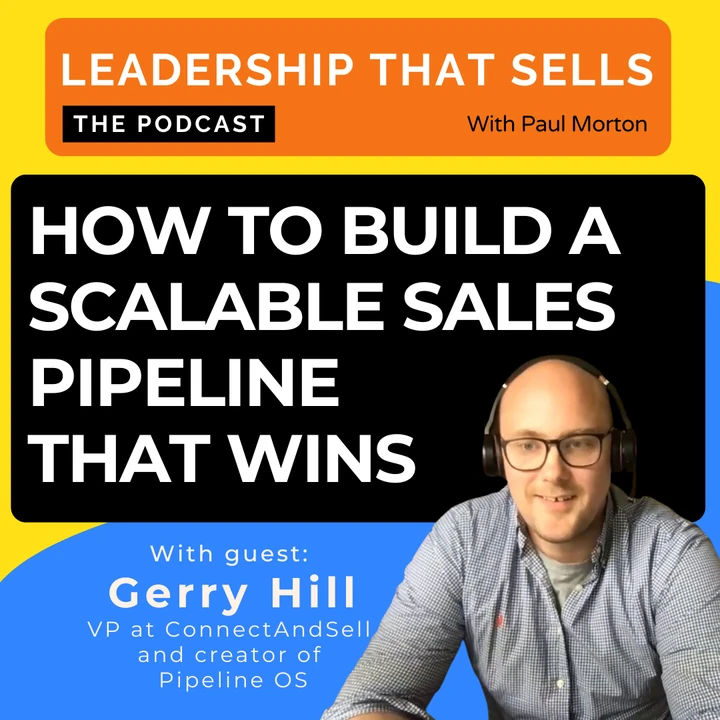
What if the root cause of your outbound problem isn’t the people but the system? In this episode, I’m joined by Gerry Hill, VP at ConnectAndSell and creator of Pipeline OS, to cut through the noise around sales development and give you a blueprint for scalable, effective pipeline generation.
Gerry’s seen firsthand how most sales orgs are wasting time, money, and talent by focusing on the wrong things tech stacks over structure, “charisma” over rigour, meetings over behaviour. We talk about how to fix that. From restructuring SDR workflows to leveraging gamification and agile frameworks, Gerry walks us through how to turn your outbound chaos into a repeatable engine for revenue.
If you’re a sales leader fed up with underperformance and overcomplication, this one’s for you.
How to build pipeline development systems that actually work
Stop romanticising “sales artistry” and focus on the science: disciplined execution, repeatable process, and tight feedback loops.
Use MECE (Mutually Exclusive, Collectively Exhaustive) thinking to segment work, avoid cross-threading, and drive clarity.
Pre-build the outbound week: define lists, scripts, execution windows, and follow-ups—then let reps iterate and learn.
Shift comp plans to reward behaviours, not just outcomes—introduce a points-based gamified system.
Borrow from agile: treat outbound campaigns like sprints, with reps acting as scrum masters.
Create systems where managers manage again—your process should do the heavy lifting on accountability and clarity.
Timeline summary
[01:45] – The biggest problem in sales leadership? Homogeneity and lack of shared mission.
[03:32] – Why curiosity is the #1 trait Gerry hires for—and how it correlates with top performance.
[05:04] – How to measure curiosity in interviews: chaos, not canned questions.
[06:47] – Why complaints are a gift: they signal engagement and highlight blockers.
[10:13] – Reps don’t need coaches—they need missions, systems and heroes’ journeys.
[13:41] – Pipeline is strategy, not grunt work: why most teams are structuring it wrong.
[14:32] – The power of the MECE framework in outbound design.
[17:16] – Making boring-but-important work fun: points-based comp and behaviour-led incentives.
[20:07] – Pipeline development = agile sprint. Here’s how to run it like software engineering.
[22:33] – Don’t have a system? Then your tech stack is a liability, not a lever.
[26:59] – Real servant leadership is not about being nice. It’s about hard-edged, mission-driven service.
Links & resources
- Gerry Hill on LinkedIn: https://www.linkedin.com/in/beaccurate/
- ConnectAndSell: https://connectandsell.com/
- Pipeline OS: https://connectandsell.com/pipeline-hero/
Enjoyed the episode? Do us a favour rate, follow, review, and share Leadership that Sells. Every click helps another sales leader level up.
Transcript
Automated transcript. Speaker labels and spellings may contain errors.
Paul
[upbeat music] A revenue systems expert and pipeline acceleration strategist, our next guest has helped scale sales organizations beyond 10 million pounds, dollars, euros in revenue with precision and efficiency. As VP EMEA at Connect & Sell and the creator of Pipeline OS, he brings deep expertise in turning outbound teams into predictable, scalable growth engines that we all want. He's a regular speaker at CRO Connected and host of the Sales Mall podcast. He knows what it takes to build high-performing sales organizations in today's market. Welcome to Leadership That Sells. This is the podcast that helps you lead first and sell more. Great sales teams need great leaders, but too often sellers become managers without the right training, and that is why we built the Leadership That Sells Playbook course to share just what leaders need and know more. Two 30-minute live expert-led sessions a week over nine weeks with coaching clinics over on top.
Check it out at the Practical Leadership Academy. Jerry Hill, thank you very much indeed for joining me. Now-
Gerry Hill
Absolutely. I think I might have to buy your course after that. That sounded pretty compelling.
Paul
Fabulous. Uh, mates rates, of course. Uh, that, that was a f- far too concise history, potted history. Uh, what did I miss?
Gerry Hill
Um, what did you miss? Um, masses and masses of failure. I think that's-
Paul
That's a feeling
Gerry Hill
... a, a big thing.
Paul
Love failing.
Gerry Hill
Yeah, just a lot of it. A steaming iceberg of failure. Um, no, I think the leadership question is one that I sort of ingest a lot. My family context, my dad was an army officer for X number of years and then went into the corporate world at IBM. I played professional rugby, and one of the things I find that most people get wrong about sales leadership and sales system design, and you mentioned it in our pre-chat, is this sort of concept of homogeneity and shared value, shared mission, and ultimately most sales teams are in it for themselves and need to kind of be able to adapt and react to that. Um, so I think that that's something I've definitely noticed. And then I was, in preparation for today, trying to come through a list of all the people I've worked for, and my mentors have never been my direct sales leadership or the sales leadership within the organizations that I've worked for.
It's always been subject matter people or CEOs or COOs or, you know, the, the people that sort of design the content and understand the problems. I've never really gone to any of my sales leaders and gone, "Wow, you're an inspirational figure. Let me learn from you." And it's quite an interesting, uh, dichotomy, that, in my opinion.
Paul
Well, I think it, it's an interesting one because then you're, you're doing your job, you're in your, your, you're in the room doing your job, but you can see out there that person's doing something interesting or that person's doing something interesting and I want to learn from them. And curiosity is one of the big things that I always hire for.
Gerry Hill
Yeah, always. Yeah, I mean, it's an intrinsic element. It can be measured. You can understand whether or not somebody's got a good range of questions they want to ask and, you know, we just hired a new rep into our team, and I was speaking with my counterpart in America who responds, is responsible for our post-customer work, and he said to me, "I really like this guy." And I went, "What about him do you really like?" Because it was a very emotional response. And he went, "He just gets it. He's so curious. He won't stop asking me questions." And nine months down, he's our number one rep across all lead indicators and revenue and, and, and his incessant curiosity around offer, product market, market fit initiatives never goes away,
and he's constantly in touch with me. His proactivity is, is insane.
Paul
Yeah.
Gerry Hill
But, um, you know, I think that there's a lot to learn in that. You don't need to be the most polished person, I think. Um, but I think if you've got inherent curiosity, you can cover a lot of skill gaps pretty much immediately. I think that's something we want to scream from the rooftops.
Paul
There, there is, there's an edge to that, um, and I, I'm sure that people listening to this are, are nodding along and there's no, there's no questions here, so we could go into, "Yes, curiosity is good because..." I'm sorry-
Gerry Hill
No, no. Fine
Paul
... if you think curiosity is good because you're, you're listening to the wrong thing. The edge, I think, to that is there's the, the piece that says the, the, a, a fool can ask enough questions to keep 100 men, wise men busy for-
Gerry Hill
Yeah, that-
Paul
... years, right? So you can ask stupid questions or you ask the same question again and again. Now, and I'm not saying there's nothing wrong with answering the same question because you want to get the right answer not the first answer, but when you said it can be measured, tell us how would you measure curiosity in a, in a interview, in a meeting, something like that?
Gerry Hill
I think people are very generic in their question sets, especially in the world of AI, where you can pretty much prep for any scenario, anytime, anywhere. I actually-
Paul
What keeps you awake at night? Stupid questions like that.
Gerry Hill
Yeah. It's the, um, it's the curiosity that happens in a conversation, not the curiosity that you can prepare and curate and, and, and battle test yourself against. It's the, "I listened to something you said. I'm gonna ask you a question against that very specific point that hopefully you've never heard before."
Paul
Mm.
Gerry Hill
Those are the things that I think where you get true breakthrough curiosity. Everything else is just a little bit of anathema, isn't it? It's like everyone has their standard I set of 24 questions that they're told by their headhunter to put together, and not everybody can infuse that with the next question that comes off the natural flow of conversation, like the one you and I are having right now.
Paul
Mm.
Gerry Hill
And the fact that you paused when there's an edge to that, there's a perspective, there's an opinion, and then there's, "But I'm still deeply curious about learning more about the thing that you just said." That, that for me is the sort of real sign of somebody that's willing to interrogate and learn and rapidly prototyping an idea or belief that they've got in their own head. Possibly it shows that they don't have self-limiting records as well, which is probably one of the biggest issues in self-performance, generally speaking.
Paul
Yeah.
Gerry Hill
You know, the kind of bullshit trash that's told you, you can't call people on a Friday afternoon because they're in the pub. You know, those type of conceits, and I think the people that believe that are also the people that ask pro forma questions and- Talk about how good their process is and tell you stories about themselves, but they're never actually constantly sort of feeding back by saying, "Well, what about this? What have you learned about that? What have you done about it? What's the gap? How does it make you feel?" You know, those are the guys and the girls that, that ultimately are, are gonna win and succeed, right? So, and easier to manage. I'd rather have somebody overwhelm me with questions and be demanding of time as a leader than the alternative, which is a person that's ultimately disengaged.
So, yeah, it's, it's a, it's a very interesting dynamic for sure.
Paul
And, and likewise, you'd rather have somebody complain about something than sitting quietly, you know?
Gerry Hill
Yeah, because your job ... My, my belief in all leadership, regardless of function, is you've got ... The major job is to remove blockers that prevent people from doing effective work. So if you don't see the hurdles because you're occupied with other elements of your job, you need people who can be the canary in the coal mine.
Paul
Mm-hmm.
Gerry Hill
And people tug you on your arm like a little four-year-old going, "This problem still hasn't been solved. This hasn't been solved. This hasn't been solved. What are we gonna do about it?" You know? I like that.
Paul
Yeah. Yeah.
Gerry Hill
Yeah.
Paul
Uh, it's, it's, it's same with customers, you know. If you've got a, a customer who's gone quiet on you, that's never good news, you know. "I haven't spoken to them for six weeks, but I'm sure it's fine." It's not, believe me. It just isn't. You know? That sort of-
Gerry Hill
Yeah, you overwhelm people with over communication, and that's up and down, I think.
Paul
Mm-hmm.
Gerry Hill
And I think that's where most people win. I think most people just assume a lot of bullshit and just assume that everything's what they want it to be based on their mental state-
Paul
Mm-hmm
Gerry Hill
... and their belief system at that moment, and the effort that they're willing to apply to something, right? So.
Paul
Yeah. Yeah. And if you don't over communicate, they'll make it up.
Gerry Hill
Yeah, definitely.
Paul
They'll fill up their-
Gerry Hill
They'll also-
Paul
... talk track. You know, they'll fill the talk track in their own heads-
Gerry Hill
Yeah
Paul
... with all the bad news that they can imagine.
Gerry Hill
All the bad news. Yeah, yeah. And then catastrophization and stuff happen.
Paul
Yeah.
Gerry Hill
You know. And then there's no sort of frank accountability as a result, is there? You know, people just leap to a conclusion about something that they've misinterpreted. And I've been guilty of that in middle layers of leadership before, where something wasn't told to me perfectly. I put my own filter on it. I distribute that news somewhere else in a different way, and all of a sudden it's sort of diluted its way back through the hierarchy and is so far away from the actual truth, it's insane. So you're responsible for being like a chain effect in Chinese whispers and stuff.
Paul
Yeah. Yeah, totally.
Gerry Hill
And I think even though it's, um, a bit cliche, I still like what Benioff does at Salesforce with V2M every year. I think that's probably one of the most-
Paul
Mm
Gerry Hill
... cons- ways to articulate leadership as an exercise and grab organizational understanding of what objectives are other than, than any other framework I've ever seen.
Paul
Uh-huh.
Gerry Hill
So.
Paul
Mm-hmm.
Gerry Hill
Yeah.
Paul
I think most people, most people are either OGSMing or OKRring or something like that, but the V2M is quite an interesting little model.
Gerry Hill
I struggle with OKRs because they seem a bit too obvious, and I think they can be a bit patronizing to certain groups of people, especially in smaller companies.
Paul
Mm.
Gerry Hill
I get it in bigger businesses, but I love V2M because you can build a lot around missions and objectives and values and stuff.
Paul
Mm-hmm.
Gerry Hill
You've got a huge, huge, huge, long way with that if you're not in a very big ship, you know?
Paul
Yeah.
Gerry Hill
Whereas I think OKRs are more sort of operational, aren't they? They're geared towards things that are already working on some element of efficiency today.
Paul
And if there [laughs] and if there's any, if there's any, uh, uh, consistency in any of the businesses that I've worked in, there's, there's, there's ... No, things are not working. [laughs] That's why they got, that's why they called me, you know. "It's all going to shit. Can you come and fix it, please?" "Okay. Right." You know, "And here's our 15-page m- m- mission guide." Really? All right then.
Gerry Hill
Right.
Paul
How much money do you make him? £2.50.
Gerry Hill
Yeah.
Paul
Let's just put that to one side for the moment, shall we?
Gerry Hill
Well, well, mission, missions work if there are incentives that drive towards the mission, and I think that's the other big sort of reckoning I've had over the past five and a half years, is the sales culture and sales leadership incentives are wildly misaligned with the job to be done.
Paul
Mm.
Gerry Hill
And, you know, reps don't need quotas. They need missions.
Paul
Mm.
Gerry Hill
They need quests, and they need hero's journeys, and they need all these other things.
Paul
Yeah.
Gerry Hill
But they don't need quarters and months and other things.
Paul
Well, yeah, I mean, this is, these are the, uh, the misalignments. These are the inherent misalignments we have in the businesses that we, we, we lead, in that I have no choice but to report quarterly, monthly, daily, hourly, weekly-
Gerry Hill
Yeah
Paul
... to the board 'cause they bloody want to know, the investors want to know, "When am I getting my money back? By how much?" But-
Gerry Hill
But the actual people executing the job don't need that story. They just-
Paul
They don't need that
Gerry Hill
... you can repackage it in a way that's fun, compelling, and exciting, and makes doing hard work easy for them-
Paul
Yeah
Gerry Hill
... or pleasurable, right? And this isn't some sort of soft, nilly, livered woke thing that I'm thinking through. There's an actual ... There is a difficult job to be done. We're over, overpromising you on based on outcome, not on process adherence and route to getting the job done. There's a reason why certain people consistently go to President's Club and certain people don't. What's the disconnect there? And I think that that's the big issue that most people are failing on right now. And the other big paradigm problem that I'm seeing is just buddy leadership.
Paul
Mm.
Gerry Hill
I think it's just this friendship leadership, and it's not helping anybody right now in any way, shape, or form. And I've seen a lot of failure on our programs at Connect & Sell because of that one inherent problem, which is who's actually getting people to do the work? 'Cause people don't do the work of their own volition since, unfortunately.
Paul
Yeah.
Gerry Hill
So how do you create systems for that? And, you know, that's where I've been spending most of my intellectual capital the past 12 months, is how do I rebuild sales cultures which are obsessed over the elements of process that actually instill excellence and execution, as opposed to I'm doing my job if I'm loading 50 people into a sequence and pressing go on a spam count. Like, there seems to be just a very, very, very big break between reality and expectation and what people are expected to do with the labor costs that we fund into them. And, and I think that it's, uh, it's a really bad state of affairs, frankly, as a result.
Paul
So the title of these episodes, and we'll, we'll come up with something good for this one, I'm sure, is always a how to insert useful thing here, and I think you just nailed it. How? We know then there's a gap. How do you, how do you deliver the former?
Gerry Hill
Yeah. So I think if you look at anybody with any real sort of rigor in the world, there's always sort of science as the inspiration, right? Sales is a bit of a weird content pillar because it's a humanities project for most people.
Paul
Mm-hmm.
Gerry Hill
Most people like focusing on the art of it, not the actual science of it most of the time. Thought track skills, um, you know, how to sort of get people to think the way that you do fast. But actually it's quite boring, rigorous, and process-oriented work to do it in any reasonable way, and that's not fun for most people getting into sa- sales, right? Most people get into sales and probably functionally dyslexic or dyspraxic in some way on a continuum. They're not particularly good at, you know, analytical work, but they're very good at sort of reasoning and talking and so on. So that's the parts of the job that we should be focusing on. And then if you look at the overlays for expert guidance and advice and coaching, it's generally from that sort of discovery to close-
Paul
Mm-hmm
Gerry Hill
... element where most people insert their, their enablement initiatives. And then weirdly, where pipeline's probably the most important thing for companies to, to, to become durable and, and resilient and, and predictable, and there's a massive gap there in how do we structure work for people that's meaningful. And for some reason we overlay that as tactical work when it's actually deep strategy. It's the first place that our company makes contact with the market. And yet we do all the wrong things consistently. So the, the framework's pretty simple. It's a management consulting principle called mutually exclusive, comprehensively exhaustive. So if Rolls-Royce goes to McKinsey, for example, and says, "We want you to analyze sub-Saharan Africa for the alternative generator market and utility scale power," very niche, very boring.
You'd think, "Okay, that doesn't sound like a difficult problem to solve." But actually even for something that niche, there's a rigor to it. So mutually exclusive. Well, what are the countries in sub-Saharan Africa?
Paul
Right.
Gerry Hill
Okay. Well, now we've identified the fact that there are 17 of those countries. Instead of analyzing the general thesis, it's like, right, we're gonna look at Angola exclusively with this set of rigorous questions that can be applied to every country. And then we're gonna analyze that in and of itself. And then at the end of that exclusive analysis of all of those 17 different countries, we can now start to tie together trends, but based on the fact that each segment of this work is universally interesting to that segment of the work. One of the big things that we kind of do in sales development particularly, or pipeline development, is we kind of cross threads. We take an initiative, we cross it with another initiative, and all of a sudden-
Paul
Can't track anything. No idea what we're doing
Gerry Hill
... can't track or learn from any of that. And then the other thing that I think is an over- overriding point of failure is what I call talk track freedom, specifically in and around cold calling for the reps-
Paul
Mm-hmm
Gerry Hill
... to create their own stuff constantly. And that's where you generally see the rep drift from high performer to low performer, and nobody's actually learning beneficially from any of that because there are a whole range of cultural things. And then you don't necessarily have a management overlay that's sufficient for maintaining the rigor needed to get good outcomes. Now, good outcomes isn't always meetings, by the way. All right? It could be referrals, it could be-
Paul
Mm-hmm. Okay, yeah
Gerry Hill
... conversations and learnings and, you know, loops. Loops and feedback, right? Outbound's got a significant high value for more than just-
Paul
Feedback. Yeah.
Gerry Hill
Object. Right?
Paul
Yeah.
Gerry Hill
So here's the framework. Imagine I'm a cyber vendor. I've got five avatars that I can sell to. Monday, I go mutually exclusive on one function of the market with a signer. Tuesday, I go mutually exclusive on the next. Wednesday, I go mutually exclusive. I don't enable my reps to make any decisions at that point. The lists are pre-built, the scripting's pre-built, the time block for the execution's pre-built, the follow-up blocks are pre-built. But I do give them some leeway towards the end of the day to sort of inherit their learnings, discuss those learnings with each other, figure out what could have been done better, and then potentially give them the opportunity to go and execute with their own stuff and measure the contrasts.
Then I do that repeatedly all the way up until the end of the week. Now, that's pretty boring work, frankly, but it's important work. So the real sort of nuance around it is beyond just the management rigor, is the how do I make it fun? And, and this is where gamification can actually lurch forward from what its potential has been to what it could be in the future. So the big compensation triggers are generally gonna be points-based as opposed to outcome-based, you know. And this is one of the things that most people-
Paul
Mm
Gerry Hill
... how do I compensate for pipeline? Well, if I'm a specialist pipeline seller, call them an SDR or whatever you want, they're getting comped on meetings or revenue. And in most instances, both of those things aren't particularly equal or fair, and nobody's ever looking back at behaviors. So how did you get there? How many referrals did you get? How many conversations did you follow up on? Did you execute your follow-ups? Did you follow up with the referrals, et cetera, et cetera? Did you phone into a switchboard to get a prospect's mobile phone number if you couldn't find it in Zoom? All of a sudden you've got this overlay of behavioral elements that are one, two, three, four points in a system where your entire month's additional OT is dependent on a points-based scheme.
Paul
Mm-hmm.
Gerry Hill
And all of a sudden you're starting to bake in and wire in the behaviors that separate the top performers who seem to be doing it of talent exclusively. And everybody else in the pack. And then behaviors build better sellers, generally speaking. Now you're gonna apply rigor to that process. So you're taking boring but important work, you're making it fun, you're creating mechanisms and systems within the work week that are defined must-do non-negotiables, but you're still finding frameworks that give back freedom of creativity and expression of thought and strategy back to people in and around the system. And, and the gamification piece is essentially one of the best ways to incentivize adults, especially in those sort of disparate, conflicting forces-
Paul
Mm-hmm
Gerry Hill
... most people seem to experience. And then the more mature and senior the seller, you, you kind of de-restrict certain elements of it, but you make any of the pipeline incentives that are built into their plan are in part of the gamification process. You still wire their work into the mutually exclusive frameworks, but they just do less of it because they've got other things to do. But I think that it's that kind of construct of how work is done which is the biggest opportunity for people to start questioning their pipeline development initiatives-
Paul
Yeah
Gerry Hill
... more and more. The answer at the moment seems to be, and I say this as a tech vendor into the space, the answer seems to be more tech, more data, more tools, more people, or no people. My AE needs to do this, my... And nobody seems to have a solid answer. But every time I implement this, the, the growth potential and the system rigor and the management development that happens as a result is, is, is huge. And I think the last inspiration point beyond the, the management consulting rigor, how to analyze and execute, is actually inspired by the stuff that our colleagues in, in development and software engineering execute on. You know, they use Agile, they've got continual feedback loops.
Paul
Sprints.
Gerry Hill
They're always being open-minded about sprint and sprint execution.
Paul
Mm-hmm.
Gerry Hill
So each of these, these motions, each campaign's a sprint. A rep can become a scrum master for the day. They can take ownership of how a sprint's developed and run, so long as it stays within the parameters that the leadership ordains. After a while, it becomes very, very autonomous, and on the job you're training your leaders how to run programs that are sophisticated and complex, not just, "You were the highest performing rep two quarters ago. We've just lost your manager. Can you do the job, please?" Which is the status quo we've all lived in for our entire career.
Paul
Yeah. Yeah. Totally. It's hard-
Gerry Hill
So it's that way of thinking. And then it's not then about tech investments, it's then not about process investments, it's about being able to comprehensively analyze your market as a function of your strategy on a daily basis every time you interact with them. And as a CEO or a leader, I need that information. Today I'm waiting for that information three months, four months, six months from today because the data's catching up.
Paul
Mm-hmm.
Gerry Hill
And I've got to employ more people to do that work for me, because I don't know how to jockey around and power the... All right? So, so that for me is the biggest innovation you can make, which is the least radical in, in innovation. It's not new technology, it's not new anything. It's reverting to a very structured work product that actually trains and builds high-quality talent.
Paul
So where have you seen this done well?
Gerry Hill
Yeah. Um, we've had a look at it at Software AG. They, they did a phenomenal job with it. Um, had a look at it in, in a couple of other private companies. My main route march here is sort of combine and connect and sell plus what, the work that we do in private equity.
Paul
Sure.
Gerry Hill
So we can't really disclose a lot of those companies, but private equity's always looking for ways to maximize labor value, right? So-
Paul
What's the edge? Yeah.
Gerry Hill
Yeah. I mean, it is an edge, right? It's an alpha source for them. And for those not familiar with alpha, it's the, the trade investment industry term for profit, right? So, you know, and it's, it's, it's got a source of competitive advantage for a long time, 'cause it's the kind of process that a long, it'll take a long time to drag an entire market behind it. It's not like repeatable revenue, which is probably why we're failing in the way that we are today. Nobody's adapted it for a while.
Paul
Mm-hmm. Mm-hmm.
Gerry Hill
You know, everybody lives in that like it's a Bible, but it's definitely not fit for, fit for modern purpose, right? So, yeah, it's, it's an interesting framework. But I think the key point for me is it's about getting managers leading again and doing it in a way where they're not scared or brittle about how to deal with humans. 'Cause the second you put a system in place, the system becomes the guardrail.
Paul
Mm-hmm.
Gerry Hill
Your behavior drives the leadership as a result of the system, and, and I see so much go wrong because nobody's got a system. Um, and when you don't have something to fall back on, where does the accountability lay?
Paul
Sure.
Gerry Hill
And so, so that's the real issue, I think, is system. And I know when something's failing 'cause they've invested in too much technology, by the way. I'll go in and look at an SDR team of about 15 people, and they're spending, you know, probably 20,000 a year a rep.
Paul
Mm-hmm.
Gerry Hill
That, that's a broken pipeline system immediately on that.
Paul
Yeah. Yeah. And you gotta wonder sometimes, could they just not spend, not, not, just not spend that and just use the money and [laughs] something else.
Gerry Hill
Yeah. Well, it's not even that. And I, I don't blame anyone, by the way, because we've come out of a sort of paradigm shift, which was the engagement culture, but actually engagement's had this weird inverse effect, which is it worked for a while, like all things do. People built products and businesses that have been, in fact, billion-dollar companies and businesses. But it had the alarming effect of making it far too easy for people to engage with prospects, right? [laughs]
Paul
Yeah.
Gerry Hill
That sort of set the prospects, you know, I need to, to move away from. So, you know, without the discipline of, of running those automations well, you've kind of created a generation of people that don't understand actually how to systemize anything, and that's a big, big problem.
Paul
And I mean, even that, the, the, the concept of systems thinking to build a system is something that a lot of people just don't... And it's not complex. It just takes a bit of, you know, take an afternoon and a whiteboard. In fact, a couple of hours and a whiteboard and I'll walk you through it, right? But I think the, my old boss used to say, uh, and I'm sure you've heard this as well, that having a plan is better than having no plan. Even if the plan is shit, having a plan is better than having no plan 'cause then you're doing something in an order, and it's the order of operations that counts. And equally, having a system is better than having no system. Even if the system's poor, there's something there you can build on, you can point to and say, "That's not working. Let's change it."
Gerry Hill
The, the best leaders I know, Paul, all have operating rhythm at the core of their thinking.
Paul
Yeah. 13 weeks.
Gerry Hill
But like-
Paul
13 weekdays.
Gerry Hill
Yeah, you, yeah, you've got a layer which is inspire and activate and measure, and then you've got this operating rhythm piece. And the people that can make people work inside the rhythm well and effectively and understand the rules of engagement-
Paul
Mm-hmm
Gerry Hill
... got total clarity, ultimately outperform everybody else. And I don't think it's any coincidence that actually the best chief revenue officers in the world don't come from the sale- classical sales and marketing background.
Paul
Mm-hmm.
Gerry Hill
They're ex-bankers or they're ex-corporate finance guys or they're ex-consultants and so on, and they've just been taught how to think critically, but there's something about revenue which has attracted them to it, and they've also been taught formally how to lead.
Paul
Yeah.
Gerry Hill
Which is the other sort of big thing because nobody's really been taught how to lead. People either have it or they don't seems to be the big conceit even in 2025.
Paul
Yes. And they've learned skills. In fact, they're not even skills. They're sometimes they're just tactics. There's a set of five questions you can ask, and all of a sudden your team's working better. Really?
Gerry Hill
Yeah.
Paul
Wholly true. [laughs]
Gerry Hill
Exactly. But people just ... I, I think it's all charisma all of the time.
Paul
Yeah. Rah, rah. Mm.
Gerry Hill
But you can't sustain it either.
Paul
No.
Gerry Hill
At some, at some point that's gonna get exposed.
Paul
Oh, yeah.
Gerry Hill
And the, the, the rebound effect, the ball against the wall effect there is the, the rise of the sort of fairly kind of soft sycophantic servant leadership, which servant leadership clearly has its place in all things.
Paul
Mm.
Gerry Hill
But it's gone far too far the other way, which is, "Yeah, okay, fine."
Paul
This, this is the thing. Now, my, my, my base is my grounding for servant leadership. I mean, I, I'm a practicing Christian. I believe all these wonderful things, and the servant leadership I see in Jesus himself, right? He was good. He wasn't nice. There was nothing nice about the man, right? Where he went, nasty things happened, right? All of his followers died horrible deaths, right? He wasn't a nice person. This is servant leadership. It's about making other people successful for their own sake despite themselves, right? So that says nothing woo woo softy about that at all.
Gerry Hill
No.
Paul
So-
Gerry Hill
No, you don't have to like people, but you kind of gotta respect them, and you've gotta buy in, and you've gotta be willing to go on the mission because it aligns with you well.
Paul
That's it. That's it.
Gerry Hill
You know, and I think looking at the military stuff, it's interesting to see the sort of shifts in how they teach command and control. It used to be quite ideological.
Paul
Mm-hmm.
Gerry Hill
Like, "Let's go beat the commies," and, you know, all the rest of it, and made it quite personal. The Americans still follow that doctrine to a certain degree, but now it's much more sort of system-focused, and it's about asking questions so that people can design their own mission.
Paul
Yeah.
Gerry Hill
And I think that problem-solving is an inherent part of leadership and the ability to enable people to solve their own problems. I think-
Paul
What are our options? What are our options?
Gerry Hill
Yeah. And, and actually the VP at one of my competitors said something really good the other day that got me thinking. Like, I'm here to build world-class sellers, but I'm not here to parent them.
Paul
Yeah.
Gerry Hill
And, you know, you kind of have to let people make their own mistakes. You can't white knight. White knight's a big symptom of-
Paul
Mm
Gerry Hill
... corporate failure right now.
Paul
Yeah. Totally.
Gerry Hill
Joining-
Paul
I mean, it has its place when you look at, you look at the different sectors.
Gerry Hill
Well, you need it sometimes.
Paul
You do. You need a, a turnaround. You need the white knight to come in on the charger-
Gerry Hill
It is true
Paul
... slay the dragons-
Gerry Hill
For real
Paul
... and then build it up again.
Gerry Hill
Yeah.
Paul
That's the job.
Gerry Hill
But it's, um ... Yeah, and I don't think anybody's actually thinking about how can we build CEOs from this company.
Paul
No.
Gerry Hill
And I think that that's a problem with mindset for a lot of people. Whatever. So yeah. And I think there's an over-indexing of individual contributors with leadership job titles now.
Paul
Mm-hmm.
Gerry Hill
Everybody's a VP or a CRO, but actually most of them are still carrying a quota 50% of their time.
Paul
Yeah.
Gerry Hill
So I, how do I sort of distribute time and leadership efforts accordingly? So yeah, there's a lot of role bits.
Paul
I ... There's, there's a, there's an entirely different conversation there about player coaches. I hate player coaches. You can't ... I don't think you-
Gerry Hill
Yeah, I'm not gonna do it a bit at the moment, but that's 'cause everybody in our business-
Paul
Yeah
Gerry Hill
... doesn't add value to a company like Connect & Sell. The, the professional management pieces and, you know, in our DNA or in our company, so, so-
Paul
That's it
Gerry Hill
... you kind of have to find that out. But I, I do personally struggle with player coach.
Paul
Yeah. Totally. We could go on-
Gerry Hill
I guess if I play a role, it's less is my type of role, so yeah.
Paul
We could, we could leave this for, for hours. Um, if I asked you if there was one message you wanted to paint on the billboards of every town in every country on Earth, what would that one message be you would leave people with?
Gerry Hill
Good, good question. Um, nuclear energy can save the world. No, I'm being facetious. Um-
Paul
That'll do. [laughs]
Gerry Hill
I am being facetious. I, I think it's, um, you don't need other people to make you a professional. You can do a lot about yourself in 2025. So if you feel like you're getting complete neglect on developing a leadership skill and being put in this role, go out and find the information yourself. Seek out your own mentor. Pay your own money. There's no reason why people can't level up off their own resources in 2025.
Paul
Yeah. Totally.
Gerry Hill
It's not the company's responsibility to build you. It's your responsibility to build you.
Paul
You are the CEO of yourself.
Gerry Hill
Yeah.
Paul
Okay. Jerry Hill, thank you very much indeed for joining me.
Gerry Hill
Pleasure. [outro music]