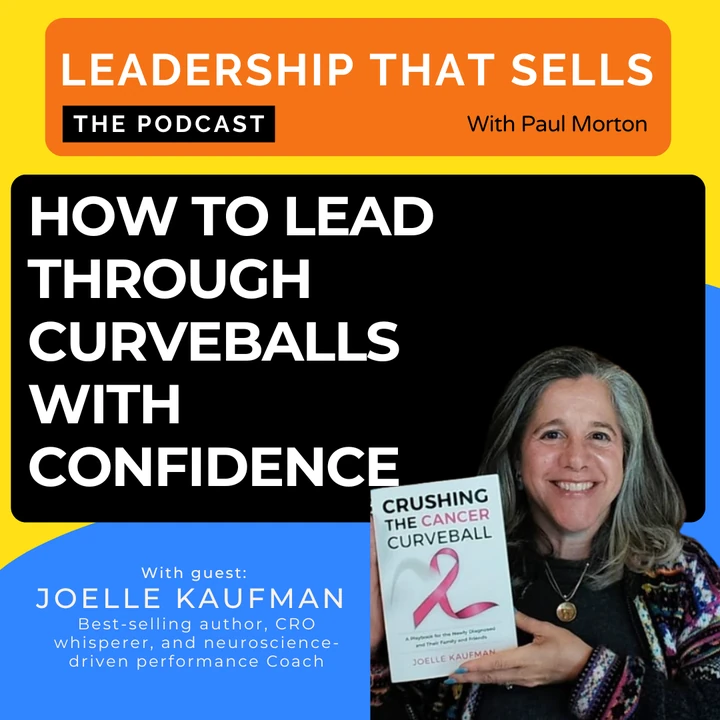
How to lead through curveballs with confidence
with Joelle Kaufman
Show notes
In this episode of Leadership that Sells, I’m joined by Joelle Kaufman – bestselling author, CRO whisperer and neuroscience-driven performance coach – and we’re diving deep into one of the biggest leadership superpowers: dealing with curveballs. Whether it’s a surprise customer objection, a missed number, or a life-altering diagnosis, Joelle lays out a powerful, actionable method to turn chaos into clarity.
We unpack her Curveball Method, a science-backed approach that helps leaders stay grounded, activate their strengths, and respond with intention rather than panic. This one’s a masterclass in leading under pressure. If you’ve ever felt the fire alarm go off in your brain mid-crisis (you know the one), Joelle’s got a way to silence it, take a breath, and lead your team through with resilience and purpose. You’ll walk away with tools you can use today.
How to lead through curveballs with clarity, calm and confidence
Name the curveball – The first step is recognising you’re facing something unexpected. Say it: “This is a curveball.”
Turn off the fire alarm – Stress shuts down your thinking brain. Take a deep breath, a sip of water, or close your eyes to calm your system.
Get curious – Don’t panic, pause. Ask questions, gather facts, understand what’s actually happening before you react.
Play to your strengths – What are you or your team good at? Lean in. If needed, tag someone else in. It’s about the win, not the heroics.
Reframe your mindset – Even if it doesn’t go perfectly, there’s something to learn. That’s how you (and your team) grow.
Create “happiness tripwires” – Small, reliable moments of joy (like a sunflower or a kind text) keep you fuelled for the long game.
Practise curveball responses – Build resilience before it’s needed. Run scenarios with your team, reflect on what went wrong, and embed better reflexes.
Timeline summary
[01:14] – Joelle’s Curveball Method explained: “Life throws them. Leaders learn to hit them.”
[06:33] – Step one: recognise the curveball, turn off the fire alarm, and breathe
[08:44] – “It’s not about being a hero. It’s about winning the game — as a team”
[12:34] – Cancer, curveballs and agency: how Joelle applied her method in life and business
[17:05] – The power of happiness tripwires: “Little moments of joy that boost your immunity and your mood”
[20:10] – Sales leaders, listen up: resilience starts with your battery
[24:01] – The one skill we’re not teaching sales managers (but desperately need to)
[25:13] – Why you need “batting practice” in your team meetings — not just pipeline reviews
Links & resources
📘 Crushing the Cancer Curveball by Joelle Kaufman
🌐 Learn more about the Curveball Method: gtmflow.com/curveball
📍 Joelle on LinkedIn: Joelle Kaufman
📸 Instagram: @growthandresilience
If you found this episode useful, please follow, rate, review and share Leadership that Sells — it helps us keep bringing you no-fluff, high-impact conversations to help you lead first and sell more.
Transcript
Automated transcript. Speaker labels and spellings may contain errors.
Paul
A best-selling author, CRO whisperer, and neuroscience-driven performance coach. She's helped go-to-market teams crush forecasts, cut decision time by 40%, and scale to billions in market capital. She's a tech exec turned rock band frontwoman turned leadership catalyst. She's human dynamo about to flip how you think about leading sales teams. Welcome to Leadership That Sells. This is the podcast that helps you lead first and sell more. Great sales teams, great teams in general need great leaders, but too often sellers become managers without the right support, the right training, and that is why we built the Leadership That Sells playbook, and you should check it out at The Practical Leadership Academy.
Joel Kauthman, thank you very much indeed for joining me.
Joelle Kaufman
Well, Paul Morton, it is my pleasure, and I love everything about the perspective of Leadership That Sells.
Paul
Marvelous. So we're gonna start directly to the heart of what you spend a lot of your time with, which is your Curveball Method. Start off, please. Most people are gonna be familiar with a curveball, not everyone. What is it?
Joelle Kaufman
Okay. So not metaphorically. A curveball is a baseball pitch, uh, that looks like it's coming fast, but it is literally moving in the air. And as a batter, it is a less powerful, less familiar pitch, and pitchers use it to throw the batter off balance and hopefully strike them out.
Paul
Right.
Joelle Kaufman
The metaphor is, you know, we can never choose what pitch we get in life, in our jobs, in our families. The pitches just come, and we all want a fastball down the middle because that's fun. We can hit that, and we can have a good time. But that's just not what we get. We get off-speed pitches like curveballs and sliders and knuckle balls, and they look different. And how we are prepared and how we approach that off-speed pitch, that unfamiliar, unwelcome pitch, that's the difference between being a successful leader and being out of the game.
Paul
And it's, I think, the, the altitude that you achieve or end up with is almost the definition of the volume of these curveballs. Most people do their daily job, their fastball, the, the daily job, uh, day in, day out. But when you get to a position of significant responsibility, what, what is the wonderful phrase? Shit flows uphill, right?
Joelle Kaufman
Mm-hmm.
Paul
That's all you end up with. You end up with the difficult decisions because if it was easy, somebody else would've done it already.
Joelle Kaufman
That's right. That's exactly right. And if you aspire to senior leadership, if you aspire to be a founder, if you aspire to be a CEO, you are signing up for a professional life of curveballs. But as you know, Paul, even if you don't aspire to that, you're gonna get curveballs in your personal life because life is full of curveballs. [laughs] There's no avoiding them. We have to have an approach that actually turns curveballs, those challenges, into opportunities and possibilities.
Paul
Hmm. I think, then, this is where your approach is really, really attractive. I mean, you have ... And we'll talk about this as well, you have the Curveball Method for sales leaders. It's a strategy to transform unseen challenges into growth opportunities, right? But you talk about this. You talk about this idea of taking the unexpected and, and focusing on the opportunity. And I, I talk to people about the word good, and I s- I, I stole this, and I wish I could remember where I stole it. It might come back to me. When horrible things happen or personally are damaging or difficult or whatever it is, you, you lose, you don't win, something bad goes wrong, the first word out your ... w- the first thing out your mind, your, your, your mouth should be good, because.
Good, right? I broke my leg. Good. Because. Why? I don't know. Find it.
Joelle Kaufman
Mm-hmm.
Paul
Find the good.
Joelle Kaufman
Mm-hmm.
Paul
Find the good in it. Because if you're sitting there focusing on the negative, you're not gonna solve whatever problems are coming your way. That's my tuppence worth.
Joelle Kaufman
Okay.
Paul
I know you've got a lot more. I know you've got a lot more. Give me a lot more.
Joelle Kaufman
[laughs]
Paul
Curveball. What is the curveball? How do we find the opportunity? Like, um, go on.
Joelle Kaufman
Okay. So to your tuppence worth, um, finding ... The first part of appro- dealing with a curveball is as simple as recognizing it's a curveball. Now, you talked about just say good, and the first thing going through your head is, "I don't want this. I don't want this. I don't want this to be happening." And a healthy way to think about that is it's a fire alarm. It's warning you something different is here, something that needs your attention. It's not telling you it's a good thing, it's a bad thing. It's telling you it's a thing. So the first step of the Curveball Method is to see it and say, "Ooh, that's a thing. That's not the thing I expected." And then turn off the fire alarm. So [laughs] you can't fight the fire with the fire alarm going 'cause it's just beeping and beeping-
Paul
Right
Joelle Kaufman
... and beeping.
Paul
Right, right, right.
Joelle Kaufman
And your, your whole physiology, physiology is getting stressed.
Paul
Mm-hmm.
Joelle Kaufman
And when you get stressed, the part of your brain that's thinking is your parasympathetic limbic system, otherwise known as the brainstem, otherwise known as your reptile brain. So if you want- A frog making the decisions. Actually, that's an amphibian. But, um-
Paul
[laughs] We'll take it
Joelle Kaufman
... if you want a snake-
Paul
Lizard
Joelle Kaufman
... a lizard making the decisions, keep going with the fire alarm. But if you actually want a homo sapien with a fully formed frontal lobe, you'd gotta turn off the alarm. So you see it, the alarm goes off, and the first thing you do is breathe.
Paul
Mm.
Joelle Kaufman
Deeply. And hold it in, and let it out. And notice how everything calms down.
Paul
Totally works.
Joelle Kaufman
And that's all it takes, 10 seconds.
Paul
Totally works. Mm.
Joelle Kaufman
Right? So we see it, we calm down, we pause.
Paul
Mm.
Joelle Kaufman
And if breathing doesn't work for you, it could be take a drink of water. It could be, uh, just close your eyes for a moment. Like, whatever works for you, experiment. Okay. Now we have to say, "I'm gonna be curious. Let me, let me look at this curve ball. What is it? How is it moving?"
Paul
Mm.
Joelle Kaufman
"What do I know about it? What do I wanna ask? What am I curious about?" And again, we can do this quickly, although an important thing, Paul, curve balls are always moving slower than they appear. So once you've turned off the fire alarm-
Paul
Mm
Joelle Kaufman
... and taken a breath. You know, a, a great example in sales is I have a prospect and they're yelling. Okay, that seems like the fire alarm. You gotta calm yourself, and then you actually have to calm them-
Paul
Mm
Joelle Kaufman
... to understand, "O- okay, what's going on, and how can I help?" Now, the way you're gonna help is you're gonna lean into your strengths. So when a batter sees a curve ball, they recognize it. They hang back. They wait for it. And then whatever their superpower is, they know that's what I'm gonna use. So your superpower could be in sales, I'm really good at handling security and data privacy questions, or I'm really good at navigating the procurement process and help guiding my prospect through it. I'm really good at navigating the integration and deployment. I'm really good at building a coalition. I don't know what you're really good at. Hopefully something on that list. I'm really good at negotiating and creating a set of terms that everybody feels is a win. Terrific. Something in that list is your strength. So you lean back, you breathe, you take an inventory of your strengths.
But in sales, it's a team at the plate, not just a single batter. So if the strength that you have isn't matching the way that curve ball's moving, well, assess which strengths you have on the team and tap in another player, because it's not about you being a hero, it's about winning the game, which means you have to then move to your mindset. Your mindset, to your point, is say good. So your mindset can be, there's gonna be something to learn from this. There's going to be interesting ways to approach this problem that I haven't thought of before. And even if it doesn't work out, there's going to be something to learn from it.
Paul
Mm.
Joelle Kaufman
And I'm always learning. I wanna be learning till my last breath. And the only way we learn, frankly, is when things don't go right, 'cause that forces us to stretch.
Paul
Yeah.
Joelle Kaufman
So now we've seen it, we've slowed down, we've used our strengths, we've focused our mindset on there's a learning opportunity, there's something good here. And then I assess, do I have any other resources I can use? Partners, other customers, other m- people that aren't on my standard team. Bring in the CEO. Do I need to bring in the CFO? Like, what are my choices here? And having done all of that, which doesn't take very long, now I swing the bat. I make my first play, and we see how it goes. And if it doesn't go perfectly, which it probably won't, we take that data, we adjust, and we swing again.
Paul
I love it. Absolutely love it. So yeah, not moving as fast as you think, I think is really important.
Joelle Kaufman
It is.
Paul
Really, really important. Taking your time and-
Joelle Kaufman
And turning off the fire alarm.
Paul
Yeah. Identifying it for what it is. This is, this is different. This is, this is a thing to pay attention to. Calm the hell down. It's not moving as fast. You've got longer than you think. You can use other people. Play to your strengths. Yeah, I love that. That's-
Joelle Kaufman
Good
Paul
... gorgeous, gorgeous way of thinking about that. So this is a un- dealing with unpredictability, dealing with the, the complexity, the, the, the, the craziness in, in business, and I think it overlaps and it plays nicely to life as well.
Joelle Kaufman
Mm-hmm.
Paul
'Cause sometimes things go wrong at home. Sometimes things-
Joelle Kaufman
Mm-hmm
Paul
... go wrong with, with health, and I know that's a big passion for, for you as well.
Joelle Kaufman
Mm-hmm.
Paul
So do you wanna take us through some ... how, how you might apply that same sort of thinking process to other parts-
Joelle Kaufman
Sure
Paul
... of your life?
Joelle Kaufman
So I am a 42, 43-year intergenerational cancer survivor. First time cancer impacted my family, I was 13.
Paul
Wow.
Joelle Kaufman
Uh, then 15, then when I was 40 weeks pregnant with my second child and my sister was 29, so I was in my early 30s, and so on and so on and so on. So I think by the time I was diagnosed, which was the day before I was supposed to have a prophylactic bilateral mastectomy, um, I think I was the 12th. And here's the thing: When you've seen a curve ball before- And then you recognize it. You actually can get very quickly through all those other elements because you're like, 'Oh, I know that curve ball. That one breaks left. And the way I've hit this one successfully in the past looks like this.' So the reason I actually wrote my book, Crushing The Cancer Curveball, was to try to give people who are seeing that curve ball for the first time a playbook-
Paul
Yeah
Joelle Kaufman
... from the experience of those of us that have seen it over and over and over and over, either as a patient or as a caregiver or as a friend. Because it has a pattern, as do the curve balls that happen in business. Now, with the cancer curve ball, it's not all that different. Like, the first thing is take a breath. This is only urgent because you know about it. It's not-
Paul
Yesterday you didn't know about it
Joelle Kaufman
... and, and you are the same person. With all the things you can and want to do, you probably will do them all, which is awesome. So now that you've taken a breath, and we have to look for curiosity, what are we looking at? Well, unless you are an expert in cancer, and you should never treat yourself, you're gonna need to put together a team. And, uh, a team is gonna include an oncologist. That should be your quarterback. And then it may include a radiology oncologist. It may include a psycho-oncologist for your brain. It may include lots of different people, surgeons, reconstructive surgeons. This team could get pretty big. One of my colleagues, unfortunately, was just diagnosed with a, a severe, uh, low survival rate cancer, and, you know, he knew nothing about it, and I tried to help him develop his approach.
And one of the things that he said is like, "I, I don't even know the language. I have no idea what to expect." And I said, "Well, I will be your tou- tour guide to the worst amusement park on earth."
Paul
[laughs] Oh.
Joelle Kaufman
But-
Paul
That's dark. That's... I love it
Joelle Kaufman
It's dark.
Paul
I love it, but it's good.
Joelle Kaufman
Well, and over the course of an hour, I answered questions, I explained, not telling him what his treatment's gonna be-
Paul
Yeah
Joelle Kaufman
... 'cause I'm not a doctor. I sh- and not telling him, "Oh, you should do this supplement or you should do..." Like, not a doctor.
Paul
Mm.
Joelle Kaufman
But I was able to help him identify the sequence of events, how quickly they would likely happen, and where he had choice and agency in the matter.
Paul
Mm-hmm, mm-hmm.
Joelle Kaufman
And when you think about that, whatever the curve ball is, you're not a pinball. You don't have to be bounced around. You can actually express agency. That can be agency over things like location, timing, um, that can be things about how you want to enjoy and celebrate your life, if there are milestones or things you wanna make sure treatment works around. But how do you shape this? Because ultimately, Paul, I used all of my leadership and negotiation skills to shape my cancer treatment to be as minimally invasive to my life and to be able to work, to be able to travel, to be able to celebrate. I couldn't drink, but that's okay. Um, to be able to engage mostly normally with my life. And my mostly was I did avoid indoor restaurants and indoor large groups because I knew my immune system had become
my temple of gold that I wanted to protect and preserve and strengthen, but I was able to do that. Ate normally, exercised as I had been. I created a strength reproduction system. So I talked about lean into your strengths.
Paul
Mm.
Joelle Kaufman
And my strength reproduction system I call happiness tripwires. I actually think we should be doing this in our lives at all times, but-
Paul
I love this. Happiness tripwires. You, you-
Joelle Kaufman
Mm-hmm
Paul
... don't get away with not explaining this.
Joelle Kaufman
[laughs] Okay. So a happiness tripwire is something that you have implemented or instrumented your life that automatically happens and makes you smile. So I happen to know your birthday's next week, and look at that smile, right?
Paul
There you go.
Joelle Kaufman
And just by reminding you that I listened and I knew you were having a birthday makes you feel good.
Paul
It does.
Joelle Kaufman
And that makes me feel good.
Paul
It's true.
Joelle Kaufman
And what just happened to both of our bodies is there was a burst release of serotonin and oxytocin and dopamine, and that cocktail is doing a number of things. It's making us feel good. Take that. It's giving us a little bit of energy. I'll take that. It's actually focusing our mind. I want that. And it's bolstering our immune systems.
Paul
Ah.
Joelle Kaufman
So for my cancer journey, I started asking people to do things throughout the journey, little things like asking my son, the baseball player, to send me a letter digitally for every chemotherapy so that I'd get a piece of digital chocolate to read as I waited between labs and infusion. It's sending a text to someone to say, "I'm thinking of you. I really loved when we did ba ba ba ba ba." Because all you're looking to do is provoke a 10-second response-
Paul
Mm
Joelle Kaufman
... that is a smile. This is not saying to somebody, "Be happy, be positive." Don't give people work to do. That's bullshit. But if you can't have other people help you out by sending something- Well, then it's on you to put things in your path. That could be, for me, I like looking at a sunflower. Sunflowers inevitably make me smile. They are really funny plants. They, their heads move with the sun.
Paul
Mm.
Joelle Kaufman
They almost have a personality, and I can't think of a sunflower without smiling.
Paul
There you are.
Joelle Kaufman
So, so I get my little sunflower dose. Some people it's a cat or a dog or just going outside and taking a breath of air. Whatever your things are, make sure you're getting them throughout your day, those little bursts, little things. And if you can give one to someone else-
Paul
Mm
Joelle Kaufman
... I guarantee that's gonna boomerang back exponentially.
Paul
So is, there's, there's no such thing as a small act of kindness.
Joelle Kaufman
None. And this is actually good for your health.
Paul
Oh, yeah. Yeah, without a-
Joelle Kaufman
And so-
Paul
Mm
Joelle Kaufman
... so the punchline is, you know, my cancer journey became one of the happiest, most loved, most connected years of my life.
Paul
Mm.
Joelle Kaufman
And by the end of my chemo, so 12 cycles of chemo.
Paul
Oh, wow.
Joelle Kaufman
That's okay. I was on an easier chemo. It was fine. Like, um, I was down to a one-eighth dose of the steroid that they give you for immunity because my labs had been good, and my doctor turned to me at my 12th session and said, "I'd never believe from your labs that you're a chemo patient." And the one change was happiness tripwires. That's it.
Paul
Okay.
Joelle Kaufman
So I call them free uppers.
Paul
Free uppers.
Joelle Kaufman
And now let's [laughs] ... Well, they are. But now let's think about sales managers-
Paul
Right
Joelle Kaufman
... and sellers. Like, selling is hard. You get punched in the teeth, or you get ghosted.
Paul
It's, it's the job description, yeah.
Joelle Kaufman
Right, or you get ghosted. I mean, lots of things happen, and if we think of ourselves like a mobile phone with a battery, and throughout the day that battery's just losing charge, right? We have to do things to recharge. Well, if you're there, the sales manager, you need to understand how to help your sellers keep their battery charged. That is not necessarily being rah, rah, attaboy.
Paul
Mm.
Joelle Kaufman
There are some people who it's like, "Hey, let's go take a walk." They just need to get their bodies moving.
Paul
Yep.
Joelle Kaufman
So you have to understand what helps charge their batteries, which means your battery has to be charged as a sales leader.
Paul
Mm-hmm.
Joelle Kaufman
And that whole reaction of, "Oh, my God, I'm not gonna make my number. My God, that deal's blowing up. My whole quarter was based on that deal." Okay, this is, all could be true. It could even go as far as, "And I'm gonna be fired, and I'm never gonna get a job again, and I'm gonna be naked dead in a ditch." Right?
Paul
By Wednesday.
Joelle Kaufman
We can go the whole way.
Paul
Yeah.
Joelle Kaufman
Right? Right? We're gonna go the whole way, and that's the fire alarm.
Paul
Yeah.
Joelle Kaufman
We need to take, "Oh, I just got an alarm, and I'm spiraling."
Paul
Mm-hmm.
Joelle Kaufman
Take a breath. It's a curveball. Okay. Time to get curious. Right? So I wanna be curious. I wanna encourage my sellers. Okay, it's a curveball. Let's get curious. What can we learn? What can we ... What, what do we need to understand to develop how we want to approach this, how we want to swing the bat?
Paul
Yeah.
Joelle Kaufman
Right? And e- e- even to the extent of if what we learn is that we missed something in qualification and we've wasted resources, that's not a waste. Because now I wanna go back to the beginning to how are we qualifying and targeting and saying, "How do I tighten that aperture so that we can actually learn from this and have better sales velocity and better win rates because we learned from this mistake?"
Paul
So what are, then, the traits that we need to try and model and bring out in the, the, the teams around us? If we wanna try and ... 'Cause, you know, this, this is more than just resilience. This is-
Joelle Kaufman
Mm-hmm
Paul
... this isn't resilience. This is, this is, uh, intelligent resilience. This is actually, this is-
Joelle Kaufman
[laughs] I like that
Paul
... active, proactive, demonstrable. There's more to it, like dealing with a curveball, you know?
Joelle Kaufman
Mm-hmm. Mm-hmm.
Paul
What do ... H- how do I then build this in my team?
Joelle Kaufman
Right. So there's a few things. First, you have to be a model of it. They will take their cues from you.
Paul
Yeah.
Joelle Kaufman
So when that fire alarm's going off and you're experiencing stress and potentially panic, you saying, "Okay, this is not what we wanted. I need to regroup for a second. I need to take a breath. Why don't you all take a breath?" You're modeling and you're guiding them.
Paul
Mm.
Joelle Kaufman
When you're saying, "Okay, what do we need to understand?" And you're doing it out loud 'cause you're modeling, these are the steps we take. We know what our strengths are. Let's list them. What are our options here?
Paul
Mm-hmm.
Joelle Kaufman
Our mindset, we are here to learn and to grow, and our success comes from delighting the right customer.
Paul
Mm-hmm.
Joelle Kaufman
And so we're going to figure out, is this the right customer? What will it take to delight them? And if the answer is they're not, we need to learn and go back to the beginning, but we are articulating the process because by articulating it, we're bringing them along. By asking them questions, they're becoming part of it and they're learning how to do this themselves.
Paul
Yeah.
Joelle Kaufman
And it's okay as a leader to say, "Oh, this bums me out. I just want you to know, like, I feel that, too. But it is what it is, and there's an opportunity here. We're just gonna peel it apart until we reveal it."
Paul
Yeah
Joelle Kaufman
Um, so I would say, like, make sure you exercise, make sure you get sleep because you've got to be able to keep your battery charged. Um, and watch them, and if you have somebody who's really not able to, to get over it, that's a time to take them aside and figure out with them, like, "What's gonna recharge your battery? What's gonna get you-
Paul
Mm
Joelle Kaufman
... in a better place?" And if they're like, "I'm just terrified I'm gonna be fired." Like, "Okay, I appreciate that, and, um, that thought process is actually getting in the way of you solving problems and could actually be a self-fulfilling prophecy if you focus on this potential catastrophe instead of the problem at hand. So how can I serve you? How can I help?" Right?
Paul
Mm.
Joelle Kaufman
So there's a lot of EQ, emotional, uh, quotient-
Paul
Mm
Joelle Kaufman
... emotional intelligence that's going into this. But I will tell you, Paul, the best way to help your team deal with curveballs is create time and practice, right? Do batting practice. So in your weekly sales meetings, carve out time to say, "Okay, hypothetical situation. Here's what comes at us."
Paul
Right.
Joelle Kaufman
"Run me through your process. Take me through the steps." Right? "And now let's give feedback. How can we do that better? Where could we..." And what we're building is a reflex. There's a reason that we make doctors do ridiculous amounts of hours in residency. It's 'cause we want them to have the right reflex when a problem happens. There's a reason that great batters, not only do they do batting practice almost every day of the week, they do batting practice before every game. Every game.
Paul
Mm-hmm.
Joelle Kaufman
For an hour, they're swinging the bat at different kinds of pitches because they are trying to get their mind, their eyes, their body in the groove for, "I've seen that before, I've seen that before, I've seen that before." But we don't do that with our sales teams.
Paul
Mm-hmm.
Joelle Kaufman
So why do you w-
Paul
Professionally, we're, we're hideously underprepared for things. We just don't ... Uh, we, we don't look after people. We don't train. I mean, every other part of the business has, you know, mech- mech- whether it's mechanical training or professional training or it's some sort of training and practice to get good at something. The most measured, the most vital, the most central part of any organization because nobody eats and nothing sells, and we say, "Oh, you're a salesperson. Good luck. Here's your telephone. Off you go." And it's even worse when you then promote them into being m- being a manager because-
Joelle Kaufman
Of course
Paul
... this assumes so much.
Joelle Kaufman
Well, and, you know, I, I've seen countless very talented salespeople-
Paul
Mm
Joelle Kaufman
... become managers, and they're intuitive.
Paul
Yeah.
Joelle Kaufman
So their ability to coach, to teach is limited because they look at it and say, "Don't you see it?"
Paul
Mm-hmm.
Joelle Kaufman
And the seller's going, "See what?" Right?
Paul
Yeah.
Joelle Kaufman
So we do need to do more than train people on, "This is our sales methodology. We're going to use MEDDIC-
Paul
No, no
Joelle Kaufman
... or BANT or something else."
Paul
Don't do that.
Joelle Kaufman
I mean, I mean, there's a place for it.
Paul
Yeah. Yeah, totally.
Joelle Kaufman
And it's good to have a qualification methodology, but, you know, and then I've been involved with challenger and solution-based selling and value-based selling.
Paul
SPIN, VTOL, ICE.
Joelle Kaufman
Right. SPIN.
Paul
You name them.
Joelle Kaufman
Right. So we, we teach them all these methods, but we don't teach them how to deal with their emotional reaction to curveballs.
Paul
Mm-hmm.
Joelle Kaufman
And that's where they fuck up.
Paul
That's probably about 80% of the problem. The, the 80% of the job is dealing-
Joelle Kaufman
Right
Paul
... with the shit that flows uphill, or it, it flows down the pipe. Yeah, you got a pipe full of shit.
Joelle Kaufman
Yeah. That's right.
Paul
Your pipe is full of shit. It flows straight at the salesperson.
Joelle Kaufman
Right.
Paul
They have to be-
Joelle Kaufman
And they are usually ... They ... I mean, their comp depends on it.
Paul
Yeah.
Joelle Kaufman
They know that they could be fired easily 'cause they are measured. I mean, there's a lot of stuff.
Paul
Mm-hmm.
Joelle Kaufman
And while I don't think sales leaders or CEOs should be therapists, there's therapists for that.
Paul
Yeah.
Joelle Kaufman
I think how you create a culture, how we talk about, you know, if you can't do hypothetical curveballs, good news, I guarantee you're seeing them anyway. So you can talk about post-action curveballs.
Paul
Yeah.
Joelle Kaufman
This is what happened. Let's go through it, and let's play it again. And what you're doing there is you're accelerating the learning of that whole team, and you are helping them, um, helping them deal with more curveballs and building the resilience intelligence. But it's also ... And this is the thing people don't realize, Paul. It's fun.
Paul
Mm.
Joelle Kaufman
Right? Like, it's a puzzle.
Paul
Yeah.
Joelle Kaufman
And being able to find new pieces to the puzzle or new ways to put the puzzle together, that's exciting. It's fun. And how boring ... I mean, I can't imagine. I've never been in a company that was an order taker, but I have to imagine-
Paul
Mm
Joelle Kaufman
... it's somewhat dull.
Paul
Yeah. I mean, you, you got the, the poor folk. I had the experience of it a few weeks ago. I was trying to sort my internet connection out, and you get somebody who's on the other end of the phone, and it's basically, do you want the small, medium, or large?
Joelle Kaufman
[laughs]
Paul
With fries. I'm thinking, "Dude, you did a great job." And he did a great job. Really, really guy did a great job, you know? Diagnosed the problem of what I wanted and all that sort of stuff, but, mm, such a ... It's a limited-
Joelle Kaufman
Right
Paul
... very limiting. Right. Right. Right. Well, my goodness. Well, there's so much to take out of a curveball. I think there is ... There's, there's a- any number of ways of leading through curveballs. That's what I'm trying to get to. It's not you're dealing with it. You're leading through it, and you're doing it confidently.
Joelle Kaufman
Mm-hmm.
Paul
You know? And you're modeling it.
Joelle Kaufman
Because you have a method.
Paul
That's it.
Joelle Kaufman
You, you have a method.
Paul
And we now have a method. We have the Joelle Kauffman Curveball Method available at bookstores and internet sites near you, gtmflow.com.
Joelle Kaufman
Yes.
Paul
Right? Is there anywhere else they can find you?
Joelle Kaufman
Yes. You can go to ... Uh, well, you can find me on Instagram at Grit, Growth, and Resilience. You can find me on LinkedIn at LinkedIn Joelle Kauffman. And, uh, but the best way to learn more about the Curveball Method is go to gtmflow.com/curveball, and you will see lots of detail about it. You're welcome to self-learn, and if people wanna talk to me, there's ways to schedule time and see if we can help up-level your leadership or that of your whole team.
Paul
And I think that's an invitation that should not be declined by anyone who's listening to this, 'cause if you are, then you are in the right place and you're talking to the right woman. Joelle Kauffman, thank you very much indeed for joining me.
Joelle Kaufman
Paul, thank you. This was a lot of fun.