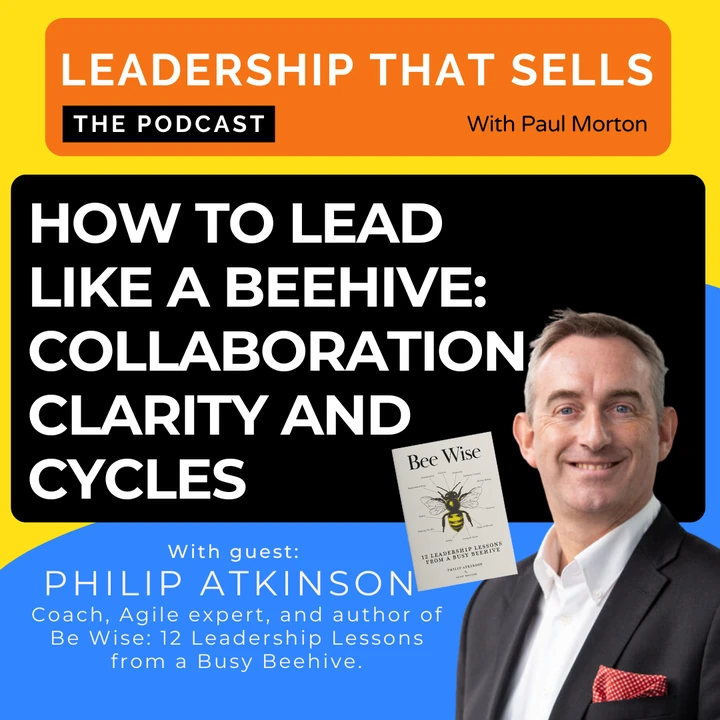
How to lead like a beehive: collaboration, clarity and cycles
with Philip Atkinson
Show notes
In this episode of Leadership that Sells, I’m joined by Philip Atkinson — team coach, agile expert, and author of Be Wise: 12 Leadership Lessons from a Busy Beehive. Philip brings decades of global commercial leadership experience and distils it into practical, real-world guidance for sales leaders who want to lead smarter, not just harder.
We dig into the surprising (and powerful) leadership lessons we can learn from bees — from how they make decisions, to how they structure teams, to how they know when to let go. If you’ve ever felt like your team is buzzing with activity but going nowhere, this episode is for you. We talk coaching, team dynamics, seasons of performance, and how to create true alignment in chaotic, high-pressure environments.
How to lead like a beehive: collaboration, clarity and cycles
Ask better questions and listen more – Great coaching starts with curiosity, not control.
Shift from competition to collaboration – Sales teams should compete outside, not inside. Internal competition kills culture.
Recognise roles evolve – Like bees, great teams change roles as they grow. Salespeople need progression, not just promotion.
Know the season – Performance has cycles. Growth, rest and renewal all matter. Don’t expect summer results in winter.
Decide like a hive – Gather intel, build consensus, commit. Don’t waste time on the wrong decisions with the wrong people.
Communicate clearly – Bees deliver messages in the dark, in the noise. You have no excuse. Say less, mean more.
Timeline summary
[02:03] – Why Philip brought 12 guest experts into his book (and why leaders shouldn’t go it alone)
[03:05] – The “aha” moment that made beekeeping a leadership metaphor
[05:25] – The first thing every sales leader should do? Learn to coach by asking better questions
[06:13] – Why most sales teams aren’t really teams — and what to do about it
[09:30] – What bees teach us about career development and role evolution
[14:32] – Understanding energy cycles: why you need to plan for endings, not just beginnings
[17:38] – The “murder of the drones” – a dramatic lesson in adapting your skills before you’re obsolete
[19:22] – How bees make life-or-death decisions as a team (and how your team can do the same)
[24:00] – The biggest benefit of collaboration? Thinking harder before doing more
[25:15] – What the hive would say if it could talk: communicate clearly, act consciously
Links & resources
🌐 Learn more about Philip Atkinson
If this episode helped you think differently about leadership, decision making or team coaching, please share it with someone who needs to hear it. And don’t forget to follow, rate and review Leadership that Sells – it really helps us keep bringing these insights to your ears.
Transcript
Automated transcript. Speaker labels and spellings may contain errors.
Paul
A transformative team coach and former global commercial leader, he's helped scale and transform marketing, medical, leadership teams at some of the world's biggest pharma companies. Now he teaches leaders how to coach, adapt, and thrive in complex, fast-moving environments. He's the founder of Hive Logic. He's the author of Bee Wise: 12 Leadership Lessons from a Busy Beehive, a certified agile coach, and a believer in better ways of working. Philip Atkinson, thank you very much indeed for joining me. Welcome to the Leadership That Sells podcast, where we help you lead first and sell more with great insights and tactics from the best minds we can find. Every leader is in sales, whether you're selling products, ideas, a mission or a vision, and great sales team in particular need great sales leaders. When managers bring out the best in their teams, targets get hit on time every time without stress.
But most sales leaders never learned how to lead. They wing it, or they repeat bad habits, and the cycle continues. Sales leaders need practical, real-world ideas that fit their busy schedules, and that's why we created the Leadership That Sells Playbook course. Nine short weeks changes your world. Check it out at the Practical Leadership Academy. And now, on with the show.
Philip Atkinson
Thank you, Paul. It's lovely to be here.
Paul
Well, did I miss anything? You've been around for a while.
Philip Atkinson
[laughs] Like, like many people, yes. Uh, I, I think that's, that's, uh, all-encompassing and, and let's, let's, uh, find out more as we discuss together.
Paul
Well, we'll roll with that then. So you, you have here, and this is a magnificent book, 12 Leadership Lessons from a Busy Beehive. You and 12 guest writers that you picked from your, your, your background, your network. Um, what ... [sighs] I mean, that was fairly bold picking 12 people together. Why did you bring other people into each chapter for a start? Let's just go with the, the meta thing first.
Philip Atkinson
Paul, thank you. I, I realized I don't do any of my work by, by myself, and in fact, people very rarely are experts at anything by themselves. Life is better with collaborating with other good people. Uh, innovation, ideas, exchange, communication, it, it's all a partnership. So I wrote the first chapter and realized, "That's my opinion. Let me hear from someone else. Let me be challenged." And in the first chapter, uh, a- an expert on organizational design said, "I don't agree with Philip. Let's discuss," and that's great. So the book is a dialogue between me and 12 experts.
Paul
Oh, that's superb. Okay, so that's why you get 12 people together. You have the dialogue. You have ... You're bringing ... I'm a firm believer in collective intelligence.
Philip Atkinson
Yeah.
Paul
If you have three people in a room, uh, you don't have three brains, you have six different conversations going on, which is the best part. If you can take us back a little bit about the, your inspiration for doing this, what first drew you to bees as a metaphor for leadership?
Philip Atkinson
Thank you.
Paul
Was, was there a moment where you just went, "Ah"?
Philip Atkinson
[laughs] Just a, a quick story. Um, you mentioned some of the study I've done. I was studying work stuff, and then I thought, "In my home life, I want to study a home hobby that's nothing to do with work," and I started to become a beekeeper 18 years ago. And it took me a few years to realize it's a fabulous metaphor for a complex organization and life today. And I was just sitting outside an office on a summer's day as people were coming and going and, and bringing their-
Paul
Buzzing in
Philip Atkinson
... yeah, exactly, and I just... And then it became a metaphor that made it easier to have the difficult conversations that have to happen.
Paul
Mm-hmm.
Philip Atkinson
So it's just a useful tool to open up people to think and pause and reflect a bit more, and it, and it's, it's served clients very well since then.
Paul
I wonder if bees are actually smarter than we are. Probably in very many ways. Different sorts of intelligence. You know, I, I, I like the idea of different sorts of intelligences. You put a ... You, you look at, um, David Beckham and you say, "How intelligent is he?" And you're thinking, "Eh, not so much." You put a ball at that man's feet, he's really damn intelligent with his toes. Okay?
Philip Atkinson
Yeah.
Paul
Different sorts.
Philip Atkinson
But he's-
Paul
Don't ask me to make honey
Philip Atkinson
... he's, he's a beekeeper now as well.
Paul
I heard, yes.
Philip Atkinson
There's a, there's a good point there, Paul. We, you know, we can't just look at the world through our own lenses and assume it's, that's right. So actually bee, bee- the bee's intelligence is something that we actually just don't understand yet. We understand a lot more. A- and in life we need to look at things with open eyes and, and, you know, let go of old beliefs and old patterns and behaviors.
Paul
I see that, um, when you have a wasp that sneaks in the back of a beehive, if it gets in the back and it's in, it's probably fine. But if it tries to go in the front door, it'll get beaten out, you know?
Philip Atkinson
Yeah.
Paul
So if you are, if you're in and you're behaving in the same way as, as everybody else, uh, there, there's probably something there, you know. We can be ... [laughs] I'm sure there are endless, endless directions we can take this down. Um, you teach leaders to coach, and we try, try to be really pragmatic and practical here and make sure that we have a how to takeaway. What would you say the first skill is that you want a ... You're an ex-salesperson as well. What's the first skill you'd want a sales manager to learn?
Philip Atkinson
And I think this is the sales 101.
Paul
Mm.
Philip Atkinson
It's about, it's about asking better questions and listening more.
Paul
Hmm.
Philip Atkinson
That's it. [laughs]
Paul
Okay. Um, you've taken over your sales team. You're looking out, you're looking around you, and you're wondering, "Why are all these people who are doing the same thing not working together? What have I done wrong?"
Philip Atkinson
A whole... Thank you. It's a whole interesting topic. In, uh, there is a chapter in the book all about teamwork and about different types of teams.
Paul
Mm.
Philip Atkinson
You know, in, in English we only have one word for, for things that are hot. Hot weather, hot food, et cetera, and it's not good enough. And then we use one word meaning team. In actual fact, there are two types of teams, and sales teams are classically lots of individuals who do their work outside of the group. In actual fact, simply, but you can elevate the performance by helping t- the teams learn with and from each other. Sales teams are not competing with each other. They're competing for external opportunities, and the role of a sales manager should be to help the team function better through better learning. And that's, that's a, that's an important step. It's not, you know, you're not controlling and competing with a team. The team needs to, to invest time to sharpen their tools, to be better, to share experience, to share failures, and that's a hard step if you haven't grown up with that model.
If you've just grown up with, "This is my results, this is how I'm doing," a, a team cannot benefit from all of those years of experience.
Paul
And typically I think as you find it's the sales manager themselves who has come from a poor education background. I don't mean they're badly educated, they just haven't had the opportunity to learn from anybody who knows better. They repeat the bad experiences that they've done, and they then set up the environment for failure. They then set people up to, to compete against each other, if not for they're competing for, um, commission or something like that, depending how you structure that, if you're mad enough to do something like that. But you're competing for attention. You're almost a kip- I, I just got a kitten, believe it or not. I got a little kitten, and my two older cats don't like it.
Philip Atkinson
Yep, yep, yep.
Paul
So the kitten has come now... The, the older cats, in fact, are competing for attention. They're competing for affection.
Philip Atkinson
Yeah, yeah.
Paul
Which in a team of grown-up, nasty... Not nasty, you know, but, but grown up, gnarly is a good word, salespeople, men and women-
Philip Atkinson
Yeah, yeah
Paul
... they compete for approbation, they compete for attention, they compete for a- affection. "Oh, that was really well done," is all you need-
Philip Atkinson
Yeah
Paul
... so often.
Philip Atkinson
And I think that, that framework of competition, you know, which does drive sales, you know, effective sales behavior, you know, people are competitive. But a sales team shouldn't be competitive with each other.
Paul
Mm.
Philip Atkinson
They should be competitive for better results externally, and therefore the role of a sales manager should be to create an environment for growth to improve better learning within the team. A- a- a- and you're right, they've often been promoted because of good sales, not because of good leadership and, and insights about human behavior, and that's what we're in the business of.
Paul
So when you write, your, in, in your book here, um, Bee Wise, right? So I'm gonna wave this again here. If you can, if, if you're listening in the podcast on audio, I'm holding up a book, and it's a very, very good one. I would highly recommend it. Bee Wise: 12 Leadership Lessons from a Busy Beehive by Philip Atkinson and guest writers, published by Buzzworks, and you can see the link in the description here on this episode. Now, you talk... There's a few things that I just want to dig into here. You talk about the hive teaching us that roles matter, and bees going through these seven distinct roles, and any team has different roles. They have supporting roles, they have performers, they have all these different things.
I think y- you're talking that an individual leader has to understand and value the different types of role and also the evolution of those roles. Can you talk us through that? How does that, h- what do the bees do, and how can we do it better?
Philip Atkinson
Great. Um, what the bees do is crazy. When they, when they hatch, the female worker bees have seven different jobs. Um, they become builders-
Paul
I, I understand that. I totally understand having seven different jobs.
Philip Atkinson
[laughs] But they do them one after another. They do them sequentially.
Paul
Okay.
Philip Atkinson
So first of all, they are trained to be, to be builders, and they are the best builders they can possibly be. They are supported by their, their peers to be the best builders, and then they, and then that's just for three or four days, and then they stop and they spend time training the previous bee, the, the newly hatched bees to be builders, and then they do something completely different, which is to be nurses. And it carries on, and they only fly for the last two or three days of their life. You know, bees, a, a beehive is not-
Paul
Really?
Philip Atkinson
... just like salespeople knocking on doors. There's a whole infrastructure. So they... When you see a bee flying, be kind to it. It's in the last, it's at the peak of its career and it's the last three days of its life. That's it.
Paul
Wow. Okay. So next time somebody comes knocking on my door trying to sell me something, I'm gonna invite them in for a, a plate of soup.
Philip Atkinson
Please, please do. Please do. Now, now look, the, you know, the metaphor or just to open up some thinking in terms of career development, um, we need to move bet- and, and evolve between different roles.
Paul
Mm.
Philip Atkinson
To be really good at the role you are in. You know, i- invest, invest in being a mentor and a p- and a, and a trainer for other people coming in, and learn, learn, learn to do the best in the current role you're in. And, and keep an eye on the horizon of what other roles are needed. What skills do you need? What training, what capabilities? So, so, you know, and then build like the bees. It doesn't need to be... The old model was you go up and up and up and up.
Paul
Mm.
Philip Atkinson
I mean, some, in narrow organizations, there's not enough room and you're out. But in this day and age, the world is changing so quickly, I encourage everyone to be far more lateral in their thinking and, and just really pay constant attention to self-awareness. What do I love? What am I good at? What do I need to learn? How do I need to keep moving? And that can be sideways and sideways and sideways, and then rocketing up.
Paul
Mm.
Philip Atkinson
There's many different paths now, and we support clients to do that.
Paul
I, yeah, I think breadth rather than height or altitude perhaps.
Philip Atkinson
Yeah, yeah.
Paul
So, and you got, y- you, the voice of the Tony Robbins things, your attitude determines your altitude. Well, yes, fair enough. But I think your attitude towards your own development and your ability to serve, and that is, really is, means a lot for me, that if you recognize that you're here, you're put on You're, you're put here to serve customers, yourself, your families, other people, and it's very, very good for you. It's healthy for you to serve. First thing you say to somebody who's miserable is, "Go out and help somebody else."
Philip Atkinson
Yeah. And, and it's our, our careers are our own responsibility.
Paul
Mm-hmm.
Philip Atkinson
And actually don't wait for HR to tap you on the shoulder. Don't, don't assume that your boss is, is, is looking out for your next career step. Ab- you know, they're important. You know, serve the community by working out where you can have an impact.
Paul
Mm.
Philip Atkinson
And, and yes, of course, HR and your boss can be important stakeholders, but it's not their responsibility, it's our own individual responsibility.
Paul
The best moments I think I've had with teams, um, who've worked for me, when I think I got it almost right, was talking to them when I hired people and say, "I don't expect you to be here forever." And you see the face of the HR person next to you going, "What, you can't say that."
Philip Atkinson
[laughs]
Paul
And then the face of the little person next... That you're interviewing sort of going, "What? No."
Philip Atkinson
Yeah.
Paul
"I don't understand." That's okay. I don't think you're gonna retire in this job.
Philip Atkinson
Good. Very good.
Paul
No, of course not.
Philip Atkinson
Yeah.
Paul
I expect this to be a tour of duty. You will have a year to learn how the toilets, where the toilets are and what the coffee is all about, and to learn the job. A year to master it.
Philip Atkinson
Yeah.
Paul
A year to pr- to, to excel and to look forward, what's the next thing, and then a year to prepare for the next thing. Now, hopefully the next thing will be in, within this organization, maybe within my organization. If not, let's talk about what that looks like and make sure you have the skills and the experiences to take forward. Yeah?
Philip Atkinson
And then just, you know, and also on that way, you know, as you're in your first, second and then third year, invest in supporting the new people.
Paul
Mm-hmm.
Philip Atkinson
That's good. That's good to bring the-
Paul
Mentoring the, bringing people along
Philip Atkinson
... It's, uh, it's servant leadership through and through. Yeah. Yeah.
Paul
Yeah. Yeah. Absolutely. Hives operate differently in different seasons. I'll, and I learned this.
Philip Atkinson
Yeah.
Paul
Uh, you talk about leaderships needing to understand the cyclical nature of energy, of output, of growth, and of renewal. Tell me more. How does that apply to me and my team?
Philip Atkinson
Thank you. It, it actually applies to everything. Everything has a beginning, a middle, and an ending. And you need-
Paul
To everything there is a season, to a season for all things.
Philip Atkinson
Yeah. And actually, you know, let's look at when you start a new job, for example. Um, starting a new job is easy. You get, you get a bunch of flowers maybe, and you get a welcome card, and you get a buddy, or you start a project and it's exciting, and I don't think we pay enough attention to the cyclical nature of closing things well. We might be on a project, you know, we, we ... It might not have worked, but there might be a lot of learning, a lot of intelligence, a lot of wisdom that comes from it. And I think we all need to pay more attention to how to close things. And it's the same with a job. If you're leaving a job, closing and leaving is as hard work as starting a new one.
Paul
Mm.
Philip Atkinson
So pay attention to what you need to do to have a good close. Um, and that might include sharing your wisdom, and providing feedback, and helping the organization. But that, that ... We, in life, we're very good at beginnings, and in businesses and in life, I think we're very bad at endings.
Paul
Yeah.
Philip Atkinson
And we can all benefit from paying more attention to that. Otherwise, it's a bit like having a mental screensaver with too many apps open.
Paul
Mm.
Philip Atkinson
There's so many initiatives and projects and ideas and things, and nothing ever gets landed, and my, my plea is pay more attention to a closing.
Paul
I think, I mean, I did some work with a wellbeing company a while ago, and they were providing a, an app coaching service for people who were grieving.
Philip Atkinson
Yeah.
Paul
And the, the end piece is, we're just appalling. We used to be very good at this in life, the endings here. I'm not gonna get us down too far, but you'd see a, um, a funeral cortege going past the street, and I would remember stopping. Everybody would stop, and men would take their hats off if they were wearing one. They would stop. I'm not that old. But you'd stop at the side of the street and you would just pay attention-
Philip Atkinson
Yes
Paul
... as they went past. And now we, we've, we don't like talking about it. We don't even like thinking about it. I have a friend who was on, on telly a while ago, and it was in the middle of COVID, in fact, and she was a, a doctor of some description. And she said, "Well, after all, everybody dies." Right? She got Ofcom complaints. I'm a doctor. We're humans. It's kind of inevitable. It happens, but nobody's, "I'm not going to die." I have good news for you. "I'm not going to leave this job." Well, yes you are.
Philip Atkinson
Yeah.
Paul
It might even be taken from you.
Philip Atkinson
Yes. Yes.
Paul
It might be taken from you. And, uh, the, the whole thinking about the ending thing here I think is underrated in that-
Philip Atkinson
Yeah
Paul
... if you're not ready for it, it'll happen to you.
Philip Atkinson
Exactly. Yeah.
Paul
Rather than you having some degree of agency.
Philip Atkinson
Yep. Yep.
Paul
So, yeah. I lo- I love ... Now, we talk then, you also talk then in the book about the murder of the drones.
Philip Atkinson
[laughs] Yes, indeed.
Paul
And wh- I have to say this just slightly ... The murder. There's been a murder.
Philip Atkinson
[laughs]
Paul
The murder of the drones. Go on.
Philip Atkinson
And, and this is a, look, it's a fun way to open up lots of topics. Uh, just basically 95% of the hi- of the f- of the hive are hardworking females. 5% are men, are males, not men, 5% are males. The male bees can't even feed themselves. They rely on the females to be fed, and their only role is to go out and have sex with the queen. That's it. Now, it's a bit of a fun metaphor, but look, there comes a time, October, when the male bees are no longer needed, and therefore they're a drain on resources. Their skills don't match what the organization needs, and the resources are tight in October, and the female worker bees starve them to death. And if it's, and if it's harsh, you know, if the weather's bad and, and resources are hard, it's more active, and the que- and the female bees go and sting the males and kill them and push them out the front door.
Now, [laughs] now this is a loose metaphor for working life.
Paul
[laughs] I want to see where you're taking this. You've ca- you've got a hive with a pile of corpses out the front door. You're there sitting-
Philip Atkinson
Lots of-
Paul
... looking at large pharmaceutical with a nice terrace and a pile of corpses. No, what? [laughs]
Philip Atkinson
There's lots of... I mean, there's, I mean, it's just, it, you know, it is actually a fun way of bringing-
Paul
Cardboard boxes
Philip Atkinson
... of bringing up topics about adapting your skills and knowing what the resources are and knowing, anticipating what skills are gonna be needed.
Paul
Right.
Philip Atkinson
And that diversity. So it's a, it's a fun entry point to some difficult conversations, and, and that's how we use it. Uh, it's a good one, yeah.
Paul
So you talked at the very beginning here about difficult decisions. What can a bee, or the hive rather, 'cause it's not a bee, teach us about difficult decisions and team consensus?
Philip Atkinson
First of all, there are lots of different decisions that we need to take, and they don't need the same decision-making model. So actually, let's, let's slow down a bit and, and just work out what is the problem we're facing, and what type of decisions, and how are we going to take that decision. And some decisions, let's delegate and give consent to people in the group to take a decision, or give consent to people to do the research and make a proposal. It doesn't need to be a whole leadership team arguing over which hotel we're going to for the Christmas dinner. You know, let's be sensible about our time and our resources. What the bees do when they decide, the bees need to decide to move to a new home, it's called swarming, and that's 50,000 bees all going to a new home, and it is a life or death decision for the whole colony.
Now, it's a complex decision, and what they do is they have scout bees that go and fly, and then let's say, let's say there are 10 bees go to 10 sites. They're, they're different sites. They're different places. Those 10 bees come back, and they report what they have found, and depending on their, the way they communicate, they're, they're covered in pollen or, or how, how voracious and passionate they are about their site, bees go, "Hang on. I'm seeing, I'm noticing what bee number one and two are saying, and I'm gonna check it out for myself." So bees, they, they, they do some research. They look at scenarios. They then do a bit of crowdsourcing. So more bees will go to site one and two, and then they'll come back, and then more bees will go, "Hang on. That looks good." So more bees will go to site one and two, and they're just collecting data.
But it might be that bees eight and nine say, "Fair enough. Fair enough. I think one and two is better." And so they fact find. They re- they take their time to establish the data, and there's no, there's no duplication here. They're not competing. They're all trying to take the best decision. And then when there is a critical mass, the entire hive says, "Yes, we trust that decision. We are going to support it." And that means there are some bees, let's say there were nine bees who were wrong, and they have to say, "I get it. I get it. For the good of the hive, for the good of this leadership team, let's support the single decision that has been researched by my colleagues. Let's all go," and they have consensus on the final decision.
There is, there is lack of consensus until then, and they, they argue, if you like, disagree, and then they reach a critical mass of data, and they take a single decision that they all stand behind, and then they go as a united front to their new home, and it's very, very effective. And if we just come back to, to leadership teams, you know, there are lots of different decisions. Take a bit of time thinking about what decision process are we going to use, and then let's stand by it.
Paul
Excellent. And the f- the, the first decision you need to make is what sort of decision am I making?
Philip Atkinson
Yep.
Paul
Is it, as you say, booking a hotel, or is it moving the entire team, moving everything?
Philip Atkinson
And how many team meetings have you been in where you can waste time talking about utter rubbish that everyone has an opinion on?
Paul
Mm.
Philip Atkinson
Well, actually, you know, [laughs] Christmas party, honestly, who organized... You know, it, it doesn't take a leadership team to, to have these kind of... And but leadership teams get carried away wasting time on the wrong things.
Paul
Yes.
Philip Atkinson
And everyone's talking, and they feel like they're busy because everyone's talking. Think a little bit more what you need to do.
Paul
Magnificent. Well, if we wrap this up, I have one couple more questions for you. How has your work with the other 12 authors, the work you put into writing the book, how has it changed the way that you lead or consult with organizations?
Philip Atkinson
That's a good question. You, you know, we come back to collaborating is good, and also I've realized I'm not always right, and I don't need to be. My job is not to be the command and control top of a hierarchy, not with this book project and not with the way I lead teams. It's actually to listen to other voices, listen to other experts, and come together to find a decision. So actually, the book, without unintentionally, has become a role model for good collaborative working and, and helping everyone to stop and pause and just think a little bit harder about what we're doing. Because our competitive advantage is about thinking harder before doing more stuff.
Paul
Yeah. There's the concept of drifting. Uh, I think it's N- I think it's maybe Norman Vincent Peale in, uh, The Interview with the Devil. I think it was him that read this. Might have been Dale Carnegie. Can't remember. One of them. And he says that most people drift. They just drift, and all you need to do to differentiate yourself is to think Take a second to think. Think about what you're thinking about. Think about what you're doing. Think about where you're going. Think about how you're gonna get there. Don't just bash on. As you said, the bees, they don't just fly out and fly off. They put a lot of effort into this, a lot of effort. I'm just, I'm wonderful, fascinated to hear this.
Philip Atkinson
O- organizations drift, and leadership teams drift, and sales teams drift. But everyone thinks they're busy because they're being noisy.
Paul
Mm.
Philip Atkinson
But no, just give a little bit more thought. That is where the competitive advantage comes from. Think about the bigger stuff. Think about the important stuff. Think about making a difference for your customers. That's where the advantage is.
Paul
Last question. If we could understand the dance of the bees from the hive, and they could speak to us directly, and everybody was able to do that, what is the one message you think it would offer us today?
Philip Atkinson
Oh, goodness. Bees, bees communicate in the dark, in a noisy environment, in a very crowded hive, yet the message is delivered with absolute clarity to 50,000 individuals. And, and, and that's through being clear and being consistent and repeating the message. So just, I mean, at a communication level, there's a lot to learn. You know, we are, you know, it might feel like we're in the dark and in a crowded hive and in a noisy place, and it's hot and it's busy. And actually, so communication, we need to be more mindful and conscious of what we're saying and how we're saying it. But actually being more mindful and more conscious applies to everything. It applies to leadership, to hiring, to firing, to change management programs, uh, to sales incentives.
Let's stop, and let's pause, and let's just think a little bit harder. Are we doing the right things? What do we need to do better?
Paul
Brilliant. Then all that remains for me to say is Philip Atkinson, author of Bee Wise: 12 Leadership Lessons from a Busy Hive, available in all the best stores in the link below. Thank you very much indeed for joining me.
Philip Atkinson
Thank you, Paul.