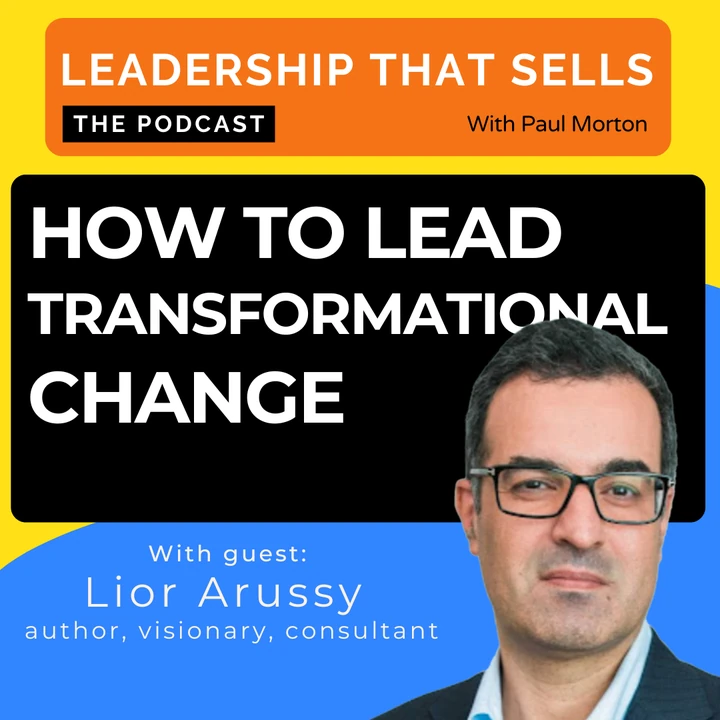
How to Lead Transformational Change
with Lior Arussy
Show notes
Change is inevitable, but why is it so hard to make it stick? In this episode, I sit down with Lior Arussy, one of the world’s leading experts on customer experience and business transformation, to uncover why most change initiatives fail and what you can do to make sure yours succeeds.
Lior doesn’t just talk about change from a boardroom perspective—he goes deep into the human side of transformation. From understanding why employees resist change to unlocking personal and organizational potential, Lior shares a powerful, bottom-up approach that challenges everything you thought you knew about leadership, identity, and strategy execution.
If you’ve ever struggled with change—whether in business or in life—this conversation is packed with insights that will shift your mindset and help you drive real, lasting transformation.
Episode Highlights
[2:02] – Why most change initiatives fail (hint: it’s not what you think)
[3:47] – How employees tie their identity to their job tools—and why that holds them back
[5:56] – The power of purpose: Why connecting work to meaning is the real game-changer
[7:26] – 9 out of 10 organizations fail at change—Lior explains why
[10:06] – Who’s writing your life story? How to take control of your own narrative
[14:25] – How cynicism kills transformation (and what to do about it)
[17:40] – The importance of fueling resilience with positive feedback
[22:21] – The one message Lior would put on 10,000 billboards
Enjoyed the episode?
If you loved this conversation, share it with a friend, leave a review, and subscribe so you never miss an episode. Your support helps us bring more amazing guests like Lior to the show!
Transcript
Automated transcript. Speaker labels and spellings may contain errors.
Paul
One of the world's leading authorities on customer experience and strategy, a self-professed chocoholic, father of five. Welcome to Leadership That Sells, a podcast for sales managers who want to lead with confidence, drive performance, unlock their team's true potential. The idea is you lead first and then you sell more. You unlock the greatness that's hidden in your team. Sales managers are the fuel of business growth. Nothing happens until something is sold. No sell, no eat. When you lead well, your teams perform, your deals close, your targets get hit. But too many sellers get chucked into leadership unprepared. There's no training, there's no support, there's just pressure to hit the number. So what do you do? You micromanage. You stress out. And in the process, you push your people towards the exit.
There is a better way. When sales managers learn to lead properly, teams thrive, culture shifts, performance skyrockets. If you're ready to lead with confidence, check out Leadership That Sells Playbook at the Practical Leadership Academy. Whether you want a self-paced course, a live cohort for your own company, or something more exclusive like our masterclass, there's an option that fits. That's what we try to do here. We're talking about real leadership, real results in a commercial environment, practical strategies you can use today. So let's dive in. Lior Arussy, thank you very much indeed for joining me.
Guest 1
Thank you very much for having me on your show.
Paul
Absolute pleasure. Now, that was ridiculously short and, uh, incomplete. Could you fill in some of the gaps I need-
Guest 1
Sure
Paul
... to know more?
Guest 1
Sure. So I, I spent the last three decades helping organizations go through major transformations. It can be after a merger and acquisition, it can be after a failure, it can be a new strategy. Organizations are having a, a, a mixed relationship with change, and what I developed is a method to help both their employees, the leaders in the organization, to move fast through that and actually capture the opportunities of the future.
Paul
Okay. Well, if you can actually do that, I think you just got hired by 5,000 people. Okay?
Guest 1
[laughs]
Paul
Now, if you can actually deliver something, if you ... Change is the thing, right? The, the, the biggest recommendation that I got as part of my career from one of my mentors was learn how to drive strategic change.
Guest 1
Mm-hmm.
Paul
I said, "Uh, what's that?" Okay? And you ... Number one, you have to work out what it is you're actually doing, but then actually driving strategic change in an organization isn't an easy thing. It's not even easy to define what it is, far less how you do it.
Guest 1
Mm-hmm.
Paul
Help us out here. Do both.
Guest 1
So you're absolutely, you're absolutely correct. Uh, and let me tell you how I start when I look at those. Uh, so again, had the privilege of being invited to over 400 of those. I've been in the trenches. I'm not an academic. I'm not just reading about it. So the first thing I tell every CEO is, uh, "Thank you very much for your choice, uh, but I'm wondering what does Susie from accounting do?" And he looks at me, he's like, "Who's Susie from accounting?" I said, "Susie from accounting is the person in charge of executing your strategy. If she'll decide to embrace it and the thousands of people underneath are with her, then it will happen. And if not, it's not." So first and foremost, we're going bottom up as opposed to top bottom. All strategy starts with the boardroom.
They decide something, and then Susie from accounting and thousands of people are killing it 100 small little deaths. So problem number one, let's go to the bottom. Second thing, and this is our biggest insight, Paul, I have to tell you. The whole change management business is focusing on helping people face the unknown of the future. We discovered that that's not the issue. The real issue is the following. The moment we hear the word change, as human beings, we hear a negative judgment on our past performance. So let's say the organization decided they wanna move to Oracle or SAP and away from spreadsheets. Now, the employee who was working with spreadsheets is thinking, "Wait a second. For 20 years I've been working with my spreadsheet. My spreadsheet is the center of my life, and now you're telling me that this is wrong?" This is the real struggle.
The real struggle is that that old chapter, they're stuck in that old chapter and they cannot write the new chapter because that chapter did not come to life, did not come to closure. So part of what we do in the process is we help them understand the difference between purpose and tools. Let me give you an example. I was working with a bank that was, uh, implementing digital transformation. The bankers were pushing back. They were telling their customers not to download the app, not to use the app because they're gonna get fired. And I remember sitting in a, in a, in a focus group with employees, and one of the bankers said to me, "If you guarantee me that I have a job, I'll embrace digital, and if not, I'm gonna fight it." And I said to her, "I'm gonna guarantee you you have no job if you will not embrace digital.
But let's step for a second and understand what is your issue." And she said, "I was the cashier. They shut down my branch. They shut down my cashier, and I feel, I feel useless. I feel like I lost my purpose." And I said, "Why did you go to banking?" She said, "I love helping people fulfill their dreams through financial means. That's what I love. I love the moment that I can help somebody buy a home because I helped them save." And I said, "This doesn't change, ma'am. In fact, your purpose of helping people fulfill their dreams through financial means, helping this father finance the, the wedding so his daughter will tell him he's the best daddy in the world, that doesn't change." So let's split the purpose
from the tools. When you started 20 years ago in the bank, probably used abacus or whatever it was, and then they gave you desktop, and now they're giving you iPad. These are tools. These are not the purpose. So the moment I create an evolution between the former chapter and the future because there is no breakage to the purpose, only change to the tools, I split the two and I open up an opportunity for em- for employees, and that's when they embrace it and run faster. Because it's not a change, it's an evolution, and the purpose remain consistent.
Paul
And the purpose remains consistent, connected to the individual's identity. And you-
Guest 1
Absolutely
Paul
... can't play with somebody's identity
Guest 1
Correct, Paul
Guest 2
You are identified
Guest 1
Let me, let me emphasize that. They, they call themselves, "I'm the, I'm the Excel person. I'm the spreadsheet per-"
Guest 2
Yeah.
Guest 1
No, no, you're not. That's a tool. You're the purpose person. So that's, that's the aha moment that we help Suzy from accounting and all the thousands of employees, uh, really realize. And the moment they realize that, and management doesn't know how to speak that language, management doesn't know how to structure that story, and that's part of the new book, Dare To Author, where we help them actually structure those stories and, and help them face the future with strength.
Guest 2
There's the lovely story, Dare To Author, I mean, it's not a book about writing books, okay? You're authoring your future. And there's a lovely story about the visit, I think it was JFK visiting NASA, and there's a story of the guy there. He walks up to the guy, he's got a brush in his hand, and he's saying, uh, obviously he's the custodian or the caretaker, he says, "And what are you doing here?" And the guy, with a brush in his hand, says, "Mr. President, I'm helping put a man on the moon." He's like-
Guest 1
Yeah
Guest 2
... "Okay." Somebody somewhere has disconnected the broom in his hand from putting a guy in space, okay?
Guest 1
Yeah.
Guest 2
That's the purpose. His identity is connected with the purpose, the outcome, the, the, the vision, the mission. That, rather than the, "Well, today I'm moving this lump of dust into that corner."
Guest 1
Eh. Absolutely. And, and that's what, that's what I talk about in the book, and I tell my clients, you know, the problem is that your purpose is on the wall, it's not in the soul. And you need to bring it to the soul, and the soul is the story that mobilizes. We don't live in facts, we live in stories.
Guest 2
Yes. Yes, very much so. I mean, we're, we're designed to tell stories. We're... One of my favorite episodes I've done most recently was with a, uh, a wonderful chap, um, who talked about storytelling and, but therefore it's messaging, it's storytelling, it's selling. It's one of the reasons I love sales is because you, it encapsulates everything, every part of human nature.
Guest 1
Absolutely.
Guest 2
It's persuasion, it's understanding deeply what people, drives people, all that sort of good stuff. And change as it relates to leadership, as it relates to sales, as it relates to life in general. It's the, again, the old joke. Hands up who thinks we need to change. Everybody puts their hand up.
Guest 1
Everybody, yes.
Guest 2
Hands up who wants to change. Nobody puts their hand up, right?
Guest 1
That's, uh, that's absolutely the case, and, you know, I'll share with you an interesting, uh, data. So I did a benchmark study with Harvard Business Review a couple of years ago. We benchmarked 422 companies, and we asked them, "How successful are your change programs?" 9%. 9% out of 100%. Now, if you substitute the n- the word change with strategy or future, you understand how significant the threat is. People are stuck in old chapters, and they don't know how to convert them into future readiness. And, and when we ask them, "Okay, so why, why did it fail? Is it budget? Is it technology? Is it governance? What are the issues?" The number one issue is the human factor, and it starts with the same top-down approach of leadership.
We decided in the boardroom, we announce it once, you all line up and start executing. It doesn't work that way. It just doesn't.
Guest 2
Mm.
Guest 1
It's about the, the millions of small decisions, every email, every phone call, every team meeting. Is it embracing change and accelerating it, or is it delaying it and keeping it behind? That's why you need to go back to Suzy from accounting. That's why you need to understand where she's afraid and how to help her understand the purpose and separate it from the tools.
Guest 2
It's, I mean, so change I think is, it's, it's intrinsic to us and our existence as, as humans. I mean, evolution is change.
Guest 1
Yeah.
Guest 2
Nature is change. Having children, you've five of them. How did you do that? You don't look like a heavy drinker. Five [laughs] you've five kids. You-
Guest 1
I-
Guest 2
Wow
Guest 1
Let me surprise you. I have five grandchildren too.
Guest 2
Away, my goodness me.
Guest 1
Yes. [laughs]
Guest 2
Awesome. You must have been a child bride. Look at you. You, you... If you're not watching in the video, you should be. This man looks like he's 18. Anyway.
Guest 1
Thank you. [laughs]
Guest 2
[laughs] So change is, it's, it's an intrinsic part of hu- human nature. Things that don't change don't live, and things that don't live are dead.
Guest 1
Yeah.
Guest 2
Yeah?
Guest 1
Yeah, absolutely.
Guest 2
And but when it comes to changing ourselves or changing how we work, it is so tied up in identity. We tie ourselves in knots with identity, and the identity that we create for ourselves is almost invariably the wrong one. It is, "I'm Suzy from accounts." No, you're not. You're Suzy who likes fly fishing. You're Suzy-
Guest 1
Yeah
Guest 2
... who is the mother of three. You're Suzy who is the successful businesswoman who does and, and creates and has and all this. She's not an accountant. She happens to be an accountant, but she's not who she is.
Guest 1
It's, it's... I would, I would step further, Paul, and develop-
Guest 2
Oh
Guest 1
... on top of what you said. Accounting is the tool you use to make an impact on someone else.
Guest 2
Exactly.
Guest 1
Your center of gravity should be the impact you make on other people, and, and what defines you is the impact that you make on other people, not the tools that you use. And people confuse tools and purpose, and assign themselves to the, to the tools as opposed to the impact on, on who they are. In the book, I raise the question, who is authoring your life story, okay? And my argument is that in the absence of you proactively, conscientiously authoring your life story, it's gonna be authored for you. And I'll give you two or three examples. Imposter syndrome.
Guest 2
Mm.
Guest 1
How many of us have experienced imposter syndrome? In the most important meetings, we freeze, we're afraid we're gonna be discovered, we're not really what we are. Imposter syndrome is authoring a very fake story for you if, if you're not authoring your own. Or what I call the, uh, the gratitude denial syndrome. Gratitude denial syndrome, we all hear feedback, and we just downplay the good feedback, and we're like, "Okay, tell me what's wrong. Tell me what's..." And I'm like, "No, the good feedback is part of who you are. It's part of your fuel and your energy for the future. Stop denying it. Stop downplaying it." Or good news, bad news, who are you first? So these are examples that I bring in the book of how our life story is being shaped for us because we are not taking charge of it, and we're not being proactive about authoring that life story.
It ends up to be very, very, very twisted ... unsatisfying, and the bottom line is we're victims. Our life story places us not in the victor and the, and the protagonist and the hero, it places us in the victim in the story. And, and, and the book is calling us to get out of victimhood and live and lead life of victory.
Guest 2
And all of this speaks to, uh, personal development. All of this speaks to the, the, the value of the individual and then how you can value yourself. You know, call it be kind to yourself. I'm not a be kind, fluffy kind of person. There's nothing I, I have less time for than fluffy fluffness, right?
Guest 1
Yeah.
Guest 2
It's the value of the individual comes starting with yourself, recognizing that you, you are who you are, that you can talk to yourself. Nobody listens to you more than you.
Guest 1
Yeah.
Guest 2
Things you tell yourself, you believe.
Guest 1
Mm-hmm.
Guest 2
If you tell yourself you are just Suzy from accounts, when in reality you're a successful CFO at a multi whatever, that's who you'll always be.
Guest 1
That's-
Guest 2
The reality is-
Guest 1
That's correct
Guest 2
... whatever you tell yourself. So the value, I think, in somebody like you coming along to an organization and helping them through a change process, you're not just delivering organizational business transformation. That sounds very fancy, doesn't it? Business transformation. Good for you. You're not just delivering business transformation. You are, I think to some extent, unlocking the potential within individuals in that organization because you help them to realize their worth.
Guest 1
It, it's, it's true, and I'm inviting them to rise up to the better version of themselves.
Guest 2
Yes.
Guest 1
Let me give you an example. Paul, let me give you a great example. I was doing a workshop for a company in crisis, and in the middle of the workshop I turned to one of the vice presidents and I said, "Please leave the room and don't come back." And the guy looked at me, he's like, "What do you mean?" I said, "The door is there. I want you to leave, and I don't want you to come back." He look at the CEO, the CEO is telling him, "Look, Lior told you to leave, leave." And, and he's like, "Why?" I said, "Because you're cynical." He said, "Cynical? Cynical is my toolbox. This is how I survive." I said, "That's correct, but show me one entrepreneur who built his business on cynicism," because let me tell you what cynicism is.
Cynicism is like drugs. You laugh at it right now. Short-term it gives you relief. Long-term, you just destroyed the motivation of everybody else. Because what does cynicism say? Cynicism says, "Why bother? Why are you trying so hard?" And, uh, as long as your language of cynicism is gonna be there in your head and in this organization, you are destroying motivation. So I'm calling people, pay attention to that cynical voice in your head, pay attention to those cynical jokes you share with other people because it's the equivalent of taking a five, five kilo hammer and starting to destroy motivation for people. So there are practical examples of how our life stories is being shaped outside of our control because we refuse to take control of that, and cynicism is a great example of that. Quick joke, we feel a relief, but we just destroyed long-term commitment.
Guest 2
Yeah. Yeah. I know. So much, I mean, I, I talk about leadership an awful lot, and so much of that comes from or is reflected in, rather, is reflected in child-rearing, you know? The, the older my kids get, I think the better my leadership gets because the more deeply-
Guest 1
Yeah, it's true
Guest 2
... I understand how-
Guest 1
It's true. Yeah
Guest 2
... more about human behavior.
Guest 1
Yeah.
Guest 2
You wanna understand yourself, either look in the mirror or look at your kids.
Guest 1
Yeah.
Guest 2
And there's nothing as easy to destroy as motivation, as enthusiasm with a, with a misplaced word or a negative, uh, piece of feedback. You talked about good feedback as one of your, uh-
Guest 1
Yeah
Guest 2
... one of the aspects. I think it's, it's ... People are so used to what I call the shit sandwich, right?
Guest 1
Yeah.
Guest 2
You know? It's the shit sandwich. It's like, "Hey, uh, uh, Lior, you're, you're really good at this." Yeah, okay, and? And when's, when, when is the negative? "But you're really crap at that. Oh, and you're also not a bad person." What, what ... So where is that to give-
Guest 1
So-
Guest 2
... any sort of feedback?
Guest 1
So, Paul-
Guest 2
It's bad
Guest 1
... five, five children taught me some things, and I'll share with you a practice-
Guest 2
Sure
Guest 1
... that I do with the teachers of my children, and the teachers get upset. So I'll go to pare- pa- parent-teacher conference, okay? I'll go to the history teacher and he says to me, "Oh, your child is a D plus in, uh, in, in history. We need to work on it." And, and my answer will be, "No." And he said, "What do you mean no?" I said, "If my child is a D plus in history, probably his heart is not in history, and I'm excluding right now your teaching skills. So what is the best I'm gonna take him to C?"
Guest 2
Yeah.
Guest 1
"I, I just came from the math teacher who told me that my child is B plus in math, and I think if I'll invest in that I'll get him to an A plus. So you know what? Let's stop doing one size fits all and look for people who are perfect in every skill and, in fact, work on their strengths, give them honest feedback, and the other things, find other ways to make the, to make the done, to get it done."
Guest 2
Yeah. Yeah.
Guest 1
And they would get crazy and furious. I'm like, "Guys, nobody's perfect in everything, and you know [audio cuts out] that, that rises are, but, but not real people." It's crazy.
Guest 2
I love it. I love it. Strengths, strengths are a huge thing for me. You'll, you'll never get somebody who's a, as you said-
Guest 1
Yeah
Guest 2
... a D to an A.
Guest 1
But, but, but-
Guest 2
You might get somebody who's a B to an A.
Guest 1
Yeah. But I want, I wanna, I wanna say something about this. The sandwich concept, you're absolutely right. Five positives before a negative, all these kind of games. But as a leader, be honest with your people and give them positive feedback because they need it. And we, as recipients of the feedback, should not be downplaying it because we all do that. And the, and the reason for that is we need that feedback as a fuel for the future resilience that we need. If we don't, we're coming to new unexpected situations empty. We, we, because that, the, the successes of the past, the achievements of the past are the fuel for us to be more resilient facing the future. And if you're gonna downplay them, if you're not gonna refuel, how are you planning to face the future?
Again, with the weakness? Again, with the victimhood?
Guest 2
Mm.
Guest 1
The, the, the, the ... This is exactly the process of authoring when we take a life experiences and convert them into future tools and future confidence and future resilience, so we can look at the next change not as a threat, but as an opportunity.
Guest 2
So true. So true. So true. Yeah. It's ... You, you, you've got a bucket and you need to fill it up, and if it's empty-
Guest 1
That's right
Guest 2
... it's empty. It's, it's a very British thing, actually. Somebody says, "Hey, Paul, that was really well done." You go, "Oh, well, you know, it's not really kinda ... " Well, no. Somebody once told me the correct way to deal with that, and I'm so grateful-
Guest 1
Yeah
Guest 2
... for them.
Guest 1
What is it?
Guest 2
It was, you say, "Thank you."
Guest 1
Yeah.
Guest 2
That's it.
Guest 1
That's it.
Guest 2
Somebody says, "Well done. You really did a good job. This was a nice thing," whatever it was, and your response should be, "Thank you."
Guest 1
Thank you, and thank you for taking the time.
Guest 2
Shut up and just enjoy it.
Guest 1
Tha- thank you, and take, take the time. You know, just the other day-
Guest 2
The-
Guest 1
... I got a, I got a call from a reader of my book. The book was just out, okay, a few days ago. The guy called me, he said, "I, I, I didn't wanna send you an email. I wanted to call you. I found your number. I wanna tell you the book made so much, uh, impact on me. It ... In fact, it has all these pages that I folded because I'm planning to, to go back to that."
Guest 2
Saw your picture.
Guest 1
Yeah, you saw the picture, and that's what I said. I said, "Thank you." You know what? There's nothing more rewarding for me to come out of a three-year process of writing the book and publishing it, to have somebody like you saying it was worth it. And thank you. That's what keeps me going. That's what's gonna give, get, gonna get me going to the next writing. That's refueling.
Guest 2
Marvelous. Marvelous. So apart from your book, which is ... Is, is it available now? I think it ... Was it coming out right about-
Guest 1
Yes, it is.
Guest 2
Now available.
Guest 1
Yes, it is. Dare to Author is available.
Guest 2
Superb.
Guest 1
As of last week.
Guest 2
Superb. Well, the links to it will be in the descriptions in this, uh, in the show. I'm sure people can find that there. What else are you working on at the moment, Lior?
Guest 1
So I am working, uh, on what I call the next generation of customer engagement. I believe that w- all the empowerment that customers have received, ChatGPT, have brought us to the, uh, tipping point in which our customers are so empowered today that companies needs to rethink their, uh, engagement. Uh, that's the first model. The second thing, it's about employment. With hybrid employment and so on and so forth, the leadership model need to change dramatically. We can no longer transfer culture by osmosis because they're all in the same, uh, office. So what are the new models of, of creating commitment and creating pride in the brand when you're sitting in your own home with your cat in the, on the side, and there's no real ... So, so I'm dealing a lot with the challenges of, uh, finding purpose in a hybrid model, finding a sense of commitment in a hybrid model, and how do you develop leadership in a
hybrid model? So those are two areas that, uh, you know, my research and my work is focusing on.
Guest 2
Wow. I mean, that, that's about as relevant as you can think. Can you give us any hints of what you find out so far?
Guest 1
Uh, yes. So I'll t- I'll, I'll give you an example. So especially with Gen Z, where people are struggling to how to speak to them, they seem to be self-centered, and so on and so forth. So the example I use is very simple. I said, let's say you're passionate about cooking. Now, you have couple of options. You can go to McDonald's, but you're not gonna express yourself. You g- just gonna flip burgers. You can go to a Nero Cafe, and maybe they'll let you switch the milk every so often, and, uh, and something of that. Or you can go to a Michelin Star. They're gonna work you like crazy, but you're gonna get an amazing stage in which to perform. And my challenge to employees is, it's your talent to the power of the brand that you're going to work for.
They're giving you the stage. You need to decide if you're gonna bring a West End or a Broadway show on that stage, or you're gonna give me one of those community college theater department performance. The company's expecting you to give me a West End pr- uh, performance. If you choose to do a community theater department, please go somewhere else. But understand, your talent to the power of the brand that you choose. So which stage do you choose to perform on?
Guest 2
Now talk about breaking things down to a mathematical formula. So talent to the power of the stage you're given. I love that. That's brilliant.
Guest 1
Yes. So that's, that's, that's your, that's your little, uh-
Guest 2
The messaging
Guest 1
... insight into the future of my writing and, and my, uh, and my work.
Guest 2
That's the next book. That's the next book. All right. Well, let's wrap this up. I got one last question for you, uh, before we, we work out where we can find you, is if you had one thing you can tell the world, if you had 10,000 billboards that you could write one message on and everyone would see it, what would that one thing be?
Guest 1
Stop choosing to be a victim.
Guest 2
Oh, that's like a second one. That's good. Stop being a victim. That's it. Stop choosing to be a victim.
Guest 1
No, choosing.
Guest 2
Choosing.
Guest 1
I'm, I'm telling you that it's a choice.
Guest 2
Very precise.
Guest 1
It's a choice. We ... You know, people can do things to us, but to feel a victim-
Guest 2
Mm
Guest 1
... that's our choice. And when we choose to be a victim, we choose to avoid the future, we choose to, to, uh, we choose to reject the future, and nothing can be worse than that.
Guest 2
Mm-hmm.
Guest 1
And it all starts with that, with that default victimhood that we choose to accept, as opposed to rising up to the better version of ourselves. Because you know what, Paul? We didn't choose our parents, we didn't choose where to be born. You know, there's so many things we didn't choose. And then there are those who are rising up with those circumstances and become victors, and others who stay as victims in their own life story. So stop choosing to be a victim.
Guest 2
Lior, that's a fairly profound way to end our conversation. Uh, we can find you on liorarusi, uh, .com. The links and everything will be in the description here. Is there any last message you'd like to leave with the listeners?
Guest 1
Create hope for yourself first.
Guest 2
No victimhood.
Guest 1
No victimhood.
Guest 2
Create hope. Lior Arusi, thank you very much indeed for joining me.
Guest 1
Thank you very much for having me on the show. [upbeat music]