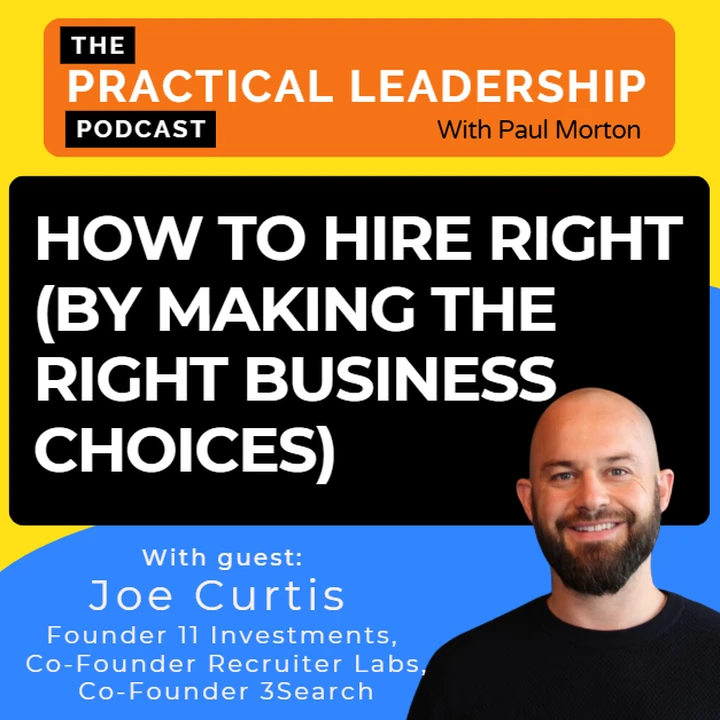
How to hire right (by making the right business choices)
with Joe Curtis
Show notes
In this episode, I sit down with Joe Curtis, founder of several successful recruitment and investment businesses. Joe shares his journey of transitioning from recruitment into entrepreneurship, building a business with a clear vision, and recruiting the right people to help that vision come to life.
Key Topics Covered:
- Starting from scratch: Joe details how he launched his first business in marketing recruitment, 11 Investments, and Recruiter Lab, and the key decisions that helped him scale.
- The importance of vision in recruitment: Joe explains how telling a compelling story about where the business is going—rather than focusing on where it is—was crucial to attract top talent, even when they were just starting out.
- Building an attractive employer brand: Learn how Joe’s businesses developed a strong Glassdoor presence, secured positive Google reviews, and won the Sunday Times Best Place to Work to solidify their reputation and attract talent.
- Hiring based on values: Joe shares how they assess potential hires not just for their skill but for their alignment with the company’s values—bravery, growth, kindness, and belonging. They believe in creating an environment where people feel they belong.
- Why recruitment never stops: Joe reveals that his primary role is recruiting for his own businesses, meeting up to 20 potential hires a week. He stresses the importance of founders staying involved in the recruitment process, even as the business grows.
- The long-term approach to talent acquisition: Joe explains the importance of being transparent about company culture and ensuring that potential hires know what to expect before joining. His approach mitigates high attrition rates typical in the recruitment industry.
Key Quotes:
- “You’ve got to build the vision and this story for people to come along the ride with you.” — Joe Curtis [00:10:54]
- “We are nothing without the people that we hire—literally. There’s no business without them.” — Joe Curtis [00:24:11]
- “Doing business in a kind way will pay back in dividends over time.” — Joe Curtis [00:27:51]
Actionable Insights:
- Create a compelling story for your business: When hiring, don’t just sell the present state of your company. Sell the future. Show candidates what role they can play in building something great.
- Hire based on values, not just skills: To build a successful company culture, focus on hiring people who align with your company’s values. Skills can be taught; values are much harder to instill.
- Stay involved in recruitment: As your business grows, it’s easy for founders to step back from the recruitment process. But Joe’s approach shows that staying involved helps ensure you hire the best people, who align with your vision.
Catch the full episode to hear more from Joe Curtis on building vision, leading with kindness, and recruiting the right people to make it all happen!
Transcript
Automated transcript. Speaker labels and spellings may contain errors.
Paul
Former director at Michael Page, then setting up his own incredibly successful international search and recruitment business, swiftly followed by setting up an investment business, swiftly followed after that by setting up his own laboratory accelerator and- Hello, and thank you for joining me on the Practical Leadership Podcast. My name's Paul Morton, I'm your host. We try to distill the hard-earned wisdom of CEOs, executives, and high performers around the world into actionable insights that you can take away and put into your leadership practices really quickly. If it's time for you to look at your own management teams and help move them from being accidental into being intentional, then in nine short weeks, the Practical Leadership Playbook course will help you do just that.
Check out the Practical Leadership Academy. And now, on with the show. Joe Curtis, thank you very much indeed for joining me.
Joe Curtis
Nice to see you. Cheers, Paul.
Paul
That was a fairly shorthand, uh, summary of the last, what, 10 years?
Joe Curtis
That's right, yeah, yeah.
Paul
Okay. I think you can do better.
Joe Curtis
Well, 10, 10 years, uh, 10 years since we, since we left gainful employment and started out on our own. Yeah, absolutely.
Paul
It's, it's a wild ride.
Joe Curtis
Yeah. It has been indeed, yeah. Thank you for the kind introduction.
Paul
So can you expand on the key parts there?
Joe Curtis
Sure. I can, uh... Yeah, it sounded a bit, it sounded a bit grand really, so I'll, um, I'll maybe, I'll, maybe, uh-
Paul
Try to big you up, you know?
Joe Curtis
Yeah, yeah. Thanks. Um, so yeah, ex-recruiter, um, turned recruitment investor basically is, is, is, is the, the strap line. So yeah, spent a good seven, eight years at Michael Page, um, where we learned our trade. And, uh, went out on our own to launch Three Search, which is a marketing recruitment company. Uh, and have subsequently invested in several other individuals to launch their own businesses under Eleven Investments brand. Eleven Investments is our, yeah, recruitment incubator investment vehicle where we bring people into the same environment as us, and we help them grow their own companies, all part of the same group. We share all sorts of things. Yeah, we share office space, we share clients, we share earnings, we share incentives, we share practices, salary bandings, everything. All that sort of thing. Um, and then, yeah, the, the, the final business you, uh, you mentioned is a, a business called Recruiter Labs, which is a, uh, a business that supports standalone recruiters.
So we, um, we provide all the back office required for people to go out on their own. We don't take any equity, we just take a revenue share on an ongoing basis for providing services and products to those individuals.
Paul
So you've got recruiters coming and going, basically.
Joe Curtis
That's right. We're, I am, we are in, I am heavily in recruitment. That's right. [laughs]
Paul
[laughs] I suppose as heavy as you can get.
Joe Curtis
Yeah.
Paul
So we talk about niching down, you're niching down and niching out, right?
Joe Curtis
Yeah.
Paul
So you've gone into... Your, your original business is digital market- It's digital and marketing, right?
Joe Curtis
Yeah, that's right.
Paul
Okay. And then obviously that was fairly successful, so you used that then to fund the investments in the other, the other, uh, verticals perhaps.
Joe Curtis
Mm-hmm.
Paul
And then used that learning to create something that you could envelope around other nascent businesses, probably, or presumably with a view to helping them grow to a point where they could become part of the party as well, that is.
Joe Curtis
May- It's a, maybe it's an option. But actually where the Recruiter Labs idea came from was me speaking to lots of people who either we didn't want to invest in or we didn't want them in our environment, or they didn't wanna be our in our, in our environment. Maybe they weren't in London or they didn't wanna be in an office. But, you know, I could see that they were gonna be successful with the right provision or with the right services. And, you know, we had this successful capable back office function, and so we just, we'd plug, plug those individuals into those services, um, provided their finance for them, their marketing set up, their, yeah, their website, their recruitment products, the services they would need, technology that they might need, so a CRM system-
Paul
All the good stuff
Joe Curtis
... that kind of thing.
Paul
Okay.
Joe Curtis
Absolutely.
Paul
Mm-hmm. So, I mean, your businesses, the ones that you are directly responsible for, that you have grown since you left, uh, uh, Mr. and Mrs. Page there, you've been busy h- hiring lots of people. Now the-
Joe Curtis
Yeah
Paul
... if, if among all businesses, I think recruitment can be quite high in terms of its turnover of staff. All right?
Joe Curtis
Right, yeah.
Paul
So you must have a nonstop insight into the prac- the practices of your practitioners if you are continually recruiting for recruiters. How much of your, how much of your day does that take up? How much of your week does that take up?
Joe Curtis
Well, it's my, it's my primary focus really. We were, um, we were lucky enough to, to happen upon three of us starting the first company. Um, we were fortunate enough that we've all got quite different skill sets, quite different capabilities, and quite different appetite of the jobs we want to do. So we naturally fell into Charlie managing the people, Andy delivering on some work, um, and being a bit of a tactician and the, the guy behind the scenes in the back office. And I, I was, you know, well, to begin with, I did a bit of client-winning, um, business development. Really from, from the early days, my focus was hiring people for our business, and then subsequently finding people to invest in, and then subsequently finding people for those businesses. Um, so yeah, an, an awful lot of my focus from day one has been getting the message of what we're building out to people
who we might be interested in hiring. Uh, so I would meet, uh, up to, yeah, up to f- 20 people a week. Um- Who we might hire. That, that would be a busy week, but it's never less than, it's never less than sort of six or seven week in, week out. So, um, it's, it's a big focus for us. It's, it's so important for all businesses, in my opinion, hiring. Um, and, and like you say, recruitment has got quite a reputation of quite high attrition 'cause it's the role, the job isn't for everybody. [laughs] Um, we, we kind of mitigate that by trying to keep hold of people for as long as possible. Our attrition's actually comparatively very low in the recruitment industry. So yeah, the, the job revolves around finding the best talent we can, engaging them,
yeah, acquiring them, kind of onboarding them, and then keeping them for as, for as long as possible. Um, giving them a- as best- the best experience that they possibly can so that it's easier to then hire the next person because we've got a good reputation, a good presence digitally, good Glassdoor, good Google reviews. If clients saying good things about us, so can- so consultants want to come work with us because of the work we're doing with clients and customers. Um, so we're kind of like the aim is to have this, um, s- kind of this, this rotation, this circle that kind of makes it easier, and easier, and easier to hire people. Um, you know, hiring the first recruiter when it was three of us with no office was, was tough. Um, and it, a- and it's kind of, yeah, with the right actions, it, it kind of can or should get easier over time.
Paul
So if you're now recruiting the 101st person-
Joe Curtis
Mm-hmm
Paul
... to come join your team, 'cause that's about the right size. You're about 100 folk?
Joe Curtis
Yeah, we're about, about that number now, yeah.
Paul
Very nice. And, and not that many years really when you think about it. Okay?
Joe Curtis
Yeah.
Paul
I always, I always like thinking that, um, when you are the entrepreneur, when you are the business builder, and yes, you're build- you're building teams, you're, you're driving revenue, you're satisfying customers, but you've also got on your shoulders, but also at your back, 100 people, and 100 people's families, and, and 100 people's pets, and 100 people's pals. So you've built something that supports the lives of many, many, many folk. It's always a thing to, to, to, to be reckoned with, I think. You know?
Joe Curtis
Yeah.
Paul
Responsibility.
Joe Curtis
Yeah. It, it is. It is. And it, um, yeah, I think I look at that when, you know, when I, when I think about that, um, you know, it obviously makes me very proud. Um, but yeah, it brings its challenges.
Paul
So talking to, uh, the founder of a successful recruitment business who in turn spends a significant amount of his time... In fact, you just said it's a primary role of any manager. And I, I would agree with you. Uh, when I was leading teams, it was, it was Friday. [laughs] That was it. Friday, it was just recruitment. Didn't matter whether it was an upturn, downturn, scale or not, Friday was networking, connecting, talking, interviewing, whatever it was. That was every single thing. Um, talking to you, looking at how you do what you do, I don't know, I'm trying to find an analogy here. It's a bit like going to, uh, going to a surgeon and trying to find out how do you stay healthy. Well, that's probably not a very good analogy [laughs] because they're some of the most unhealthy people you can imagine. But I'm trying to get into your head, how do you do what you do?
'Cause you must, or at least you must aspire to be the archetypal, typical highest performing organization you can be. Because you must eat your own dog food, or even better, drink your own champagne. You want to have... Why would I go to a, why would I go to a barber who had a bad haircut?
Joe Curtis
Yeah.
Paul
Right? Why would I go to a recruiter who couldn't recruit? Okay. You evidently can. How'd you do it? What's important? Where do you start?
Joe Curtis
What, in, in hi- in terms of how to hire people?
Paul
Well, what's your, what's... Give, give us a picture of the, your, your process here so that... What do you go through? If it's not your secret sauce, and you're willing to spill the beans.
Joe Curtis
So it, it's, it's e- everything is all... I, I think everything speaks to everything else. So it, it's all-encompassing. So you have to have a good... You have to build a good story. So yeah. And th- this can be, you don't have to be 100 people for this. You can be, you can be n- no hires yet. You know, I, I remember making our very, very first hires. Um, you know, w- we spent a lot of time... You know, we hired, um, two gu- two... First lady we hired was called Jasmine and, um, she doesn't work with us anymore. Uh, and then we hired two, two chaps, one called David, who we call Gaz, and one called Ollie. Um, and this was in the start of 2015. And they're both, they're both still with us, um, i- in, in senior, in senior, um, important roles within the business. And we spent an awful lot of time, um, at that, at that period of time persuading these guys to join us, basically.
So w- we spent a lot of time creating a, yeah, creating a vision and building this story of where we were going, not where we were, 'cause where we were wasn't impressive, right? So where we were going, where, where the business was going and the, the key roles they were gonna play and, uh, they could play as part of that journey. Um, and it's really, at that point, it's about telling the story of, of what, what these guys are buying into. And, um, yeah, w- we, we were acutely aware that we were not a particularly attractive proposition at that time. Um, you know, we didn't have an office, or if we did, it was tiny with no furniture. And, you know, we, we were, we were heading... We believed we were heading somewhere great, but in order to get there, you've got to persuade people that that's where you're going.
So, um, you know, you've got to build this vision and this story to, to, for people to come along the ride, come along with you for the ride. Um, and now, that, yeah, that manifests itself in all different ways now. You know, having a decent website, and EVP, and yeah, employer proposition and, you know, we've won Sunday Times' Best Place to Work that we entered a couple of, couple of years ago, and we've got a really good Glassdoor review and, um- Yeah, as I said, as I've already said, our, our customers say very good things about us. We've got over 1,000 five-star Google reviews across the board. Um, we're, we're now through... You know, my business partner Andy is championing this, but we're, we're now going really heavy in MPS, which isn't particularly, um, prevalent in the recruitment industry and we, we've just got three search up to 70 plus MPS score.
Um, so all of these things help, I think. Having a good track record. If you don't have a good track record to begin with, so you've got to build that story. Um, yeah, having a good track record, having lots of people who say nice things about you, whether it's people who still work there or don't work there anymore. You know, we- we've got people involved in, in, in processes where if someone might want to speak to somebody who doesn't work there anymore to ask what it's like, yeah, we, we, we do that. Um, we get people to me- to, um, to meet a lot of people when they come and interview with us, uh, to make sure that we're right for them and they're right for us. Um, yeah, a, a whole, a whole host of things go into, go into powerful talent acquisition.
Paul
So you have to have a good story. You have to have something you can articulate who you are and where you're going.
Joe Curtis
Yeah. You, you have to be... You have to believe where you're going. You have to have a compelling story-
Paul
Mm-hmm
Joe Curtis
... to articulate, to give you the best shot of hiring the best people. I believe that, yeah.
Paul
Okay. I think when I help people who are coming into roles, and you're trying... Typically, it's the company's been acquired. It's just the places that I work. They go in, somebody's been acquired, somebody goes in and their first job is to identify the talent and make them stay. Right? Identify the talent, make them stay. Please don't leave because otherwise we're kind of all screwed. So you identify the talent, and what do you say to them? "Please stay," yeah, that's gonna help. The thing that I recommend people do is you find out from that person what they want, and then you articulate to them a plan, and you work on this plan for them to make the next two steps in their career. We'll get you to here, and we'll get you to there. Don't know how, don't know when, but this is a plan which is more than most people have. Most people live paycheck to paycheck, and if your boss suddenly comes in and says, "Well, I'm gonna get you from here to here, and then I'm actually gonna think about how do we get you from there to X, which is further," wow,
somebody really actually has listened and cares, and yes, I will now stay at least for the next year. Okay. So you're talking about articulating the vision of where you are and where you're going to go. That alone I think is a differentiator for most. So you- you're clear on that. You've got people coming in the door. We skipped a few here. Okay? Clear on what it is you're trying to do. You then go where? Who are you looking for? How do you identify the sort of people you're looking for? What are the characteristics? How do you match that versus how do you find them out? How do you make sure you're getting the right person you're talking to?
Joe Curtis
We... They've got to be able to do the job that we want them to do, which is, you know, 90% of our employees are recruiters, so they've got to be able to do recruitment. They've got to want to do recruitment, um, which lots of people do recruitment and don't want to do recruitment. So they've got to be capable and willing. Um, and then we, we also, beyond that, we then hire based on our, basically our four values, um, which are bravery, growth, kindness, and belonging. Now, belonging is it's not really a value I suppose, but it... We're so, we are so, um, committed to creating an environment where everybody feels like they belong, 'cause we think that's incredibly powerful, that it's, that it's listed in our values.
So we, we want to make everybody feel like they belong. We want to, we want everybody to feel like they belong. We want that. We want all of our actions, um, to, to make people feel like that, to be a very welcoming environment. Um, and the, the, the other three are, are very, very important to us, um, important to how we operate and how we want, how we want everybody who we work with to operate. So if we feel that somebody's capable of doing the work, wants to do the work, and will operate in the way that we want, then we'll do everything we can to, to, to acquire that person. Um, and usually if they are the right people, uh, then they usually want to work at our business because we do operate relatively uniquely in the industry that we're in.
Um, I'm sure you're aware that, you know, recruitment as a industry has a reputation, somewhat justified but less so these days, but somewhat justified as being, yeah, kind of like a cold, hard sales floor environment where the people are only interested in the next deal and moving on and, you know, would do whatever to make the next commission check, which we've never been on board with, um, isn't really how we've ever operated. And, and thankfully the industry is changing a bit, but, um, we- we're still at the kind of, um, at one end of that spectrum in our industry. So usually, um, usually the right people want to work with us. We just need to meet enough of them.
Paul
Okay.
Joe Curtis
We need to get our message out to enough of those people. Uh, you know, and, uh, uh, we've got, you know, our talent director who, who work- who works closely with me, Sarah, is fantastic, um, at getting that message out and, and getting lots of people in, in through the doors for us to, for us to have conversations with.
Paul
So you're out there advertising that you exist. You do... I'm sure you do podcasts, you do ma- marketing in some ways and shape and form to both attract customers and to attract talent. Somebody comes in your door, how... What's, what's the first thing you do to say yes or no? 'Cause you've got a fairly defined role that you're looking for. You're looking for a recruiter who can spend quite a lot of time re- researching and speaking to people. Yeah? What... How do you determine the fit for the role as a start?
Joe Curtis
So we hire, so we do, we do hire based on role, but we also hire very opportunistically. We will also meet good recruiters and see if we can find a home for them within our environment. So our process at the moment is, um, talent will speak to the per- sorry, Sarah will speak to the individual and it, they'll, she'll perform an interview with that person assessing their previous track record. Um, and if, if, yeah, if she feels they're suitable as a general, um, track record and, and environment fit for us, I will then meet everybody, um, at the next stage, which is, which is unique again, for a, a business of our size that one of the founders will, will meet, meet all applicants at, at an early stage in the process. The reason for that is, um, I think it creates huge buy-in, and I think that, um, I want to be the person making the call on whether, whether I commit further time from our sales managers, leaders, and other founders to whether they're spending time with, with
people externally. The whole idea of what we're building is that we make it as easy as possible for the guys to make money, and that means I do a lot of filtering of, of that talent. Um, so twofold. One, it doesn't, others don't spend time doing it, and two, I think it gives us the best shot, the best shot of hiring somebody or, or it gives us a really strong footing of hiring somebody we might want to hire if I'm there selling the, selling the business, selling the opportunity, and then assessing that person on a, um, that's really a kind of like a cultural fit, environment fit, values fit sort of level. And I don't, I, I don't have an exact science and process to talk to you about. Um, I will just probe, uh, I won't have a set patter. I will just have a conversation with somebody. Depending on what they say to me, depending on what their answers are, I'll then ask them something else.
I might probe a certain area and I'll, I'll get an understanding of, of you, a sense if I think they're the right sort of person for us. Um, they'll then go in front of either our investment director or another founder, and that's where they get properly interviewed as to their, their track record. Um, and at that stage, we'll, we'll make a call on where we want to hire them. Uh, and there might be another meeting after that for them, um, again, for them to meet more people and maybe to meet the manager they're gonna work for if it's not one of the people they've already met already. We might get them in a social environment if, if we want to do more probing on how they interact with people. Um, we might get 'em to meet several people, up to maybe 10 people, not, not 10 different stages, but we might get them to meet up to 10 people in, in a process.
Um, because I think it's really important for that person to make the decision and for, and for... Yeah, that's really why we would want to do that, for them to meet so many people, is for the, for the prospective candidate to, to decide that it's the right place for them to work. Because of lots of people, it's very, it's very difficult for these guys to, to, to know, um, what things are really like when they get in the door of a company. And lots of people in the recruitment industry will describe the business they're hiring for, um, in a very, very kind way that, um, maybe isn't the truth when people land in the business. And we want people to know exactly what our business is like before they start because we don't want them joining and then realizing they've bought into something they, that's, that's not what they thought it was and leaving after six months.
That's just a huge waste of everybody's time. But the industry is littered with, with operators who, who do that.
Paul
Sure.
Joe Curtis
Um, just focus on just acquiring the person and then worry about keeping them later. Whereas we're like, "No, we wanna make sure that we're all aligned and that you're gonna stick around for three, five, however many years."
Paul
It, it speaks, I think, to either your experience, your intellect, or your ego, or all three of them, that you, the founder, have decided to stay at that stage in your process. Typically, when you get to, you're talking to any organization, they get to a point which is normally about, what, four to 5 million ARR where the founder steps out of the sales process because it's a pivot point. It's, it's an intrinsic pivot point in the scaling journey, which is founder does all the selling, uh, then you have non-founder-led sales. So you have like an innovative, uh, salesperson comes in and does the selling, and then founder steps back and does all the strategy stuff and that, which is the, the highest value things that somebody like you should be doing, right? But you've made the decision, uh, to stay embedded in this process where you're doing this filtering, which could be a,
a fairly mid-role talent job, right? Somebody's got a sense of the business. Do they have one, one head or two? Okay, two heads, out the door. So you're doing this filtering and you're still involved in this stage of the business, and you've obviously made the decision because if you're doing this, you are not doing many other things, right?
Joe Curtis
Yeah.
Paul
How did you come to the conclusion that you needed these people? You are, you're... You're a people business, right? Of course, you're a people business. You're a recruitment company. Of course, you're a bloody people business. But the people that are doing the recruiting are the partners of the product, the product being the individual that you are getting from market to job, and you have to find these partners who can prize them out of wherever they are, match them to the culture and position that the, the target company has, and carry them along on this journey. How did you make the decision to stay there and not back off and let your talent people do it?
Joe Curtis
Because I li-, I, I li-, I like it. I'm good at it. Um, uh, I'm perfectly comfortable that that's part of my skill set is, is recruiting for us. Um, and I think it gives us the best chance, uh, of growing and h- and hiring the best people. And, and that is the... You know, we're nothing without the people that we hire. Um, li- literally there's no business, right? As you said, we, we don't have a product. Our product, we need to go and find our product every day. And the pe- we, we hire people to go and find that product and service our customers. So we are just the people that we hire. And, um, it is the, uh, in my view, my humble view, it's the most important thing we do is, is hiring talent for our business.
Um, yeah, hopefully Charlie, my business partner, would tell you that the most important thing we do is managing the people that we hire and, and how we service our customers, and, and, y- yeah, that's fine as well. But, um, yeah, I, I think it's the most important thing. Maybe I would think that because that's, that's how my, what my day revolves around. But I'm perfectly comfortable in that that's what I do. Um, and, uh, yeah, enjoy it and I'm good at it, just to repeat myself.
Paul
Well, there you go. I think that's it. It's, it's the recognition that it is the most important thing that you do, and it fits neatly within your skill set, and it makes you smile.
Joe Curtis
Yeah.
Paul
I mean, if you've hired somebody good and you're going, "All right. She's good. I'll have her."
Joe Curtis
Yeah.
Paul
Nice. That's, that's a very nice confluence there. So I think there's the two... If I had to take away two things from the conversation we've just had, one is have this strong story of who you are and where you're going, but then the, the deeper part, the, the, the message you just made, was, is recognizing that you've made the decision you have to stay as the founder doing the selling 'cause it's very easy a lot of the times for people, typically founders are either techs or they're sales or something. And if they're tech, they hate selling, or if they're selling, they hate the tech, and you have to do both, right? So as soon as you can, you're back the hell out of that role and you get some other bugger in to do the job, right?
But the beauty I think you've managed to find yourself is you're in this position where not only is your core skill set of vital, of a vital nature to the business you've got, you like it. You know?
Joe Curtis
I, I, I have to say I, I'm, I'm in this position, I, I have this luxury of doing what I want to do only because of the two business partners we started with.
Paul
Mm.
Joe Curtis
Um, and then Charlie and Andy are also both very capable of doing the bits that they do and, and want to be doing that. So it, it is fortunate. And, um, yeah, it's unrealistic probably for a single founder to, to spend as much time recruiting, um, for their own team. But I just think that, that, yeah, that gave us a huge advantage and continues to do so.
Paul
Mm. Well, I think if you're, if you are the single founder or you're one, one of the other founders, they're doing their thing.
Joe Curtis
Yeah.
Paul
You are the single founder, and you can find that role where you can do something of high value that is intrinsic to the nature of your business as, as you've found. It's a message for us. It's a recipe for success, one would hope.
Joe Curtis
Hope so.
Paul
Is there one thing that you would like to share with the entire world? If I could give you 10,000 billboards, after all your years of recruitment and life experience, 10,000 billboards and you can paste one message on it and we'll stick it up at every tube stop. And you're not allowed to use your website.
Joe Curtis
Uh, I don't know. I, I think doing business in a kind way is the right way to do business and, um, will, will, will pay back in dividends over time. I think it's ne- net positive to try and operate, um, in a considerate and kind way, and that's certainly, um, what we try and do. I mean, s- people have asked me, um, iterations of that question before, I'm sure, and I don't think I've ever answered with that. So maybe that's just how I'm feeling today. But it's, uh, it's certainly how we, w- we hold close to, close to how we operate all the time.
Paul
It's, it's, uh... I like it. I like it. I've had a variety of the, the, the answer with one of which was, "Don't be a jerk." [laughs] On that, I will leave it here. Joe Curtis, thank you very much indeed for joining me.
Joe Curtis
Pleasure.