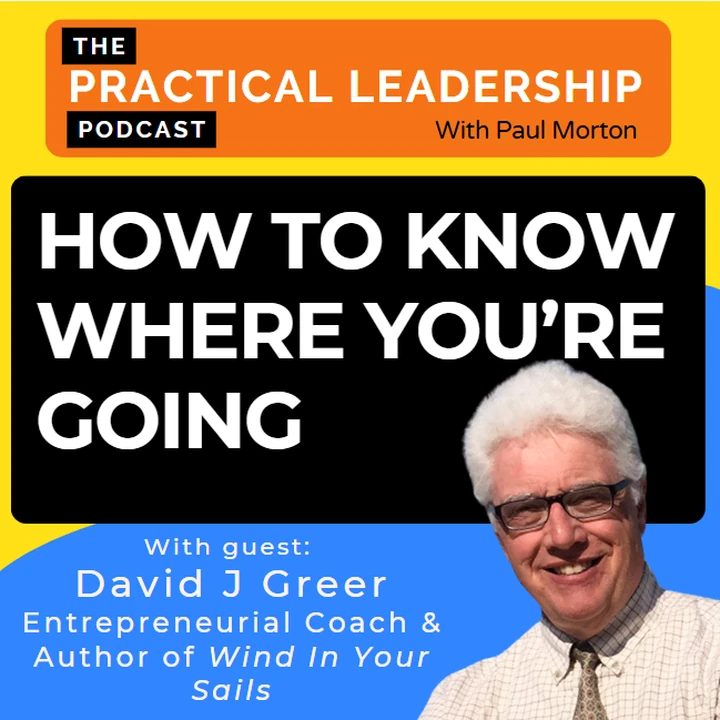
How to know where you’re going
with David Greer
Show notes
In this episode, I sit down with David J. Greer—entrepreneur, sailor, business coach, and a man who lives life with conscious intention. We talk about everything from scaling businesses to navigating personal challenges, like overcoming alcoholism. Here are the highlights:
- 40+ Years of Entrepreneurial Experience
From building a software company into a global success to facilitating strategic planning for senior leadership teams, David shares lessons from decades in business. - Overcoming Personal Challenges
David opens up about his battle with alcoholism and how hitting rock bottom led to transformational personal growth. “The greatest achievement of my life is getting sober, and it’s something I have to achieve again every day.” - Conscious Intention in Life and Business
According to David, one of the most critical lessons he teaches his clients is to live with conscious intention—be deliberate in both personal and professional decisions. - Why Strategic Planning Matters
David explains the power of strategic planning, drawing from Verne Harnish’s Scaling Up framework, and offers actionable advice on setting and achieving 3-to-5-year goals. - Sailing the Mediterranean for 2 Years
David talks about his incredible two-year journey sailing across the Mediterranean with his wife and kids—a bold life choice that forged unforgettable family bonds. - Legacy and Leadership
“Leadership is about leading people to a place they wouldn’t get on their own.” David emphasizes the importance of servant leadership—helping others succeed as the key to personal and organizational success.
Key Quotes:
- “Leadership is not about me. It’s about making others successful.”
- “Know where you’re going—if you don’t, how can you measure progress?”
David’s story is one of perseverance, risk-taking, and conscious decision-making. Whether you’re scaling your business or facing personal obstacles, this episode will challenge you to live—and lead—with purpose.
Ready to gain clarity and strategic direction for your business? David offers a free, one-hour coaching session where you’ll walk away with three actionable ideas to accelerate your career or company in the next 90 days. Reach out at coachdjgreer.com.
Transcript
Automated transcript. Speaker labels and spellings may contain errors.
Paul
Entrepreneur of 40-plus years. After 22, he started his own company, where he was for 20 years, built it into a global powerhouse, and then headed for the high seas with his wife and children, homeschooling all the way. Hello, and thank you for joining me on the Practical Leadership podcast. My name's Paul Morton. I'm your host. We try to distill the hard-earned wisdom of CEOs, executives, and high performers around the world into actionable insights that you can take away and put into your leadership practices really quickly. If it's time for you to look at your own management teams and help move them from being accidental into being intentional, then in nine short weeks, the Practical Leadership Playbook course will help you do just that.
Check out the Practical Leadership Academy. And now, on with the show. David Greer, thank you very much indeed for joining me. That-
Guest 1
Thank you, Paul.
Paul
Now, that was a ridiculously short and uncomprehensive introduction for somebody of your experience and caliber. Would you do yourself more justice?
Guest 1
Uh, well, it's [laughs] hard, hard to know, uh, where to start because, uh, you know, I have done a lot of things in life. I've been very fortunate. Uh, as you mentioned, I'm, you know, a long-term entrepreneur. I'm now a business coach, and I facilitate strategic planning for entrepreneurs and their, uh, senior leadership teams. Uh, it's, uh, a work that I find, uh, really rewarding. Um, I'm a recovering alcoholic. Um, the single biggest achievement of my life, and one that every single day I have to get up and I have to achieve again. Um, like, I don't get to rest on my laurels, uh, on that one. Um, I'm an adventurer. Uh, I'm a sailor. Um, I live in one of the most beautiful parts of the world, Vancouver, BC, Canada, surrounded by, uh, ocean and mountains, where if you like to go hiking and doing the things I do, skiing, um, it's really fabulous.
And married to someone who actually matches my energy and is foolish enough to go on some of these, um, crazy adventures. And, you know, Carolee and I, I think few people dream, and then even fewer people do. And, uh, Carolee and I are a couple and individuals who do both. Um, and as, as others have pointed out to me, you know, we play the game of life to win, uh, not to not lose. Like-
Paul
Mm
Guest 1
... we don't always win, but we're always, like, going for the big one.
Paul
Well, I think there's so many people just drift through life, and then it's- they're surprised when they get kinda close to the end and they realize that the one day will become never, you know?
Guest 1
Yeah, my biggest ask of my client, my coaching clients, is conscious intention.
Paul
Yeah.
Guest 1
Like, you know, I... It doesn't... It's your life. You choose what you wanna do, but I ask you to actually make a conscious choice about it and not just, like, let the waves of life kind of push you around this way and that, that, that you... And some of my work is just pointing out to people they have way more choice than they realize.
Paul
Yeah.
Guest 1
Like, like that they've got themselves in a mental box that restricts, feel, it, it feels like they don't have any choice, and I can totally understand and relate to that feeling, but some of what I offer as a coach is a separate viewpoint where I might be able to point out, like, well, if you think this way, then obviously there's no choice. Well, what would happen if you thought this other way? Would that open up some possibilities?
Paul
And at some point, you and Carolee must have looked around and said, "You know what? We need a little bit more of a horizon than we get where we are." And it led you to spending, what, two years on a boat cruising the Mediterranean with your kids.
Guest 1
Yeah. That one was an, an accident in some ways. So what happened is after 20 years with this software business, I had a major disagreement with my partner, and we ended up, uh, with him buying me out, and, like, it was very unexpected. Um, like, we just, we'd got along very well for 20 years, but the last year was, you know, we had a major disagreement, and it ended in divorce. So I'm in, you know, early 2001. Uh, I'd been a tech entrepreneur. I had not really noticed the dot-com meltdown, so I'm, like, trying to chase deals and opportunities. When someone smarter than me, a woman who helped, uh, career individuals transition into, into new careers, who I'd met through networking, um, she took me to lunch, and then we sat in her office, and I remember sitting in her chairs in front of her
desk, and she looked at me and said, "David, your kids will never be 11, 9, and 5 again. Do you need to work right away?" And I'm like, "No, I just got a pretty good check on my genes. I'm not done, but I don't need to work right away." And if you listeners can imagine the cheesiest, biggest, cartoonish light bulb going off over my head, like literally a massive aha moment. And, um, we, we flew C- my wife's, uh, mom down to look after the kids, and we went on a driving ski trip for about 10 days, and we talked about all these possibilities, and we had... We, we talked about renting a house in a different country every month for a year. We talked about going on a barge, which we had friends which were in the middle of doing in the north of, um, northern, like in Holland and Belgium and France, um, or sailing the Mediterranean.
And, um, we decided to go sail the Mediterranean. And, uh, what I didn't realize, like, I'd been reading long-term cruising books and, you know, by authors who'd traveled with their families for probably 20 years. I didn't know how much of a dream it was until suddenly the possibility opened up, and then I, I was like, I, I had no idea just how deeply embedded that dream was in me until the possibility arrived. And then, like, it was all in, and away we went.
Paul
So you jumped on board a boat, and then two years later you docked somewhere and flew home.
Guest 1
Basically, yeah. More or less. Like, that's the, that's the 50,000-foot [laughs] view of it.
Paul
Okay. 50,000-foot.
Guest 1
Yeah. [laughs]
Paul
What-
Guest 1
You're missing a couple adventures on-
Paul
I'm probably-
Guest 1
... along the way [laughs]
Paul
... glossing over some interesting stuff. I'm sure there's some Greek islands, some Peloponnese, or some-
Guest 1
Yeah
Paul
... Croatian-
Guest 1
Oh, living in Tunisia for five months. That-
Paul
Wow
Guest 1
... that was, uh- Culturally and s- and socially was by far and away the most out there experience we had in the two years we lived in the Med
Guest 2
Wow. That, that is, that is different. Okay. But w- what did you pack in your bags, metaphorically speaking, to take home with you?
Guest 1
Um, we, we packed a legacy with our children that few parents ever get to have.
Guest 2
Mm-hmm.
Guest 1
Like, an intensity of time period. Like, when we came back, a lot of other parents pointed out to us we'd spent more time with our children in those two years than most parents spend with their children in their entire lifetime.
Guest 2
Mm-hmm. Yeah.
Guest 1
And, and, you know, there's, there's an intensity of that as a f- the friend of ours who, who lived in the barge talked about. You know, it's kind of like being in a pressure cooker. Like, either the lid blows off, um, or over time kind of the, the sum of the parts become something greater, you know, as, as you live together. And believe me, your children see you, like, up close and personal, like, the good, the bad, the ugly, the wonderful. Like, 'cause there's nowhere to hide and, you know, for, as my wife s- likes to say, we lived on 400 square feet for two, for, uh, two years. Um, and thankfully it's the Med, so you could dock and, you know, or anchor and let the kids run ashore, and the weather was, you know, usually pretty nice. Um-
Guest 2
Yeah
Guest 1
... so, and, and like other legacies, like, we were 18 months without being in an English-speaking country. Like, what's that... You know, and the kids would watch me try and get the butane bottle, the sh- the fuel you need for your stove, like, to get that refilled in the south of Italy. Like, you know, I go to tourist information, I hold up this little b- blue butane bottle, they don't even know what it is, but, you know, they speak a little English. They kind of direct me down the street. We go a kilometer. We find someone else who speaks a little English. You know, they direct us. It takes a half a day. Then eventually you go down a little lane, and you go through a beaded curtain, and you hold up the bottle, and they, "Oh, si, si, si." And they go back, and they have a full one. But, you know, like, the kids watch you just trying to figure out life when you can't speak the language.
I, I think it's, uh, I think it's a great education as an adult and also, you know, for your children. Like, not everyone speaks your language. It's not always easy to communicate. It's not always easy to get things done.
Guest 2
Before you went off, I mean, you're a strategic planner by trade. Um, before you went off, how much of a plan did you actually put in place? Or was this a, "We're just gonna go and wing this"?
Guest 1
Um, so the rough plan was get a sailboat, commission it, move on board, um, and travel the Mediterranean for one year. And like in true entrepreneurial fashion, it took, what, twice as long as we thought.
Guest 2
Of course.
Guest 1
And, and, you know, we roughly had an idea. We, you know, of, um, the c- you know, we wanted to cover the Western Mediterranean and then get to Greece and Turkey. Um, Tunisia was, I don't think... We'd talked actually about going Tunisia, I think, from the get-go. Um, you know, and, you know, just as it worked out, we had friends with a child. Like, you have so few families traveling in the Mediterranean that you really try and stick together, and they had decided to winter over in, uh, this town, Monastir, in Tunisia. And so we decided to follow them. Um, and by then we had decided we were gonna do a second year 'cause we'd only got through a fraction of the Western Med, uh, in one year. Um, so, but honestly, like, you know, that... And we were gonna homeschool the kids. Like, that, that was the big picture plan.
Guest 2
Wow.
Guest 1
And plans don't need to be complicated. In fact, I do a lot of coaching. Like, I think, you know, your three to five year goals, you should have maybe three to five.
Guest 2
Mm-hmm. Yeah.
Guest 1
Right? Like, then you got a chance of actually getting there, whereas if you have 12, like, where do you start focusing?
Guest 2
Yeah.
Guest 1
Like, which one's most important? Um, and, and a lot of the difficulty I find in planning is actually restricting. Like, you know, you have a lot of opportunity, but you have to go pick which spots you're gonna go focus on, at least for the next quarter or the next year. Um-
Guest 2
That gets down to decision-making, which is always, which is always a challenge as well. Strategic decision-making is a lot more complex than it sounds.
Guest 1
It, it is and it isn't. I think, again, it's just getting down to a small set of goals that you're gonna focus on, you know, in three to five years, or one y- the next one year. Even if I'm talking just personal planning, not, um, you know, career planning, um, business planning. I, I mean, I think the, the model I use is the same no matter which of those areas you're focusing on. And then I'm a big believer in quarters are 13 weeks long, and they're long enough to get a lot of serious shit done.
Guest 2
Mm-hmm.
Guest 1
And short enough that if you'll know at the end of the quarter whether you, like, made the right choice or whether you need to make a drastic course correction.
Guest 2
Yeah.
Guest 1
And nothing catastrophic happens in 13 weeks generally.
Guest 2
Mm-hmm.
Guest 1
Um, so, you know, you can course-correct without killing a business, at least from a business planning point of view.
Guest 2
You can pull things back. I, I, I love the idea that, um, priority was, I suppose still is, it's a, it's a singular thing. People keep talking about priorities. Well, you can priority. Pri- a priori means the one at the top, the one that comes-
Guest 1
Yep
Guest 2
... first.
Guest 1
Yep.
Guest 2
It's not the ones.
Guest 1
Correct.
Guest 2
I've got 17 strategic priorities. Well, you might as well have none.
Guest 1
Exactly. Exactly.
Guest 2
Yeah.
Guest 1
Um, and, it, you know, uh, s- entrepreneurs and senior leaders that are working with me, like, they always get caught up in the day-to-day firefighting.
Guest 2
Mm-hmm.
Guest 1
And I always... You know, they say, "Well, I'm not making progress on my strategic plan." And I say, "Well, I worked with you on your goals. What's the number one goal for the quarter?" So I make sure they can articulate it, like they haven't forgotten it. [laughs] Um, 'cause I build plans that you're supposed to, like, post at your desk and look at every day, not... They don't, they're not supposed to go in a binder and be tossed in a top drawer. Um, and I'm like, "You know, you should take the first, the best," uh, I won't say first 'cause it's, it's not always- ... the first part of the day for an individual, but take the best two hours of your day and focus on your number one priority until it's done.
And if it's not done, and if it's ... You can't do any more on it or it's done, then focus on the number two priority. And if you're not spending two hours on your strategic priorities every day, you're not gonna get there. Like, like they're not really your strategic priorities.
Guest 2
If you-
Guest 1
Like, our, our behaviors always tell us, like, you know, if we don't focus on things, why? Because either it's not important, or because we don't believe in them, or because we think they're too hard.
Guest 2
I think the, the too hard one probably comes up quite a lot. I mean, people will give a lot of lip service to, yes, I'm doing this because I believe in it. Yes, I'm doing this because I've, I've said it's my priority. But the too hard box and the getting started challenge, I think is, is a real, a real deal for people. You said you had a model on how you go about helping people prioritize, and how you help p- people think their-
Guest 1
Yep
Guest 2
... way through this. Can you talk us through what that is? What, what is it you do with people when they, when they have come to you with this problem?
Guest 1
Uh, so the framework I use comes from a guy, Verne Harnish. Uh, published a couple books, The Rockefeller Habits and Scaling Up, and he has, uh ... I ... In the early 2000s, I kept hearing all my entrepreneur friends kept talking about the one-page strategic plan, and that comes from this guy, Verne Harnish. And, you know, the idea is you can articulate all the important aspects of your business in one page. Now, I will tell you, you gotta print it out, like in a-
Guest 2
Really small. [laughs]
Guest 1
No. Well, or you take two sheets of A4 paper, whatever. I forget what size that is.
Guest 2
Yeah, it's very big.
Guest 1
Right? Or, or two eight and a half by elevens if you're Canada-
Guest 2
Yeah
Guest 1
... or the US. Um, but if you print it on that size of paper, you can actually ... It's quite readable. And it starts with, like, what are your core values? What do you believe? How should people behave in your company? What are those? How do your ... You know, they should be articulated. Then what's your purpose? Like, why are you here? What change do you wanna bring in the world? A lot of times with new clients, you know, I ask them like, "Why did you start your business?" And they've like ... They started a business for a certain reason, and then they started to get successful, and then it grew, and now they're like managing this wildly successful business, but that's not what gets them out of bed in the morning. Like, it's, it's because they could help certain people. I mean, so I just help remind them, like, "This is why you started the business. This is the bigger purpose." Um, and then there's some other aspects, uh, that are business specific.
I mean, a lot of these could apply in any organization, not-for-profit, profit. Um, three to five years, what are the key capabilities and thrusts that you need to achieve in like the next three to five years? So pick some future date where you're gonna aim for. And I've used this in personal planning as well. Like, where ... You know, what do I wanna be twice as good at in three years?
Guest 2
Mm-hmm.
Guest 1
Right? Um, and then, uh, four or five goals for the year that are gonna get you moving in the right direction for where you wanna be in three to five. And then what are you gonna achieve this quarter? Again, three to five goals, no more. Um, and, um, and then from, again, from a business perspective, what are the key productivity indicators? What's the number you need to focus on to go ... so you can achieve your goals? Is it more calls to prospects? Is it more leads? Is it, you know, better delivery, um, of the things that you deliver? Like, you know, and how you measure that on a daily and weekly basis so you know that you're making progress. So I do a lot of work. As I, as I coach people, I believe that core values and our behavior should be demonstrated through storytelling.
Guest 2
Mm-hmm.
Guest 1
Like, I think that's the most powerful way to make it real and to demonstrate it. But you should run the business on the numbers. 'Cause here's what I know as an entrepreneur, and I've done this many times in my career. It's all too easy for me to buy into last conversation. The salesperson that said, "Oh, I couldn't close the sale 'cause you didn't have feature X, Y, Z," right? And like to now do a whole quarter where we're working on feature X, Y, Z, but it turns out there's just one person in the world that wants that feature, which is the one who that salesperson was talking to. And, and you know what? Most of the time when you do X, Y, Z, like when that's the objection, even if you do it, they'll find another objection.
Guest 2
Mm.
Guest 1
Like, um, so I find it's very dangerous to run a business on this anecdotal ... It's very easy as a human-
Guest 2
Yeah
Guest 1
... to do that, right? So I just ... Like, it's very easy. Um, so what are the numbers? What are the true numbers? What are the numbers telling you? What are your financial numbers? And I, I do a lot of work with entrepreneurs just helping them to understand their financial statements as it actually relates to the business. Like, not these different line items on the income statement, but like how this number relates to the number of T-shirts you shipped today. You know, what it costs to make them. Like, I have a client that's in the T-shirt printing business. Um, so, so I help them untangle like, or relate the financial statements to the actual specific operation of the business.
Guest 2
Mm.
Guest 1
And then how do we make it more efficient?
Guest 2
The unit economics. I mean, the number of people who don't understand the unit economics of their own business, any of them.
Guest 1
Oh, uh, it's, uh, it's shocking.
Guest 2
It's really.
Guest 1
Absolutely. And, and I think that every person in the business needs to understand your business model and the underlying economics, 'cause that's why everyone gets paid.
Guest 2
Yeah.
Guest 1
You get paid because you have an economic model that makes sense. Like, there's pain in the marketplace. Your company has some pain pill that solves that pain, and then you need to be able to consistently deliver whatever product or service you have, uh, in a way that the market, um, that your customers get to be put out of their pain. And the bigger the pain, the better your pain pill, the better you are at delivering it, the more value you create.
Guest 2
Yeah.
Guest 1
Like, big picture. That ... I mean, it's, it's simple to say. Hard, hard to do sometimes.
Guest 2
Yeah. Yeah.
Guest 1
Um, but, um, it really boil ... A, a, a lot of my work is boiling things away to make them simple. Like-
Guest 2
That's ... That, right? Problem solving. Um, you talk to anybody about problem solving and they say, "Well, what we'll do is we'll add this process. We'll, we'll do this as well. And we'll start doing this thing." Say, "Well, how about you stop doing some stuff? How about you pare it back to some point where-" It's simple. Everything is exposed, you know?
Guest 1
Mm-hmm.
Guest 2
And it's the number of simple questions, even in some incredibly sophisticated, modern, you think, organizations of a sales force size, that sort-
Guest 1
Mm-hmm
Guest 2
... really serious organizations, you go to them and say to senior people, "What do you sell? Who buys it?"
Guest 1
Right.
Guest 2
"How do you make money? Where do you find your customers? Why do they come back? Why do they leave?"
Guest 1
Mm-hmm.
Guest 2
And there's a lot many... I've got a list of about seven or eight questions like that, and then the trick is you go to the next senior leader and you ask the same darn questions. You see if you get different answers.
Guest 1
Yeah. [laughs]
Guest 2
If you get different answers, that speaks to another problem entirely. Oh, let's go to strategic alignment, shall we, ladies and gentlemen, you know? That's a different-
Guest 1
Yeah, um, yeah, lots of, lots of nuggets in what you just said. Y- y- you know, one of the, one of the questions I ask people is, uh, "Is it strategy or is it execution?" Strategy is your plan.
Guest 2
Mm.
Guest 1
Execution is how well do you do your plan.
Guest 2
Mm.
Guest 1
And, um, my belief is it's neither. It's about alignment.
Guest 2
Mm. Mm-hmm. Okay.
Guest 1
You have to get alignment. Like, it doesn't matter what the strategy or the execution is. If you're not aligned... I liken it to if you're all in a boat and you're all pulling on your oars, and you're pulling really hard, and, like, you're splashing, and there's a lot of action, and all the water around you is moving, but you're totally uncoordinated and not moving in the same direction, so the boat just goes around in circles.
Guest 2
Mm.
Guest 1
And, and that's what happens in that example you gave, where the two senior leaders, uh, have totally different takes on who the market is, how you get the customers, how they're making money. Um, how are you ever gonna row the boat in a direction that, you know, makes more revenue and makes a lot more money if you don't have agreement on those basics of your business model and of your markets and your customers?
Guest 2
Yeah. And to, to, to continue the, the, the watery analogy, given that we started with yachts, you think sometimes you've got a CEO at the back of the boat, and the CEO thinks that he or she has their hand on the tiller and they're pointing it in the right direction, and that alone will, you know, move things in the correct direction. And yet, if your, your leaders, your, your o- rowers are out of sync, you can do an awful lot of damage with one of those oars. They're really big and they're really heavy.
Guest 1
Yeah. [laughs]
Guest 2
You can cuss somebody, you know, one-
Guest 1
Exactly. And-
Guest 2
There's blood in the water, half the sharks, you know?
Guest 1
And if there's eight of them and one of you, it doesn't matter how powerful-
Guest 2
No
Guest 1
... the tiller is, like, they can out-oar you.
Guest 2
Exactly. Exactly.
Guest 1
Right? So, um, yeah. And I, you know, I see the CEO's role as, yes, the tiller and setting the direction and the vision for where we're going, but then it's that constant checking in and making sure that all of the team members are aligned and the things that they're doing are moving you in the direction that you've set.
Guest 2
Mm. Mm.
Guest 1
And making them individually successful. Like, leadership is not... To me, leadership's not about me, it's about the people I lead and making them successful and making sure they have the resources, the tools, the knowledge to be successful.
Guest 2
Yeah. Yeah.
Guest 1
Right? My success comes from their success.
Guest 2
Um, and I, I define it as leading people to somewhere that they would not ordinarily get on their own-
Guest 1
Mm-hmm
Guest 2
... coupled with magnanimity, in that seeing the greatness in others, exposing the greatness in others, making other people, exactly as you said, successful. Servant leadership. Mm.
Guest 1
Yeah. You know, when, when I... A few years after I came back from the Med, I was visiting with, uh, a woman who started at the software company the same month that I did, and, um, so we, we worked 10 years. We didn't work... We, you know, we, we worked together, but not directly. She was in admin, I'm in software development and delivery, um, and marketing. Um, but when I bought out one of the founders of this company, she became my first report. So for 10 years she was my right-hand person. Um, and so I had the courage at lunch one day a few years after we'd both been out of Robel to say, "Carrie, what was the biggest challenge of my being your boss?" And she didn't pause, and she just looked at me and she said, "David, over and over and over again,
you asked me to do things that I knew in my heart of hearts I couldn't possibly do, and every single time I did them." Now, I think I probably had quite a bit of room to support her better, 'cause I didn't know that. [laughs] Um, but on the other hand, if that's my legacy, I'm okay.
Guest 2
Yeah.
Guest 1
Right?
Guest 2
That's-
Guest 1
If that's my legacy, I'm, I'm okay. 'Cause I only ever asked Carrie to do things that I believed she could do.
Guest 2
Yeah.
Guest 1
And apparently I, I was pretty accurate in that. [laughs] 'Cause in the end she figured it out.
Guest 2
I, I... As legacies goes, that's pretty nice. I mean, I know for sure that my leadership legacy is, is a trail of destruction, at least certainly in the early days. There's a lot of victims of my, uh, bad practices and experimentation, which hopefully I've made up for over time, but that's a lovely legacy. Okay. I mean, if you took then and you had to distill down this magnificent career and all this reflection, um, 'cause I think I like to def- define wisdom as knowledge with experience, applying the knowledge, and then reflection upon that. And then my son came to me and he disagreed with my, um, definition. He said, "It doesn't matter a darn what you've got unless you share it." So it's knowledge plus experience, applying it, plus the reflection upon that, and then you actually have to get it out of your head, otherwise it's selfish.
Guest 1
Yeah.
Guest 2
Take that then and apply my wee boy's last idea of sharing it. What's your how to? What's the biggest, most valuable thing that you can share based on this?
Guest 1
Well, if we follow up in kind of the strategic planning part we've been talking about, or just planning-
Guest 2
Mm
Guest 1
... um, is, uh, you know, um, is to know where you're going. And again, back to this conscious choice. Like, like, if you don't have some idea of where you're going, like, how... You know, how do you know whether you're making progress or not? Um, and I think, you know, a lot of us just... And, and, and again, I, I mentioned earlier, like, we just let things happen to us, whereas I think we actually have way more power- We have way more power and way less power, uh, than we think. I, I think we have a lot more power over ourselves and our choices-
Guest 2
Mm-hmm
Guest 1
... and we have a lot less power than we think to control others.
Guest 2
Yes. Yeah.
Guest 1
Um, right? Like, um, I, I've come to believe, you know, the only thing I really can control is my response to something someone else says and my next choice. Like, that's, that's really it. You boil it all away. Um, and, uh, um, now i- if I have a vision for where I'm going and I have a plan for where I'd like to be, then the next choice I make is much li- more likely to be on a path that's gonna take me where I wanna go. And I, I'm not saying you have to, like, spend oodles of time doing this. I mean, you know, once a year spend two or three hours and figure out, you know, what you wanna do. And I break it down. I- my former coach, Kevin Lawrence, he has this model that I use which is to focus on three areas of your life.
So first is career, like career/finances. Um, so that's the first area. Then the second is, is what I would call your life, your relationships, um, the people you wanna be with, your interactions. And then there's a piece in the middle that almost all high-performing people, um, squeeze out. So, like, I work with a lot of high-performing entrepreneurs. They're super passionate about their business, super passionate about the people they wanna help. They are very, very focused on their lives or their spouse or their children or, you know, their hobbies or racing cars or whatever it is that they do, but they squeeze themself out in the middle and they don't have a plan to build resiliency for themselves.
And I think it's as important to set specific goals, like what are the things that completely renew you? You know, for me it's, like, go sailing, right? Um, no, no real surprise there. Um, and you know, like sometimes in the last couple years my wife hasn't wanna come with, do, do as much sailing as I wanna do, and so I set things up so I can solo sail. And in fact, I've been setting some pretty ambitious challenges for myself in some of those solo sails, and that's all just pure for myself. Like, and as I do those challenges and I overcome them and, you know, take some chances, um, I build more resiliency for myself which then I can bring to my coaching practice and I can bring to my life with my wife, with my children, with my friends, with my recovery.
Um, so those three things. And I, you know, I asked, I suggested a question, like, "In each of those areas, what do you wanna be twice as good at in the next three years? You know, what's the number one thing you want for your career this year? What's the number one thing you want for yourself? And what's the number one thing you want for your life?" And if you just had one goal in each of those areas, I think you'd, you'd have a really powerful plan.
Guest 2
One priority.
Guest 1
Yeah. I think two or three in each of those are, are doable, um, you know, because you're kind of splitting it off. And, uh, Coach Kevin encouraged us to, like, what's your passion ratio, which I kind of think is energy times time.
Guest 2
Hmm.
Guest 1
Um, so you know, like if you wanna put 80% of your passion into your business, I'm okay with that. W- which means, so then what? You're gonna do 10% for yourself and 10% for your life. Okay. So I just, again, conscious choice. Make sure you understand or make sure that your spouse and your children [laughs] and others around you understand that you're gon- 80% of your passion's gonna go into the business, and they're ... Then you're gonna give them a solid 10%, but it's only gonna be 10%.
Guest 2
Yeah.
Guest 1
Right? And it doesn't have to be a third, a third, and a third unless that's what you want. Like, um, you know, some business, some entrepreneurs are so passionate about their business, like, you know, less than 70% is just not going to cut it, and they're gonna do whatever it takes. You know, and, and if it's a global business and you have to travel to trade shows, like, you know, you're gonna be away a certain amount of time. Um, but at least when you're back, and you make sure that you're giving a full, that 10% of passion or 15% of passion you're gonna give to your, to your life, that you're doing it consciously and not so exhausted every single time that you have nothing left to give, which is back to that self. Like, what do you need to do, you know, renew yourself? So, um, like maybe after a big trip you don't go into work on Monday and you actually take a day off.
Guest 2
Mm-hmm.
Guest 1
I mean, some entrepreneurs are like, that is such a radical ... Like it- for them, it's a radical concept. But I point out, like, you, you, you're planning a trip where you're gonna work 20 days in a row without a break. Like, it's perfectly reasonable to come back and say, "I'm gonna take two days off," even though they're business days, right? Like, your business will survive. It survived 20 days with you on the road. It'll survive two more.
Guest 2
You'd hope.
Guest 1
Or, or come in Monday, Tuesday, Wednesday, and take Thursday and Friday.
Guest 2
There you go.
Guest 1
Come in-
Guest 2
Mm-hmm
Guest 1
... fight the fires, you know, be a face, show yourself, but, you know, take the last two days off and do a day that's something just for you and do a day that's something just for your family.
Guest 2
Yeah. That was one of the nicest pieces of advice I got as I was stepping up in my career. I had a, I had ... I was very fortunate to have two great managers over time, and one of them, a great guy called Jacques, he encouraged me to, number one, learn how to delegate properly, to delegate tasks to people, and then to reserve that time. So aim to find yourself back 20, 25% of your time, and see when you've got it, go watch a movie.
Guest 1
Yeah. [laughs]
Guest 2
Like, what? Seriously.
Guest 1
Yeah.
Guest 2
"You're my boss. You should be telling me to work hard." I said, "Yeah, I am."
Guest 1
Yeah.
Guest 2
"Delegate better, then go watch a movie." He's like, okay. And I, I, I've actually done it. I did it. I mean, I, I think I went, I went to see two movies over the course of, like, six weeks, six, six months actually when I was trying to do this, learning how to do this. And I went to see two mo- I went to see a movie. I was like, okay. Well, went on my own.
Guest 1
Right.
Guest 2
Watched some mad film, whatever it was.
Guest 1
[laughs]
Guest 2
And I came out feeling quite naughty-
Guest 1
Mm-hmm
Guest 2
... but wonderful because it had, it was the result, it was a rewarded result. I'd given myself the reward because of- ... having delegated out all this stuff, and other people were doing the traveling, other people were doing this stuff.
Guest 1
Yes.
Guest 2
That was, that was the quote unquote-
Guest 1
And, and smart boss, because he consciously or un- or consciously understood about the self piece.
Guest 2
Yeah.
Guest 1
About the having to renew yourself, like the going to a movie-
Guest 2
Mm-hmm
Guest 1
... just because, right? And also how a radical idea it would be for you-
Guest 2
Yeah
Guest 1
... and experience.
Guest 2
Yeah. That was a-
Guest 1
Right?
Guest 2
He was-
Guest 1
I th-
Guest 2
Yeah. Smart
Guest 1
I, I love, I love that story because it, it's really an insightful boss who-
Guest 2
Mm
Guest 1
... who, you know, probably guessed at your discomfort around that, but still pushed you to do it anyways.
Guest 2
Totally. He was, he was a, he was a very, he's a, well still is, he's around. He's a, he's a sharp, sharp guy. Really sharp.
Guest 1
Mm-hmm.
Guest 2
Really quiet, really calm, but he's one of those that goes, "I can see your soul based on the wrinkles of your nose."
Guest 1
[laughs]
Guest 2
That sort of person. You're like, "Okay. Amazing." Is there something perhaps in your, your, your long career that has taught you the most? Is there one thing that has just smacked you in the head, other than perhaps the, the light bulb moment where you realized that you didn't have to work for that moment in time? Is there something that's actually-
Guest 1
Um, yeah, I guess, you know, it's take chances. It's, um, um, you know, even joining... Like, when I joined Robel, I was in fourth year uni- university. Now, I had worked with the founder for a year and a half on a big rewrite of a project for a cable company here in Vancouver, so it wasn't like I didn't know him. But, you know, it was starting with this company who had the two founders and nothing else, and, you know, kind of a couple years of, uh, track record. And, um, obviously taking the chance to go on the Mediterranean trip.
Guest 2
Mm-hmm.
Guest 1
Um, another thing I took an enormous chance on, or it felt like at the time, was getting sober. Like, when I got sober, I could not imagine a meal without wine.
Guest 2
Mm-hmm.
Guest 1
Like, I, like, my imagination was completely limited as to how I could possibly ever survive day-to-day life without having alcohol in it. And, you know, Coach Kevin, this coach I referred to earlier, like, he's the one I trusted enough to admit that I had a problem, and he coached me to go to 12-step recovery, and made me do a commitment to go, which I did the day that I made the commitment. And, you know, it completely changed my life. Like, I was scared. Took me five or 10 years before I really admitted how scared I was. Um, but I took a chance, and what he said was gonna be right. And, and it, and it turns out that over the years he had met several people in 12-step recovery and had lengthy conversations with them. So, like, he, he knew the process and he knew that was the right thing to coach me to do.
Guest 2
Mm-hmm. He could see the signs.
Guest 1
Yeah. And, uh, well, he had no idea until I admitted to him. Like, 'cause I was a high-performing alcoholic, right?
Guest 2
Mm-hmm.
Guest 1
So whenever we were on calls, and, uh, most when we were on calls was the afternoon. And, you know, I'm a proper gentleman, I didn't start drinking till 4:00. Um, so I, [laughs] I wouldn't have even had a drink when I was talking to Kevin. Um, and, uh, yeah, so it was a complete shock to him, but it didn't matter. He knew what to do-
Guest 2
Yeah
Guest 1
... when I admitted that that was my problem.
Guest 2
And it's, I think it's a, a, a blessing that you had that sort of level of trust with somebody who could point you in the right direction.
Guest 1
It took us 18 months. It took us 18 months of working together.
Guest 2
Mm-hmm.
Guest 1
Um, and we'd, like, cleared the table of kind of all the other clutter-
Guest 2
Mm-hmm
Guest 1
... until, like, the elephant in the room, like, that's all that was left. Um, but I will say I knew it was a one-way street because I had built such a strong trust relationship with Kevin that I knew when I admitted it to him, like, he was never gonna let me off the hook.
Guest 2
Mm-hmm.
Guest 1
Like, I didn't know what that would look like, but I knew he, he was never... He would always bring the subject back if I didn't do something about it.
Guest 2
Mm-hmm.
Guest 1
Like, so I n- I just knew that once I did the admittance to him, like, he was gonna... He's that kind of person. He was gonna bird-dog me until I did something about it, so-
Guest 2
Tire-
Guest 1
You know, um, 'cause we'd worked on enough other things [laughs] which he'd bird-dog me until I got there. Um, and so I really knew that that admittance was... And then that night, you know, I went to a 12-step meeting, and I stood up and I said, "I'm David, I'm an alcoholic," and I, I just said it. I don't think I really knew what it meant, but it, it was really admitting my truth. And, and later I came to realize that, like, really owning my truth.
Guest 2
Well, I mean, and again, uh, uh, just because I'm asking a question doesn't mean you answer it, but what was the, the defining moment, the epiphany moment that led you to say that to Coach Kevin? What was-
Guest 1
I got sick, I got sick and tired of being sick and tired.
Guest 2
Mm-hmm.
Guest 1
Like, literally I just... It's an internal story. It's an in- Like, it just, you know, I just got sick and tired of being totally beholden to the alcohol. I got sick and, you know, and, and 4:00 became 3:30 became 3:00. And, you know, I had a whole bunch of red lines. I'd never drink in the car, and then I never drink in the car when it's moving. And, you know, I, I just, it crossed all of these, and crossed all of these. And, uh, and I just internally I just was done. I just was, uh, I, I just sick and tired of being sick and tired and didn't wanna live my life that way anymore. Y- you know, when I came into recovery, you know, I had a house and I had a couple cars, and I had a wife and I had three children.
And 15 years on, you know, I have a house. It's a different house, one that costs a lot less. Um, and, you know, we have two cars and we have three kids, and now we have two grandkids. And so if you looked just at the outside and looked at me, you'd say, "Oh, wow, David, like, nothing really looks different 15 years on." And on the outside it doesn't look all that much different, but on the inside, I'm here to tell you, I am a completely different person than I was 15 years ago. Completely different. Um, and in so many different ways. Um, and, and that's truly the story of recovery. It's not about your outsides, it's about your insides. It's about how you feel, it's about how you behave. Um, and the al- you know, the alcohol is like an iceberg.
The alcohol is the 20% that's showing up above the surface-
Guest 2
Mm-hmm
Guest 1
... and it's the 80% underneath which is, you know, what's inside you, what drives you to drink. Like, that is how, what you really have to go work on 'cause it's that 80... If you don't work on that 80%, eventually you'll go back and pick up a drink again or a drug. Um, so, you know, a- and in 12-step recovery we have these things, the 12 steps, there's really just a process for you to work on that 80% [laughs]
Guest 2
Mm-hmm
Guest 1
... internal stuff. I mean, there's other. I've done therapy work, um, Caroline, I've done relationship counseling work. Um, you know, there's learnings I did from my coach training. Um, like, all of these things have contributed to my personal growth and my being a, just a very different human being today than I was before.
Guest 2
Well, I, I don't know if you'll accept congratulations from somebody you hardly know, but congratulations.
Guest 1
Thank you so much. Um-
Guest 2
It's, it's very impressive
Guest 1
... it, it's, it's the single biggest achievement of my life. Um, and, uh, you know, every day I have to get up and I have to achieve again the single biggest achievement of my life. Like, 'cause that's the nature of addiction, it doesn't go away. And I, it, it, like we talked earlier about the number one thing for me-
Guest 2
Yeah
Guest 1
... the number one thing every day, stay sober. Um, like, and that, you know, that's my lot in life, that's the cards I've been dealt, and, um, I understand that. And, you know, it gets a lot easier. Like, but I don't know, I sit in my cushion and I ask something bigger than me to keep me sober for today 'cause I got a lot of practice saying I can't keep myself sober.
Guest 2
Yeah, yeah. So other than that-
Guest 1
[laughs] Yeah
Guest 2
... other than that-
Guest 1
Other than that minor little thing [laughs]
Guest 2
... what are you working on?
Guest 1
Um, well, I'm doing, uh, podcasts like this. I think that I have a lot of experience, strength, and hope to share, both, uh, from the business perspective, the planning perspective. Um, s- you know, I do, you know, strategy and business, um, execution and people. And, you know, I do a lot of work, uh, with my clients around people. 'Cause it turns out you can't run a business without people, and the, and every time-
Guest 2
Has to
Guest 1
... you get people together, yeah, th- there's, uh, there's stuff that happens. Um, and, um, I wanna star- share about my recovery. So, um, you know, if all I can do is come on podcasts like yours and help one person, I will be thrilled. Like, um, just to be able to share my experience, strength, and hope, which you've allowed me to do today, and I wanna really thank you for that, and, um, to have the opportunity to have an impact on one of your listeners. Um, that, that's, uh... You know, I would like to get more clients than I have capacity at the moment for more, especially co- one-on-one coaching clients. Um, that, that would be fantastic, and, uh, I hope eventually it'll be an o- be an outcome of doing this work, but it's not the primary purpose that drives me.
Guest 2
Well, my mum always says, "Never underestimate the power of one conversation to change the course of your life." Perhaps this has been a thing for somebody, so f- uh, good luck if you're listening. Where can people find you, apart from LinkedIn?
Guest 1
Uh, so first of all, I just wanna remind listeners that, uh, I offer a free one-hour coaching call to anyone that wants. Uh-
Guest 2
Very generous. Good
Guest 1
... and, uh, my promise to you is if you spend an hour with me, you'll have, uh, three ideas that accelerate you in your career and your life, uh, within the next 90 days. And, uh, to do that, go to my website, coachdjgreear.com. Coach, D as in David, J as in James, greear.com. And my phone number and my email address is in the top left corner of every page on my website. So, um, just reach out. I try and make it as easy as possible.
Guest 2
Wonderful. David, just before we wrap, what's the one thing you would want to thank your younger self for doing?
Guest 1
Um, yeah, that's a hard one. I'd... So may- maybe go with this one. Um, when I was in grade nine, I got taken for a tour of the government buildings in Edmonton, Alberta, which is the provincial capital of the province of Alberta, and I saw a lot of, I saw a computer room and spinning tape drives.
Guest 2
Oh, yes.
Guest 1
And I had a m- math teacher that taught me octal arithmetic. Turns out that you don't have to have... That we count to 10 'cause we have these 10 digits on our, on our hands. Um, and I knew then that I wanted to combine business and computers. I don't know how, where that came from, but I just literally had that vision and, um, you know, that's, I just wanna thank my younger self for having that vision 'cause it carried me a super, super long ways.
Guest 2
It's a good vision. Coachdjgreear.com. Thank you very much indeed for joining me.
Guest 1
Thank you so much for having me. [outro music]