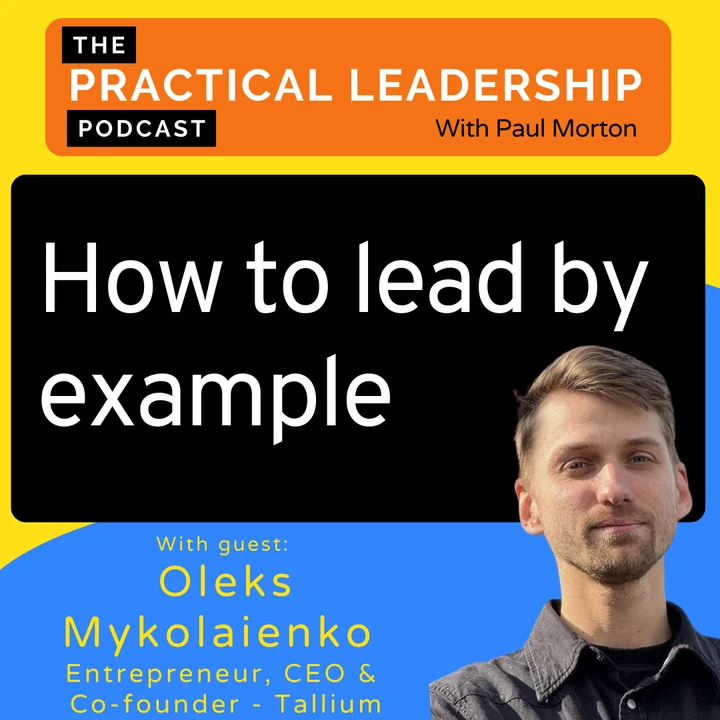
How to lead by example
with Oleks Mykolaienko
Show notes
“Being honest with your people sets the right expectations.”
On this episode we’re joined by Oleks Mykolaienko CEO of Tallium Inc. and an entrepreneur with a robust track record in software development and a passion for building digital products across various markets.
Oleks shares invaluable insights into the evolution of management practices from traditional structures to modern leadership approaches.
His journey highlights the shift from hierarchical command to collaborative guidance, emphasizing the importance of adapting leadership styles to meet the needs of new generations in the workforce.
Oleks and I discussed:
- Adaptive Leadership: Transitioning from command-driven approaches to more collaborative, example-led leadership.
- Clear Expectations Setting: The crucial role of defining clear objectives and deliverables for team members.
- Cultural Adaptation: Adjusting management strategies to align with contemporary work environments and employee expectations.
Impactful Quotes and Timings:
- “Management theory and practice have shifted a lot… from management to leadership.” – Discussing the evolution of management styles. (00:04:17)
- “Being honest with your people sets the right expectations.” – On transparency and expectation management. (00:04:36)
- “I hire you because you have more experience in this specific field.” – Reflecting on humility and trust in leadership. (00:15:08)
Find Oleks on Linkedin Here: https://www.linkedin.com/in/oleks-mykolaienko-ua/
Transcript
Automated transcript. Speaker labels and spellings may contain errors.
Paul
thrill seeker who loves the challenge of building something new. Climber of Mont Blanc, Kilimanjaro. Deliv- deliverer of a company that has a presence in 16 countries, who's in the Ukraine, in Poland, the Netherlands, Sweden, Canada. Builder of business ideas and bringer of them to life. [upbeat music] Hello, and welcome to The Practical Leadership Podcast. I am your host, Paul Morton, and we are talking about leadership, management, and the various lives that surround it. It's my joy, delight, and privilege to bring into my studio some of the smartest, wisest people I've been able to find for your delectation and enjoyment. And I hope that you do get a lot out of the conversations that we have here.
When you realize that your management team has grown too fast or you've inherited a new team and the fastest, best lever you have for growth and improvement is attached firmly to those managers, get in touch. I help you run management coaching and training programs that'll make a big difference really quickly. You can find me at the Practical Leadership Academy website and on all the usual social channels. [upbeat music] Oleg Smilenko, thank you very much indeed for joining.
Oleks Mykolaienko
Thank you, Paul, for, for such a nice intro. [chuckles] It's a pleasure to be here.
Paul
Well, I'm sure I've got it far too, uh, short and missed out so many interesting things. Would you please introduce yourself to both of my listeners?
Oleks Mykolaienko
Oh, let, let me try to keep it short. So my name is Oleg. Uh, I'm initially, uh, from Ukraine, but for the last couple of years I'm living in Europe, uh, in Ireland and now in Amsterdam. And, uh, yeah, I'm entrepreneur with, uh, more than 10 years of, uh, entrepreneurship experience. As for now, I'm running, uh, two businesses. So one is called Salium, basically software development company with couple of R&D offices, uh, in Ukraine and in Poland, as you say. And basically I'm kind of ICO of the company as well as a founding partner, uh, trying to combine these, these both roles effectively. Another business is called iDealer. It's basically a startup that we created in, in, in Salium which is kind of a Uber-like solution but for B2B if, if we will tell it very short. That's, that's the short story of myself. And I'm also kind of a f- uh, member of couple of communities like Forbes Tech Council and Growth Mentor trying to share my experience with some other folks around the globe and help
them to build successful digital products. That's short story about myself.
Paul
That's far too short, bro.
Oleks Mykolaienko
[laughs]
Paul
We've got like 35 minutes to fill. You need to speak more closely, tell some stories.
Oleks Mykolaienko
[laughs]
Paul
So you've got what? 100-plus people in your business. You didn't have that, did you? So it was-
Oleks Mykolaienko
Yeah
Paul
... you plus what? Where did you start?
Oleks Mykolaienko
We started with just a couple of engineers actually. So, uh, to be f- to be completely honest, I started as a, as a manager of a small team of engineers, uh, for my current partner, uh, Sergey, who's based in Canada. So he was running his own digital business, digital product and, uh, once we met I kind of suggested him that I can run his team in Ukraine, uh, to make his business more efficient and that's how I started basically to manage people and started my man- managerial career. And, uh, it was way back in time, I think more than like 12 years ago and it was pretty tough time for me just because it was my I think first that kind of experience, uh, to manage people and nobody, uh, taught me how to do it properly.
I kind of finished a university degree in the management of corporations, but to be honest it wasn't quite, quite practical. It was more like very theoretical experience and, uh, yeah, like it worked well in the books and in a classroom but never worked well in, in, in real life. So I kind of learned how, how to manage people myself, uh, by, by learning, uh, and doing it myself and, uh, yeah, I had a lot of my, a lot of my own problems, hiccups and, uh, yeah, let's say, uh, negative case studies, uh, which led, uh, to, to some good experience that I have now and I'm using it in, in my current, uh, operations I would say.
Paul
I find that the problem with a lot of management and business theory is that it just doesn't work in practice.
Oleks Mykolaienko
Yeah, for sure. I read a lot of books related to management and still doing it I would say, but, uh, as per my experience there were no book which you can use as is in, in your everyday, uh, working life. So I kind of try to combine different, uh, advices from different books and that's probably what, what, what, what makes it works I think. And also not only books as well of course some, some learning indications and courses, et cetera.
Paul
There's a lot of wonderful material out there. Um, and the stuff that I tend to rely on has been around for very ... So one of my, one of the books I give away most frequently is How to Win Friends and Influence People with Dale Carnegie. It's been in print since 1936 and if it's still in print my argument is that it must still be pretty good.
Oleks Mykolaienko
Yeah.
Paul
But you look at things like, uh, Good to Great, Jim Collins, a great book. Good to Great I think it was like 1984. So it's been in print for a pretty long time. Um, Peter Drucker, Owen Peters, these guys are from the '80s, the '70s, the '60s. So you find something that's at the airport and it's the latest thinking on whatever and you read the book on the plane wherever you're going and you think, "That could have been a blog post," or even worse, "That could have been a tweet."
Oleks Mykolaienko
Yeah.
Paul
Right?
Oleks Mykolaienko
No, but at, at the same time in my o- own opinion I think that the management theory and the management practice or let's say best practices are changed a lot since, uh, that time since, uh, Peter Drucker released his first book probably. There are of course some principles that you can use even now and they are like fundamental I think. Yeah, like, uh, be, be honest with your people, probably set, uh, uh, expectations in the right way and, and stuff like that, right? But at the same time from my perspective the management shifted from, from management to leadership and especially with this new generations of, of people, uh, of, of your coworkers you, you need definitely to, to find a different way how you can effic- effectively manage
them, right? And to, to be like a, a leader not, not a proper manager, uh, at least from my perspective and opinion.
Paul
It's a good point and I would ask what would you say defines each? What's a manager and what's a leader? What's the diff-
Oleks Mykolaienko
That's a good question. And, uh, from my perspective, and at least how I always, uh, uh, thought about it, the, the good leader is always, uh, showing a good example and managing your people by, by, by, by doing a lot of things, uh, himself. Not, not everything, of course, but, uh, this is definitely a person who can basically lead by example, right? So it doesn't mean that you need to do a lot of work yourself, right? And, uh, 'cause otherwise you will end up with a fully booked calendar. But, but still, when it comes to some, some practical things and some tasks that you delegate, you still should be able to show like a good, uh, example yourself, right? That, that's my approach. When it comes to classical management, I think it's more like, at least once again from my perspective, it's more a thing for a hierarchy approach, right?
When, when, when you basically have a strict, uh, hierarchy within your company and, uh, you have like a very, uh, defined set of rules, how everything should be done, like a set of reports, let's say like this. And, uh, yeah, basically some guidelines how, how these sort of things should, should happen. And, uh, it's, it's good that, that, that you, you have it and it's all about processes as well, right? But it's not about people management from my perspective. And when it comes to people management, you still needs to be more flexible and be like a leader from, from my point. Not sure if I express myself well, but that's, that's my idea.
Paul
That's just-- It's fairly clear. What then would you say, but you've been through this journey yourself, and you've now got hundred or so people in multiple different locations, which is another story on its own, how do you deal with all the remote management, remote, uh, organization or what needs to be done? But what would you then suggest as a valuable piece of advice? It was a-
Oleks Mykolaienko
That's, uh, a tricky question. And I would say that at the moment, uh, managing all, all the people remotely, it's quite a big challenge for me, right? 'Cause I was always, uh, receiving a lot of energy from, from people when I was able to meet them in person and talk to them and, uh, have a brainstorming session, maybe play table tennis in, in, in the office, maybe have like a coffee, tea, whatever. So these live conversations always recharge me as, as a leader, as a manager, and I always found a lot of motivation in, in these conversations and in these people that I can basically talk to and, uh, yeah, sometimes ask some questions, sometimes just listen to them and see how, how the things are going on in their end, right?
Now, uh, for the last couple of years, uh, I think after COVID hit us, uh, we shifted completely to remote work. Not completely, but mainly to re-mo-to remote work. And then I was, uh, yeah, required to, to leave, uh, Ukraine and move to, to Ireland. And it's also kind of, you know, removed the possibility for me to move to the office completely, even for after works and whatever. And, uh, my, my approach to, to people management changed a bit as well, right? And, uh, when it comes to, to advice that I can, can, can give, give you, right? It- It's definitely, uh, different advice for, for different, uh, let's say, uh, managers and different, uh, period of, of your management, management, managerial experience, right? So if you're just a, a new, a newly, uh, how to say it, but yeah, newly hired manager, right?
And this-- And you don't have like people management experience at all. Probably in this case, my, my advice will be, uh, something that we already discussed, right? Uh, like just set the clear expectations, what you expect from your people and, uh, yeah, what is the, the timeframe of, of the deliverables that you need to, yeah, they need to deliver for you. And, uh, yeah, basically, what is your performance standard? What, what is your estimation of, uh, when and how they should complete the, the task, right? And this is very helpful 'cause it, it, it helps you to, to set the, yeah, the rules of the, of the game. That's probably first point. And then again, lead by example, right? So you should follow the same work ethics you would like to your employees and your team members to follow as well. So if you kind of said, uh, that we are usually preparing for all the meetings, right?
And you, you need to prepare an agenda for the meeting that you will have like with someone or within your team, it means that you should be also prepared for that meeting, right? If you need to, you, you need to prepare meeting minutes afterwards, you need to prepare agenda from your side as well. And, uh, it's, it's really bad if you want, uh, to... If you demand this from your, uh, team and not doing it yourself. That's probably my, my piece of advice.
Paul
It's like bad parenting, isn't it? Don't do what I do, do what I say.
Oleks Mykolaienko
Yeah. Could be said like that as well.
Paul
Yeah. Okay. I mean, I've had, as you would imagine, many, many different definitions of, uh, leadership on this show. Um, and I think over time I've come to just the most basic conclusions is that the, the, the job, I think, is to get other people to be successful.
Oleks Mykolaienko
Mm-hmm.
Paul
Ultimately, the job is to get other people to be successful. But then how do you do that? You do that in the wonderful word I heard was magnanimity, which is getting the-- Bu- pulling what you can out of other people, making people great by exposing their greatness.
Oleks Mykolaienko
Mm-hmm.
Paul
Pulling things out. That's, um... And it moves on then to a concept called agape, which is the, one of the Greek words for love.
Oleks Mykolaienko
Hmm.
Paul
It's not romantic love. It's not, um, that sort of thing at all. It's the willful desire for other people to do well. And unless you see that that is your driving goal, you typically won't be a good manager. You have to look that [clears throat] your job is to make somebody else successful, and you make sure that they have the tool, training, the capability, the space, the security to do their job very well. And that's kind of the attitude approach.
Oleks Mykolaienko
There is a good book about that that I just finished. It's called When They Win, You Win. I don't remember the author, unfortunately-
Paul
Okay
Oleks Mykolaienko
... but I think you can mention it in comments, but it's pretty, pretty good one, and it's basically, uh, explaining the same concept, right? So if you want, uh, to be a successful manager, you need to make sure that your employees or your, um, team members are successful and they, they have like a clear path, clear career path. They have all what they need in order to achieve that path. And basically, you as a manager need to support them on this road. That's how, how you make them successful and make you a successful manager or leader.
Paul
The book, uh, When They Win, You Win: Being a Great Manager is Simpler Than You Think by a guy called Russ Laraway.
Oleks Mykolaienko
Mm-hmm.
Paul
There we go. Yeah. Very nice. That's exactly the same concept. Exactly. It's like-
Oleks Mykolaienko
As I said, there are so many books about management and, and I believe some of them are even contradictual one to each other. So one will-
Paul
Oh, the best ones are
Oleks Mykolaienko
... do it this way, another one will say it completely different. But yeah- That's normal
Paul
It's like y- like you said, it's, it's when you get... You end up thinking about what it actually means, and then it's how do you apply it. So you've got the what, what's the meaning of it. Once you've sorted out what the question is, what's the problems thing you're trying to resolve. So in you, you and your role, s- you probably spend a lot of time with founders and, uh, leaders in organizations trying to get them to understand what they're actually wanting to build. So you try and, you try and convert somebody's business idea into a deliverable piece of technology.
Oleks Mykolaienko
Mm-hmm.
Paul
So you've probably spent a lot of your time saying, "Well, yeah, uh, what do you actually want?" "Well, we want something that does this." "Yeah, but that contradicts the thing you just told me five minutes ago." So you try and spend, you're doing this discovery to get to the level of what actually is it we're trying to do, and I think that what is it we're trying to do, as we just defined, is get other people to be ... Then the how you do it, those are the, the management tasks, and they are very simple.
Oleks Mykolaienko
Yeah.
Paul
It's exactly as you said before. It's being clear about what you want, being clear about, uh, when it needs to be delivered, and helping people to, to get it done, right?
Oleks Mykolaienko
Right. But a- at the same time, I, I can probably, uh, comment on that is, uh, and, and say that when it comes to our discovery phase and when we are trying to, to define what, what people are actually wanting to, to achieve with their digital idea, that's a big challenge, right? 'Cause sometimes people don't know what they wanna achieve, right? And, uh, for us, it's very important to be able to guide them, right? We've created, like, many frameworks how you basically can achieve this goal and, and make sure that the idea that you, you basically start developing is, is the one that customer has in his mind or her mind, whatever. And I think same thing is applicable to, to your team as well, right? It's sometimes it's pretty hard for them to understand what do they want to achieve themselves, right? And, uh, that's basically where, when we also can rely on the book that I just mentioned, right? So you, you need to define this very, very high level goal for them.
Like, uh, they called it like, uh, I don't know, uh, I forget the word about it, but, uh, yeah.
Paul
North Star.
Oleks Mykolaienko
Yeah, yeah, like, like North Star. That, that's a good example, right? And then basically once you define that, yeah, it will be easier for you and for them also to, to, to see, like, a smaller chunks of, of, of their direction that they're pass, actually. But it's still a challenge from my perspective, and I had so many cases when, when someone came, came to my team with, with one intention, right, and the one idea and one role, and eventually, like, over the years, his role transformed to something. Not completely different, but different, and he or her felt way more comfortable, uh, in this specific role, and that was also my, uh, task to help them to define.
Paul
See, I think that's it. That's where it gets really interesting is that you don't know the answer-
Oleks Mykolaienko
Yeah
Paul
... but your job is to help them discover the answer. So that goes to the s- the coaching question, you know. So that's an interesting question. What do you think? And you, you clip it right back at them. Uh, that's not to say you don't actually have to come with an answer now. Um, more often than not, people are looking for validation. They're looking for a partner-
Oleks Mykolaienko
Yeah
Paul
... in some sort of discovery, and you say that with your frameworks. If some- if I come to you with the idea that, uh, I want to build the, you know, the, the Uber of, uh, butchers, right?
Oleks Mykolaienko
[laughs]
Paul
You're gonna say-
Oleks Mykolaienko
The Uber
Paul
... "Okay, right. Um, sausages or steak? You know, where, where are we, where are we starting here?" And you go through this framework, I'm sure you can. You said you got many of them, and you're helping. You're a partner with me on that journey, right?
Oleks Mykolaienko
Yeah. And same, once again, same is applicable to, to your, your, your employees or your team members. And also, I think when it comes to, to the way how, how you manage them, right, or how you communicate with them, I think it's very important not to be afraid to say, uh, that you do not know something, right, and you also don't know the answer 'cause, I mean, being honest with them is also, like, a very important quality of, of you being a leader, right? And, uh, I mean, it's f- at least from my perspective, right, it was a big, let's say, change in my, uh, approach when I started to, to, to say my people that I, I don't know the answer, right? And, uh, sometimes I even say, like, "I hired you 'cause you have more experience in this specific field comparing to me," right? "So please tell me your opinion," right, "and I will probably, uh, uh, approve it or agree with it." But that was really, really a big shift from my perspective.
And, uh, I feel how it helped me as a, as a manager to work less at the same time and work more efficiently. Uh, it's an also important thing.
Paul
Was one of the differentiating factors of outstanding companies is that instead of having a vision and then hiring people to execute on that vision, is you hire the people, and then you work out what it is you need people doing. You use them and their knowledge and experience together as your leadership team to say, "Well, okay, this is the direction you need to be going in."
Oleks Mykolaienko
For sure. But, I mean, I, I can also argue a bit on that 'cause-
Paul
Yeah
Oleks Mykolaienko
... uh, you'll need to have your own vision, like your own strategy. Maybe not your own, but your company strategy, right? And then the people you are hiring, basically they, they can add a lot of i- information and a lot of value to this strategy and, and, and, and direction for sure. But still, uh, I mean, you should probably, I mean, hire them. I mean, not, not in the beginning, of course, right? But at least when, when you are a bit on a mature stage, you should hire them with this clear vision in your mind, right? 'Cause, uh, hiring the right people, uh, who more or less can fit this vision, right, or can add on top of this vision is, is, is a good thing, and it will help you to, to reach out to this, like, yeah, strategic point in your company lifetime.
Paul
Mm. I think, as you said, it does, it does really depend where you are in the sort of maturity cycle of your organization. If you're still building, if you're still on a journey, on a building journey, then absolutely you have to have a, have a clear direction. You're trying to fit people into where you're going. I think it does, uh, once you've got a degree of inertia behind you, you end up then trying not to... You're not trying to build something, deliver on your idea. You're trying to bui- build an organization that will outlive you.
Oleks Mykolaienko
Mm-hmm.
Paul
So when you decide to go and sit on your desert island having sold it to Apple, right, um, that's how you want to see an organization thrive without you at the helm.
Oleks Mykolaienko
Yeah.
Paul
So you're trying to build a team around you that has that and those executive chops, those executive capability to, to lead themselves, you know.
Oleks Mykolaienko
100% true. Can agree with.
Paul
So, um, I mentioned that you're a bit of a thrill seeker, and that was my words, not yours. I'm sure you, you can re- you can challenge me on that. But in the same way that I think that a good manager, a good leader has to really burn for the success of other people. They have to burn for other people doing well. You, in your role Of taking very complex business ideas, simplifying them using your experience, your, your capabilities down to delivering a concrete product. You have to burn for the challenge of delivering something new, building something new. You've climbed, you've climbed Kilimanjaro. That's not easy. You know, it sounds like something you can just say, "Oh, I'll just turn up on Tuesday and climb the world's fourth highest mountain," or whatever it is.
You know, it takes, it takes some planning, some thought, some work, some grit and determination, all that good stuff.
Oleks Mykolaienko
It's a long journey. Sure.
Paul
A long journey. But it... Talk, talk to me then about this, the desire you must have because as we were talking there about trying to find the right people, how do you find people who have that desire? What is it to build something new, to tap the essence of-
Oleks Mykolaienko
That's also a good question [chuckles] and a tricky one, and I would say there is no simple answer to it, uh, or maybe even no answer at all. And that's definitely a big challenge, uh, for me as a leader to find the right people who, who can basically share this desire with, with us and, uh, yeah, share this responsibility as well. And, uh, how do we do it? That's, that's a good question. Uh, we have, like, well-established recruitment process, uh, which involves a lot of different assessments on different stages of, of this process. We're starting with, with the, yeah, a s- small one by, by a recruitment team. Then basically we have like a mid-level management, project management team who is doing their own, uh, assessment and trying to check like hard skills, soft skills, whatever. We also do have like our own corporate values, right? It's, yeah, it's basically not defined in stone, but we, we, we do have them and that what's, uh, kind of allows us to hire right people.
And then the last stage of the interview is basically usually with, with me. I'm not like doing interview for everyone in, in the company, but, but I'm trying to, yeah, to, to talk to most of the people that we are hiring. And sometimes it just like, you know, even like o- o- on, on this level, right? So you, you feel that this is like your person, right? So because of, of, of the conversation you had, right? The, the openness, the, the, I don't know, like the, the, the, the emotion that you had during this conversation and you just feel it, uh, right? Sometimes it's because of the answers on some specific questions, right? And some case studies. So I'm, I'm a big fan of, uh, talking about some different case studies that, that, uh, we already have in our company and, and asking the person, "How would you approach this specific case study?" And then I see if the person is trying to, to act in the same way as we try to do or maybe had like some better
approach or maybe even worse approach, I don't know. But it usually helps me, you know, to understand how, how people will act, uh, in, in different, uh, situations. And, uh, even considering all these processes, right, and all the steps, we still had, I won't say many bad hires, but, but a lot of bad hires, uh, when, when it just didn't work out, right? And, uh, it's definitely, uh, an experience, right, for, for me. Uh, I won't say that after a couple of bad hires, we started to hire, uh, just right people. No, it's still happening and we still can hire, yeah, someone who was very good on, on talking, right, with you on an interview and can promise you a lot and can share like a lot of different experiences and stories and
whatever. But in the end, the, the person is just not delivering what, what he was c-committed to actually, and, uh, he's not a doer which, which is a big problem. Uh, but we have like, uh, own probation period, right? When we are trying to pay as much attention to a person as possible, and also we're trying to set up very clear deliverables for, for this probation period, right? So that we, we both know what is expected from, from this new hire and, uh, yeah, we'll also kind of discuss the way how, how the person will deliver the specific action points. And that basically allows us to understand, uh, if it's a right hire or not right hire within the first couple of months and, uh, then, yeah, make a decision if we should proceed with this person or should not proceed with this. Uh, but then you also ask about the desire, right?
And how, how I find people who shares the desire. And it's, it's also, uh, a challenge, I would say, right? 'Cause, uh, y- I wanna have people in my team who, who share the same level of involvement, uh, to every specific project as I do, right? Who, who, who, who love to dive deep into challenges. This is actually one of our values stated on our website, that Tylum is about diving deep, right? And that's what I value in people most probably, right? And, uh, it's also really hard to, to kind of to check during the interviewing process, right? So you can only check it when you actually started to work with the person, right? So even if you ask some, some questions about case study, right? Person can, yeah, can, can, can fake answers. But, uh, once you start work with this person and you start monitor his approach or her approach, that's the moment when you realize if it's the right hire or not, if the person shares same desire with you or not.
But then it's also not about hiring people, right? It's also about your role as a manager, right? How you empower or energize these people, right? Uh, to, to have this desire, right? And, uh, that's what we are trying to achieve, uh, with different level of communications with, with our people, right? So I am, I'm trying to do like, uh, quite frequent all hands meetings, uh, when, where I'm trying to share like all my recent... Not my, but our as a company, recent updates, achievements, maybe fails sometimes, right? Just for everyone to be on the same page. I mean, company is, is not that big, right? It's mid-size, but still there are some people who are not aware of some other departments', uh, work. That's, that's my, my kind of goal to share it and make sure everyone knows what's happening on, on some other department.
And also, yeah, sh- share some success stories with them via emails, via, via chat messengers, et cetera, right? 'Cause I mean, you also need to be responsible for their motivation, for their desire and, and, and do it like quite frequently, right? It's not something that you can do like one time per year or only once, right? It's like continuous work and continuous investment of your time to, to the desire.
Paul
I think when you just, you just mentioned a few things, um, not least of which is the, the, the hiring folks and then motivation. I really believe that good hiring gets rid of about eighty percent of your people problems.
Oleks Mykolaienko
Yeah.
Paul
Hire well. The people you hire are self-motivated. They are driven because you've hired self-motivated and driven people. If you have some specific things that are vitally important to you, you mentioned going deep, attention to detail.
Oleks Mykolaienko
Yeah. Yeah.
Paul
That's important for you. And it's quite hard to test for certain things in your recruitment process. But I would look at your case study and make sure that you get a one-hour session with them where they go deep on something. They have to show their attention to detail. It's like if you're gonna hire a window cleaner, you want them to wash some windows and show you, you know, they know how to do it, right? If you're hiring a coder, you have them write code. If you're hiring a marketeer, this is what I want to do to penetrate this market. What would you suggest? Now, there isn't a right or a wrong answer, but there is an approach. There's a how you make decisions, right? What do you decide to focus on first? Well, I would do this first, this first, and then this first. Okay. Point two, what would you do in?
How would you take that forward? Well, I would go into that piece there. Show me that.
Oleks Mykolaienko
Yeah.
Paul
Take that out. Let's spend the next forty-five minutes and sketch out exactly what that looks like.
Oleks Mykolaienko
Makes sense. Yeah. That's what we are trying to achieve. But once again, even this complicated process is not, yeah, not, not, not allowing you to avoid all the mistakes, uh, with your hires, right? So it's not bulletproof, unfortunately. But, uh, you can, you can make it better for sure.
Paul
Ah, always. Always.
Oleks Mykolaienko
[laughs]
Paul
I mean, you've then... So you've got the, the, the attention to detail bit there, and you've got the, the h- the hiring of the right people there. Um, and y- the hiring mistakes are, are something that everybody does all the time. But ideally, you get a good team on board, they settle down, and you have them for a long time. You have them there for a long time. They become the backbone of your organ- Is there, other than hiring, is there an event or a mistake or something that's taught you the most?
Oleks Mykolaienko
Uh, for sure, yeah. And I think it's like an opposite process of hiring. It's, it's like firing people or let them go, I would say. And, uh, looking back at my, uh, experience and at my career, I had couple of, uh, cases when I... Yeah, I, I didn't let someone go when it was a perfect time for it, actually, and it ended up, yeah, not well for, for both of us, right? And, uh, based on that experience, now I, I'm trying, yeah, kind of to, to accept the situation and, uh, yeah, just let them go if it's needed or, or even fire people, right? 'Cause sometimes, I mean, you know, there are so many c- circumstances and so many conditions in your business that it's, like, just not the perfect time for you to fire someone as you feel or as you think. But it's, yeah, still leading to more pain in the end, right?
So if, if someone is not delivering, someone is leading to a problem, someone is not listening to you, someone is, yeah, I don't know, like, not saying truth to you, that's definitely a red flag that you need to, yeah, to count on and basically make a decision right away. And it will save time for both of you, for you and for your, for, for a person who work with you. You will just let them go, and, uh, yeah, they will find a better opportunity for themselves, and you will find, like, a better replacement for, for your team. And it's also, like, allowing you to, to decrease the level of demotivation for other team members, right? 'Cause when someone is, is feeling that there is, like, a person who's not working efficiently, right? And, uh, someone is not, yeah, basically doing, like, very simple steps to, to deliver something, right? And, and the, the organization is still kind of keeping, uh, him or her in your team, that's very frustrating and demotivating for other people as well, and that's what I'm trying to avoid now.
Paul
There are some good stories of, um, ironworks, uh, where they hire, they, they actively hire really, really hardworking people, and to the point where a lazy guy got chased out of the building by his colleagues with shovels saying, "Get out of here, you lazy sod," like, right?
Oleks Mykolaienko
Yeah.
Paul
Because they were, he was dragging them down as a-
Oleks Mykolaienko
Yeah. Yeah
Paul
... team, right? So they chased him out the building with a shovel. They said, "Get out." I like that. Maybe not quite, you know, chase and throwing laptops at somebody.
Oleks Mykolaienko
[laughs]
Paul
But yeah, you're right. It's so demotivating for the people, for the good people left behind, demotivating when their manager doesn't act. I don't think I've ever regretted getting rid of somebody sooner rather than later. And the f- the f- the step before that is to recognize that if you cannot find the right person for the job, you never compromise.
Oleks Mykolaienko
Yeah.
Paul
Never compromise. I've done that before. I've fallen in love with someone and thinking, "Oh, this would be great, but not quite perfect. But oh, it really would work over here." No. Just no. Find the right person. Fire them quickly if they're the wrong person, 'cause they're gonna bring down-
Oleks Mykolaienko
But still here, I, I think there is a small comment from my end here that, I mean, you, there are so many cases when you are not able to find, like, a 100% fit person, right? So you still need to look for a compromise, right? But you just need to define what's critical for you at this specific role. What is not, yeah, w- what you're not ready to compromise with, right? And, like, what values you need to have in this specific person. What, what hard, uh, skills you need to have in this specific person, right? And you should not compromise on that. But then you still can have, like, you know, this, this compromise with some other skills, and then you have, like, this learning curve for a person when, when he or she just starts in your organization,
right? And then you, you, you need to focus on, on this onboarding process and need to make sure that he, he or she gets everything he or she needs to get to the point where, where it will be 100% match.
Paul
Yeah.
Oleks Mykolaienko
That's, that's how I deal with it.
Paul
I think that speaks to the, even before that piece, which is what is it you actually want? And if you've got a job description that has three pages of details-
Oleks Mykolaienko
Yeah
Paul
... just throw it away. I mean, find the five things that you're actually... Four, three things that you're actually trying to hire for, and hire for that. 'Cause if you're trying to hire for, uh, a five-legged sheep, right? As the French call it, a [laughs] ...
Oleks Mykolaienko
Yeah.
Paul
Number one, good luck. Number two, you've really reduced your hiring pool because how many of those people exist? And they're probably not that... You've, you've closed off your hiring pool to a, a very rigid, small amount of people-
Oleks Mykolaienko
Mm-hmm
Paul
... um, who might not match your values. There's lacking in talent. There's whatever it is. All these different-
Oleks Mykolaienko
Yeah
Paul
... you can close and damn market.
Oleks Mykolaienko
Totally makes sense.
Paul
So it's hiring. Hiring was a big problem. Hiring is a big challenge. We talked about that before as well. Um, if you had 10,000 billboards, you know, the big advertising boards you have at the side of the road when you drive along, 10,000 of them all over the world, and you could write one thing on them, what would it be? What's your message?
Oleks Mykolaienko
Should we think about approaching managers or all people around the globe? [laughs] Whatever I want.
Paul
Your call.
Oleks Mykolaienko
Yeah. [sighs] Good. I, I, I will not address it to, to managers probably. I will address to, to, to all the people, and it will be that simple as just protect your planet, right? So every small action today can lead to a greener and healthier tomorrow, and, uh, you as a person can have a big impact, right? So that will be my message. And, uh, nowadays, I think we are not, you know, uh, treating our planet well as, as a, as, as a, and as a people, and we need to rethink how we, yeah, how we deal with that.
Paul
Nice. Nice. What's the, what's the biggest thing you're working on just now? What's the most exciting thing you're working on right now?
Oleks Mykolaienko
Uh, we just released quite big mobile application for, uh, one of the biggest Ukrainian, um, e-commerce shop. Uh, it's basically a grocery, uh, retailer called Prostore. They have, like, more than 400 offline stores, uh, across Ukraine, and they have, like, more than, I don't know, 5,000 employees and, like, more than 4 or 5 million customers. And, uh, yeah, that's, that's a huge user base and a huge kind of- responsibility, uh, on our end to deliver high quality mobile application, and we just released it. Uh, I was also involved into, into the process, uh, slightly like, uh, to make sure that everything is going in the right direction. And, uh, yeah, the launch was really successful. We get like first 10K downloads without a marketing campaign and, yeah, now we're working like to, to improve the, the app. But, but yeah, for me it's like I'm, I'm really proud of, of the team and of this result, to be honest.
That's, that's only one part of what [laughs] we're doing now. For me personally, I'm currently responsible... not responsible, but, but involved in a lot of sales cycle processes. I just, uh, finalized the, the webinar with my, with my partner from, from, um, Netherlands about like scaling up your health tech digital product. It was also ki- kind of a challenge for me. And now we're thinking about having like a, a s- a couple of other webinars on this specific topic. So yeah, busy with, with that.
Paul
Uh, so I, so I was watching you just as you were telling me about the, the launch of this mobile app.
Oleks Mykolaienko
Yeah.
Paul
And you were really, you, you're just really excited about this.
Oleks Mykolaienko
Yeah. Yeah, I'm really proud of it, to be honest. I mean, that's, that's, that's a huge client. That's not the biggest one, for sure. We had like we, we, we work with the banks and then we had like different financial institutions, but this one is... I mean, when I imagine that our product will be used by like millions of people, that, that what motivates me. I, I'm, I'm sure. And when we also like get a positive feedback on that, that's, that's even more better.
Paul
That's great. We were talking before about, you know, burning for the thrill of building something new. I wonder, do you feel the same when even if it's a smaller project, still, do you still get a, a kick?
Oleks Mykolaienko
It's hard to, to, to get yourself motivated and I'm trying to delegate this, this motivation to someone else. For him it, for, for, for whom it will be a bigger challenge, right? 'Cause for me, I still kind of trying to pay my attention to, to some, some bigger projects that we deliver. Uh, 'cause I mean, time is limited of course, and you cannot, you know, dive deep into every specific project. And I also feel responsi- not, not to feel responsibility, but, but be as motivated as, as, as you should with, with, with every project, right? So that's why I try to delegate it to someone for, for whom it will be really big challenge, right? But still, I mean, for me, I, I, I still believe that we should deliver every specific project with a high quality, right? And I'm still motivated when I hear, uh, some, some good words from, from, from our customers or from customers of our customers, right?
That's what keep me motivated for sure, even with the smaller projects.
Paul
So what should I come to Tallian for?
Oleks Mykolaienko
[laughs] That's a good question. Uh, so we, uh, we can help you with, uh, shaping your, your idea into complete digital product. Uh, and, uh, yeah, we can do it efficiently for web and for mobile platforms. We, we can help you with a product design concept as well. So as, as, as long as you need something digital, right, and you, you need to have like this online presence, that's, that's the time you should call us.
Paul
Then lastly, where can people find you?
Oleks Mykolaienko
Uh, you can find me on LinkedIn. Uh, I, I, I believe you can share my, my [laughs] , my LinkedIn, uh, profile in comments or whatever, but that's where I spend a lot of my professional time and where I'm very responsive. Uh, but also you can, you can reach out to my email if you have any specific requests. I'll be happy to answer. And also there is a possibility to book a quick session with me on the GrowthMentor platform. If you need some consultation about your existing product or how, how to find like a product market fit or, yeah, I mean, any other consultancy, I'm doing it for free, like, uh, pro bono. So you can book like a 30-minute session with me and I will be happy to help and chat with you.
Paul
Outstanding. Oleg Smektalyenko, thank you very much indeed for joining.
Oleks Mykolaienko
Cool. Thank you, Paul, for having me here. [upbeat music]
Paul
And that's a wrap. I hope you enjoyed the show. Thank you for joining me. If there's ever anything I can do to help you on your journey, then do please reach out. You can find me on LinkedIn and all the usual sources. Do please subscribe, leave me your five-star review, and most importantly, get in touch with your comments and feedback. It's really how I grow, and that's what I'm doing this for. Thanks again. [upbeat music]