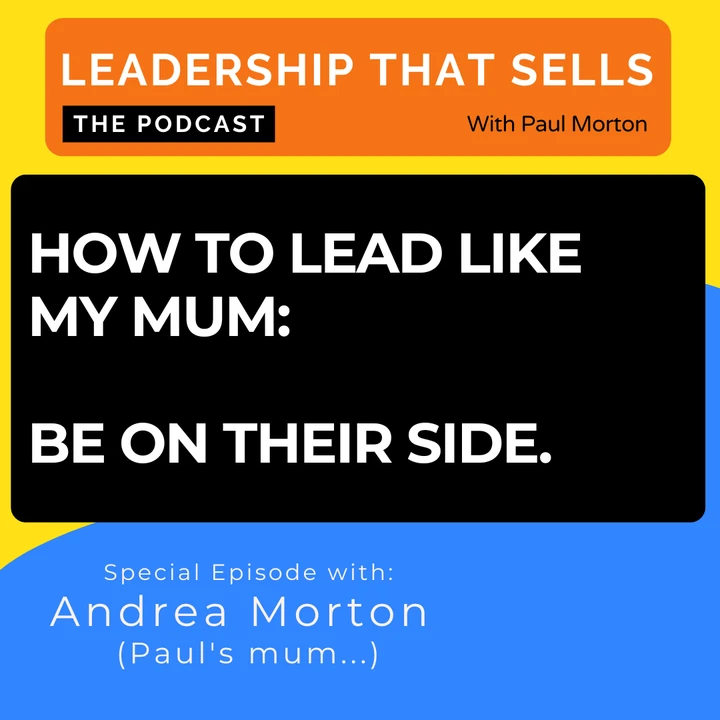
How to lead by being on their side
with Andrea Morton
Show notes
This is a special episode—it’s me chatting with my Mum. I’ve learned a lot about leadership over the years, but it’s humbling to sit down with the person who taught me first and most. My Mum, Andrea Morton, spent decades as a headteacher, leading schools through everything from petrol bombs and staff conflicts to building community pride from scratch.
Throughout our conversation, I was delighted that one idea kept shining through: great leaders like my Mother are simply on their people’s side. It’s not complicated. It’s genuine care and support, small gestures that build trust, and stepping up to clean the school yourself when needed. Her stories aren’t flashy, they’re real and practical. Leadership, according to Mum, isn’t about ego. She says it’s about service.
Here are three big lessons she shares here about “being on their side”:
-
Serve first, lead second: Leadership isn’t about authority – it’s about helping your team succeed. Mum started with simple things like improving the staffroom, making sure teachers had what they needed. It showed she genuinely cared.
-
Deal with trouble early: When there’s a problem, waiting won’t fix it. Mum tackled tough situations fast, protecting her team’s morale. She never let issues linger, knowing it would only make things worse.
-
Build something together: People feel connected when they’re part of building something meaningful. Mum involved teachers, kids, and even parents in designing uniforms and shaping the school’s identity. It gave everyone pride and belonging.
This is probably the most personal episode I’ve done. It’s my Mum’s wisdom, but it’s for anyone who wants to lead with heart, humility, and genuine care.
I hope you enjoy this 100th episode – and if you find value in it, please rate, share, and review. It helps more people find conversations like this one.
Transcript
Automated transcript. Speaker labels and spellings may contain errors.
Paul
[upbeat music] So this is my 100th episode.
Andrea Morton
No, it's not. It has to be your 99th.
Paul
Why?
Andrea Morton
'Cause your 100th one has to be your son interviewing you.
Paul
Oh, that's a good idea. So this is my 99th episode, okay? So if you've been p- paying attention, this is episode 99, not 100. So I'm swapping that around. And-
Andrea Morton
Are you recording this?
Paul
This is recording, yes, okay.
Andrea Morton
Thank you very much.
Paul
So, and this is my mum.
Andrea Morton
[laughs]
Paul
Okay. So this is Portobello Boon. Now, uh, I normally start off with some sort of boisterous introduction of all the wonderful things that you've done-
Andrea Morton
[laughs]
Paul
... and then come to some dramatic crescendo and say, "Andrea Morton, thank you very much for joining me." But it's my mum, so I would feel a bit daft doing that, so you'll excuse me and bear with me if I'm not doing that, all right? This is-
Andrea Morton
It's a bit sad, because the most wondrous thing I've done is birth you.
Paul
Oh, shucks. Thank you very much. I'll take that all day long. Um-
Andrea Morton
Yeah, all day long
Paul
... would you introduce yourself to both of my listeners?
Andrea Morton
[laughs] That'd be, that'd, that'd be your aunties. [laughs]
Paul
Well, there's one auntie, and there's the some guy that has seen Travels in, like, 26 different countries, so I'm not doing too badly at AC that we are.
Andrea Morton
My name's Andrea Morton. I am a retired headteacher. Long time, nearly 20 years retired.
Paul
20 years retired. Jesus. I remember going to your retirement party.
Andrea Morton
I remember you going to my retirement party as well. [laughs]
Paul
You came by helicopter.
Andrea Morton
[laughs]
Paul
Now, I'll quote to you very thoroughly. Well, I, I do. There was a niece, um, out in Monaco, and I had... I got a taxi. It was actually the airport taxi, but it was a helicopter 'cause somebody else was paying for it. Obviously didn't know that at the time, so got the, the helicopter to go and see my mother retire-
Andrea Morton
[laughs]
Paul
... from Monaco to Nice, and then flew home to Glasgow.
Andrea Morton
That was-
Paul
Was it 20 years entirely?
Andrea Morton
20 years come June.
Paul
Wow.
Andrea Morton
There you go.
Paul
My goodness me.
Andrea Morton
I know.
Paul
Wow.
Andrea Morton
Scared you.
Paul
When did you... I mean, you started work age what?
Andrea Morton
21.
Paul
21. Straight out of college. Yeah. Teacher training college.
Andrea Morton
Mm-hmm.
Paul
And that was just as a plain ordinary kind, plain ordinary teacher.
Andrea Morton
You don't get plain ordinary teachers.
Paul
Of course not.
Andrea Morton
All teachers are special.
Paul
Of course not. All teachers are special. Uh-
Andrea Morton
Yes, I did, and I taught for nine years in a variety of n- mixed, mixed ability schools, shall we say. Some were a bit more, you know, dangerous than others. I've had-
Paul
Dangerous?
Andrea Morton
Dangerous. Um, I actually got danger money.
Paul
[laughs] I did.
Andrea Morton
I got £100 a year extra for going to a second school-
Paul
Uh-huh
Andrea Morton
... because it was so dangerous and they couldn't get staff.
Paul
So inner city Glasgow?
Andrea Morton
Yes. Uh, it's got a school near a pub called the Sary Head.
Paul
Sary Head.
Andrea Morton
The Saracen's Head.
Paul
Right.
Andrea Morton
And then you weren't allowed to walk from the bus stop to the school unescorted.
Paul
Right.
Andrea Morton
And they put a petrol bomb through the office window to destroy the P files.
Paul
Nice.
Andrea Morton
Yes. So yes.
Paul
That was a good introduction to some... Well, wel- welcome to your worthwhile, uh, profession as the-
Andrea Morton
I learned more that year than I ever learned, I think. [laughs] Yeah.
Paul
So nine years in, then what happened?
Andrea Morton
Um, I got a headship in, uh, this little town, this little village called Brancepeth in County Durham.
Paul
What was the, what was your story behind that, before that bit? What were you gonna do?
Andrea Morton
Oh, I know. I'd always wanted... I was gonna be a headteacher before I was 40.
Paul
Mm-hmm.
Andrea Morton
That was my ambition. But I made it before I was 30, so that was fine. Um, the... I tried to get a deputy head's job, assistant head's job at the time, and when I was being interviewed for one, a, a job that I didn't get, I was told there that I could apply straight for the headship. So I did in that, in Argyll. I got it. So that was basically I was being told at the interview to apply for the next job.
Paul
Uh-huh.
Andrea Morton
And I did, and I got it.
Paul
That's the old, the good old days when you, there was a vast shortage of teachers.
Andrea Morton
Yes.
Paul
Uh-huh.
Andrea Morton
Uh.
Paul
Especially in these schools where there were-
Andrea Morton
Eight children.
Paul
Right.
Andrea Morton
Yeah. One of whom was your, uh, yes.
Paul
Well, not quite. I mean, I was starting school.
Andrea Morton
You started in primary one, yes.
Paul
Started primary one aged?
Andrea Morton
Aged five.
Paul
Aged five.
Andrea Morton
Mm-hmm, mm-hmm.
Paul
Okay. And you were my headteacher.
Andrea Morton
Yes. And you would come home and say you didn't have any homework, and I'd set it. [laughs]
Paul
[laughs]
Andrea Morton
But, but then you know I did because you'd done it with such just three and a half crowns. But there you go, yes.
Paul
So that was your first-
Andrea Morton
That was my first headship.
Paul
So an executive role.
Andrea Morton
Yes. Yeah.
Paul
Well, it's, it's, it's different because you weren't just teaching. You weren't just a, an individual person teaching. You actually had the responsibility. This is a different level of responsibility.
Andrea Morton
Yeah. I had all the paperwork and everything else to do, and the ordering, and your requisitioning, and, and the, everything, basically everything. And so there was the odd day I cleaned the school when, when the cleaner didn't come, you know?
Paul
Mm-hmm.
Andrea Morton
I, I drew the line when the cook was off sick. We went down to the hospital myself.
Paul
Yeah.
Andrea Morton
I saw my, yeah. We- [laughs] That's a snide remark.
Paul
It's all-
Andrea Morton
You survived my cooking.
Paul
I survived very well.
Andrea Morton
Oh. [laughs]
Paul
Very, very well.
Andrea Morton
Yeah. It's got worse. Um, but we go down to the local hotel if the-
Paul
Mm
Andrea Morton
... if the cook was off. If the cleaner was off, I just did it, so that's-
Paul
The vacuuming.
Andrea Morton
Yeah.
Paul
So you stepped from nine years as a teacher in interesting circumstances. This, this was the, um, ordeal by fire, quite literally.
Andrea Morton
Mm-hmm.
Paul
Right.
Andrea Morton
Mm-hmm.
Paul
Fistfight people for miles.
Andrea Morton
Yeah. Oh, yeah.
Paul
Uh.
Andrea Morton
That was common.
Paul
Right.
Andrea Morton
Uh-huh.
Paul
Then, um, as your first executive, probably your first role of responsibility was a small school to-
Andrea Morton
200-odd learning space.
Paul
Yeah.
Andrea Morton
Yeah.
Paul
And how long were you there?
Andrea Morton
There for three years.
Paul
Mm-hmm.
Andrea Morton
Just, just over three years. Three years and a couple of months, and then I moved to, um, bigger school, which had three teachers and myself, but again, they, they still had no... To start with, they had no office staff.
Paul
Uh-huh.
Andrea Morton
So I was still doing all the office work, all the administration from the office.
Paul
Mm.
Andrea Morton
And answering the phone as well as teaching a class.
Paul
Mm.
Andrea Morton
That was a composite five, six class.
Paul
And how old, how old were those kids?
Andrea Morton
Then, well, there were 10, uh, ni- nine and 10
Paul
Nine
Andrea Morton
... nine and 10. You were one of them, um, 'cause you were in that stage. That, and I'm not sure what it inflicted in you also. But, uh, [laughs] that was only probably a brief respite. Uh, um, so that was interesting, and I remember saying to a fellow colleague saying, who had gone to a non-teaching post from the same s- situation. I said, "I don't know how you can do it and not teach." And after a year in that situation, I said, "I need to be non-teaching."
Paul
Mm-hmm.
Andrea Morton
Because I really couldn't do both jobs properly.
Paul
Sure, you were doing both jobs okay, but-
Andrea Morton
Yeah. I, I could, I could have done more. I eventually got two hours a week, uh, office stuff.
Paul
Mm.
Andrea Morton
Which was a big difference. And once I realized how much I'd been doing that wasn't really my skill set-
Paul
Mm
Andrea Morton
... then it was easier. Once I got some office stuff, then it was easier to see the potential.
Paul
Was that the first time you discovered delegation?
Andrea Morton
Um, yes. With a vengeance.
Paul
And how did it work?
Andrea Morton
Very well, thank you. I'm very good at it. [laughs]
Paul
Okay.
Andrea Morton
I discovered I could do this.
Paul
A genetic skill.
Andrea Morton
Yeah. [laughs]
Paul
[laughs] It's a thing.
Andrea Morton
Uh, it's, um, not... Since I did a delegation at the time-
Paul
Mm
Andrea Morton
... I just wanted people to help, and persuaded them they could. And I actually got quite a lot of the community involved. So that, that was quite, that was an interesting development from there. Mm.
Paul
So you were, you're, at this point, you're now, you've gone from being the, the responsible and the teacher for all of them, because of course the, the, the, the tape comes from school. The kids were age five to 12.
Andrea Morton
Five, yeah.
Paul
So you had every class-
Andrea Morton
Uh-huh
Paul
... in one room.
Andrea Morton
Yeah.
Paul
That was the, that was interesting. Um, but then went from that to a small-ish school, three other member of staff.
Andrea Morton
Uh-huh.
Paul
And you got somebody in to help.
Andrea Morton
For the victim did.
Paul
To, to some-
Andrea Morton
And, uh-
Paul
... and help admin stuff.
Andrea Morton
And...
Paul
So did that mean that you were doing less teaching at that point?
Andrea Morton
Yes.
Paul
As you as kind of-
Andrea Morton
I had, I had some time off.
Paul
Okay.
Andrea Morton
I had, uh, I had the two hours that she was in-
Paul
Right
Andrea Morton
... to do the, um, so I had that off.
Paul
Mm-hmm. What did you do with those two hours?
Andrea Morton
Probably drew breath. [laughs]
Paul
[laughs]
Andrea Morton
Um, but actually probably did more planning. You could sort of get a chance literally to draw breath and to plan, uh, activities for the whole school.
Paul
Okay.
Andrea Morton
Because you had to monitor everyone. That was when I first had the aspect of having to check up on other folk.
Paul
Mm-hmm.
Andrea Morton
And that was different as well. That's a different take on it.
Paul
Mm-hmm.
Andrea Morton
Because all right, you're doing it yourself, you know you can do it, and if you don't do it, then you know you have to go back and do it.
Paul
Mm-hmm.
Andrea Morton
But when somebody else doesn't do it, and you have to go in and say, "Excuse me, but that's not happening. You need to do X, Y, and Z."
Paul
Mm-hmm.
Andrea Morton
That was a little experience, 'cause I'd had no training in that at all.
Paul
Nobody ever does. This is what I'm all about.
Andrea Morton
[laughs]
Paul
Is that nobody ever gets this moment in time where somebody says, "By the way, congratulations. Here's your new job. There's your team. Good luck."
Andrea Morton
Uh-huh.
Paul
And is never followed up with, "Here's your team, good luck, and this is the first three things you need to know about how you actually deal with people."
Andrea Morton
Mm-hmm. Like, uh, that would've been helpful.
Paul
Uh.
Andrea Morton
That would have been helpful, because I had a guide in the role, teacher-
Paul
Mm
Andrea Morton
... who did exactly the same thing every year. And I found that out when she left, and her workbooks, her planners were there. And the one for 20 years before that was exactly the ones, the one she was using.
Paul
Mm-hmm.
Andrea Morton
Um, and regardless if the children had progressed, needed anything else.
Paul
She just sort of crossed out feet and inches and put in centimeters?
Andrea Morton
She wrote the whole thing out again.
Paul
Right.
Andrea Morton
Exactly the same, and all that was changed was the dates.
Paul
Nice.
Andrea Morton
Yes. [laughs]
Paul
Sufficient.
Andrea Morton
No.
Paul
[laughs] So when, when you, when you first started then taking on the responsibility, working the responsibility of the role to the responsibility of having a team, now there's a difference between being in charge of some individuals and being in charge of a team. But, and, and I know your latter years, you're very, very good at building teams. Doesn't sound like that was a team.
Andrea Morton
No, that was not a team. Um, once I got, well, once a certain member of staff left-
Paul
Mm. That's speed.
Andrea Morton
Yes.
Paul
Mm.
Andrea Morton
Um, actually Jim came in one day and was never seen again.
Paul
There you go.
Andrea Morton
That's, yeah.
Paul
Open the door, hit the backside on the way out.
Andrea Morton
Nothing to do with me. [laughs]
Paul
[laughs] Nothing to do with her.
Andrea Morton
Um, once that had been sorted, there was, um, the start of one.
Paul
Mm.
Andrea Morton
There was the start of one, because unbeknown to me, it had been aggravating the other members of staff.
Paul
Oh.
Andrea Morton
So, yes. So that, that was a start. And the chain I left, there was the, the, the start of a team. They, they felt more united. They did feel more united.
Paul
It's not an uncommon thing that I see a lot, I'm sure people know this, is you have high performers, or even just averagely decent people, and somebody's pulling them down, and you're sitting there going, "When is the boss gonna fire that person?" Or, "When is somebody gonna deal with that person?" And very hard in public sector because it's very hard to do that.
Andrea Morton
Mm.
Paul
But it's, it's hard enough in private sector where you've got a boss who just doesn't know how to set performance standards, how, how to hold people accountable, or, uh, ultimately how to fire someone. They just go, "Ah." And just, "Well, I don't know, but..." And my, my one learning, which we'll get to yours in a second, my one learning is the minute you know that something has to be done, has to do it. The minute you know that there's a performance issue, or there's a challenge, or there's a problem, you've gotta deal with it. It will never improve on its own. You can never hear that second chance. You can never... Nothing's gonna change. You've gotta deal with it. Just that's it. And your situation, of course, you're, you're kinda hamstrung.
Andrea Morton
Yeah.
Paul
'Cause you cannae fire teachers.
Andrea Morton
Mm-hmm.
Paul
You just, it's not how it works. So some- she magically left with her own accord, which is a story for another day altogether.
Andrea Morton
[laughs]
Paul
Right? Um, you then got a chance to build this into a team. How'd you do that?
Andrea Morton
That one we, I didn't really do a lot of, because by that time I was kind of halfway through... I'm gonna say my term, but you know, but my f- she, I, I was-
Paul
10 year. You were 10.
Andrea Morton
Yeah.
Paul
Yeah.
Andrea Morton
Yeah, well, I was... I'd intended to be there longer, but things outwith happened, and I was only there for about two and a half years.
Paul
Mm-hmm.
Andrea Morton
So it wasn't long enough by the time I had dealt with that.
Paul
Mm.
Andrea Morton
A year wasn't enough time-
Paul
Mm
Andrea Morton
... to build a, an efficient team.
Paul
Mm.
Andrea Morton
But, um, we did it basically with extracurricular things. So the-
Paul
What does that mean to people who don't know the schools?
Andrea Morton
Um, we had a choir, and we went out singing basically. We got the kids to do that and to become, be more involved in the community. And because the teachers were all local-
Paul
Mm
Andrea Morton
... they enjoyed it.
Paul
Nice.
Andrea Morton
That, that was, that was basically how we did that one. Um, yeah.
Paul
Mm. So you hooked into things that were outside of the day-to-day?
Andrea Morton
Yes. There was, where there was no competition between them.
Paul
Right.
Andrea Morton
Where they could all excel.
Paul
That's, that's interest- That's interesting, where, where you, you can, you're allowing people to be good and to, to feel good about themselves.
Andrea Morton
Yeah. And care about.
Paul
Uh-huh. Collected.
Andrea Morton
Yeah.
Paul
Uh-huh.
Andrea Morton
Is it.
Paul
Oh, interesting. Okay. So that's, um, where you had engaged a small-ish team. First cutting your teeth on dealing with difficult, d- difficult, not difficult kids. They're fire bombs. [laughs] Okay. Uh, challenging individuals. Then starting to build a team. What, where did you go from there?
Andrea Morton
I went to a much bigger school, um, where I had, instead of having three teachers, I had 12. And I also had ancillary staff, and I had office staff, plural.
Paul
Mm.
Andrea Morton
Which was absolutely amazing, and God bless them. [laughs]
Paul
[laughs]
Andrea Morton
They made my life so much easier.
Paul
Mm.
Andrea Morton
And probably that was where I got, realized the importance of involving everyone, especially the janitor and the dinners, because they can make life hell on earth-
Paul
Mm
Andrea Morton
... or they can make it run smoothly.
Paul
Smoothly.
Andrea Morton
Yes. Yes. Because the, the backup from the janitorial staff-
Paul
Mm
Andrea Morton
... and the office staff, that's all your admin, that's all your organization.
Paul
Mm.
Andrea Morton
That's your outside behavior. Um, basic manners in children, looking out for other people.
Paul
Mm.
Andrea Morton
Being responsible for doing things because other people are involved that they wouldn't have thought otherwise.
Paul
I remember the janitors were wonderful.
Andrea Morton
Yes.
Paul
Uh, absolutely wonderful human beings.
Andrea Morton
Uh-huh.
Paul
Uh, and fix anything. But with that was-
Andrea Morton
Including doors.
Paul
Uh, uh.
Andrea Morton
Yeah. They were, yeah. Very well placed with that.
Paul
Uh.
Andrea Morton
Um, yeah. So that was, um, that was it. At the, the other thing was the, the, the school had been a primary department of a secondary school.
Paul
Right.
Andrea Morton
And-
Paul
Yes
Andrea Morton
... I was actually the first headteacher of the school when it became a separate entity.
Paul
Mm-hmm.
Andrea Morton
And when I started, the school didn't even have its own telephone.
Paul
Mm.
Andrea Morton
It had an extension. And the staff were absolutely over the moon when we got our own telephone and became independent. [laughs]
Paul
[laughs] That's wonderful.
Andrea Morton
I thought they would, because-
Paul
Mm
Andrea Morton
... that-
Paul
Up the rebels
Andrea Morton
... was so much easier on everyone.
Paul
Uh.
Andrea Morton
Especially the office staff. But yes, it's what I did.
Paul
Let's, let's go into the idea. You came in, you waltzed in the door one day and says, "Oh, I'm the new boss."
Andrea Morton
And apparently they tell me, or people have told me that when I was talking about the independence of the school, I banged on the table. I don't remember that.
Paul
[laughs]
Andrea Morton
The
Paul
You're a table banger.
Andrea Morton
"We will do this. We will do this."
Paul
Uh-huh.
Andrea Morton
"And we will win."
Paul
Uh-huh.
Andrea Morton
And they liked that. They liked the me then as opposed to...
Paul
On the practicality of that, now remember we, we moved house.
Andrea Morton
Yeah.
Paul
Okay. And 1st of September or something like that, I assume it was a start of, that was October. It was the start of the school year, wasn't it?
Andrea Morton
No, it wasn't.
Paul
No?
Andrea Morton
It was the second term.
Paul
May.
Andrea Morton
Yeah. But no, that was an April one.
Paul
April.
Andrea Morton
That was, we moved in the April, 'cause you were still primary six.
Paul
Oh, right.
Andrea Morton
You were just-
Paul
Think I was just six, seven. I did have one year in that school.
Andrea Morton
Yeah.
Paul
Yeah, yeah, one year. Uh-huh. So you, you walk in the door. You, how much notice did you get on this?
Andrea Morton
Um, probably a few months.
Paul
Few months.
Andrea Morton
Two months, yeah.
Paul
Two months to move house. But did you find out anything about the school before you went in?
Andrea Morton
Oh, yes.
Paul
Mm.
Andrea Morton
I found out a lot about the school.
Paul
The other staff.
Andrea Morton
[laughs]
Paul
Yeah, the staff.
Andrea Morton
Actually, it was the off- the education officers.
Paul
Mm.
Andrea Morton
I, I'm not going to go into detail about the education [laughs] officers.
Paul
It was 40 years ago. You're fine.
Andrea Morton
Yeah.
Paul
They're all dead. [laughs]
Andrea Morton
[laughs]
Paul
Right. So you, you, you took on, you took on the, the responsibility for the school, the responsibility for the staff, responsibility for 300 kids?
Andrea Morton
Yeah, 300 there.
Paul
332 resources.
Andrea Morton
No. No, it wasn't. It was 260. That one was 260.
Paul
Because-
Andrea Morton
If you got 261, you got a, an assistant head.
Paul
Oh.
Andrea Morton
I only had 260.
Paul
Oh, so close.
Andrea Morton
Yeah.
Paul
So-
Andrea Morton
It's all right, Bill Arnott
Paul
... there you were like... [laughs] Fine. So when you took the teamwork, when you went in first, had you a, a manifesto in mind? Had you a plan in mind? How did you build that?
Andrea Morton
I didn't. I honestly didn't have one in mind at that point. Um, everything that I knew all round about, you know, this, this, the job was, we moved because we had to move from, you know- Geographically means move. So we had moved and, um, I can't say I hit a running.
Paul
Mm.
Andrea Morton
They didn't. But the staff were all willing. No, that's not true. Um, I'm going to say they're all e- they were all able. There was a right mixed bag of folk.
Paul
Right.
Andrea Morton
They were decent folk.
Paul
Mm.
Andrea Morton
The, the staff were, were nice. It was a lovely area. Children were just children.
Paul
Mm.
Andrea Morton
But with, um... I don't know how we did that one, as we didn't have the external thing to keep us together. I started with the staff and the social thing because the staff room was awful, and we started literally there with a cup of tea.
Paul
Mm.
Andrea Morton
I mean, the seats were uncomfortable, and we started there. I said, "What would you like to make this more comfortable?" They said, "Oh, you know, secondhand stuff." This, that. I said, "What would you like?"
Paul
Mm-hmm.
Andrea Morton
You know, and, "Well, but you're asking us, put me one." And I said, "Well, yes, you're in it more often than I am. What would you like?" So they thought about it, and they came back with a list, and I did fundraisers.
Paul
Mm.
Andrea Morton
And, you know, one, one teacher actually said, "Don't put anything down or she'll raffle it." [laughs]
Paul
[laughs]
Andrea Morton
And that was kind of true-
Paul
Uh-huh
Andrea Morton
... because I got the money.
Paul
Uh-huh.
Andrea Morton
And we did it, and we did it ourselves. We didn't bother with the education authorities. Yeah, I did that for other things, but, you know, we did it. And they knew that if they wanted anything for their classes, we would get it.
Paul
Mm.
Andrea Morton
Fair. I even sold the furniture. [laughs] We... There was a, um, sh- I don't... You, you're an eminent, but in the hall, the central hall, because it had been a secondary thing, there was this glass cabinet, which must have been about 20 feet long.
Paul
It was like the awards cabinet or something like that?
Andrea Morton
Yes. Uh, and it was cupboards at the bottom and glass cup and things along.
Paul
Mm.
Andrea Morton
And I sold it to the auctioneer, and we got a new reading scheme out of it.
Paul
[laughs] Floored them obviously. Well, would you need that
Andrea Morton
Well, this is it. So I think that was what it was when they realized-
Paul
You're on their side
Andrea Morton
... they could actually get things, you know, that, that, that they could, they then could do.
Paul
So you put them in the position of-
Andrea Morton
You decide
Paul
... you decide. You're in charge of this bit-
Andrea Morton
Uh-huh
Paul
... not this bit. When it came to the dis- the, the overall direction of the school, you committed to that and probably been, been part of a, another organization for a long time. You basically pulled out, which to my many listeners is basically what's demerger, right? That's what you did.
Andrea Morton
Yeah.
Paul
You went in there-
Andrea Morton
And I ate it
Paul
... took it over, separated this out, carved it out from this, this entity, and you had to create its own identity.
Andrea Morton
Yeah. We got the kids to do that.
Paul
Uh-huh.
Andrea Morton
They designed their uniform.
Paul
Wow.
Andrea Morton
They, they had to, you know, they made their own, a new uniform.
Paul
Mm.
Andrea Morton
And we got two parents on board with that too, planned. So we asked them what, what kind of clothes they wanted, and then we let two kids design it. Um, basic symbols of sweatshirt.
Paul
Yeah.
Andrea Morton
That's, we did twice.
Paul
Twice was very early because that was all... I mean, this was the
Andrea Morton
That's avant-garde, right?
Paul
It was blazers and ties and shirts and all that sort of stuff at this point. And if you're listening from the States, most kids in the UK wear uniforms, right? And as a parent of children, saints be praised, you have one set of kid- one set of clothes you need to worry about. Um, 'cause most of Europe, most of the US, they just wear their own clothes, which means that every kid has to have some something to wear, and everybody's going, "Oh, that's not the latest whatever." Um, but going for a blazer, it's cheap, it's recyclable, and-
Andrea Morton
It hangs in the floor of the cloakroom
Paul
... it sits in the floor of the cloakroom all day long.
Andrea Morton
Yes.
Paul
Or you've got to, you've got, I believe-
Andrea Morton
Yeah
Paul
... a 20 pound blazer, a 20 pound jumper, or a 70 pound blazer sitting on the floor.
Andrea Morton
No, we went for the sweatshirts.
Paul
Uh-huh.
Andrea Morton
They only went down to collar ties. We've got that lot. We've got 100 pound that way as well. And then we started with the local communities.
Paul
Mm.
Andrea Morton
Um, in those days you, you had a, you had to go through the television room-
Paul
Mm
Andrea Morton
... if you wanted to watch.
Paul
Yes, it was programmed. And you didn't have one on the, the wheel. You could trolley around. There was
Andrea Morton
Yeah.
Paul
... later.
Andrea Morton
Yeah, but we ended up without it as well.
Paul
Uh.
Andrea Morton
So I got the local shops to shove people again, sort of not quite raffles, but, um, said that we would have the education department start listening to us.
Paul
Yes, ma'am.
Andrea Morton
Um-
Paul
They're all dead. It's fine. You can talk. [laughs]
Andrea Morton
So-
Paul
It speaks to your professionalism that still you're not naming names. There's some good stories here somewhere, I tell you. You know that. [laughs]
Andrea Morton
We had a local TV guy in, and he put a television in every single classroom. So no one went and need to spend hours wandering from one place to the other. And then he set it all up with the videos. When I went into the hall, we could stick in cartoons. The kids could watch cartoons. [laughs] Yes. We got people involved-
Paul
Uh-huh
Andrea Morton
... to do things. You know, we got the local horticultural people to come in and do planting with the kids, so they could do bowls and things like this, you know. So we did a lot of-
Paul
Mm
Andrea Morton
... you know, people coming to us as, as well as us going out and things like that, so yeah.
Paul
So you're doing, you're doing two things here. One is you're bui- building the, building the identity of the school itself, but doing it as you had to because it's a school full of kids who have parents, who have lives outside. These, that is the... They were, their education was the product that you were providing, and you did that in the context of the community around you at the same thing, building both of you.
Andrea Morton
Yeah. We, we had a really good-
Paul
Was that conscious or just serendipitous?
Andrea Morton
Maybe a bit of both. You-
Paul
That's not all
Andrea Morton
... once we're saying, "Well, we could do this," and things like, "We can do that. We can do this."
Paul
Mm-hmm.
Andrea Morton
You know, and it kind of built up that way. And we were the biggest school in the area, and there was lots of small s- small single teacher schools around about, and we became the, the, the focus. We then became the focus.
Paul
Yeah.
Andrea Morton
And if anybody wanted anything, they would come and borrow it from us. We were kind of like a lending library.
Paul
Mm-hmm.
Andrea Morton
And, um, we had a visitor from, um- A BC. Then he came in and some of, some swaps were going on around about him, and he was kinda watching. Said, "Did you do this?" I mean, said, "Yes." Yeah, I said, "Oh, yeah, we do this, and we'll do this for that, and do that for that." He said, "Yeah." So he said, uh, "Would you like to do the primary, you know, BBC thing with the education program?" And I said, "Why?" And he said, "Well, you- you're doing this." And I said, "Yeah, but..." He said, "Well, do you use BBC programs?" I said, "Yes." "Well, they're rubbish." And-
Paul
[laughs]
Andrea Morton
... okay, and I thought, yeah. So we got involved in that, um, for a while, and then it was two techniques. Uh, we, we did a lot of other-
Paul
Mm
Andrea Morton
... bits and pieces. Um, yeah, we... Some staff left, some retired, some... And other ones joined us.
Paul
Yeah.
Andrea Morton
And the ones that joined us were more, you know, able to fit in, shall we say. Able to fit in with what we were doing. But then, um, yeah, that was kind of when we started doing trips abroad and stuff like that as well. So that was, yeah, we did. [laughs]
Paul
'Cause I have to go back to this, this, the group and the, the, the staff here.
Andrea Morton
Mm.
Paul
Now, maybe we should actually move on, 'cause I think it gets more interesting. 'Cause this is you as well gaining experience in-
Andrea Morton
Working people
Paul
... working, working people, working with people, working with communities, working with the bigger and bigger schools. So you were, you were at that school for how long?
Andrea Morton
A lot more at that school. [laughs]
Paul
Yeah.
Andrea Morton
Um, eight years.
Paul
Eight years? Mm.
Andrea Morton
Yeah.
Paul
So you did... You mean, typically, uh, I call that tour of duty. Any job's a tour of duty. So you've one year to learn how the towers work.
Andrea Morton
Mm.
Paul
One year to get good at it.
Andrea Morton
To-
Paul
One year to master it, and one year to get ready for the next time. So you were there for eight. So you got-
Andrea Morton
Maybe it was six. Yeah
Paul
... up, and then had this-
Andrea Morton
Yeah
Paul
... extended period of excellence, 'cause it was an excellent school.
Andrea Morton
Mm-hmm.
Paul
Then you moved up to another.
Andrea Morton
Yeah.
Paul
One up.
Andrea Morton
Um, I had the school. I had-
Paul
Humming.
Andrea Morton
Yeah, basically. It was running well.
Paul
Mm.
Andrea Morton
And I think one of the reasons I got involved in things like the BBC and stuff like that was 'cause I got it running well and-
Paul
Mm
Andrea Morton
... and have enough, lot, uh, left to... Not so much, much to, but keep my interest.
Paul
But you still had a job.
Andrea Morton
No. No.
Paul
Okay.
Andrea Morton
It can never be that. No.
Paul
Well, isn't that the goal? Do you wanna make-
Andrea Morton
No
Paul
... you wanna help people?
Andrea Morton
No, I want to watch people doing it all.
Paul
Yeah.
Andrea Morton
Yeah. That's, that's-
Paul
That's the, that's the thing. You, you wanna, you want-
Andrea Morton
No, you want to be in a position where you can see. You don't, you don't-
Paul
Yeah. I know
Andrea Morton
... wanna have the job-
Paul
No
Andrea Morton
... because you're, you're just keeping the eye out.
Paul
Yeah.
Andrea Morton
But the... Yeah, I'm not actually having to scrub the toilets. That's-
Paul
Yeah.
Andrea Morton
We've gone from that one, but still had to do it on occasion.
Paul
Okay.
Andrea Morton
Um, but I, I can remember definitely 'cause there was a few of us, um, sitting having, uh, well, dinner one night, um, three c- colleagues, and somebody said, "You need to move to such and such." And I said, "Where? Why? When? Where? Why?" And they said, "It's in dire straits." [laughs] And I said, "Well, why should I move there?" And they said, "Because you would love it there."
Paul
Right.
Andrea Morton
And I thought... And then when normally I thought about it, thought, uh, well, may as well try it. You know, it's feasible. It's travel. You could travel there. And I did. And then I went to see it. It had its own loving glacier.
Paul
Mm-hmm.
Andrea Morton
Because the place that, you know, windows got smashed every night. It was due for, not demolition, but rebuild. It was, it was either going to be, um, upgraded or rebuilt. And fortunately, it was rebuilt. So I went there before it was rebuilt, so I had enough time to get to know the staff. It was a, a U-shaped building, which meant you were forever on the trot going right, 'cause it was a fair size one. That one had the 330 kids. Sometimes more of them. You know. Um, and they rebuilt it as an open plan school.
Paul
Mm.
Andrea Morton
Totally open plan.
Paul
With the three fun, mean, tharty little squeaky voices. And how many, how many staff was there?
Andrea Morton
We had 10. I had 10 teach- no, I actually had 12 teachers. Um, I had four auxiliaries. I had two office staff. A janitor. I had six cleaners, and eight in the dining hall.
Paul
Mm-hmm.
Andrea Morton
Yeah.
Paul
Mm.
Andrea Morton
And a lot of complaining.
Paul
And a lot of complaining.
Andrea Morton
And a lot.
Paul
On the team.
Andrea Morton
Yeah.
Paul
Right. Uh-huh.
Andrea Morton
Uh-huh. That was a shock to the system. So while we were still in the old school, I introduced team teaching.
Paul
Mm.
Andrea Morton
And so the kids actually had, um, two teachers working with o- with one larger group of children.
Paul
Right.
Andrea Morton
And sometimes we had to put them in the hall because that was the only space that we could accommodate them. And we spent a lot of time with the children learning to t- learning... [laughs]
Paul
[laughs] Well, I learned you really well.
Andrea Morton
Learned you real- Learning how to change their shoes.
Paul
Right.
Andrea Morton
Because the car- the, the new school was going to be carpeted.
Paul
Oh, yeah.
Andrea Morton
And they had to change their shoes. And that was a challenge for some of them.
Paul
Can you do the laces?
Andrea Morton
They... Yeah. No, we actually suggested that the parents done gyms.
Paul
The slip-on blunders.
Andrea Morton
Yeah. Done so.
Paul
Sannys.
Andrea Morton
Guttys.
Paul
Guttys, guttys.
Andrea Morton
Guttys.
Paul
Which comes from gutta percha, which I'm sure you knew that.
Andrea Morton
[laughs] No.
Paul
Gutta percha is gutta percha rubber.
Andrea Morton
All right. Okay.
Paul
That's where guttys comes from.
Andrea Morton
Oh, baby. What?
Paul
Now I'm random myself. [laughs] Back off. No, I'm... [laughs]
Andrea Morton
So, so with it, with that, um, uh, yeah, I remember it was a nightmare. [laughs]
Paul
Yeah.
Andrea Morton
Because in that school they had... It was a Christian school, so, you know, that meant that there was two, two primary sevens, two primary sixes, two primary fives. And the two primary fives weren't even doing the read- same reading scheme.
Paul
Smart ladies.
Andrea Morton
Or the same books, as you know. Uh, there was no consistency with anything in there. The senior teacher was responsible for music, and she was actually a brilliant music teacher, but her responsibilities meant that she had the key to the music cupboard.
Paul
Mm.
Andrea Morton
That was all she did So she was not element when I said to her, "I'm sorry, but hey, clear out. You can do music. You'll do music." And yes, she did music after that. Everybody benefited from that. And we did a lot of, with the team teaching aspects of things, we said, "Right, you, you prefer to do PE rather than art, and you prefer to do art rather than PE. Guess who's working together?" Yeah, we did that. So we played to the strengths of the staff.
Paul
Mm-hmm.
Andrea Morton
Um, and yeah. We-
Paul
Yeah
Andrea Morton
... got them to... What I did was I said to them, "What would you like to remain the same? What do you like about the school?"
Paul
Mm-hmm.
Andrea Morton
We did a survey and we did it with everybody. We did it with the kids, we did it with parents, we did it with cleaners. Everybody did the survey, and they had to write down six things, three they liked and wanted to remain the same, and three they didn't like-
Paul
Mm-hmm
Andrea Morton
... and wanted to change. And we worked from there.
Paul
That's a good place to start.
Andrea Morton
It, well-
Paul
Well, you had, you had there some data points.
Andrea Morton
Yes. Get that, um, you've called it.
Paul
Ah, exactly. [laughs]
Andrea Morton
Well, we knew what w- what they wanted and what they didn't want. We knew what they liked about the school and what they didn't like about the school. And it was surprising how coherent these lists were.
Paul
Mm-hmm.
Andrea Morton
Uh-
Paul
Was it?
Andrea Morton
Yeah. It, uh, it was. So yeah, it, it worked quite well. My first parent meeting at that school, it was with the school board who, who were representative on the, um, interview panel.
Paul
Mm-hmm.
Andrea Morton
They were actually representative-
Paul
On, uh, the interview, your panel, they interviewed-
Andrea Morton
On the one I was interviewing for.
Paul
Right. Mm-hmm.
Andrea Morton
The first meeting that I went to-
Paul
Mm-hmm
Andrea Morton
... as the head teacher-
Paul
Mm-hmm
Andrea Morton
... debated the legitimacy-
Paul
Mm-hmm
Andrea Morton
... of the interview.
Paul
Nice. Good start.
Andrea Morton
Yes. There were 20 people. Now, this, the, the school board should have consisted of six.
Paul
Right.
Andrea Morton
There were 20 people at that meeting-
Paul
Mm-hmm
Andrea Morton
... uh, complaining about the fact that I got the job.
Paul
Good stuff.
Andrea Morton
That, that was my start to that one.
Paul
Nice.
Andrea Morton
Yeah.
Paul
Mm-hmm.
Andrea Morton
So I called in the big guns after that-
Paul
Mm-hmm
Andrea Morton
... and said, "Well, I'm sorry, but, you know, you come in and sort this out first of all."
Paul
Mm-hmm.
Andrea Morton
And they have people.
Paul
So but [laughs] so I'm just, there's the parallels between everything we're talking about here. Now, you're doing this 20 years ago.
Andrea Morton
Yes.
Paul
Pardon, five years ago, and dealing with, dealing with boards. Okay. Dealing with the equivalent of, you know, a, a, a dysfunctional board, a dysfunctional organization, trying to get your constituency on side, understanding what they wanted. Under- the, I'll get that in a second. And, and dealing with this, this board is dysfunctional. I am not gonna work with them. You have to fix them. So you go to whoever it is who owns the board, 'cause everybody's got a boss. Everybody always has a boss. Even the boss always has a boss. You can find someone with somebody. That's, the parallels are just phenomenal between what you were doing and what I see in a daily basis. Absolutely. Even with team teaching, you're trying this, but it's not a, it's not a thing for, for commercial, but you're trying to do something, uh, valuable that strengthens your organization, playing on the strengths of the individuals you have at hand to deliver something of higher value to the people-
Andrea Morton
Mm-hmm
Paul
... you've exposed in delivering them to. You're playing to their strengths. You're identifying, uh, the, the, the, the, the challenges, the, the, the, the positives, what went well, what, how to be even better therefore, that sort of stuff. Um, and the consistency there is, is, is absolutely predictable. You do that in any organization-
Andrea Morton
Yeah
Paul
... and you will pick up, oh, everybody's talking about this is the problem. That's what we have to fix first. Everybody says that this is good. That's, that's the third rail we don't touch. We don't go there yet.
Andrea Morton
Yeah.
Paul
Well, actually, I think it's quite interesting. This is where I want to go back to, is when you start to talk to your, your, your team, your team who are trying to deliver this, and you talk to them and you ask them questions like, what do we do? Who do we serve? How do we do that? What are we for? What are we against? And if you get, typically in a dysfunctional organization, you get very inconsistent answers to that. Who do we serve? Oh, the school board. Who do we serve? Oh, the kids. Who do we serve? Oh, the parents. Who do we serve? Oh, the, the janney. If you get all these different answers, then you know, okay, I got some work to do here. That's, that's interesting. When you took over at the one-person school where you were there, you were taking over, there was nobody there. You walked in and there was a cleaner.
Andrea Morton
Mm-hmm.
Paul
Occasionally. So you had to invent that from scratch. You had no nothing to go on.
Andrea Morton
Yeah.
Paul
Kids turned up Monday morning and one of them was like, "Hello, miss." And I said, "Hello, I'm your new teacher." And nine years in, you knew who, you knew how to teach, had just discovered that you now had the keys to the school, and had to make sure everything else was running. You're discovering jotters from 1926.
Andrea Morton
Yes. Uh-
Paul
Reading schemes from the 1850s.
Andrea Morton
Brass protractor.
Paul
Brass protractor.
Andrea Morton
Introduction to the King's English.
Paul
Magnificent. What? Cathode ray TV.
Andrea Morton
Yeah.
Paul
You should have just get, and I only used mine to build a window sill. [laughs]
Andrea Morton
Swapped it for that. Yeah. [laughs] I swapped it for, um, duplicate pictures.
Paul
A band-
Andrea Morton
Band machine
Paul
... the days before photocopying.
Andrea Morton
Yes.
Paul
Right. So you went into that raw. You went into the next school with some insights from the, the, the management, the executive who gave you that-
Andrea Morton
Mm-hmm
Paul
... and had to take on this school. You went into the, the, the third one at the end, uh, trying to build this team up by going to the staff themselves and saying, "Well, do you want a better kettle on the dart board, or what is actually gonna make a difference for you starting with this team?" When you went to this one last school you were working at, um, what was it? Where did you start? Where did you start? 'Cause you go in, and people go do this all the time. An exec walks into a new business that they have to run. They have to take it forward. They're it. How?
Andrea Morton
That one was hard. Um, as I said a bit- I had, I had got the job and the deputy head hadn't, and the deputy head was still there.
Paul
Mm.
Andrea Morton
And the deputy head had-
Paul
That happens all the time.
Andrea Morton
Yeah. The deputy head had her clique.
Paul
Mm-hmm.
Andrea Morton
Um-
Paul
That also happens all the time.
Andrea Morton
Yeah.
Paul
People are people.
Andrea Morton
But they were in the minority.
Paul
Mm.
Andrea Morton
And the majority of the staff had been isolated from this clique.
Paul
Oh, okay.
Andrea Morton
So I was in a winner-
Paul
Yeah
Andrea Morton
... because they wanted change. The clique, fortunately, two of them retired. One moved, and one stayed until she retired but a few years later.
Paul
Mm.
Andrea Morton
And was a thorn in the side-
Paul
Mm
Andrea Morton
... right the way through.
Paul
Mm.
Andrea Morton
Um, did some instigating with parents at school gate, that sort of stuff. But contracted it.
Paul
Mm.
Andrea Morton
We, we, you know, there's nothing that could be done. We just had to thaw them.
Paul
Mm.
Andrea Morton
But the rest of the staff were delighted-
Paul
Mm
Andrea Morton
... because they could then work.
Paul
Mm.
Andrea Morton
And yeah, they, they were, they were excited about getting to new premises. This couldn't be a timescale for that, so it was a timescale of, yeah, so they knew within the next year they were going to a new premises, and they knew there would be a lot of work to be done to do that, and they were willing to do it. Um, it was a lot harder.
Paul
Mm.
Andrea Morton
It really-
Paul
What did you do first?
Andrea Morton
Well, the first thing I did was I actually went in on the Easter holidays and took photographs and sent them to the... Delivered them. I went and had an appointment with the director of education and said I wanted to show my holiday snaps.
Paul
Right.
Andrea Morton
And at that point I could see him thinking I've appointed the wrong person.
Paul
Yeah.
Andrea Morton
Um, and I showed him the holiday snaps.
Paul
Mm.
Andrea Morton
And they consisted of the corridor windows being tied together with string.
Paul
Mm.
Andrea Morton
A padlock on the emergency exit.
Paul
Oh, nice. [laughs] At a children's school. Classy. One assumes they took it off during the day, or was it sadly just holding the door shut? [laughs]
Andrea Morton
Um, the, the door, the windows, 50% if any one time of the windows were boarded up.
Paul
Mm-hmm.
Andrea Morton
Um, so these were the kind of photographs I was showing him.
Paul
Mm.
Andrea Morton
And he touched the adaptability and I thought, "That's it."
Paul
That's all.
Andrea Morton
That was one person on my side.
Paul
Right.
Andrea Morton
Um, so they used to play, the, the, the tow rags, the old tow rags used to play golf in flat roof of the school.
Paul
On the [laughs] ...
Andrea Morton
You, you, I mean, that, that, that was kind of what was accepted. Um, then we discovered later that the janitor at the time was not so much encouraging the, the locals to come and smash the windows because then she'd get overtime, but, um, wasn't doing anything-
Paul
Yeah
Andrea Morton
... doing about it. And also it was funny that, um, she managed to go to Canada on holiday after three of her computers were stolen.
Paul
[laughs]
Andrea Morton
You know, these weird coincidences. I knew that was the kind of thing.
Paul
That was all.
Andrea Morton
When we started, sorted that out.
Paul
Mm.
Andrea Morton
And then one of the times we, we made a playroom for the infants, and we'd all worked at it, and, you know, other teachers would take the kids away. So, and to let other teachers off, they'd knuckled up. They'd done all sorts of things.
Paul
So a lot of effort in.
Andrea Morton
They really, really worked at this, and it was fantastic.
Paul
Yeah.
Andrea Morton
And it was gonna start on the Monday, and over the weekend it was vandalized.
Paul
They get into the school?
Andrea Morton
Uh-huh, and they destroyed it. They only, they targeted that room to the point that they had burnt pockets in the far wall, and somebody had actually put glass inside the burnt pocket-
Paul
Charming
Andrea Morton
... so that when they put their hand in it, it would cut.
Paul
Right.
Andrea Morton
That, what I would say, was a catalyst-
Paul
Right
Andrea Morton
... when the staff really came together because they-
Paul
Uh
Andrea Morton
... they were seriously, uh-
Paul
And this was in the old school?
Andrea Morton
This was in the old school.
Paul
This is going-
Andrea Morton
'Cause we were at the old school for a year.
Paul
Mm-hmm.
Andrea Morton
And we had some staff left and other ones would... Um, when that happened, there were actually some staff in tears.
Paul
Mm.
Andrea Morton
So I had got the call on the Sunday evening.
Paul
Mm.
Andrea Morton
And, um, the janitor, or the janitor had called me, and I called the cleaners.
Paul
Mm-hmm.
Andrea Morton
And I called the staff.
Paul
Mm.
Andrea Morton
And I literally phoned every member of staff.
Paul
Mm.
Andrea Morton
And at eight o'clock the following morning, the, um, everyone was there. They were in wellies. They had proper gardening gloves.
Paul
Mm-hmm.
Andrea Morton
You know, everyone was there. And those children went into that playroom-
Paul
Mm
Andrea Morton
... on the afternoon.
Paul
Mm-hmm.
Andrea Morton
On the Monday afternoon. And-
Paul
So you got the little redone?
Andrea Morton
Yeah. It was gutted and redone. Now it was done in a matter of hours.
Paul
Mm.
Andrea Morton
Because everybody was angry.
Paul
Mm-hmm.
Andrea Morton
And at that point, um, that was the realization that there was an internal person working with the outside vandals.
Paul
Ah.
Andrea Morton
And, uh, yes. That problem-
Paul
Right
Andrea Morton
... was resolved as well.
Paul
I can imagine.
Andrea Morton
So we got a lovely new janitor.
Paul
Right.
Andrea Morton
And, uh, after that things, you know, we didn't have as much vandalism. But, you know, then the new school was being built.
Paul
Mm.
Andrea Morton
And we did watch all that. And so that, that was the turning point.
Paul
So you had, you had the moment where you actually, uh, uh, an external catalyst br- drawing you all together. At the previous school, you manufactured the external thing where you could go off and you could... Same. Now you also have help from the other, all the other schools. So you've always managed to... I, and then I would imagine that if that hadn't happened, you would've done something similar.
Andrea Morton
Manipulation, yes.
Paul
You said that, and we said that when we were talking about doing this, you said, and I said my, my, my shtick is, uh, servant leadership. And I find that the idea is that you unlock the inherent greatness in the people that you're working for. And you went, "Oh, I tell them to..." Absolutely. Right. Bullshit. Cutting forward. But in reality, I think you are in service of the children, you're in the service of the community, and you're in the service of. So you're unlocking, you are finding the thing, you find the strengths of the teachers and bring them together. You find the, the thing that would allow them to jail, put it as a quiet. You found, you unlocked it. You found the key.
Andrea Morton
Yeah, and you could see it that way, but then there had to be the stay and stay has done well.
Paul
Absolutely.
Andrea Morton
I mean, the, the one, the biggest one that I found, not biggest one, but one of the most that come back to mind when I looked at it. Not a major one, but one that had quite like a, a significant effect was the dining room staff.
Paul
Mm-hmm.
Andrea Morton
Because they were, you know, they were dining room staff. You know, some people-
Paul
Always
Andrea Morton
... they had their dinner ladies.
Paul
That's magic.
Andrea Morton
You couldn't tell, so you know, some of the staff didn't know their names-
Paul
Mm
Andrea Morton
... of the dinner ladies, 'cause they were never in touch with them. They were never in it.
Paul
Yeah.
Andrea Morton
And we got the dinner ladies one side, and it ended up that if we had anything, they would make the, you know, the cakes in the shape of gingerbread men. They would do the Halloween stuff. They were doing all of this because I made sure that everybody else knew who they were, and if they had any problems, we sorted out. If any child dared to be cheeky-
Paul
Mm
Andrea Morton
... to any of the dinner ladies, which they'd got all the murder for before.
Paul
Mm.
Andrea Morton
No way.
Paul
Mm.
Andrea Morton
They were in service you. They had to go and work for them. [laughs] They, they had to-
Paul
They had to build
Andrea Morton
... they, no, not quite. They weren't working that side. But they had, they had to clean the tables.
Paul
Mm.
Andrea Morton
You, they had to do something to make amends.
Paul
Mm-hmm.
Andrea Morton
And the cleaning staff as well, you know, I said to the cleaning staff, I said, "Right, if you've got any problems in any of these rooms, I need to know."
Paul
Mm.
Andrea Morton
I said, "Because they need to know."
Paul
Mm.
Andrea Morton
And you, it wouldn't be the first time that, that they would, the cleaning staff would get a letter of apology from a child-
Paul
[laughs]
Andrea Morton
... because they'd made such a mess of whatever it was, you know?
Paul
Mm.
Andrea Morton
And that-
Paul
Mm
Andrea Morton
... the little thing like that, that made a big difference.
Paul
Mm.
Andrea Morton
Because then you could see the teams having me, every adult member, and that's, uh, you know, everyone. And it wasn't just the teachers, you know? And that disappeared. And some of the, the, some of the cleaning ladies or, or the dinner ladies, you know, if they were having concerts-
Paul
Yeah
Andrea Morton
... after, I could make such and such for you, or I could do... And then they truly became-
Paul
Mm
Andrea Morton
... involved as concerts were a big thing. And, you know, I would never think-
Paul
Make a pile, pile of money and they love them, you know.
Andrea Morton
Yeah. I spent it just as fast.
Paul
Ah.
Andrea Morton
You know, every, every was good. Uh, uh, well, everyone was good. And that was, uh, I mean, the janitor was a godsend because he had an artistic talent that nobody knew before that.
Paul
Yeah.
Andrea Morton
I mean, he made the footprints to show these kids how to get from the car park to wherever. I mean, he made white, he made wooden feet and dipped them in white paint.
Paul
[laughs]
Andrea Morton
He drew a map of the world on the out. He painted a map of the world on the outside wall that the kids, you know, talked to the kids in the interval from playtimes and said, "Well, there's such and such." You know.
Paul
Right.
Andrea Morton
He would do that. He made, he made them a stage. The kids liked acting, so he made up an outside stage.
Paul
Mm.
Andrea Morton
You know, he, he did so much.
Paul
Right.
Andrea Morton
Like, and he was good for ideas.
Paul
The lot all.
Andrea Morton
Absolutely. He was fantastic.
Paul
So-
Andrea Morton
You know, the teachers were great. I mean, we had a, you know, library and she made a fortune, you know. The-
Paul
Yeah. Old-fashioned homestead.
Andrea Morton
Oh, yeah. It was, yeah, it was a really good team.
Paul
So-
Andrea Morton
Truly was an excellent team.
Paul
How long were you in that school for?
Andrea Morton
12 years.
Paul
12 years. And you retired from that?
Andrea Morton
I retired.
Paul
That's ri- So by the point you retired, you were getting old and grizzled, right?
Andrea Morton
I was not.
Paul
Well-
Andrea Morton
I was, I retired young.
Paul
You retired young. So were you, you know, did you have the opportunity to mentor, to coach, to help other people about potential new head teachers or new... You know, I know you had lots of teachers, like, um, uh, trainees come in.
Andrea Morton
Students, yes.
Paul
Students, yeah.
Andrea Morton
Mm-hmm.
Paul
So you, did you see staff that went off to other places and, and took on leadership roles?
Andrea Morton
Uh-
Paul
Yeah?
Andrea Morton
I think so.
Paul
So you worked, the people who came to work for you-
Andrea Morton
Mm
Paul
... learned how to do it well, then went on and, uh-
Andrea Morton
Yeah. We actually had, um, because it was so, it was not a unique experience, but because it was a completely open plan, there was no walls, no walls at all. My, it was... The class, classroom spaces was a U-shape around this central hall, and I would stand at one top corner, and my deputy would stand at the other top corner, and we started as a school together. We sang a song together.
Paul
Mm-hmm.
Andrea Morton
We would declare together. We, we finished together.
Paul
So-
Andrea Morton
Every school day started and finished together-
Paul
Mm
Andrea Morton
... as a school.
Paul
Mm.
Andrea Morton
You know, the whole thing together. And because with no walls at all, I mean, the highest division was, you know-
Paul
Mm
Andrea Morton
... like PVI and everything, everybody could see everybody. It was brilliant when, uh, teachers came in and said, "Oh, this is so-and-so's picking on Jimmy Jimmy," and I would say, "Yes, and I'll tell you why."
Paul
[laughs]
Andrea Morton
Or they'd say, "And they're picking on Jimmy Jimmy."
Paul
For real.
Andrea Morton
And I'd say, "No, they're not, because I'm here as well, and I know they're not."
Paul
Mm.
Andrea Morton
You know, so it was really good for-
Paul
Mm
Andrea Morton
... discipline that ways.
Paul
Was it not loud?
Andrea Morton
Yes. At times it was loud, and we had all, we tried all sorts of things to quieten it down.
Paul
Mm.
Andrea Morton
Four bells.
Paul
Yeah.
Andrea Morton
Four bells, and every single child had to stand and put their hand in the air.
Paul
Mm-hmm. Just shh.
Andrea Morton
And nobody could move-
Paul
And silence
Andrea Morton
... until I let them out. You know, somebody came round and said, "Right, sit."
Paul
Mm-hmm.
Andrea Morton
Quietened down. And that was it. The whole school was quiet. So, and we-
Paul
It was discipline.
Andrea Morton
Yeah. Yeah.
Paul
Mm.
Andrea Morton
You know, wet intervals were fun.
Paul
Mm.
Andrea Morton
So we ended up doing, um, post-school gymnastics or after wet intervals. [laughs] Some of the parents-
Paul
Bringing their own uniform out
Andrea Morton
... that's, but because we became well-known for it, we actually became well-known also for, um, a reporting system.
Paul
What?
Andrea Morton
[laughs] Shall I go on?
Paul
Go on, go on. Go on, dress.
Andrea Morton
Then it became known as Ladywell's Automated Reporting System.
Paul
Oh.
Andrea Morton
And I have a son who was quite good at, you know, quite good at that sort of thing. And he devised it-
Paul
Mm
Andrea Morton
... with a little bit of input, and he devised an automated reporting system.
Paul
Mm.
Andrea Morton
And we did in-service for other schools, and it ended up that, I think he got £200 or something like that.
Paul
Something like that.
Andrea Morton
You don't give young Hugh to pay for that. And, uh, all the schools in South Lanarkshire were doing it.
Paul
Mm.
Andrea Morton
You know, doing that. So we, we got a name for ourselves.
Paul
Mm.
Andrea Morton
And the, the students that came knew where they were coming to.
Paul
Yeah.
Andrea Morton
And I don't think they were handpicked, but, you know, they were, they knew what they were coming to. And it got to the point where the lecturers actually asked if I would go and speak-
Paul
Mm
Andrea Morton
... to other people about it. One of them was in Slovenia, and I said, "Oh, hell"
Paul
[laughs]
Andrea Morton
... "I can't. That happens."
Paul
That was it.
Andrea Morton
So yes, it was a unique experience-
Paul
Mm
Andrea Morton
... because it was a unique building.
Paul
No.
Andrea Morton
And it was cramped. There wasn't a lot of space, you know, but, uh-
Paul
You do what you can do, make do with what you've got
Andrea Morton
... yeah, meant to make do so.
Paul
Mm-hmm.
Andrea Morton
But it was very much a team.
Paul
Mm.
Andrea Morton
And the, the girls came on board too. You know, they, they really... Yeah, it was a team. Took a while, but it was a team.
Paul
You started with fire warnings and frisking people in the late 1970s.
Andrea Morton
Uh-huh.
Paul
Okay. And then we fast-forward, and you go through all these different stages where you learn how to do your job. You learn how to do everyone's job. Uh, you learn how to build a team. You learn how to co-opt the, the community. You learn how to, you know, um, deal with the difficult situations and all manner of challenges, and some tragedies, some success, many successes. What's the thread? What's the thing?
Andrea Morton
I think it's togetherness.
Paul
Mm-hmm.
Andrea Morton
I really think it is, you can't do it on your own.
Paul
Mm-hmm.
Andrea Morton
Um, much of the time, there's a lot of the times I said just, "You know, let me do it."
Paul
Mm.
Andrea Morton
But no, you can't do it on your own. You need, you need to know where your baseline is, you need to know where you're going-
Paul
Mm-hmm
Andrea Morton
... and you need other folk to get you there.
Paul
There's a lovely analogy of, uh, curling, where you've got the stones, and you push the stones along the ice. You've gotta know where it is. And it's the idea is this, like, it's the only sport that Scotland is good at in the Winter Olympics, right, is curling.
Andrea Morton
Uh-huh.
Paul
And I often liken the leadership role to the wee man with the brush, because what you've got is you've got the thing that needs to get to where it's going, and you've got the edges that you set. So this far and no further, and your job is not necessarily to do it, but it's to sweep all the rubbish out of the way and make sure that halfway is as clean as possible, and let them go. Americans would call it quarterback. So, so you have the, you have the blockers running ahead of you, and quarterback's carrying the ball. So these people are moving the stuff out of the way so that the, the fella with the ball can get to where he's going. I think they would call it that. I'm not overly good with football.
Um, and I think that's... So you just, that thread of togetherness, that thread of, um, understanding where you're going. And it's not a goal, it's a journey.
Andrea Morton
Oh, yeah, definitely a journey.
Paul
'Cause if you, there's nowhere to get to.
Andrea Morton
Yeah, yeah. [laughs]
Paul
You know, there isn't.
Andrea Morton
No.
Paul
You know, it's, it's, it's like this, it's the idea of systems versus goals. 'Cause you create a goal, you're either a hero or a loser. You know, we, uh, I'm gonna lose 20 pounds of, of weight. Well, you're a failure because you haven't lost 20 pounds of weight. You set a target and you say, "I'm going to live healthily and exercise every day", and immediately you're the winner. And then the result of that is gonna be that you're gonna have weight and follow. So that, that togetherness is, is the right thing. Is there... What's the, what's the, if there was one thing, you know, 10,000 billboards and you could write one message on it, what would it be?
Andrea Morton
You can if you think you can.
Paul
Oh.
Andrea Morton
And that's it. We actually got them, uh, put it on pencils.
Paul
Really?
Andrea Morton
And the kids got pencils.
Paul
You can if you think you can.
Andrea Morton
You can if you think you can.
Paul
Uh, mm.
Andrea Morton
And you, the wee-est child can understand that.
Paul
Mm.
Andrea Morton
The youngest one can understand that.
Paul
Mm-hmm.
Andrea Morton
And, you know, "Well, I can't do that." Well, you can. You can, you know. You know, you really can. To say, "I can do it." You know, "I can do it." Yeah, no, you can. You can do it. And it's self-belief.
Paul
Okay.
Andrea Morton
And it's that simple.
Paul
Right. And, um, with the two kids, um, I have the word yet. Whenever they say, "Oh, I can't do that", and look at them and they say, "Yet." And it's this, oh, okay. [laughs] It's just bad selection on yet. I can't do that yet. Yet. Can if you think you can. It's nothing. Well, ordinarily I would go and say, "Well, who would recommend you? What you're doing great to find you." And well, the choreographer. We had lots of it recommended. [laughs] And, uh, as, as, as a, a life well-lived, I think what, can we work out once you did impact this up with 3,500 children?
Andrea Morton
Oh, it's like having a life of, um-
Paul
Meaning and purpose. I think you, you cannae do much better than that.
Andrea Morton
Yeah. I, I thoroughly enjoyed my job. I-
Paul
Yeah
Andrea Morton
... thoroughly enjoyed my job.
Paul
What's the best bit?
Andrea Morton
Retiring.
Paul
[laughs]
Andrea Morton
[laughs] I, I had intended, always intended to re- I mean, I wanted to be a head before I was 40, and I wanted to retire at 55.
Paul
Mm.
Andrea Morton
Circumstances didn't make anything. I got 56, so that's fine. Uh, and I booked the retirement full. Don't regret it at all. I thoroughly enjoyed my job right up to the end. I've enjoyed it, and I wanted to leave when I was enjoying it, and when I had nice memories. And throwing off the staff that I still meet up with.
Paul
Mm.
Andrea Morton
Um, unusual ones, ones not the promoted sort of staff type thing, but the staff that I still meet up with, and that's, they are very nice.
Paul
Good.
Andrea Morton
And they always, you know, that's, that's, they are the friends. They're in other things I don't, which is, I mean, that's all right. [laughs] But that's the way. Yeah.
Paul
Good man.
Andrea Morton
I, I, I, I've no regrets.
Paul
How to live a life with no regrets.
Andrea Morton
Yeah.
Paul
Andrea Moffat and my mother thank you very much indeed.
Andrea Morton
Yeah.
Paul
[laughs]